



Winter Front

Mountain Pass


Joined: Jul 2019
Posts: 175
Likes: 7
From: NW Suburban Chicago
I just got done a 7000 mile trip. I went the full length of route 66 out to la la back through el paso, baton Rouge and up through Louisville. I was pulling a 15k RV. 90% of the time I had the cruise set at 62 mph on my f450. The slower I drove the better the mpg.
I noticed when driving the long flat straight stretches in Texas that my mileage was dropping about 1/10 of mpg every 2-3 degrees colder it got. My mileage was averaging right at 9.0mpg after 2500 miles. At a fuel stop in Texas I decided to cut some pieces of cardboard and insert them in the grille. I was careful not cover any specific coolers and covered about 1/2 the main rad. My mileage instantly went up 0.5 mpg. I kept a close eye on elevation changes and temps the rest of the trip and everything was fine. My trip average ending up being 10.4 mpg according to the computer. I checked a few tanks along the way and it was always about 2-3% optimistic so close enough.
After this experiment I am convinced to find a winter front with flaps I can open. I live in Ontario so it can get cold here and the truck has too much cooling for our climate. The gauges read fine but I am guessing the rapid heat and thermostats are making engine work harder and the truck isn't getting as warm as it should. Also my def consumption went down as well.
I noticed when driving the long flat straight stretches in Texas that my mileage was dropping about 1/10 of mpg every 2-3 degrees colder it got. My mileage was averaging right at 9.0mpg after 2500 miles. At a fuel stop in Texas I decided to cut some pieces of cardboard and insert them in the grille. I was careful not cover any specific coolers and covered about 1/2 the main rad. My mileage instantly went up 0.5 mpg. I kept a close eye on elevation changes and temps the rest of the trip and everything was fine. My trip average ending up being 10.4 mpg according to the computer. I checked a few tanks along the way and it was always about 2-3% optimistic so close enough.
After this experiment I am convinced to find a winter front with flaps I can open. I live in Ontario so it can get cold here and the truck has too much cooling for our climate. The gauges read fine but I am guessing the rapid heat and thermostats are making engine work harder and the truck isn't getting as warm as it should. Also my def consumption went down as well.
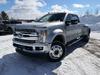
The pics I attached don't show the different configurations I can make to my winter based on the temp.

Cargo Master
Joined: Feb 2004
Posts: 2,101
Likes: 60
From: N. Illinois
Texas? Louisiana? Florida? Winter front? NO WAY. Unless you are consistently below 20 degrees, you’re asking for trouble. What temps are you seeing there? That’s still T-shirt weather to us northerners. A winter front isn’t cardboard. You’ll get too hot.

Mountain Pass
Joined: Nov 2018
Posts: 221
Likes: 10
From: Manitoba, Canada
At -20 and a 35 km drive to work half highway and half city my 6.7 doesn't hit full operating temp. I feel a thermostat doesn't close completely. Ford doesn't agree. Not sure what to do but will continue to monitor.
Mountain Pass
Joined: Jul 2019
Posts: 175
Likes: 7
From: NW Suburban Chicago
I've kept mine on even with our near 60 deg weather during the past holidays. I opened my winter front as much as possible ( closed off area about 25% or so) during the Chicago area heat wave. No issues at all with running too hot at 80 MPH back and forth to work on the NW tollway. Water temp was in the 190's, as was the oil and trans temps.
The radiators on these trucks are way over sized for most driving conditions and temps during the cooler months.
Mountain Pass
Joined: Jul 2019
Posts: 175
Likes: 7
From: NW Suburban Chicago
Don't be afraid to install a winter front.
Mountain Pass
Joined: Mar 2019
Posts: 133
Likes: 6
It was down around the freezing mark or lower each night and days were usually around 45-60. The truck is designed to be able to cool itself pulling 30,000lbs on a 100 degree day. I have done it multiple times and even pulling long hills it rarely gets crazy hot. On this trip I was only pulling a 15k trailer that was reasonably aerodynamic although 13' tall. I was driving 10 hour days with the cruise control on for hours and I found blocking off some of the radiator made it work much better. The truck sounded and felt better and used much less DEF. I used 4 gallons of DEF in the first 2500 miles and only 4 gallons of DEF after blocking off the radiator a bit for the second 4500 miles. That tells me the combustion efficiency was likely better even though the gauges read they were at operating temperature. There is still a ton of air moving through and I only blocked off the larger radiator partially.
Yes, if done incorrectly and not watching things you could definitely toast something. If you want to play it safe I definitely wouldn't do anything. But those of us trying to maximize efficiency these trucks have too much cooling even for pulling modest trailers. It gets down to -30 here and rarely get above 50 for 8 months of the year.
Yes, if done incorrectly and not watching things you could definitely toast something. If you want to play it safe I definitely wouldn't do anything. But those of us trying to maximize efficiency these trucks have too much cooling even for pulling modest trailers. It gets down to -30 here and rarely get above 50 for 8 months of the year.
Mountain Pass
Joined: Jul 2019
Posts: 175
Likes: 7
From: NW Suburban Chicago
The truck sounded and felt better and used much less DEF. I used 4 gallons of DEF in the first 2500 miles and only 4 gallons of DEF after blocking off the radiator a bit for the second 4500 miles. That tells me the combustion efficiency was likely better even though the gauges read they were at operating temperature.
This is why t'sats don't open until the 190's or so - combustion efficiency. This is nothing new and has been known for years and years.
Mountain Pass
Joined: Mar 2019
Posts: 133
Likes: 6
I have a 2019 XLT 6.7, and the middle of the water temp gauge corresponds to about 200 deg. If your to the left of the middle, the water temp is probably in the 160-170 rage.
This is why t'sats don't open until the 190's or so - combustion efficiency. This is nothing new and has been known for years and years.
This is why t'sats don't open until the 190's or so - combustion efficiency. This is nothing new and has been known for years and years.
FTE Stories
Ford Trucks for Ford Truck Enthusiasts

Top 10 Fords at 2026 Carlisle Ford Nationals
Joe Kucinski
3 Best / 3 Worst Parts of Modern Ford Ownership
Brett Foote
10 Amazing Upgrades That Solve Common Ford Truck Owner Headaches
Pouria Savadkouei
Every 2026 Ford Engine Explained
Brett Foote
10 Ugly Ford Trucks That We Still Kinda Love
Joe Kucinski
10 Things Every Truck Owner NEEDS (2026 Edition)
Michael S. Palmer
Rezvani's Latest Post-Apocalyptic Monster Is a Ford F-150 Raptor Underneath
Verdad Gallardo
Top 10 Most Expensive Ford Trucks Ever Sold on Bring a Trailer
Joe Kucinski
2027 Ford Super Duty Buyer's Guide (Every Model, Engine, & Package)
Brett Foote
Fleet Mechanic

Joined: Jun 2011
Posts: 1,865
Likes: 34
From: Annandale, VA
I run a winter cover in the DC area. I have found that the thermostats allow the engine to run up to 207 from the initial cold soak before it settles into 194. You don't get to 194 and hold, it overshoots to 207 and then gradually cools the motor to its operating temperature.
I run the winter front from November until March around here and have run into no problems running it up to 55 degrees. I have flaps that I open if i know I'm going to be above 50 just to help out, but there's still plenty of cooling available.
I also plug my truck in at night if its going to be below 30. Does it need it? No, but it sure helps the engine and cab heat catch up in the morning. I have a 21 mile commute and if I don't plug in / winter cover in the winter, my truck can't complete an active regen before I pull into the work parking lot. Best I can get down to is 20%. The cover and block heater allow me enough time to complete a regen when needed in the winter.
I run the winter front from November until March around here and have run into no problems running it up to 55 degrees. I have flaps that I open if i know I'm going to be above 50 just to help out, but there's still plenty of cooling available.
I also plug my truck in at night if its going to be below 30. Does it need it? No, but it sure helps the engine and cab heat catch up in the morning. I have a 21 mile commute and if I don't plug in / winter cover in the winter, my truck can't complete an active regen before I pull into the work parking lot. Best I can get down to is 20%. The cover and block heater allow me enough time to complete a regen when needed in the winter.

More Turbo
Joined: Jun 2017
Posts: 602
Likes: 2
It's simply an old mentality coming from old diesels.
im pretty far north in Canada , had a fair share of continuous -30 weather and I do not need a cover.
Nobody is gonna make me believe that they need one in +30 LOL.
I'm currently on a trip in Florida and the neighbor remote start his car because it's 45 in the morning....
im pretty far north in Canada , had a fair share of continuous -30 weather and I do not need a cover.
Nobody is gonna make me believe that they need one in +30 LOL.
I'm currently on a trip in Florida and the neighbor remote start his car because it's 45 in the morning....
Hotshot
Joined: Oct 2015
Posts: 19,711
Likes: 12,851
From: Wyoming

Correct me if I'm wrong, but isn't a thermostat open, closed or in the process of moving between one of those two states? If it's half way open/closed for an extended period of time I would consider it to be broken.



Laughing Gas

Joined: Dec 2021
Posts: 1,098
Likes: 343
From: PG, BC, Canada
I agree with the winter fronts are totally unnecessary... in todays vehicles above -20 degrees, In the olden days the fan was run by a belt with no control, and was always sucking air through the radiator whether needed or not, today the fan only comes on when the temps are high enough to need the airflow through the radiator, as for the bug screen, yea, whatever... JMO


Thread
Thread Starter
Forum
Replies
Last Post
Liquid10Rider
1999 - 2003 7.3L Power Stroke Diesel
12
Sep 21, 2010 08:41 AM