





Bouncing and Chucking solution wanted

Logistics Pro


Joined: Jul 2002
Posts: 4,821
Likes: 19
From: South Dakota
The F250 is more than capable of the rig he's pulling if setup correctly.
Keys to check:
pin box connections are good and tight
hitch connections are good and tight.
no broken frame welds
trailer suspension is in good condition without any worn components like bushings and drag links.
trailer tires in good condition and properly inflated
truck tires are proper load range and fully inflated
a good set of Hd shocks on ALL four corners of tow rig (prefer rancho 9000xl)
timbrens ok but I prefer bags.
if you cover all these areas in detail you should eliminate your chucking problems.

Elder User
Joined: Aug 2011
Posts: 858
Likes: 2
From: Chico,CA.
The hitch connection absolutely can be part of the problem. If not setup correctly or worn it acts like a big rubber band.
The F250 is more than capable of the rig he's pulling if setup correctly.
Keys to check:
pin box connections are good and tight
hitch connections are good and tight.
no broken frame welds
trailer suspension is in good condition without any worn components like bushings and drag links.
trailer tires in good condition and properly inflated
truck tires are proper load range and fully inflated
a good set of Hd shocks on ALL four corners of tow rig (prefer rancho 9000xl)
timbrens ok but I prefer bags.
if you cover all these areas in detail you should eliminate your chucking problems.
The F250 is more than capable of the rig he's pulling if setup correctly.
Keys to check:
pin box connections are good and tight
hitch connections are good and tight.
no broken frame welds
trailer suspension is in good condition without any worn components like bushings and drag links.
trailer tires in good condition and properly inflated
truck tires are proper load range and fully inflated
a good set of Hd shocks on ALL four corners of tow rig (prefer rancho 9000xl)
timbrens ok but I prefer bags.
if you cover all these areas in detail you should eliminate your chucking problems.

Mountain Pass

Joined: Nov 2005
Posts: 162
Likes: 0
From: Las Cruces, NM
All this talk about chucking just comes down to the fact that the truck and the trailer are fighting each other on the expansion cracks on concrete roads, or the transition from the highway to a bridge, etc. It's just going to happen. TrailAir made a hitch called a tri-glide that worked well--I wore one out. Mor-Ryd has one as does Demco. They all work to a degree, but there are some situations that you will just have to slow down for. I-20 around Birmingham, and Lake Charles are just two. It has nothing to do with an F-350 vs. F250 at all. I know folks who pull with a semi who talk about the same thing. The fact that the truck weighs more than the trailer, and the fact that they are sitting on air seats, with an air bag under the cab, and air bag suspension on the truck kind of evens it out. They don't care what the trailer is doing. But don't go blaming the problem on the wrong things.

Thread Starter
|
Laughing Gas
Joined: Dec 2015
Posts: 889
Likes: 38
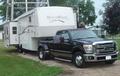
With a typical travelling load, I'd bet he's a thousand pounds over on the rear axle. Yes, we can argue all day whether they're actually the same axle or not, I really don't care. That trailer has to be very close to 3000 lb. on the pin. That doesn't count any tools, ice chests, firewood or bikes in the back of the truck. Nobody's going to convince me a 250 can safely haul a trailer that grosses 16K at highway/freeway speeds. Too much tail, not enough dog. That load needs a dually. If you guys want to do it, go right ahead. Try to convince the comml. cop it's more than capable. I wish you luck.
Moderator


Joined: May 2004
Posts: 6,528
Likes: 927
From: Home Base Nebraska

I've been doing this for a long time and I will say it again, bucking, clunking or what ever you want to call it is caused by the trailer suspension not the hitch. My 20K Resse has play in it and it doesn't clunk with a standard pin box because my trailer is dampen with rubber spring block equalizer and good shocks. You can change your pin box or use a dampen hitch and it will help but the problem is still there your just masking it.
Denny
Denny
Elder User
Joined: Aug 2011
Posts: 858
Likes: 2
From: Chico,CA.
If you're pulling the trailer dry/empty then the mfg's numbers may be close, but I'm highly skeptical of the numbers you posted. I Know my posted pin weight is 2380, but with a typical load it comes in at 2700-2750, so nearly 300 over whats published. That puts me right at 7000 on the rear axle. That's with nothing else in the bed. I'll stop ranting about weight, you got what you got, so....
1) Best shocks you can get
2) Air bags
3) Mor-Ryde pin box
4) Equa-Flex equalizers for the trailer.
5) Shocks for the trailer, if it's not a logistical nightmare to install them
-- by that I mean dropping/cutting belly sheeting, moving wires etc.
1) Best shocks you can get
2) Air bags
3) Mor-Ryde pin box
4) Equa-Flex equalizers for the trailer.
5) Shocks for the trailer, if it's not a logistical nightmare to install them
-- by that I mean dropping/cutting belly sheeting, moving wires etc.

New User
Joined: Mar 2017
Posts: 7
Likes: 0
In my last 5th wheel, a 36 footer, I had an airbag receiver on the trailer. On bad road I would get one bounce and the hitch took care of the bouncing.
FTE Stories
Ford Trucks for Ford Truck Enthusiasts

Top 10 Fords at 2026 Carlisle Ford Nationals
Joe Kucinski
3 Best / 3 Worst Parts of Modern Ford Ownership
Brett Foote
10 Amazing Upgrades That Solve Common Ford Truck Owner Headaches
Pouria Savadkouei
Every 2026 Ford Engine Explained
Brett Foote
10 Ugly Ford Trucks That We Still Kinda Love
Joe Kucinski
10 Things Every Truck Owner NEEDS (2026 Edition)
Michael S. Palmer
Rezvani's Latest Post-Apocalyptic Monster Is a Ford F-150 Raptor Underneath
Verdad Gallardo
Top 10 Most Expensive Ford Trucks Ever Sold on Bring a Trailer
Joe Kucinski
2027 Ford Super Duty Buyer's Guide (Every Model, Engine, & Package)
Brett Foote
Moderator
Joined: May 2004
Posts: 6,528
Likes: 927
From: Home Base Nebraska
Here's a example, we had a 2001 Hitchhiker Premier trailer with shocks and standard equalizers and it had a bucking clunking problem, not bad but is was there. When we ordered our 2003 Hitchhiker Premier the only thing we changed on the suspension was adding Mor-Ryde RE equalizers and all that went away. Same DRW truck, hitch, 3200 to 3400 pin weight and 16K trailer weight, it is 3 ft longer.
They no longer make the RE Equalizer option but they make SRE 4000 that still uses rubber spring blocks so you get suspension dampening and the rubber springs gives up and down travel, both give you a better ride and pulling experience.
Denny
They no longer make the RE Equalizer option but they make SRE 4000 that still uses rubber spring blocks so you get suspension dampening and the rubber springs gives up and down travel, both give you a better ride and pulling experience.
Denny

Moderator
Joined: May 2004
Posts: 6,528
Likes: 927
From: Home Base Nebraska
Yes that is what I have but a older version that bolts on not welded, it was installed at the factory. You can see the rubber spring blocks that the equalizer is bolted to.
Are they yours, if so it looks like the outer rubber is starting to tear, I replaced my rubbers on both sides last summer. I looked on their website and they said to use 010 rubbers and when I took my old ones out they were 08, made the trailer ride harder with the 10 springs.
Denny
Are they yours, if so it looks like the outer rubber is starting to tear, I replaced my rubbers on both sides last summer. I looked on their website and they said to use 010 rubbers and when I took my old ones out they were 08, made the trailer ride harder with the 10 springs.
Denny
Mountain Pass

Joined: Jan 2016
Posts: 115
Likes: 3
From: SE Tennessee
I've been doing this for a long time and I will say it again, bucking, clunking or what ever you want to call it is caused by the trailer suspension not the hitch. My 20K Resse has play in it and it doesn't clunk with a standard pin box because my trailer is dampen with rubber spring block equalizer and good shocks. You can change your pin box or use a dampen hitch and it will help but the problem is still there your just masking it.
Denny
Denny
I have ordered a shock kit, a correct track kit and wet bolts. That should fix it or at least dampen it. I hope.

Lead Driver


Joined: Jan 2002
Posts: 8,679
Likes: 4,786
From: Itinerant
Yes that is what I have but a older version that bolts on not welded, it was installed at the factory. You can see the rubber spring blocks that the equalizer is bolted to.
Are they yours, if so it looks like the outer rubber is starting to tear, I replaced my rubbers on both sides last summer. I looked on their website and they said to use 010 rubbers and when I took my old ones out they were 08, made the trailer ride harder with the 10 springs.
Denny
Are they yours, if so it looks like the outer rubber is starting to tear, I replaced my rubbers on both sides last summer. I looked on their website and they said to use 010 rubbers and when I took my old ones out they were 08, made the trailer ride harder with the 10 springs.
Denny
Rubber Shear Spring Replacement Criteria
Rubber Shear Spring Inspection (inspect at each oil change)
The rubber springs should be periodically inspected for any tears or cracks. If a rubber spring exhibits a
3” long and 3/4” deep crack or tear, the rubber shear spring should be replaced. This can be checked by
using a flat tool such as a putty knife. The putty knife can be used to probe the rubber shear spring in the
affected area. If the knife can be inserted 3/4” deep, by at least 3” long, the spring rate of the spring is
affected and should be replaced. Note: It is normal to see rubber spring weather checking, which is
small surface cracks in the rubber. Weather checking does not require a rubber spring to be replaced.
Shear springs do not need to be replaced until a tear goes all of the way across the body of the shear
spring and works its way into the shear spring a minimum of ¾ inches.
Moderator
Joined: May 2004
Posts: 6,528
Likes: 927
From: Home Base Nebraska
Yes that is what's on mine. Most of those are surface cracks and not deep by Morryde specs. As soon as I know where I'll be for a short period of time I'm going to order the HD shackle kits and install it, it doesn't look like a hard thing to do. I don't have the pleasure of concrete other than the desert ground plus the Bigfoot system should help lifting the trailer.
Rubber Shear Spring Replacement Criteria
Rubber Shear Spring Inspection (inspect at each oil change)
The rubber springs should be periodically inspected for any tears or cracks. If a rubber spring exhibits a
3 long and 3/4 deep crack or tear, the rubber shear spring should be replaced. This can be checked by
using a flat tool such as a putty knife. The putty knife can be used to probe the rubber shear spring in the
affected area. If the knife can be inserted 3/4 deep, by at least 3 long, the spring rate of the spring is
affected and should be replaced. Note: It is normal to see rubber spring weather checking, which is
small surface cracks in the rubber. Weather checking does not require a rubber spring to be replaced.
Shear springs do not need to be replaced until a tear goes all of the way across the body of the shear
spring and works its way into the shear spring a minimum of ¾ inches.
Rubber Shear Spring Replacement Criteria
Rubber Shear Spring Inspection (inspect at each oil change)
The rubber springs should be periodically inspected for any tears or cracks. If a rubber spring exhibits a
3 long and 3/4 deep crack or tear, the rubber shear spring should be replaced. This can be checked by
using a flat tool such as a putty knife. The putty knife can be used to probe the rubber shear spring in the
affected area. If the knife can be inserted 3/4 deep, by at least 3 long, the spring rate of the spring is
affected and should be replaced. Note: It is normal to see rubber spring weather checking, which is
small surface cracks in the rubber. Weather checking does not require a rubber spring to be replaced.
Shear springs do not need to be replaced until a tear goes all of the way across the body of the shear
spring and works its way into the shear spring a minimum of ¾ inches.
Denny
Lead Driver

Joined: Jan 2005
Posts: 7,782
Likes: 221
From: Huntington Indiana
Air bags adjust ride height only, the only improvement in ride is by getting the truck up off the overloads if you are squatting too much. Correct pin weight, air hitch/pin box and shocks on the 5th will help with chucking and bouncing if they are matched with good shocks on the TV. Just remember, some roads are just plain bad and no amount of money thrown at your rig will help, the only answer is to just slow down. I hit a section of I69 around Lansing, MI this summer and 45 mph was too fast.