








Repacking Pulley Bearings

Thread Starter
|
Posting Guru
Joined: Mar 2007
Posts: 1,425
Likes: 9
Repacking Pulley Bearings
I hadn't seen much about this before, so if some one here has already done this I apologize. I figured I'd post up what I found, and the repair. I pulled my fan belt today to check my pulley's and I found that the top idler was making a dry sound when I spun it. I removed the pulley, and removed the bearing seal (1st set of pic's) front and back with seals removed. It was pretty crusty in there. Anyhow I cleaned it out (2nd set of Pic's) with parts cleaner and repacked it and reinstalled it. Good to go.

Hotshot


Joined: Jan 2002
Posts: 17,988
Likes: 207
From: La La Land

It sure looks like yours were due!
What did you use for grease, Carlos?
The supply house from which I get bearings uses a Mobil Polyrex, polyurea-base grease in these types of applications, including alternator bearings.
BTW, polyurea is not compatible with lithium-based greases.
Pop
What did you use for grease, Carlos?
The supply house from which I get bearings uses a Mobil Polyrex, polyurea-base grease in these types of applications, including alternator bearings.
BTW, polyurea is not compatible with lithium-based greases.
Pop
Thread Starter
|
Posting Guru
Joined: Mar 2007
Posts: 1,425
Likes: 9
Thank you fellas. I think I was bored yesterday and it seemed like a good idea. LOL.
I think I'm gonna do as Adam mentioned, and add this to the maintenance list. It does seem easier to just buy a new one, but honestly, it was quicker to do this than to replace it. The bearing was still in good shape also. After 270K I just replaced the tensioner because I ate up a belt. I'm not sure if it can be rebuilt, but it would be nice to rebuild the tensioner, and put it on a shelf for the next install. I'm just not sure if the tensioner itself can be rebuilt.
I think I'm gonna do as Adam mentioned, and add this to the maintenance list. It does seem easier to just buy a new one, but honestly, it was quicker to do this than to replace it. The bearing was still in good shape also. After 270K I just replaced the tensioner because I ate up a belt. I'm not sure if it can be rebuilt, but it would be nice to rebuild the tensioner, and put it on a shelf for the next install. I'm just not sure if the tensioner itself can be rebuilt.
Trending Topics

Super Moderator


Joined: Dec 2011
Posts: 13,283
Likes: 6,048

Helifixer, can you explain more about why?
_________
I've only done this once, a couple of years ago.... and took a short cut. The thickener component of the grease was still in tact (ha ha... as in tacky), but the oils seemed to have spun out. This is a high speed bearing, not so much a heavy weighted bearing, so I didn't want to create more friction in the bearing by stuffing it even further with thick extreme pressure grease. So I injected grease oil through a syringe slid through the seam under the seal cover. The small restrictive diameter of the eye of the needle tends to push more of the lighter oils in the grease rather than the thickeners.

I found that other parts of the bearing can fail, including the plastic fluted collar that fits in sequence with the shoulder bolt that mounts the bearing. Clearly, the fluted (castle nut like) cuttings, and the softer material of this plastic washer serve an important purpose... otherwise, the OEM would have just made the shoulder bolt the width of the bearing and call it done. But they didn't. The shoulder of the shoulder bolt only covers a portion of the internal 17mm diameter bearing axis support, and the plastic castle washer covers the remaining portion. Mine cracked apart.
I found some 5/16 fuel hose had just the right inside diameter to stretch tightly over the bolt threads, and just the right outside diameter to fit snugly in the 17mm diameter of the bearing to match the shoulder diameter. So a cut a slice of this fuel hose to serve as the bushing in lieu of the broken plastic castle, figuring a continuous band of rubber would be just as ductile as a segmented band of plastic.
But I worried enough about it that I ended up buying new idler bearings top and bottom just the other day. Which made me wonder why Helifixer, despite being every bit capable of regreasing bearings correctly (helicopter mechanics tend to have excellent mechanical credentials), found that he ended up replacing his bearings anyway, soon after greasing them?
FTE Stories
Ford Trucks for Ford Truck Enthusiasts

AEV FXL Super Duty - the Super Duty Raptor Ford Doesn't Make
Brett Foote
Lobo Vs Lobo: Proof the F-150 Lobo Should Be Even Lower!
Michael S. Palmer
Ford's 2001 Explorer Sportsman Concept Looks For a New Home
Verdad Gallardo
10 Best Ford Truck Engines We Miss the Most!
Joe Kucinski
2026 Shelby F-150 Off-Road: Better Than a Raptor R?
Brett Foote
2027 Super Duty Carhartt Package First Look: 12 Things You NEED to Know!
Michael S. Palmer
10 Most Surprising 2026 Ford Truck Features!
Joe Kucinski
Top 10 Ford Trucks Coming to Mecum Indy 2026
Brett Foote
5 Best / 5 Worst Ford Truck Wheels of All Time
Joe Kucinski


Lead Driver


Joined: Mar 2004
Posts: 5,372
Likes: 108
From: Northern Indiana


Elder User
Joined: Dec 2006
Posts: 718
Likes: 2
From: Chattanooga, TN
I have been replacing all the bearings in the tensioning pulleys and the idler pulleys for several years now, very simple to do. I even have a second set and when I replace a serpentine belt I simply replace with the backup set, then when convenient replace the old bearings and I'm ready for the next time. These bearings are basically all the same size. If you purchase the China bearings which most box stores and bearing houses will have they run somewhere around $5 to $7 each. However, If you opt for a better bearing you will typically have to order them and end up paying about twice the China bearing costs.
I also tried removing the side seal and inserting fresh grease without removing the old grease. Really not worth the effort. You would not remove the front wheel bearings (two wheel drive) and re-pack them without removing the old grease and cleaning them up before installing new grease.
Just replace the old bearings and be done with the maintenance.
Whenever doing a water pump R/R or other front engine work take that time with the belt off and check the individual pulleys for wear, wobble, etc.
I also tried removing the side seal and inserting fresh grease without removing the old grease. Really not worth the effort. You would not remove the front wheel bearings (two wheel drive) and re-pack them without removing the old grease and cleaning them up before installing new grease.
Just replace the old bearings and be done with the maintenance.
Whenever doing a water pump R/R or other front engine work take that time with the belt off and check the individual pulleys for wear, wobble, etc.
Super Moderator
Joined: Dec 2011
Posts: 13,283
Likes: 6,048
It sure looks like yours were due!
What did you use for grease, Carlos?
The supply house from which I get bearings uses a Mobil Polyrex, polyurea-base grease in these types of applications, including alternator bearings.
BTW, polyurea is not compatible with lithium-based greases.
Pop
What did you use for grease, Carlos?
The supply house from which I get bearings uses a Mobil Polyrex, polyurea-base grease in these types of applications, including alternator bearings.
BTW, polyurea is not compatible with lithium-based greases.
Pop
Marv, you mentioned that the supply house where you get bearings uses Mobil Polyrex. Since Carlos greased the stock bearing, the issue of grease compatibility would have to be limited to exactly what the OEM grease is. Do you happen to know what grease was used in the OEM stock bearing?
The inference that replacement bearings of the same type would likely have the same grease is perfectly reasonable. In fact, as a pulley bearing that, at 90mm, probably rotates 2.2:1 times the engine RPM, which rotates 3.73 to 4.10 times the wheel speed RPM, no one would argue that this pulley bearing needs a high speed grease, not unlike electric motor and alternator bearings. This is not an extreme pressure application, like say, a wheel bearing that is supporting a 7,000 lb. truck.
Therefore, it could be argued that "extreme pressure" might not be a needed property that is appropriate for pulleys that don't carry all that weight, and that also spin much faster. To any extent that an extreme pressure grease has properties that mutually exclude other properties appropriate for pulley bearing duty, there could be an "incompatibility" in application, even if the thickener bases were chemically compatible, or even the same. The very existence of so many different grease formulations, developed for application specific purposes, proves that there is no one grease that fits all purposes.
Here is what ExxonMobil advises on how to choose a grease for bearings:
Originally Posted by ExxonMobil
Anti-wear: Unless a motor is mounted so there is a thrust load (axial load, not a serpentine belt load) on the bearings, it is advisable to choose a grease that does not have extreme pressure additives. These additives can shorten the life of the grease and are not recommended for use where they are not required.
That all being said, Marv's caution on mixing greases had more to do with chemical compatibility rather than mechanical performance. Base compatibility is a very valid concern, because if greases of incompatible thickener types get mixed, bad consequences can result, even if both types of greases meet the performance requirements of the application.
Yet, there is also no way to make a blanket statement about chemical incompatibility between Polyurea based versus Lithium based greases, because there are formulations of "shear stabilized" Polyurea greases that ARE in fact compatible with Lithium Complex greases.
Here is what David Turner, who works for Shell Global Solutions Inc. and who is also the co-chairman of the National Lubricating Grease Institute’s technical committee (NLGI), says about the compatibility between Polyurea and Lithium Complex greases:
Originally Posted by Dave Turner, NLGI, ShellOil
The compatibility of polyurea greases with soap-thickened greases is probably the most debated area of grease compatibility today. Greases based on simple lithium soaps (lithium stearate or lithium 12-hydroxystearate) and lithium complex soaps (containing simple soap and a complexing agent, such as lithium azelate) may or may not be compatible with polyurea greases. This is because of the wide variety of materials that can be reacted to form a thickener that is termed polyurea. Some polyurea thickeners are completely compatible with lithium and lithium complex thickeners, while other polyurea thickeners are definitely incompatible with the lithium and lithium complex thickeners.
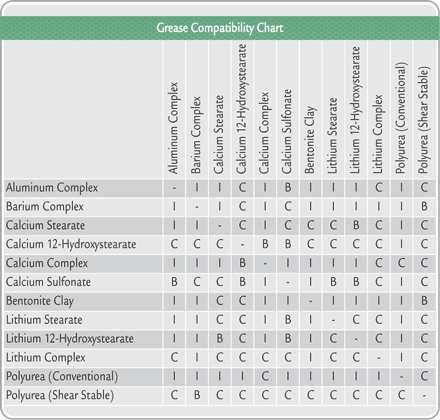
Figure 1. Relative Compatibility Rating
B = Borderline C = Compatible I = Incompatible
Schaeffers 238 is an Aluminum Complex grease, which, depending on what type of Polyurea grease it is being mixed with, like Lithium, may or may not be compatible.
In summary, both of the foregoing counter points are said to support the premise of my question, which is...
do we know the SPECIFIC type of grease that was used in the OEM pulley bearing?
Hotshot
Joined: Jan 2002
Posts: 17,988
Likes: 207
From: La La Land
I guess we'd have to know the source of the OEM bearings to be able to determine that.
In the only instance where I have truly investigated this type of thing, i.e. our front-end OEM hubs made by Timken, I was able to go to the source to find out that the lube of Timken's choice was Mobil Infinitec 152, (which is not commonly available, BTW).
In the only instance where I have truly investigated this type of thing, i.e. our front-end OEM hubs made by Timken, I was able to go to the source to find out that the lube of Timken's choice was Mobil Infinitec 152, (which is not commonly available, BTW).
Thread Starter
|
Posting Guru
Joined: Mar 2007
Posts: 1,425
Likes: 9
[QUOTE=Y2KW57;16819805]Marv, you mentioned that the supply house where you get bearings uses Mobil Polyrex. Since Carlos greased the stock bearing, the issue of grease compatibility would have to be limited to exactly what the OEM grease is. Do you happen to know what grease was used in the OEM stock bearing?
The inference that replacement bearings of the same type would likely have the same grease is perfectly reasonable. In fact, as a pulley bearing that, at 90mm, probably rotates 2.2:1 times the engine RPM, which rotates 3.73 to 4.10 times the wheel speed RPM, no one would argue that this pulley bearing needs a high speed grease, not unlike electric motor and alternator bearings. This is not an extreme pressure application, like say, a wheel bearing that is supporting a 7,000 lb. truck.
Therefore, it could be argued that "extreme pressure" might not be a needed property that is appropriate for pulleys that don't carry all that weight, and that also spin much faster. To any extent that an extreme pressure grease has properties that mutually exclude other properties appropriate for pulley bearing duty, there could be an "incompatibility" in application, even if the thickener bases were chemically compatible, or even the same. The very existence of so many different grease formulations, developed for application specific purposes, proves that there is no one grease that fits all purposes.
Here is what ExxonMobil advises on how to choose a grease for bearings:
That all being said, Marv's caution on mixing greases had more to do with chemical compatibility rather than mechanical performance. Base compatibility is a very valid concern, because if greases of incompatible thickener types get mixed, bad consequences can result, even if both types of greases meet the performance requirements of the application.
Yet, there is also no way to make a blanket statement about chemical incompatibility between Polyurea based versus Lithium based greases, because there are formulations of "shear stabilized" Polyurea greases that ARE in fact compatible with Lithium Complex greases.
Here is what David Turner, who works for Shell Global Solutions Inc. and who is also the co-chairman of the National Lubricating Grease Institute’s technical committee (NLGI), says about the compatibility between Polyurea and Lithium Complex greases:
Figure 1. Relative Compatibility Rating
B = Borderline C = Compatible I = Incompatible
Schaeffers 238 is an Aluminum Complex grease, which, depending on what type of Polyurea grease it is being mixed with, like Lithium, may or may not be compatible.
In summary, both of the foregoing counter points are said to support the premise of my question, which is...
do we know the SPECIFIC type of grease that was used in the OEM pulley bearing?[/QUOTE
From what I gather from your post, I quite possibly used the wrong grease in this application. The reason I used the Schaeffers grease is because of the Molybdenum and it's benefits, and it's all I have right now. Also, I first cleaned the bearing, completely removing all the caked and dried grease that was in the bearing before I repacked it. I'll have to check the pulley from time to time to see how it's holding up to the Schaeffers grease. If need be, I'll remove the pulley and repack it with the proper grease. I know Marv will come back and let us know his findings on this as well.
The inference that replacement bearings of the same type would likely have the same grease is perfectly reasonable. In fact, as a pulley bearing that, at 90mm, probably rotates 2.2:1 times the engine RPM, which rotates 3.73 to 4.10 times the wheel speed RPM, no one would argue that this pulley bearing needs a high speed grease, not unlike electric motor and alternator bearings. This is not an extreme pressure application, like say, a wheel bearing that is supporting a 7,000 lb. truck.
Therefore, it could be argued that "extreme pressure" might not be a needed property that is appropriate for pulleys that don't carry all that weight, and that also spin much faster. To any extent that an extreme pressure grease has properties that mutually exclude other properties appropriate for pulley bearing duty, there could be an "incompatibility" in application, even if the thickener bases were chemically compatible, or even the same. The very existence of so many different grease formulations, developed for application specific purposes, proves that there is no one grease that fits all purposes.
Here is what ExxonMobil advises on how to choose a grease for bearings:
That all being said, Marv's caution on mixing greases had more to do with chemical compatibility rather than mechanical performance. Base compatibility is a very valid concern, because if greases of incompatible thickener types get mixed, bad consequences can result, even if both types of greases meet the performance requirements of the application.
Yet, there is also no way to make a blanket statement about chemical incompatibility between Polyurea based versus Lithium based greases, because there are formulations of "shear stabilized" Polyurea greases that ARE in fact compatible with Lithium Complex greases.
Here is what David Turner, who works for Shell Global Solutions Inc. and who is also the co-chairman of the National Lubricating Grease Institute’s technical committee (NLGI), says about the compatibility between Polyurea and Lithium Complex greases:
Figure 1. Relative Compatibility Rating
B = Borderline C = Compatible I = Incompatible
Schaeffers 238 is an Aluminum Complex grease, which, depending on what type of Polyurea grease it is being mixed with, like Lithium, may or may not be compatible.
In summary, both of the foregoing counter points are said to support the premise of my question, which is...
do we know the SPECIFIC type of grease that was used in the OEM pulley bearing?[/QUOTE
From what I gather from your post, I quite possibly used the wrong grease in this application. The reason I used the Schaeffers grease is because of the Molybdenum and it's benefits, and it's all I have right now. Also, I first cleaned the bearing, completely removing all the caked and dried grease that was in the bearing before I repacked it. I'll have to check the pulley from time to time to see how it's holding up to the Schaeffers grease. If need be, I'll remove the pulley and repack it with the proper grease. I know Marv will come back and let us know his findings on this as well.
Thread Starter
|
Posting Guru
Joined: Mar 2007
Posts: 1,425
Likes: 9
Here's some info I just found that should help to identify the right grease for this application, as well as others. There's a lot of really good Info on grease and it's applications in the link below.
]Lubrication of rolling bearing - Tips and advice - Klüber Lubrication
High Speed Spindle Design and Construction : Modern Machine Shop
Bearing Lubrication Methods
Angular contact ball bearings require some form of lubrication to operate properly. The function of lubrication is to provide a microscopic film between the rolling elements, to prevent abrasion and skidding. In addition, lubrication protects the surfaces from corrosion, and protects the area from particle contamination.
The most common type of lubricant is grease. Grease provides the most simple method of lubrication. The grease is injected into the space between the ***** and the races, and is permanent. It therefore requires minimal maintenance, and represents little if any cost. Grease lubrication, however, does have limitations. Grease packed spindles generally are not run above dN values of 850,000 for continuous operation. As speeds increase, operating temperatures increase, and begin to break down the grease. Most grease is rated to operate at temperatures under 300° F. The grease type that can tolerate high speeds generally has a ester oil base, and Barium complex thickener. An example of this would be Kluber Isoflex NBU-15. With regard to the quantity of grease, more is not better. Excessive grease can cause heating due to churning, which will cause the grease to deteriorate. Approximately 20% to 30% of the open area between the races should be filled. Following the grease fill, a careful run-in period is required, to fully distribute the grease within the bearing.
In general, high speed spindles that utilize grease lubrication do not allow for replacement of the grease between bearing replacements. During a bearing replacement, clean grease is carefully injected into the bearing. Positive air overpressure is typically used to prevent contamination from entering the bearing, which could lead to rapid bearing failure.
Table 31. Typical Grease Lubricants
Bardon Code Designation Base Oil Thickener Operating Temp. Range °FMaximum dNComments
*G-2Exxon Beacon 325DiesterLithium-65 to 250400,000Good anti-corrosion, low torque.
*G-4NYE Rheolube 757SSGPetroleumSodium-40 to 200650,000Anti-oxidation additives, machine tool spindle grease. Not water resistant.
*G-6Exxon Andok CPetroleumSodium-20 to 250650,000Good for high speed, low grease migration. Not water resistant.
*G-12Chevron SRI-2PetroleumPolyurea-20 to 300400,000General purpose, moderate speed, water resistant.
*G-18NYE Rhoetemp 500Ester and PetroleumSodium-50 to 350500,000For high temperature, high speed. Not water resistant.
*G-32Supermill A72832DiesterLithium-100 to 250400,000MIL-G-23827, EP, anti-corrosiion additives.G-33Mobil 28Synthetic hydrocarbonClay-80 to 350400,000MIL-G-81322, DOD-G-24508, wide temperature range.
*G-35DuPont Krytox 240 ABPerfluor
alkylpolyether Tetrafluoro-
ethylene-
telomer-40 to 450400,000Excellent thermal oxidative stability, does not creep, water resistant and chemically inert.
*G-42NYE Rheolube 350-SBG-2PetroleumSodium /Calcium-30 to 250+650,000Spindle bearing grease for normal temperatures and maximum life at high speed.
*G-44Braycote 601Perfluorinated PolyetherTetrafluoro- ethylenete-
lomer-100 to 500+400,000Excellent thermal and oxidative stability, does not creep, water resistant and chemically inert.
*G-46Kluber Isoflex NBU-15EsterBarium Complex-40 to 250+850,000Spindle bearing grease for maximum speeds, moderate loads.G-47Kluber Asonic GLY32Ester/ synthetic HydrocarbonLithium-60 to 300600,000Quiet running spindle bearing grease for moderate speeds and loads.G-50Kluber Isoflex Super LDS 18Ester/mineralLithium-60 to 250850,000Spindle bearing grease for maximum speed and moderate loads.G-51Mobilith SHC 15Synthetic hydrocarbonLithium-60 to 450500,000General purpose, moderate speed, water resistant.Grease Types Used in High Speed Spindle Bearings (Courtesy Barden Co.)
]Lubrication of rolling bearing - Tips and advice - Klüber Lubrication
High Speed Spindle Design and Construction : Modern Machine Shop
Bearing Lubrication Methods
Angular contact ball bearings require some form of lubrication to operate properly. The function of lubrication is to provide a microscopic film between the rolling elements, to prevent abrasion and skidding. In addition, lubrication protects the surfaces from corrosion, and protects the area from particle contamination.
The most common type of lubricant is grease. Grease provides the most simple method of lubrication. The grease is injected into the space between the ***** and the races, and is permanent. It therefore requires minimal maintenance, and represents little if any cost. Grease lubrication, however, does have limitations. Grease packed spindles generally are not run above dN values of 850,000 for continuous operation. As speeds increase, operating temperatures increase, and begin to break down the grease. Most grease is rated to operate at temperatures under 300° F. The grease type that can tolerate high speeds generally has a ester oil base, and Barium complex thickener. An example of this would be Kluber Isoflex NBU-15. With regard to the quantity of grease, more is not better. Excessive grease can cause heating due to churning, which will cause the grease to deteriorate. Approximately 20% to 30% of the open area between the races should be filled. Following the grease fill, a careful run-in period is required, to fully distribute the grease within the bearing.
In general, high speed spindles that utilize grease lubrication do not allow for replacement of the grease between bearing replacements. During a bearing replacement, clean grease is carefully injected into the bearing. Positive air overpressure is typically used to prevent contamination from entering the bearing, which could lead to rapid bearing failure.
Table 31. Typical Grease Lubricants
Bardon Code Designation Base Oil Thickener Operating Temp. Range °FMaximum dNComments
*G-2Exxon Beacon 325DiesterLithium-65 to 250400,000Good anti-corrosion, low torque.
*G-4NYE Rheolube 757SSGPetroleumSodium-40 to 200650,000Anti-oxidation additives, machine tool spindle grease. Not water resistant.
*G-6Exxon Andok CPetroleumSodium-20 to 250650,000Good for high speed, low grease migration. Not water resistant.
*G-12Chevron SRI-2PetroleumPolyurea-20 to 300400,000General purpose, moderate speed, water resistant.
*G-18NYE Rhoetemp 500Ester and PetroleumSodium-50 to 350500,000For high temperature, high speed. Not water resistant.
*G-32Supermill A72832DiesterLithium-100 to 250400,000MIL-G-23827, EP, anti-corrosiion additives.G-33Mobil 28Synthetic hydrocarbonClay-80 to 350400,000MIL-G-81322, DOD-G-24508, wide temperature range.
*G-35DuPont Krytox 240 ABPerfluor
alkylpolyether Tetrafluoro-
ethylene-
telomer-40 to 450400,000Excellent thermal oxidative stability, does not creep, water resistant and chemically inert.
*G-42NYE Rheolube 350-SBG-2PetroleumSodium /Calcium-30 to 250+650,000Spindle bearing grease for normal temperatures and maximum life at high speed.
*G-44Braycote 601Perfluorinated PolyetherTetrafluoro- ethylenete-
lomer-100 to 500+400,000Excellent thermal and oxidative stability, does not creep, water resistant and chemically inert.
*G-46Kluber Isoflex NBU-15EsterBarium Complex-40 to 250+850,000Spindle bearing grease for maximum speeds, moderate loads.G-47Kluber Asonic GLY32Ester/ synthetic HydrocarbonLithium-60 to 300600,000Quiet running spindle bearing grease for moderate speeds and loads.G-50Kluber Isoflex Super LDS 18Ester/mineralLithium-60 to 250850,000Spindle bearing grease for maximum speed and moderate loads.G-51Mobilith SHC 15Synthetic hydrocarbonLithium-60 to 450500,000General purpose, moderate speed, water resistant.Grease Types Used in High Speed Spindle Bearings (Courtesy Barden Co.)