


New 445 Build


Thread Starter
|
Laughing Gas
Joined: May 2007
Posts: 960
Likes: 10
From: Victoria (North Saanich)
Final report for this year. We had one day of 70 degrees last week and then winter broke, so I put her in storage.
I've had good results since advancing the cam timing to 4 degrees (actually advanced it 8 since it was 4 retarded) and taking the carb back to altitude adjusted factory specs. It runs strongly, and since I switched from Shell 91 octane to a 94 octane brand (which includes up to 10% ethanol, so I had avoided it), the run on has stopped - she shuts down cleanly.
I did go to start it the day after the last run and it fired up fine and then died. No gas in the carb so I started taking the fuel system apart. Bit of a surprise to find that much of what seems to be silicone in the filter, since I don't remember using more than a smear to seal the fuel float into the tank, but there it was.
I may get it out in the spring, but I'm looking at having hip surgery in March so I may not be able to get behind the wheel before June. Then I have a bit of timing work to do, followed by some carb adjustments. Have all winter to think about it.
This is her idling hot just before I put her away:
I've had good results since advancing the cam timing to 4 degrees (actually advanced it 8 since it was 4 retarded) and taking the carb back to altitude adjusted factory specs. It runs strongly, and since I switched from Shell 91 octane to a 94 octane brand (which includes up to 10% ethanol, so I had avoided it), the run on has stopped - she shuts down cleanly.
I did go to start it the day after the last run and it fired up fine and then died. No gas in the carb so I started taking the fuel system apart. Bit of a surprise to find that much of what seems to be silicone in the filter, since I don't remember using more than a smear to seal the fuel float into the tank, but there it was.
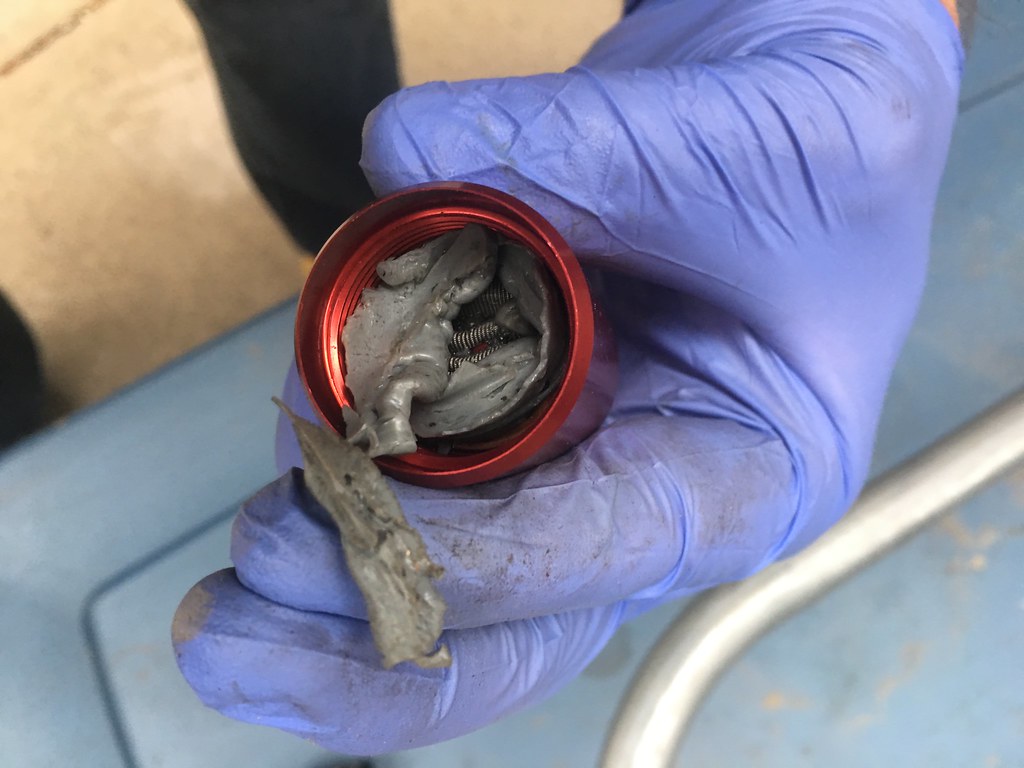
I may get it out in the spring, but I'm looking at having hip surgery in March so I may not be able to get behind the wheel before June. Then I have a bit of timing work to do, followed by some carb adjustments. Have all winter to think about it.
This is her idling hot just before I put her away:



Thread Starter
|
Laughing Gas
Joined: May 2007
Posts: 960
Likes: 10
From: Victoria (North Saanich)
Well, hip is great, and I've moved to Vancouver Island facing the Saanich Inlet. Moved the truck in the moving van, and that led to some fun. It was -35C when the movers came and I had to put the truck outside overnight so we could sort and pack the garage the day before. To get it to start on moving day I put a couple of small electric space heaters under the hood and put a moving blanket over them.
It started up fine, and to drive it onto the flatbed tow truck we needed 4WD, but that was no problem. While it was pointed uphill (steeply) on the tow truck and running the tow driver was hooking it up to lift it. He jumped back and yelled it was on fire. I shut it down and jumped out and there was a puff of smoke out of the Holley Blue fuel pump (on the frame rail under the passenger door).
Stopped smoking and the mover said lets get it loaded. Tow driver got it level to the moving truck and the mover told me to drive it in. At this point the fuel pump was not working and I pulled the fuse, but it had enough fuel in the carb to drive it back into the moving van.
A month later it was delivered in BC and I tested the pump - it had failed so I ordered a new Carter pump. Took the Holley off and it had clearly had a fire in the motor, and it smelled of burnt fuel. I had installed it with the pump over the motor and the installation instructions do say it is best to do it with the motor above the pump. I think the cold caused a small leak through the seal because it had never had a problem. Interestingly the Carter is supposed to be installed with the pump over the motor.
Fired up right away, but I didn't drive it since we had moved from 3,500 feet to sea level. I took the jets up two sizes to Quick Fuel's spec for sea level (78/86 and it ran ok, but clearly it was not as happy as it could be. Turns out one of my new neighbours, Percy, is a local carb specialist, engine builder, and a very nice guy. He said he thought my engine was labouring and the valves were too tight. I've been concerned that some of them were a little loose, and we pulled the covers and Percy went through them. He agreed they were mostly good with a few a little loose, so we adjusted those.
Now he wanted to look at the timing and I put a light on it and we saw it was at around 18 degrees (I'm not running vacuum advance). It smoothed out a lot up to 26 degrees but didn't change all the way up to 38, low vacuum has been an issue and it came up from 8 to 10 inches. Running the engine up to 3,000 I saw total timing was reaching 45 degrees so we reworked the dizzy to restrict total to 34 degrees. It ran very nicely but Percy thought the transition from 1,800 to WOT wasn't snappy enough. I got a 5.5 power valve to replace the stock 6.5, and we upped the primary pump sizes a little.
It really snaps now, spinning the tires at 30 mph and screaming up 6,000. It is finally running the way I hoped. Next I may put it on a chassis dyno, and I should thread in the O2 sensor to see what my A/F looks like.
It started up fine, and to drive it onto the flatbed tow truck we needed 4WD, but that was no problem. While it was pointed uphill (steeply) on the tow truck and running the tow driver was hooking it up to lift it. He jumped back and yelled it was on fire. I shut it down and jumped out and there was a puff of smoke out of the Holley Blue fuel pump (on the frame rail under the passenger door).
Stopped smoking and the mover said lets get it loaded. Tow driver got it level to the moving truck and the mover told me to drive it in. At this point the fuel pump was not working and I pulled the fuse, but it had enough fuel in the carb to drive it back into the moving van.
A month later it was delivered in BC and I tested the pump - it had failed so I ordered a new Carter pump. Took the Holley off and it had clearly had a fire in the motor, and it smelled of burnt fuel. I had installed it with the pump over the motor and the installation instructions do say it is best to do it with the motor above the pump. I think the cold caused a small leak through the seal because it had never had a problem. Interestingly the Carter is supposed to be installed with the pump over the motor.
Fired up right away, but I didn't drive it since we had moved from 3,500 feet to sea level. I took the jets up two sizes to Quick Fuel's spec for sea level (78/86 and it ran ok, but clearly it was not as happy as it could be. Turns out one of my new neighbours, Percy, is a local carb specialist, engine builder, and a very nice guy. He said he thought my engine was labouring and the valves were too tight. I've been concerned that some of them were a little loose, and we pulled the covers and Percy went through them. He agreed they were mostly good with a few a little loose, so we adjusted those.
Now he wanted to look at the timing and I put a light on it and we saw it was at around 18 degrees (I'm not running vacuum advance). It smoothed out a lot up to 26 degrees but didn't change all the way up to 38, low vacuum has been an issue and it came up from 8 to 10 inches. Running the engine up to 3,000 I saw total timing was reaching 45 degrees so we reworked the dizzy to restrict total to 34 degrees. It ran very nicely but Percy thought the transition from 1,800 to WOT wasn't snappy enough. I got a 5.5 power valve to replace the stock 6.5, and we upped the primary pump sizes a little.
It really snaps now, spinning the tires at 30 mph and screaming up 6,000. It is finally running the way I hoped. Next I may put it on a chassis dyno, and I should thread in the O2 sensor to see what my A/F looks like.

Thread
Thread Starter
Forum
Replies
Last Post
Navy_Chief
1973 - 1979 F-100 & Larger F-Series Trucks
229
Jan 18, 2020 01:40 PM
ktgovols
1948 - 1956 F1, F100 & Larger F-Series Trucks
34
Feb 7, 2017 08:38 PM
MikeWire
FE & FT Big Block V8 (332, 352, 360, 390, 406, 410, 427, 428)
26
Feb 7, 2014 11:25 AM


