


Anzo Headlights
Thread Starter
|
Junior User
Joined: Nov 2015
Posts: 55
Likes: 0
From: Glendora
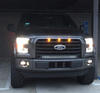
Pattern have gotten a lot better. cleaner & smoother not like the 2013's &14's Anzo lights. there was only one small little area that had extra dried glue or rubber bond (sealant) that was hanging out, but i just removed it. my only con so far is that the Halo around the headlights could be brighter. You can only see it at night not durning the day.
And another PLUS is my truck is lifted, the Anzo light adjustment is great. I can lower the beam angle downwards a lot better than my OEM's. So I do not blind people.
And another PLUS is my truck is lifted, the Anzo light adjustment is great. I can lower the beam angle downwards a lot better than my OEM's. So I do not blind people.

Posting Guru
Joined: Feb 2005
Posts: 2,295
Likes: 2
I'd love to see some night-time photos from the driver seat, and against a flat surface (garage door or something) to assess pattern, if you have some time to do so.
Which bulbs did you go with?
I was forced into a Lariat 501A as I needed a truck without the floor console/shifter... which means no LED headlamps. I'd love to upgrade, but don't really want to drop nearly $2K for the privilege... looking for other options.
Which bulbs did you go with?
I was forced into a Lariat 501A as I needed a truck without the floor console/shifter... which means no LED headlamps. I'd love to upgrade, but don't really want to drop nearly $2K for the privilege... looking for other options.

Moderator


Joined: May 2005
Posts: 8,237
Likes: 1,248
From: San Antonio, TX

Pmac, start a thread about your suspension. I'm debating over a leveling kit or coil overs right now.
The headlights look better than I expected. But, like others have said, try to get a cut off pattern shot.
The headlights look better than I expected. But, like others have said, try to get a cut off pattern shot.

Lead Driver


Joined: May 2015
Posts: 5,889
Likes: 360
From: Mts. S. of San Francisco
I have an uneasy feeling if the LEDs need fans to run. Dirt, water, and so on could easily compromise their function. It's curious to me how Ford got the factory LED headlights to operate without the aid of fans. Since LEDs are theoretically much lower power than incandescent, I don't quite understand why the fans are necessary, unless they have to be "juiced up" somehow in order to get enough brightness.
Trending Topics
Posting Guru
Joined: Feb 2005
Posts: 2,295
Likes: 2
You either need fans or a large heatsink. Contrary to popular opinion, LEDs, especially those used for illumination purposes, are nowhere close to 100% efficient. About 70% of the input power is converted to heat. When you're playing with diodes that are running 3-5 watts, that's a LOT of heat being generated from a very small area. Transporting that heat away is critical to diode life.
Cree covers it way better than I can, if you want to dive into some math:
http://www.cree.com/~/media/Files/Cr...Management.pdf
Fans are typically used on the high-output headlamp replacements to allow them to fit in the limited space of most headlamps. Look at a typical Rigid LED lightbar... the entire case is one big heat-sink, with the rear being large, thick fins for added cooling. Those bars are typically running about 120 watts in for a 10" bar. The headlamp replacements are running 30-50 watts, in something you can hold in your hand. Active cooling becomes pretty much the only option.
If you get dirt and water inside the back of the headlamp, you've most likely sucked it in to the motor anyway...
Cree covers it way better than I can, if you want to dive into some math:
http://www.cree.com/~/media/Files/Cr...Management.pdf
Fans are typically used on the high-output headlamp replacements to allow them to fit in the limited space of most headlamps. Look at a typical Rigid LED lightbar... the entire case is one big heat-sink, with the rear being large, thick fins for added cooling. Those bars are typically running about 120 watts in for a 10" bar. The headlamp replacements are running 30-50 watts, in something you can hold in your hand. Active cooling becomes pretty much the only option.
If you get dirt and water inside the back of the headlamp, you've most likely sucked it in to the motor anyway...
FTE Stories
Ford Trucks for Ford Truck Enthusiasts

Top 6 Best Deals Available on New Fords & Lincolns Right Now
Brett Foote
This Hennessey Takes the Expedition Tremor's Off-Roading Capability to the Next Level
Verdad Gallardo
Top 10 Fords at 2026 Carlisle Ford Nationals
Joe Kucinski
3 Best / 3 Worst Parts of Modern Ford Ownership
Brett Foote
10 Amazing Upgrades That Solve Common Ford Truck Owner Headaches
Pouria Savadkouei
Every 2026 Ford Engine Explained
Brett Foote
10 Ugly Ford Trucks That We Still Kinda Love
Joe Kucinski
10 Things Every Truck Owner NEEDS (2026 Edition)
Michael S. Palmer
Rezvani's Latest Post-Apocalyptic Monster Is a Ford F-150 Raptor Underneath
Verdad Gallardo
Thread
Thread Starter
Forum
Replies
Last Post
curtis73
1968-Present E-Series Van/Cutaway/Chassis
5
Mar 10, 2012 10:10 PM
kc5hwb
1973 - 1979 F-100 & Larger F-Series Trucks
29
Feb 11, 2005 01:10 PM