When you click on links to various merchants on this site and make a purchase, this can result in this site earning a commission. Affiliate programs and affiliations include, but are not limited to, the eBay Partner Network.
The two highest amp draw items pulling primarily from the passenger battery, with the drivers side battery only helping through the long wire in front of the radiator that naturally has resistance supplying less available amps.
The 4/0 interconnect wire upgrade from FICMrepair.com should be pretty darn near electrically transparent.
I'm seeing maybe .1V drop during the GP cycle, and generally none while running. Full disclosure though, my DVM has maybe a 5% tolerance (if even that good), it's not a Fluke
The 4/0 interconnect wire upgrade from FICMrepair.com should be pretty darn near electrically transparent.
I'm seeing maybe .1V drop during the GP cycle, and generally none while running. Full disclosure though, my DVM has maybe a 5% tolerance (if even that good), it's not a Fluke
I know there's probably skeptics after reading my explanation but you have to understand any amount of difference between the 2 batteries during use adds up over cycles. To see it you would need to test it while it's under demand. Also the amperage difference between the 2 goes both ways, drawing power out and putting it back in. The driver side battery is the farthest from the alternators so the passenger side sucks up the power from the alts. the most. Electric travels the path of the least resistance.
Hope that's clear enough.
A heavier cable connecting the two would help but also the ground wires and connections.
I have a video that I never finished that goes through testing the current flow, resistance, etc of the electrical system on the 6.0 trucks. And there is a reason the pass side battery takes the brunt from the normal starting operation, especially as the vehicle ages.
The crossover cable between the batteries, while could be one size up, is not at fault. The power for the grow plugs should have no problem drawing from both batteries, the crossover cable can carry the load without question. The discussion about the alternator having a higher amp to bring up the initial voltage is a different discussion and not relevant here. And you can install the prettiest cables all over the top of the motor, it ain't going to help. The problem is in the basic design.
Keep in mind that although we make think different, battery electrons move from the negative terminal to the positive terminal.
Having the battery terminals clean of course is a necessity, and so is keeping the negative connections at the engine block and drivers side frame rail. And it's down at the bottom of the engine compartment where things get funky.
The design layout is such the passenger side negative terminal connects to the body by the battery with an 8ga wire, to the engine block through a 1/0ga cable, and then another 8ga between the block and the passenger frame rail. Over on the drivers side the negative terminal connects to the drivers side frame through a 1/0ga cable. So for all those little electrons to get from the drivers side battery are expected to connect through the drivers fame rail, across riveted cross members to the passenger frame rail, and then get to the passenger side 1/0ga cable through an 8ga wire. And a presumption is there is a good electrical connections between the rails and cross members. Not likely on my east coast rusty truck. Now the 8ga may be fine for sharing the GP load between the batteries before start, but it's not for sharing the starters load.
So to provide a full potential from both batteries IMO you need to add a 1/0ga cable from the drivers rail connection point to the engine block. I've done this with a 24" 1/0ga cable made up at NAPA for me, which connects at a boss by the power steering pump. I'll post up the electrical diagrams in a few minutes.
I was afraid someone was going to ask that ..... not good ones.
Not missing, but undersized at 8ga and going through a poor pathway.
Here the service manual I believe shows the boss between the pump and the stator connector.
Here is the one image I have. The paint was cleaned off before bolt up.
The drivers rail connection point where the battery cable is bolted to and becomes the connection point with the new cable, noted as G109 in the service manual.
The factory engine block connection where the 0ga and 8ga wires are spliced, noted as G102 in the service manual. I cleaned this connection, both at the block and the stud.
I don't have a picture of G102, the 8ga connection at the passenger rail which I also cleaned. I think I had to pull the CAC tube to get to it, maybe the battery box too.
A Dremel tool with an abrasive flap wheel works great to clean all of these.
On edit I'm adding test results of my two plus year old batteries, Walmart Maxx 850s, a deviation from the Motorcrafts that I've always used. One set of results were as they came out of the truck after an hour of running, the other date after sitting for about 30 hours.
It's a shorter, less resistive and less expensive option to just put an 18"-24" cable from the drivers rail to the block.
On edit .....
With that configuration while you may have tied the two batteries negative terminals together, you are now asking the 1/0ga cable from the passenger negative terminal to the engine block to carry the full starting load, and in that mode it then should be sized as the positive cable, a 2/0 cable. It doesn't achieve what you really need, a greater flow capacity in the electron pathway.
follow the passenger battery negative to the block. Run your negative cable (adding this cable as per above) from drivers side frame (same ground location for drivers battery) pictured above, the one next to the steering box, under the fan shroud and hit the same stud that the passenger battery is on. Takes a couple feet of cable, its out of the way and zip tie it to the shroud so it doesn't hang to low. Should take all of 30 minutes including removing the air filter and putting it back.
that will connect you from drivers battery to frame, drivers frame to block, block to passenger battery for negative connections. I added a negative block at the alternator stud to body cable, passenger side. You also have a block to body on the drivers side already, small cable.
I also did positive alternator to passenger + making it a three cable upgrade. My truck is a solid 14.2 all the time and very little lower voltage even with plugs on.
I'm going to run another cable between both neg terminals on the batteries.
Not really any help... if you read above, voltage flows from negative to positive so it starts with a good negative cable to battery. Not a lot of people know that... ToManyToys does. He must be an electrician or electronic something? And he can read that drawing.. he be trained!
Thanks. Not a sparky, although my initial training included the field. However I was knocked unconscientious by 110vac when I was five years old so I did get to have a relationship with electrons at an early age.
I had looked at bringing that extra cable over to the existing stud but I felt an additional pathway into the block and eventually the starter had better flow and less chance of higher resistance as it oxidizes.
The analysis of the circuits was actually done years back over at the 6.0 forum at TDG during a 220+ post thread on upgrading the wiring. I have to admit while I did this I never posted the info to the multiple forums I participate on, which I do feel bad about. However I also never understood why none of the alternator or FICM suppliers ever critically looked at the circuitry while providing expensive upgrades for the upside / positive cabling (which is sufficient with the exception of higher output alternators) when in fact the real bottleneck only requires a $15 fix.
On Sunday I'll pull my air filter to try to get a better picture of my cable.
You really don't need any alternator negative wire upgrades as all the charging electrons have a large pathway through the block to the 2/0 wire up to the negative terminal on the passenger battery, and an 8ga wire then to the frame pathway. However during the highest load, during starting, the layout is deficient and you need an upgrade by running a 1/0 wire from the drivers frame rail connection to the engine block. IMO, this is the reason that some people have noticed that the passenger side battery is the first to lose its charging ability. A battery's life is determined by how many starting events and how much is drawn at each one of those (with a given it is recharged correctly each time).
With the addition of a higher amp output alternator you do need to upgrade the positive side wire as it is only a 6ga wire. The addition of a fused 12ga wire from the alternator output to the passenger positive terminal will do this for a 140amp. If you go to a higher output alternator like a 230a, then the additional wire should be a 4ga. All the other cables on the truck are sufficient. Going a little higher in ga won't hurt anything but it is important to use a fuse or fuseable link for the additional current rated at the proper size.
Some people feel more comfortable in adding a wire between the alternator terminal and the drivers side battery positive terminal in case a high resistance issue develops between the two batteries positive cabling. That gets more complicated as the size of the wire and fuse has to be implied for the situation your expecting. If current is shared equally then the sizing is simple. But if you are designing around limited flow to one side, how high in amps do you fuse at without exceeding the point you are trying to protect at? It is just more simpler to go to the passenger side and insure that the connections are good at every oil change.
But whatever makes you comfortable! That's why we mod.
TooManyToys- So I put in a 140 amp alternator just before Memorial Day. I wanna do this upgrade as I am noticing that if I let the truck sit for a week or so, the batteries are low. I doubt this will fix that, but I wanna improve the electrical system! Everything else is stock as far as the wiring goes. So, if I'm reading your posts correctly, I need to add a 24" 1/0 wire from drivers negative frame rail connection to the block where the passenger battery negative connects to? And then I need to add a 12g fused wire from the alternator to passenger positive. What fuse size do I need? Then, where to get the cables?
As you've noticed from not burning up your OE wiring with the higher output alternator, the 140a unit stays under 110a at normal startup idle so you've been fine for these few months. But at some point you need an additional wire so provide both full support and protection for the extra 30a. The 36" 12ga wire from the alternator output post to the battery positive terminal will provide more then enough of a path, and the easiest way to provide fusing is with a setup used in my neck of the woods for boating and available through Amazon or a boating supply store. When I had a 140a unit in place I used a 40a to give me a little headroom so it didn't quick blow.
For the 1/0 cable you can get that made up at a NAPA store with 3/8" (corrected) lugs for a reasonable price or order one through Amazon or eBay. NAPA is my normal go to place and they might even be willing to make a 12ga wire too. Usually anything smaller then 8ga I make up myself.
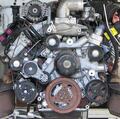
The 1/0 goes from the drivers frame connection to a boss to the right side of the crankshaft pulley as noted above in my truck.
The picture shows what I have with my 230a alternator, but the fuses are all the same as far as connection, which makes it simple to carry a spare in the glove compartment.
There are those who believe that, but IMO the GP load is not the problem, and that initial battery load is shared between both batteries quite easily by the 2ga cable connecting the positive terminals. It's the starter load, especially the initial inrush that overwhelms the aged negative side layout forcing the passenger battery to get pulled down more then it should, sacrificing it to a shorter life span.
BTW, my first "car" was a 1956 F-500 292ci 4 speed.
There are those who believe that, but IMO the GP load is not the problem, and that initial battery load is shared between both batteries quite easily by the 2ga cable connecting the positive terminals. It's the starter load, especially the initial inrush that overwhelms the aged negative side layout forcing the passenger battery to get pulled down more then it should, sacrificing it to a shorter life span.
BTW, my first "car" was a 1956 F-500 292ci 4 speed.
Battery current in parallel circuits with 2 or more batteries can be influenced by many things........... (and the current can be different between batteries) ................ But the actual load is not a "cause" of the difference
My first one was a 1957 Fairlane 500 with a 292 under the hood! (I wish I had it back!!)
This Hennessey Takes the Expedition Tremor's Off-Roading Capability to the Next Level
Slideshow: The VelociRaptor Expedition gains a lift, upgraded suspension, Brembo brakes, and trail-ready equipment while retaining the stock 440-horsepower EcoBoost V6.
Rezvani's Latest Post-Apocalyptic Monster Is a Ford F-150 Raptor Underneath
Slideshow: Called the Fortress, the 850-horsepower pickup combines Raptor underpinnings with military-inspired features, survival equipment, and a starting price of $285,000.














 And he can read that drawing.. he be trained!