When you click on links to various merchants on this site and make a purchase, this can result in this site earning a commission. Affiliate programs and affiliations include, but are not limited to, the eBay Partner Network.
Hello, I tow heavy loads with a 2002 f350. 14klbs, 7 tons on the hitch.
Axle wrap is a real problem.
Starting from a stop light in low gear, I have trouble keeping up with traffic flow until I get up into 2nd or 3rd gear and can really mash the go pedal and accelerate without fear of my driveline self-destructing.
A short shifter made it easier to get from one gear to the next without as much shifting delay, but if I don't figure something out soon, I fear a broken u-joint and further carnage from a driveshaft breaking loose at full torque and acceleration.
I have resigned to not tow anything heavy until I come up with a solution and install some form of reinforcement parts for the rear axle/driveshaft.
I can tell you that traction bars really help to smooth out the shifts on an auto - and I imagine you'd get far less clunk from throttle to coast (like I did). I have the Tuff Country traction bars and they have worked well so far for driving and towing - but I have not put a heavy load in the back yet. I don't yet know if mine will bind.
I will say that after a little more "lernin'", I'm not sold that mine were installed correctly by the shop.
The truck is 4wd manual transmission. It has manual front hubs and I am hauling from a dead stop to highway speed and at all speeds in between.
Tugly I'm not convinced that those are the traction bars that would be ideal. It is my understanding that the leaf springs get longer when compressed -- and they swing toward the rear shackle which allows spring articulation.
In theory -- when your rear wheels hit a bump, the rear leaf springs cannot compress because the traction bar is holding the axle forward and not allowing the springs to articulate.
Hopefully somewhat knowledgeable about this comes along.
Corksil, I have the same problem, although it is much less since I installed the Roadmaster Active Suspension spring helper. Unloaded I have no axle wrap anymore, but put the 30 ft travel trailer on and it returns. It is much better now with the spring helper even with the trailer, but still evident. I also replaced the rear leaf springs and that helped a bit too.
I plan/hope to install OUO bolt on adjustable traction bars this winter, but it is a big coin to drop.
The track bar prevents most axle rotation (that's where hop comes from) but does very little to reduce articulation. If it did the truck would ride like a conestoga and the bars would be bent in no time.
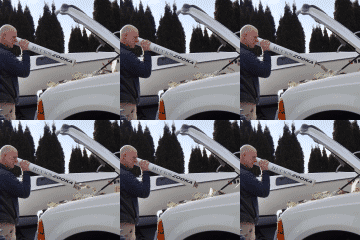
Let's see if we can draft Rich into making a video to demonstrate. Just 15 seconds of bouncing on his bumper to demonstrate the compression and rebound remain even with ladder bars. While striking a lighter, natch. C'mon man it's been a while!
...Let's see if we can draft Rich into making a video to demonstrate. Just 15 seconds of bouncing on his bumper to demonstrate the compression and rebound remain even with ladder bars. While striking a lighter, natch. C'mon man it's been a while!
Oh Gawd... I suppose you want a montage... with classic rock.
I can try, but the new shocks kinduh put a "damper" on my having a meaningful impact on suspension articulation with my weight. I can tell you that my old warm shocks would have Stinky twerkin' with a jump on the bumper.
The track bar prevents most axle rotation (that's where hop comes from) but does very little to reduce articulation. If it did the truck would ride like a conestoga and the bars would be bent in no time.
Let's see if we can draft Rich into making a video to demonstrate. Just 15 seconds of bouncing on his bumper to demonstrate the compression and rebound remain even with ladder bars. While striking a lighter, natch. C'mon man it's been a while!
Are you saying want to see a video of Rich twerkin on the back bumper of Stinky?if he does ,are we supposed to throw bitcoin?
I assume it was meant to say traction bar as opposed to track bar as they are completely different. Unless the different swing arcs are calculated in the dimensions of the spring and traction bar you will end up with suspension bind which will affect travel and bind.
I have made a few sets of ladder bars. Your theory is incorrect when hitting a bump but that's not what you seem to be considered about though that's what you've said. I'll explain both anyway in a combination
When you hit a bump your springs are designed to go straight up off of an imaginary straight line between the two points of your leaf springs (mounting bolts). Over time the springs loose the ability to keep everything in a straight line (torque and a heavy load also). That causes your springs to form an "S" shape. The "S" shape is what causes the diff to point to the sky and what you feel coming from the rear.
By installing ladder bars they "lock" your axle in so the rear diff looses its ability to point up and in most cases takes the "S" shape out of the equation that comes from your springs.
If you have the money laying around I would take a closer look at that is the cause and think about replacing the springs. If you have low mileage and the springs seem to be in good shape then I would recommend ladder bars first to help assist the springs. If your springs are in rough shape start there, replace wear items first, ladder bars last.
Articulation should not be much of an issue as long as the heim joints have played in them. If you solid mount them you're asking for trouble. One end solid mounted is fine as long as the heim can allow the bar to move with the truck. I imagine you don't off road so it shouldn't be much of a problem being worried about maximum articulation
The truck is 4wd manual transmission. It has manual front hubs and I am hauling from a dead stop to highway speed and at all speeds in between.
Tugly I'm not convinced that those are the traction bars that would be ideal. It is my understanding that the leaf springs get longer when compressed -- and they swing toward the rear shackle which allows spring articulation.
In theory -- when your rear wheels hit a bump, the rear leaf springs cannot compress because the traction bar is holding the axle forward and not allowing the springs to articulate.
Hopefully somewhat knowledgeable about this comes along.
If you had the vacuum actuated hubs I was going to suggest using your SOTF to engage the front axle when taking off from a dead stop, splitting the torque between the front and rear axle should enable you to give er all the coal she's got at launch I would put some vacuum hubs on before adding traction bars, use your front axle and you will have all the traction you need.
I have made a few sets of ladder bars. Your theory is incorrect when hitting a bump but that's not what you seem to be considered about though that's what you've said. I'll explain both anyway in a combination
When you hit a bump your springs are designed to go straight up off of an imaginary straight line between the two points of your leaf springs (mounting bolts). Over time the springs loose the ability to keep everything in a straight line (torque and a heavy load also). That causes your springs to form an "S" shape. The "S" shape is what causes the diff to point to the sky and what you feel coming from the rear.
By installing ladder bars they "lock" your axle in so the rear diff looses its ability to point up and in most cases takes the "S" shape out of the equation that comes from your springs.
If you have the money laying around I would take a closer look at that is the cause and think about replacing the springs. If you have low mileage and the springs seem to be in good shape then I would recommend ladder bars first to help assist the springs. If your springs are in rough shape start there, replace wear items first, ladder bars last.
Articulation should not be much of an issue as long as the heim joints have played in them. If you solid mount them you're asking for trouble. One end solid mounted is fine as long as the heim can allow the bar to move with the truck. I imagine you don't off road so it shouldn't be much of a problem being worried about maximum articulation
1. An axle located by leaf springs does not and can not travel straight up for 2 reasons, a. The front pivot point is fixed so the path of travel is an arc b. The spring is an arch and gets longer as it flattens, your axle moves backwards as the spring flattens.
You can design a linked suspension to move the axle straight up but the physics of a leaf spring can not be ignored.
Heim joints do not and should not have fore and aft play in them, they would be worn out if they did.
Steel does not wear out from time or use, you can cycle a spring made of steel an infinite number of times and it will not lose its ability to store energy unless you deform it to its yield.
You are correct on the moveable end of a traction bar. Because the axle moves fore and aft during cycling a traction bar must move fore and aft, a shackle at the front end will allow this but prevent rotational movement. ( pics to follow )
This Hennessey Takes the Expedition Tremor's Off-Roading Capability to the Next Level
Slideshow: The VelociRaptor Expedition gains a lift, upgraded suspension, Brembo brakes, and trail-ready equipment while retaining the stock 440-horsepower EcoBoost V6.
Rezvani's Latest Post-Apocalyptic Monster Is a Ford F-150 Raptor Underneath
Slideshow: Called the Fortress, the 850-horsepower pickup combines Raptor underpinnings with military-inspired features, survival equipment, and a starting price of $285,000.

















 I would put some vacuum hubs on before adding traction bars, use your front axle and you will have all the traction you need.