



Brake problems
Thread Starter
|
Posting Guru
Joined: Jun 2011
Posts: 1,385
Likes: 3
From: Tempe

Brake problems
Hey guys. I have a 1966 f100 and I'm having some brake issues. So I bled the brakes a couple months ago and doing this also noticed I would need new pads and my drums turned. But back to today I jump in and the brake pedal goes to the floor. I do not have power brakes just a cylinder. I took the lid off and there is no brake fluid in it. No signs of it leaking and all 4 fittings on the tires are dry and tight. It was parked for a couple days and drove fine a couple days ago. Added more fluid and pumped the brakes while checking the cylinder and all 4 fittings all dry no leaks and the pedal became stiff again. So my question is what would have cause the brake fluid to disappear in a couple days?

Postmaster
Joined: Apr 2002
Posts: 3,613
Likes: 6
From: Coal country
The master cylinder's erratic behavior is very typical of one going bad.
Also look for any leakage (from underneath the truck) at the bottom of the brake backing plate.
Do you have transplanted disc brakes with pads or the original drum brakes with shoes?
It makes a difference on which master cylinder you look for.
Also look for any leakage (from underneath the truck) at the bottom of the brake backing plate.
Do you have transplanted disc brakes with pads or the original drum brakes with shoes?
It makes a difference on which master cylinder you look for.
Thread Starter
|
Posting Guru
Joined: Jun 2011
Posts: 1,385
Likes: 3
From: Tempe
Original drum brakes all around. But would it leak out just on its own? Cause I don't see anything wet around the master cylinder or anything on the steering like it was dripping off. Hmmm
Lead Driver


Joined: Apr 2011
Posts: 6,399
Likes: 40
From: El Dorado, Arkansas
A manual brake MC isn't going to leak brake fluid down the engine side of the firewall --unless the lid seal is bad. It will leak fluid down the INSIDE of the firewall, inside the cab.
Look at the back end of the MC, under the dash where the input rod from the brake pedal attaches to the MC, and see if the back end of the MC is wet with brake fluid.
Trending Topics

Lead Driver

Joined: Aug 2003
Posts: 6,305
Likes: 18
From: Boulder Creek, Ca

If there's no evidence of leak I would suspect the MS seal/cup/'O' ring, is the culprit and IMO not worth rebuilding when new MS run as cheap as $30. If do decide to replace may want to consider a dual reservoir, whether a 4 drum distribution valve would be required I do not know; perhaps more knowledgeable member can advise??
Again, if no evidence of a leak, and depending upon method one uses to bleed the brake lines there is the possibility a pocket of air remained in the line. Found in bleeding the brakes it's best to start from furthest brake cylinder to closest. Also, if the old school method where helper pumps the pedal then holds pedal down while helper bleeds the line, and if not familiar with method, very important if the pedal goes to the floor it remain in that position until brake cylinder valve is closed. Anyhow, food for thought??
Again, if no evidence of a leak, and depending upon method one uses to bleed the brake lines there is the possibility a pocket of air remained in the line. Found in bleeding the brakes it's best to start from furthest brake cylinder to closest. Also, if the old school method where helper pumps the pedal then holds pedal down while helper bleeds the line, and if not familiar with method, very important if the pedal goes to the floor it remain in that position until brake cylinder valve is closed. Anyhow, food for thought??
FTE Stories
Ford Trucks for Ford Truck Enthusiasts

3 Best / 3 Worst Parts of Modern Ford Ownership
Brett Foote
10 Amazing Upgrades That Solve Common Ford Truck Owner Headaches
Pouria Savadkouei
Every 2026 Ford Engine Explained
Brett Foote
10 Ugly Ford Trucks That We Still Kinda Love
Joe Kucinski
10 Things Every Truck Owner NEEDS (2026 Edition)
Michael S. Palmer
Rezvani's Latest Post-Apocalyptic Monster Is a Ford F-150 Raptor Underneath
Verdad Gallardo
Top 10 Most Expensive Ford Trucks Ever Sold on Bring a Trailer
Joe Kucinski
2027 Ford Super Duty Buyer's Guide (Every Model, Engine, & Package)
Brett Foote
Top 10 Ford Truck Tragedies
Joe Kucinski
Thread Starter
|
Posting Guru
Joined: Jun 2011
Posts: 1,385
Likes: 3
From: Tempe
All very good assumptions thank you guys. I checked behind the firewall and the seal that connects the pedal to the MC is good. I've seen no signs of brake fluid anywhere. But my question remains, if there was a leak in the MC wouldn't you feel the pedal loose pressure as you press it. Cause it stiffens and stays there. I guess the real test would be to test drive it huh? Haha

Post Fiend
Joined: Apr 2002
Posts: 19,311
Likes: 97
From: Waterloo, Iowa
Well the brake fluid didn't disappear, it's leaking somewhere. On my '64 it started with a few drops from the M/C on the floor mat in cold weather. It's really a matter of replacing everything at this point. Some insist on modern brake performance - with front discs swapped from later years. But, whatever you decide it's going to need all new parts and hardware to include the hard brake line, rubber hoses, wheel cylinders, master cylinder, springs, shoes, etc. New drums will have the most meat on them if you stay with the drum system.
Brakes can't really be done piecemeal or halfway very safely. The good news is the parts for a 66 should be reasonably cheap, and the new brake line materials are easy to work with. If you shop carefully, the total (parts) for a complete replacement brake job on all 4 corners and hard line, master cylinder should be under $500, the labor charge would push this considerably higher.
Brakes can't really be done piecemeal or halfway very safely. The good news is the parts for a 66 should be reasonably cheap, and the new brake line materials are easy to work with. If you shop carefully, the total (parts) for a complete replacement brake job on all 4 corners and hard line, master cylinder should be under $500, the labor charge would push this considerably higher.
Lead Driver
Joined: Apr 2011
Posts: 6,399
Likes: 40
From: El Dorado, Arkansas
The single reservoir (suicide) MC has great potential for disastrous results from total brake failure.
Federal law mandated that all domestic auto manufactures install tandem MCs, beginning in 1967. This split the primary (front) brakes from the secondary (rear brakes). If there was a brake component rupture and hydraulic pressure loss in one cuircuit, the other brake circuit would still function.
1967 is also the first year the Pressure Differential valve was used in conjunction with the tandem MC. It's function is to sense for an imbalance of pressure between the primary and secondary brake circuits and to warn the driver by illuminating a red warning light, if there is a pressure imbalance due to a fluid leak.
My friend's '65 F100 I converted from a single reservoir MC to a tandem MC (he had also converted the front from drums to Dentside front discs and DJM lowering beams).
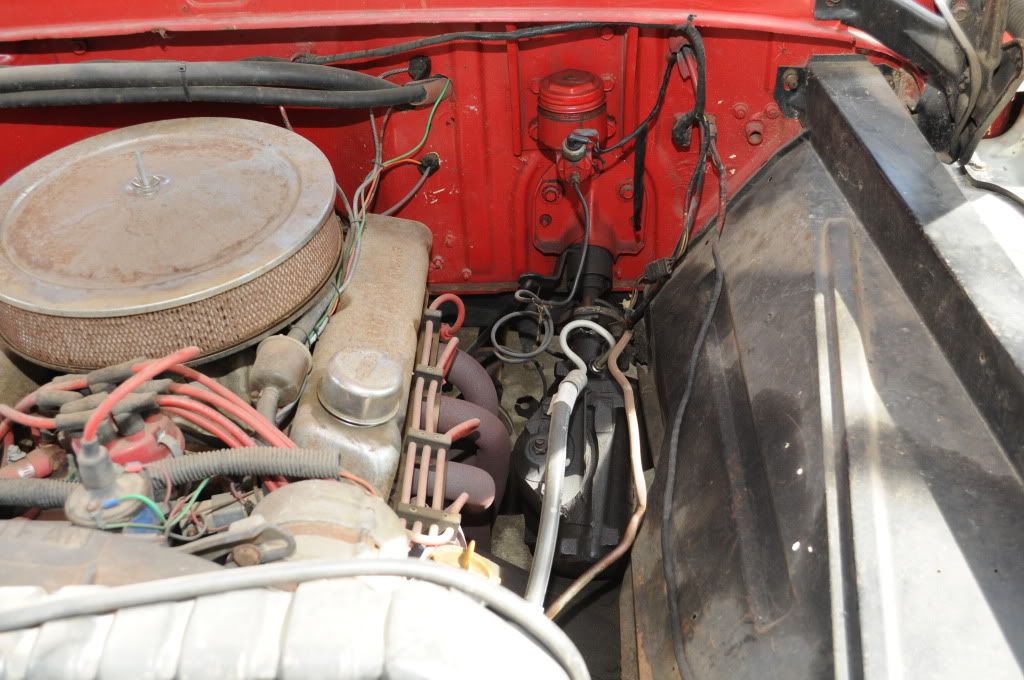

Internal view of the drum/drum pressure differential brake valve.
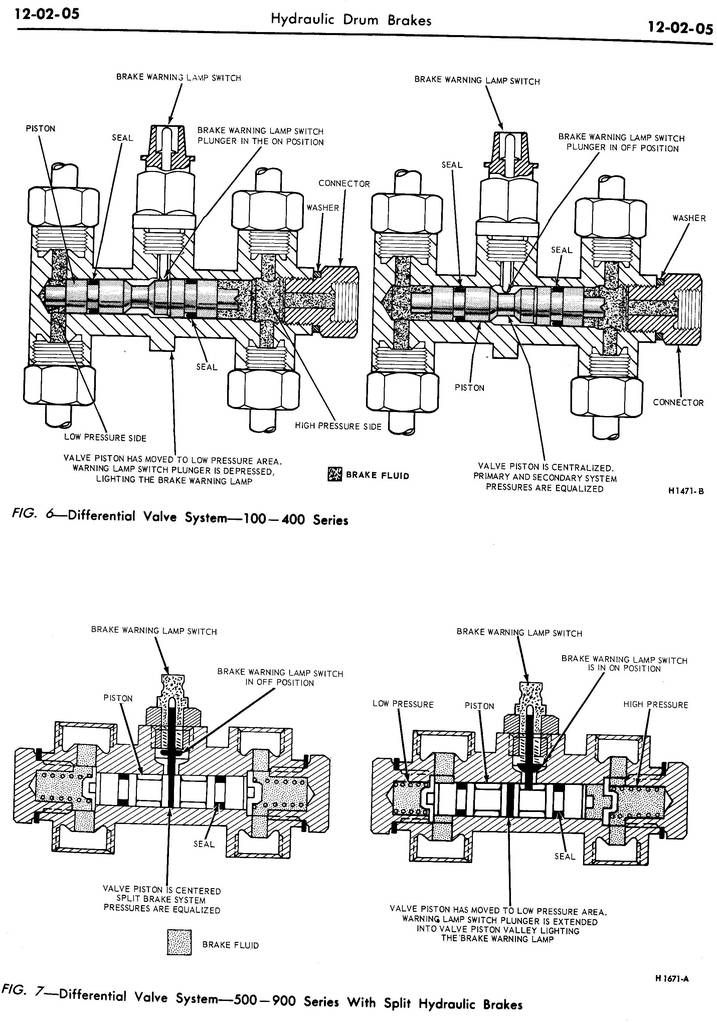
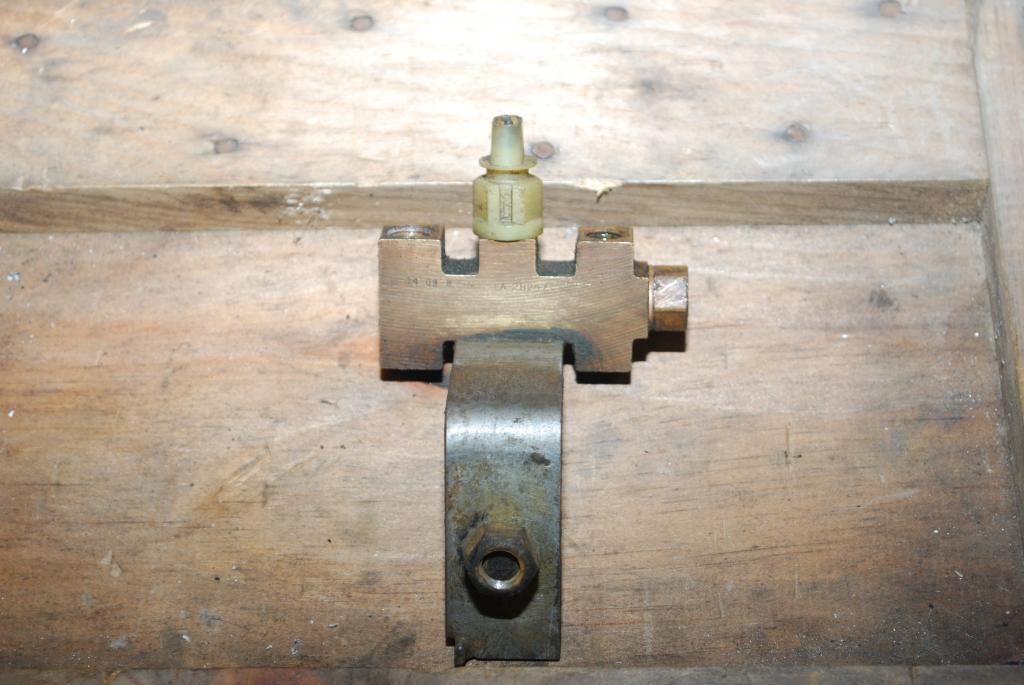
Photo of the old drum/drum pressure differential brake valve from my '69 F100 (I converted the front of my '69 from drums to discs from a '77 F100 and replaced the drum/drum brake valve with a disc/drum brake valve).
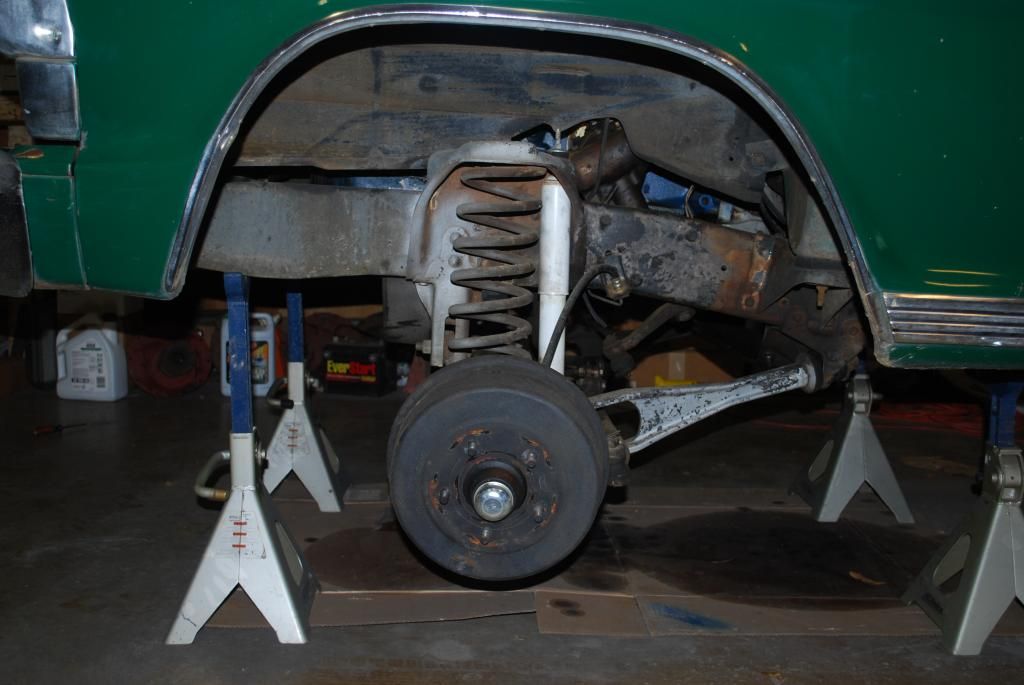
....my '69 F100 Ranger with its stock front drums.
....and its old manual (conventional style) cast iron tandem MC.
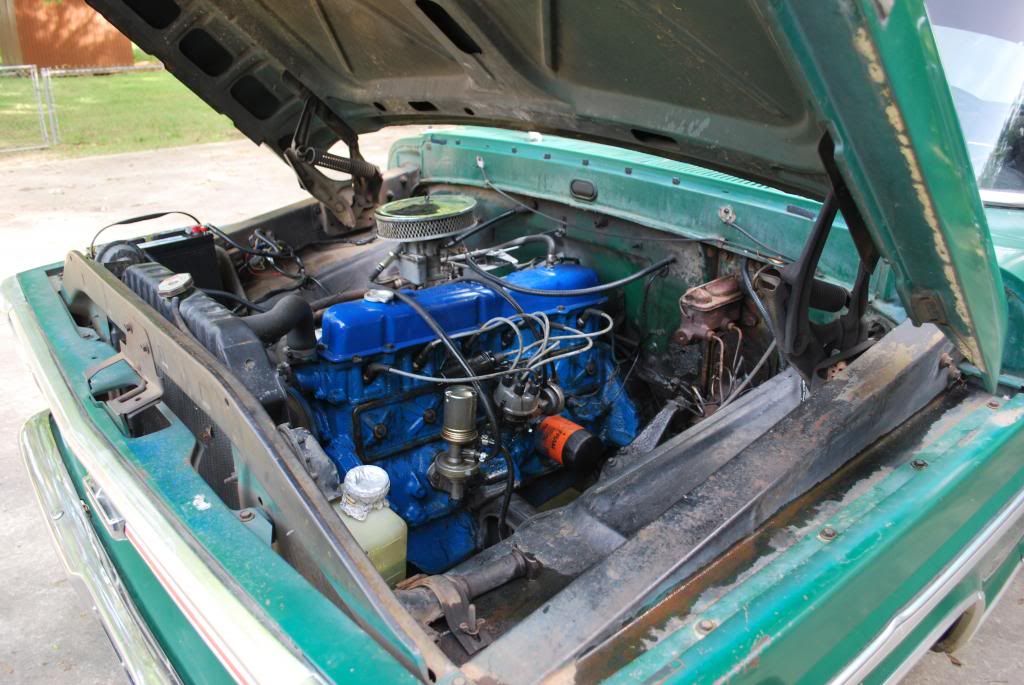
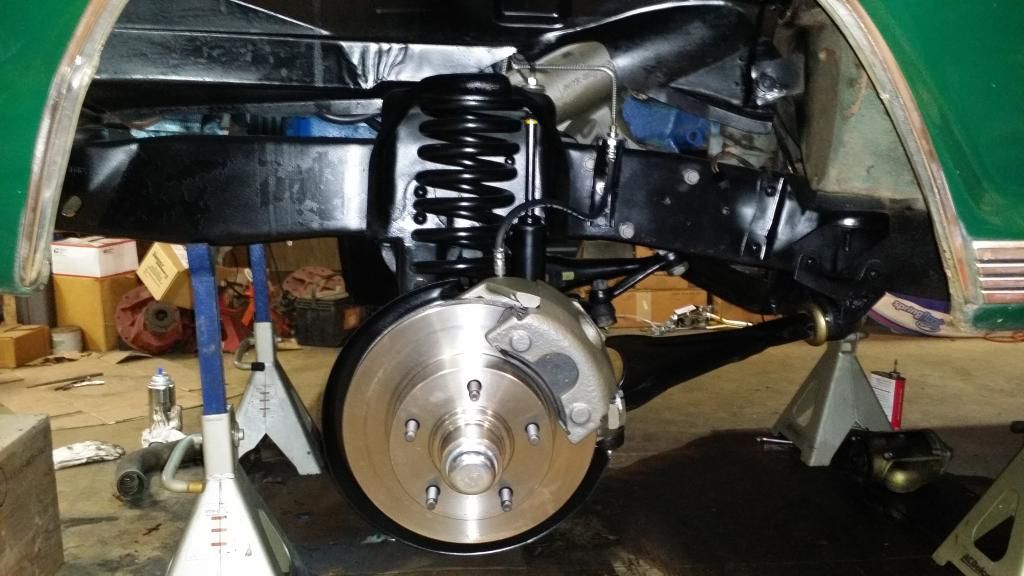
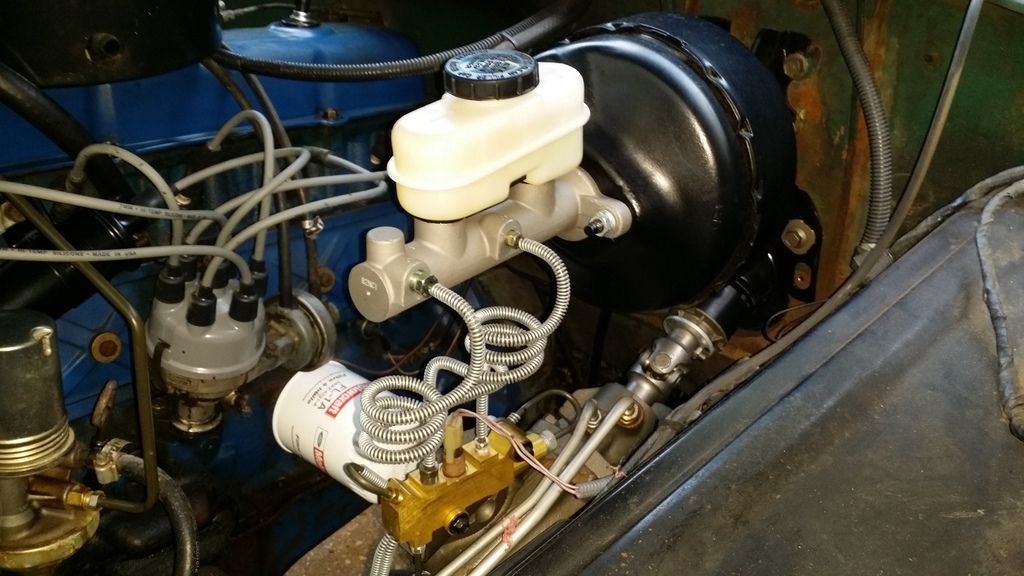
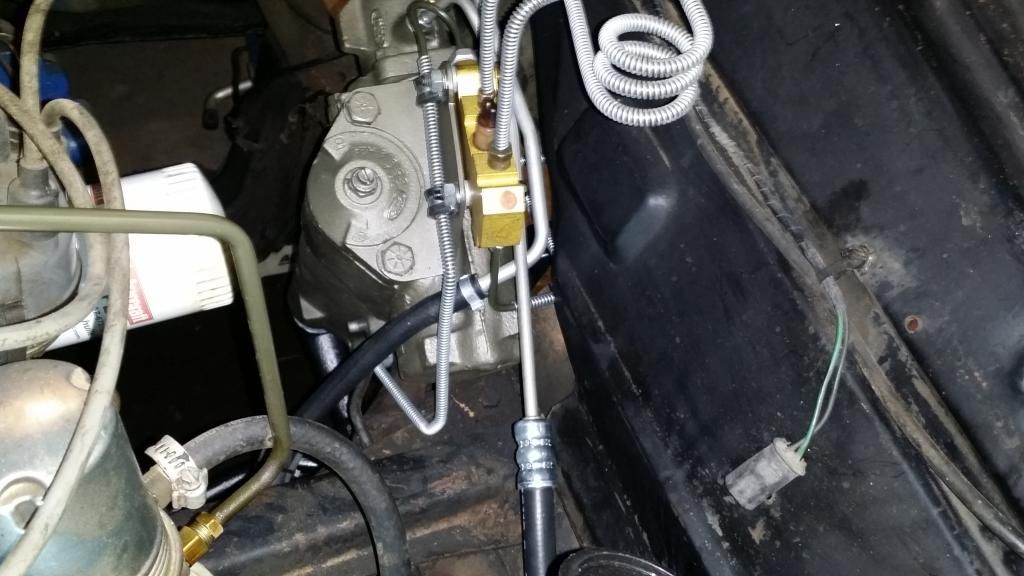
After I converted to '77 F100 front discs/I-beams/radius arms, added a '75 F350 dual diaphragm brake booster, 'modern' brake MC and installed the disc/drum brake valve (brake valve mounted on top of the Saginaw PS gear box).
Federal law mandated that all domestic auto manufactures install tandem MCs, beginning in 1967. This split the primary (front) brakes from the secondary (rear brakes). If there was a brake component rupture and hydraulic pressure loss in one cuircuit, the other brake circuit would still function.
1967 is also the first year the Pressure Differential valve was used in conjunction with the tandem MC. It's function is to sense for an imbalance of pressure between the primary and secondary brake circuits and to warn the driver by illuminating a red warning light, if there is a pressure imbalance due to a fluid leak.
My friend's '65 F100 I converted from a single reservoir MC to a tandem MC (he had also converted the front from drums to Dentside front discs and DJM lowering beams).


Internal view of the drum/drum pressure differential brake valve.

Photo of the old drum/drum pressure differential brake valve from my '69 F100 (I converted the front of my '69 from drums to discs from a '77 F100 and replaced the drum/drum brake valve with a disc/drum brake valve).

....my '69 F100 Ranger with its stock front drums.

....and its old manual (conventional style) cast iron tandem MC.

After I converted to '77 F100 front discs/I-beams/radius arms, added a '75 F350 dual diaphragm brake booster, 'modern' brake MC and installed the disc/drum brake valve (brake valve mounted on top of the Saginaw PS gear box).


Thread
Thread Starter
Forum
Replies
Last Post
dixiehornford
1980 - 1986 Bullnose F100, F150 & Larger F-Series Trucks
14
May 9, 2018 12:14 PM
Cabledude
1948 - 1956 F1, F100 & Larger F-Series Trucks
7
Jul 30, 2010 07:10 AM
Jacques
1948 - 1956 F1, F100 & Larger F-Series Trucks
6
Oct 2, 2004 01:30 PM
olgreymare
1980 - 1986 Bullnose F100, F150 & Larger F-Series Trucks
4
Oct 14, 2001 02:38 PM