




Tire size/rating question

Thread Starter
|
Mountain Pass
Joined: Jul 2011
Posts: 198
Likes: 1
Tire size/rating question
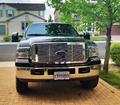
Guys, I've got a possible deal on four tires for my Excursion but not sure what the size and rating has to be.
I posted a tire question a couple of years ago ( https://www.ford-trucks.com/forums/1...ndation-2.html ) and apparently I now have the following on the truck:
"Michelin LTX A/T 2 Load range E tires that are size 265/75/16"
Is this EXACTLY what I have to have or is there some kind of leeway in any of the measurements?
The place that had them was closing so I never got the info but they were goodrich tires.
Thanks
I posted a tire question a couple of years ago ( https://www.ford-trucks.com/forums/1...ndation-2.html ) and apparently I now have the following on the truck:
"Michelin LTX A/T 2 Load range E tires that are size 265/75/16"
Is this EXACTLY what I have to have or is there some kind of leeway in any of the measurements?
The place that had them was closing so I never got the info but they were goodrich tires.
Thanks

Posting Guru
Joined: Jan 2012
Posts: 1,176
Likes: 4
From: Indiana
This was a sticky issue for me when I first joined up here and was working on my Super Duty. Apparently, if I used anything less than an "E" on my pickup, the truck would automatically plow down a bus full of nuns transporting orphans and puppies. However by magic, "D" tires are just fine on an Excursion which is about the same weight or close enough.
My advice would be to not go below what the door sticker says.
Disclaimer: "E" on the truck has to do with the potential to haul cargo in the bed. But we've all seen about 1200 lbs of people pile out of an Excursion in the Wal Mart parking lot. So there's that.
My advice would be to not go below what the door sticker says.
Disclaimer: "E" on the truck has to do with the potential to haul cargo in the bed. But we've all seen about 1200 lbs of people pile out of an Excursion in the Wal Mart parking lot. So there's that.

Lead Driver
Joined: Nov 2007
Posts: 5,139
Likes: 209

There is some leeway in the tire size. Guys run from 235's -305's on their stock rigs. 265/75/16 is the factory tire size. Which way do you want to go?
Load rating is up to you. I won't run anything but E rated tires, but I drag a trailer that throws 1500#'s of tounge weight on the hitch. Like mentioned above, don't go below the weight rating on the door jamb sticker. Just about any tire you can think of will have load rating/inflation pressure charts available. Stay within those recommendations. Tires are way too critical to take chances with, IMO.
Load rating is up to you. I won't run anything but E rated tires, but I drag a trailer that throws 1500#'s of tounge weight on the hitch. Like mentioned above, don't go below the weight rating on the door jamb sticker. Just about any tire you can think of will have load rating/inflation pressure charts available. Stay within those recommendations. Tires are way too critical to take chances with, IMO.

Senior User
Joined: Mar 2015
Posts: 126
Likes: 0
From: Loganville, GA
Bingo. I couldn't agree more with that. People think.."Oh I can save $80 on a set of 4 tires...with these cheapos." Uhh, no thanks.
Lead Driver
Joined: Mar 2010
Posts: 5,250
Likes: 11
From: West Virginia
My truck weighs 8270 lbs and I tow a 5 ton trailer. Allowing for ten (let's be realistic fifteen or so) percent tongue weight that's close to 5 tons on my truck.
Would load range d's work? Sure. Buuuut...
Radial tires don't have ten or eight plies. What tires use now is ply rating which is the tires equivalent in a bias ply. And it's also sort of meaningless.
The load range, effectively, gives you an idea of the tires construction as far as stiffness but is primarily there to let you know the maximum inflation pressure. It's the air in the tire that supports the load, not the tire. All the tire does is hold the air. All things being equal, a tire that handles more pressure will handle more load. Less pressure means more sidewall deflection which means more heat and a quicker failure.
The actual load index or load rating is the single most important factor in determining suitability for carrying weight. The load range will tell you the inflation pressure which is the second most important. A load range d tire will carry 3k per tire at 40 psi and be within its rating, but towing with that tire will be a very different experience than carrying 3000 lbs per tire on the same size lre tire at 60 or 70 psi.
At the same time, those trucks are gonna drive quite different unloaded as well.
Would load range d's work? Sure. Buuuut...
Radial tires don't have ten or eight plies. What tires use now is ply rating which is the tires equivalent in a bias ply. And it's also sort of meaningless.
The load range, effectively, gives you an idea of the tires construction as far as stiffness but is primarily there to let you know the maximum inflation pressure. It's the air in the tire that supports the load, not the tire. All the tire does is hold the air. All things being equal, a tire that handles more pressure will handle more load. Less pressure means more sidewall deflection which means more heat and a quicker failure.
The actual load index or load rating is the single most important factor in determining suitability for carrying weight. The load range will tell you the inflation pressure which is the second most important. A load range d tire will carry 3k per tire at 40 psi and be within its rating, but towing with that tire will be a very different experience than carrying 3000 lbs per tire on the same size lre tire at 60 or 70 psi.
At the same time, those trucks are gonna drive quite different unloaded as well.
Thread Starter
|
Mountain Pass
Joined: Jul 2011
Posts: 198
Likes: 1
Ok, the sad part is that I have no clue about anything, I just drive so I'm going to start off by finding if they are E rated or not and then IF they are, probably come back and ask again.
As for the size, I have no idea what the difference is and whether it should be 235's, 265's or 305's
There are things I'm pretty good at, this ain't it
Thanks guys
As for the size, I have no idea what the difference is and whether it should be 235's, 265's or 305's
There are things I'm pretty good at, this ain't it
Thanks guys
Trending Topics
Posting Guru
Joined: Jan 2012
Posts: 1,176
Likes: 4
From: Indiana
The tires you have on there now are pretty much the same size as what came on it. Do you like the look, or would you rather go a little taller? That is pretty much all up to personal preference as long as you aren't planning to get radically tall and tow hasteranger's load.
Your door sticker likely calls for "D" range tires, but that could be a product of the Ford bean counters trying to "soccer mom" the Excursion (like they did with the front springs). Excursions are heavy, heavy machines. I personally wouldn't want to attach a heavy trailer and load it up with 8 healthy adults and go screaming down the interstate at 80 mph on "D" tires in a crosswind...
When I get mine on the road, she'll be wearing "E" tires like my truck. It'll help me sleep better. And it might just save a nun. Or an orphan. Or a puppy.
Your door sticker likely calls for "D" range tires, but that could be a product of the Ford bean counters trying to "soccer mom" the Excursion (like they did with the front springs). Excursions are heavy, heavy machines. I personally wouldn't want to attach a heavy trailer and load it up with 8 healthy adults and go screaming down the interstate at 80 mph on "D" tires in a crosswind...
When I get mine on the road, she'll be wearing "E" tires like my truck. It'll help me sleep better. And it might just save a nun. Or an orphan. Or a puppy.
FTE Stories
Ford Trucks for Ford Truck Enthusiasts

Rezvani's Latest Post-Apocalytic Monster Is a Ford F-150 Raptor Underneath
Verdad Gallardo
Top 10 Most Expensive Ford Trucks Ever Sold on Bring a Trailer
Joe Kucinski
2027 Ford Super Duty Buyer's Guide (Every Model, Engine, & Package)
Brett Foote
Top 10 Ford Truck Tragedies
Joe Kucinski
AEV FXL Super Duty - the Super Duty Raptor Ford Doesn't Make
Brett Foote
Lobo Vs Lobo: Proof the F-150 Lobo Should Be Even Lower!
Michael S. Palmer
Ford's 2001 Explorer Sportsman Concept Looks For a New Home
Verdad Gallardo
10 Best Ford Truck Engines We Miss the Most!
Joe Kucinski
2026 Shelby F-150 Off-Road: Better Than a Raptor R?
Brett Foote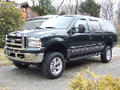
Moderator


Joined: Jul 2010
Posts: 12,052
Likes: 1,550
From: Media PA

Ok, the sad part is that I have no clue about anything, I just drive so I'm going to start off by finding if they are E rated or not and then IF they are, probably come back and ask again.
As for the size, I have no idea what the difference is and whether it should be 235's, 265's or 305's
There are things I'm pretty good at, this ain't it
Thanks guys
As for the size, I have no idea what the difference is and whether it should be 235's, 265's or 305's
There are things I'm pretty good at, this ain't it
Thanks guys
A tire size works like this;
265/75R16E
265 is the tires width measured in millimeters.
75 is the aspect ratio, meaning that the tire has a side wall that is 75% as tall as the tire is wide (265MM).
R signifies that it is a radial tire, you will be using radials on your EX, bias ply tires are kind of old school or trailer tires.
16 identifies the size rim the tire will fit on, the EX has factory 16" rims.
E is the load range, early EXs had factory spec'ed D rated tires but Ford later changed that to E load range as the spec for an EX.
So a 285/75R16E will be just a little wider (10MM wider) and a hair taller than the stock tire's size. It is a very popular size that many EX owners have upgraded to and it fits on the stock suspensions and fills the wheel wells better.
Lead Driver
Joined: Mar 2010
Posts: 5,250
Likes: 11
From: West Virginia
285 75 16's are close to 33" in diameter. About 2" larger than stock. They will decrease cruising rpms but male acceleration a little slower. In my case they made the speedo accurate instead of 5 mph top high. They also rubbed my front fender liners at full lock.

Senior User
Joined: Oct 2005
Posts: 114
Likes: 0
When I put the 285s on my 2000 V10 4x4 Excursion, they made the speedo inaccurate. Plus, there is a noticeable decrease in acceleration and overall pep, and towing is especially miserable.
Thread Starter
|
Mountain Pass
Joined: Jul 2011
Posts: 198
Likes: 1
Guys, that sob sold the tires although he agreed to hold them for me so no tires for me.
I'll still go through your answers and see if I can learn and above all, remember things bu it's a no go for me.
People suck!
THanks for the quick replies though
I'll still go through your answers and see if I can learn and above all, remember things bu it's a no go for me.
People suck!
THanks for the quick replies though
Post Fiend
Joined: Feb 2011
Posts: 26,410
Likes: 6
From: Ft. Lauderdale, FL


Thread
Thread Starter
Forum
Replies
Last Post