





Cody test

Thread Starter
|
Laughing Gas


Joined: Jul 2008
Posts: 772
Likes: 27
From: Brighton CO.
Cody test
I am not familiar with the testing procedure and I have not seen any threads on.
I did not find any threads in the search function for it either.
Does anyone have a procedure or a link to the threads?
Thanks in advanced.
Brice.
I did not find any threads in the search function for it either.
Does anyone have a procedure or a link to the threads?
Thanks in advanced.
Brice.

Butt-Head
Joined: Apr 2004
Posts: 9,405
Likes: 2,894
From: Reed Point, MT
The test (which needs to be renamed by the way) is used to determine and help narrow down the source of a high pressure oil leak.
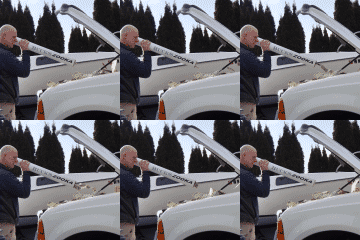
By removing one or both of the high pressure oil lines from the head (or the pump if one was so inclined), a person effectively isolates the oil rails from the rest of the high pressure system. By using compressed ("shop") air and a blow gun (preferably one with a rubber tip to minimize leakage), it's possible to hear a high pressure oil leak to diagnose injector or injector o-ring problems without first removing the valve covers. By doing this, the high pressure oil pump and injection pressure regulator are isolated and NOT tested (or botching the test). Besides, it's impossible to hear a leak with the engine cranking since there's a lot of noise present. Sure, a person experiencing low injection pressure (too low to allow a start condition) could remove the valve covers and watch for oil leaks....but that involves actually removing the valve covers and cranking the engine and watching for oil at the same time.
If there happens to be a high pressure oil leak on or near the injectors large enough to cause a no-start condition, using pressurized air is a quick and easy way to find out which side AND which hole is the culprit. Just be sure to cover the tip of the air gun with a rag just in case you don't find a leaking injector/o-ring....you'll be wearing 120-ish PSI of oil spray otherwise when you remove the blow gun nozzle from the oil line fitting.
By removing one or both of the high pressure oil lines from the head (or the pump if one was so inclined), a person effectively isolates the oil rails from the rest of the high pressure system. By using compressed ("shop") air and a blow gun (preferably one with a rubber tip to minimize leakage), it's possible to hear a high pressure oil leak to diagnose injector or injector o-ring problems without first removing the valve covers. By doing this, the high pressure oil pump and injection pressure regulator are isolated and NOT tested (or botching the test). Besides, it's impossible to hear a leak with the engine cranking since there's a lot of noise present. Sure, a person experiencing low injection pressure (too low to allow a start condition) could remove the valve covers and watch for oil leaks....but that involves actually removing the valve covers and cranking the engine and watching for oil at the same time.
If there happens to be a high pressure oil leak on or near the injectors large enough to cause a no-start condition, using pressurized air is a quick and easy way to find out which side AND which hole is the culprit. Just be sure to cover the tip of the air gun with a rag just in case you don't find a leaking injector/o-ring....you'll be wearing 120-ish PSI of oil spray otherwise when you remove the blow gun nozzle from the oil line fitting.

Post Fiend
Joined: Mar 2007
Posts: 26,966
Likes: 50
From: Texas
I see. So now that we're talking about it, why wouldn't one be inclined to remove the hoses from the pump instead of the head? Seems like much easier access with a blow gun reaching a hose than the fitting on the head.

Cargo Master
Joined: Feb 2005
Posts: 2,837
Likes: 1

Trending Topics
Post Fiend
Joined: Mar 2007
Posts: 26,966
Likes: 50
From: Texas
FTE Stories
Ford Trucks for Ford Truck Enthusiasts

10 Best Ford Truck Engines We Miss the Most!
Joe Kucinski
2026 Shelby F-150 Off-Road: Better Than a Raptor R?
Brett Foote
2027 Super Duty Carhartt Package First Look: 12 Things You NEED to Know!
Michael S. Palmer
10 Most Surprising 2026 Ford Truck Features!
Joe Kucinski
Top 10 Ford Trucks Coming to Mecum Indy 2026
Brett Foote
5 Best / 5 Worst Ford Truck Wheels of All Time
Joe Kucinski
Ford Super Duty: 5 Things Owners LOVE, 5 Things They LOATHE!
Joe Kucinski
Every 2026 Ford Truck Engine RANKED from WORST to FIRST!
Michael S. Palmer
The Best F-150 Deal of Every Trim Level (XL through Raptor)
Joe Kucinski
Lead Driver
Joined: Jun 2007
Posts: 7,760
Likes: 27
From: Hampton, Maryland.

Thanks to Cody, I have done it several times now to find o-ring leaks, and it works very well. Do NOT forget the part bout therag, believe me. Also realize that if you have a small o-ring leak, you have to maintain that pressure for a little bit of time. You need enough time nd prseeure to drive enough of the oil out of the rail for the leak to be udible.
Hotshot


Joined: Jan 2011
Posts: 18,849
Likes: 179
From: Puget Sound
MY FAULT! Cody was the first to suggest it and a couple of members benefitted big-time from this simple test. Cody came up with it, I never heard of it before, and it needs a short name... so I call it the Cody test.
The Hutch mod is named after someone named Hutchinson.
If doing it through the hoses is easier, so be it... you can test more components for leaks this way.
The Hutch mod is named after someone named Hutchinson.
If doing it through the hoses is easier, so be it... you can test more components for leaks this way.


Senior User
Joined: Sep 2011
Posts: 203
Likes: 1
From: Delaware
Back in the early days of the 444 and DT 466 I worked at a International dealer. If a injector O-ring was suspected warranty demanded that you replace only the defective cyl. So we used a porta power pump and a gauge. You could reach 500 psi and I used ATF fluid because it added color.

Lead Driver


Joined: Jun 2004
Posts: 6,303
Likes: 575
From: Amarillo, TEXAS!
Back in the early days of the 444 and DT 466 I worked at a International dealer. If a injector O-ring was suspected warranty demanded that you replace only the defective cyl. So we used a porta power pump and a gauge. You could reach 500 psi and I used ATF fluid because it added color.