


Suspension

Thread Starter
|
Senior User
Joined: Sep 2011
Posts: 156
Likes: 0
From: Whispering Pines, NC
Suspension
On my 83 f150 4x4 5.8 liter pickup, the truck floats back and forth which is typical of fords. The shocks and steering box are new but hasn't seemed to help. What can I do to take out the excess play in the steering?
Thread Starter
|
Senior User
Joined: Sep 2011
Posts: 156
Likes: 0
From: Whispering Pines, NC
Suspension
Yes sir. After I installed the steering box, I took the truck down to our local alignment shop and had the front aligned. I didn't have the back aligned due to not messing with it. Is there some sort of stabilizer kit that can be attached to the suspension, or do I have a floater?

Moderator


Joined: Jan 2001
Posts: 57,005
Likes: 2,750
From: Virginia

If we assume they checked the frontend over before they aligned it(that's a big assumption sometimes) then we can assume your play is coming from something not related to the frontend components.
That would leave the rag joint going into the steering box from the column, the collapsible double D shaft in the column could have play in it, or we have had a lot of posts lately with trucks that have cracks in the frame near where the steering box mounts, and also loose rivets in this same area that fasten the large crossmember under the engine to the side frame rails.
If you have a lift on it, I would also check the drop down bracket bolts and see if they are loose.
What type of play do you have? Can you feel it in the steering wheel just sitting in the driveway? Or it only comes about when driving?
That would leave the rag joint going into the steering box from the column, the collapsible double D shaft in the column could have play in it, or we have had a lot of posts lately with trucks that have cracks in the frame near where the steering box mounts, and also loose rivets in this same area that fasten the large crossmember under the engine to the side frame rails.
If you have a lift on it, I would also check the drop down bracket bolts and see if they are loose.
What type of play do you have? Can you feel it in the steering wheel just sitting in the driveway? Or it only comes about when driving?

FTE Legend


Joined: Jul 2010
Posts: 32,875
Likes: 48
From: Northeast, OK
Also, don't forget to check the wheel bearings.
And if you don't have sway bars on it, even when you get the play out it will still have some bump-steer. I've found that just installing sway bars makes a huge difference.
And if you don't have sway bars on it, even when you get the play out it will still have some bump-steer. I've found that just installing sway bars makes a huge difference.
Thread Starter
|
Senior User
Joined: Sep 2011
Posts: 156
Likes: 0
From: Whispering Pines, NC
Suspension
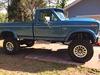
The steering is tight when in the yard or just starting out. Once I'm on the road the truck tends to roam left to right and back requiring me to constantly move the steering wheel to re-direct the truck. There isn't a lift kit on the truck nor sway bars. If I keep my hand on the steering wheel at one particular place, I can control it, but my daughters are scared to drive it.
Trending Topics
Posting Guru
Joined: Apr 2011
Posts: 1,636
Likes: 5
From: Orlando area
The "caster" alignment angle is the most critical that affects "straight line drift". Caster is the imaginary line drawn from the upper ball joint center to the lower ball joint center (a.k.a kingpin angle). The imaginary caster line extends to the road in front of the tire. The further ahead of the tire the point of contact of that imaginary line is on the raod, the more straight line stability you have. So to get the line further ahead of the tire you can move the top ball joint back (towards rear of truck) with alignment shims, drop the radius arm (at the frame mount end), or lower the rear end of the truck (more weight in bad or lower axle-to-spring perches.
FTE Stories
Ford Trucks for Ford Truck Enthusiasts

Top 10 Fords at 2026 Carlisle Ford Nationals
Joe Kucinski
3 Best / 3 Worst Parts of Modern Ford Ownership
Brett Foote
10 Amazing Upgrades That Solve Common Ford Truck Owner Headaches
Pouria Savadkouei
Every 2026 Ford Engine Explained
Brett Foote
10 Ugly Ford Trucks That We Still Kinda Love
Joe Kucinski
10 Things Every Truck Owner NEEDS (2026 Edition)
Michael S. Palmer
Rezvani's Latest Post-Apocalyptic Monster Is a Ford F-150 Raptor Underneath
Verdad Gallardo
Top 10 Most Expensive Ford Trucks Ever Sold on Bring a Trailer
Joe Kucinski
2027 Ford Super Duty Buyer's Guide (Every Model, Engine, & Package)
Brett Foote
Moderator


Joined: Nov 2007
Posts: 22,415
Likes: 92
From: Denver Metro Area, CO
I wonder if the "alignment" recently done dealt only with toe-in and toe-out, ignoring caster & camber. I'd take it for an inspection to a place known to do good work on trucks, not a run-of-the-mill, consumer-oriented, chain store shop.
Moderator
Joined: Jan 2001
Posts: 57,005
Likes: 2,750
From: Virginia
We can determine what kind of alignment he got if he tells us how much he paid to have it done. It should have been at least $60 or higher. A $30-$40 job would be just the toe. With a lift kit it's usually a $150-up alignment job.

Thread
Thread Starter
Forum
Replies
Last Post
Freightrain
1987 - 1996 F150 & Larger F-Series Trucks
11
Aug 10, 2011 10:53 AM
hartski
1967 - 1972 F-100 & Larger F-Series Trucks
1
Mar 10, 2010 10:11 AM
dassmoof
1980 - 1986 Bullnose F100, F150 & Larger F-Series Trucks
5
Jun 15, 2002 12:32 AM