


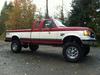

Project: ThunderStroke

Thread Starter
|
Senior User
Joined: Nov 2008
Posts: 104
Likes: 0
From: Sorrento BC, Canada
The reason it makes good boost at 1400 is that I put a smaller exh housing on the turbo .84 ar vs 1.15. My higher flowing manifolds, and up pipes may have an effect on low end boost too. I did not want a lazy turbo with no boost below 2000 rpm. I advanced the intake event on the cam because I wanted to see if there was more grunt to be had on the bottom end since I found it to be lacking for a 7.3. It seems to be working as it pulls good off the bottom, but I will have to find a dyno to find out. It also may put a limit on the amount of power that it can put out due to high cylinder pressure but well see.
Thread Starter
|
Senior User
Joined: Nov 2008
Posts: 104
Likes: 0
From: Sorrento BC, Canada
Update. I have been running the thunderstroke for awhile now, and it has been running well. I turned the pump up to max which gave more torque everywhere, and 100 degree lower pyro temp, but would like more fuel. I have seen 17 psi boost at 2700 in 4th at 1000 degree pyro. I have not run it very hard so 20 psi is attainable. The turbo produces a cool 8 psi max from 1600 to 1900 where i like to run it. After 2000 rpms it comes alive almost like a light switch. I put a stock 96 powerstroke filter assembly into it for the cold air intake and better filtration (dont trust cone filters). The cold air intake lowered egts 100-150 degrees, more low end grunt, and no drop in boost. The turbo performs better then I expected but I would not run it without the .84 ar housing. I did have to pull the turbo and intake to fix a leak at the back of the intake from not enough silicone. I picked up an 6.0 litre intercooler but wont be installed for awhile. The turbo whistle is so bad in the cab that I wear earplugs to not go deaf. Got some pics of the pedestal but my pos camera took small pics.


Posting Guru
Joined: Sep 2011
Posts: 1,523
Likes: 5
I like your build. I'm surprised I missed this thread before this. I'm curious what the truck will do on the dyno as well. One thing I have thought about when I read this thread is that with the added cylinder pressure from your cam, you should theoretically have more power per pound of boost due to the added compression pushing down on the piston. You will just be slightly more limited as far as max boost goes cus of it though. It will be interesting to see the difference in numbers when you do add more fuel down the line. Also another reason the turbo might be spooling up quicker on top of the smaller hot side being on there is probably the fact that the extra compression might cause more drive pressure thus faster spool.
Thread Starter
|
Senior User
Joined: Nov 2008
Posts: 104
Likes: 0
From: Sorrento BC, Canada
Yes, theoretically the cam should make more power then the stock cam due to less bleed off of boost. I did notice a bit more no throttle idle torque as I can almost drag my front tires with the brakes on in 1st. One problem I did notice with the cam is my mileage did go down a bit, so I may change back to the stock cam. I came up with the cam on the engine analyzer pro program where I put valve size, port sizes, chamber size, turbo sizes, lobe lift, diesel option, ramp rates, .050" lift duration, and adv duration. I ran many, many lobe combinations to find the best torque production cam and this one besides the stock cam or stock with more agressive ramp rates worked best. I like the stock ramp rates due to them being easy on the valve train for longevity. Whether or not the program is accurate is something i dont know, but decided to try the cam to see if it would work.
Lead Driver
Joined: Apr 2008
Posts: 6,945
Likes: 13
The type4 cam has is stock on the intake, may have more lift but i dont think so. Pretty sure its all exhaust.
FTE Stories
Ford Trucks for Ford Truck Enthusiasts

3 Best / 3 Worst Parts of Modern Ford Ownership
Brett Foote
10 Amazing Upgrades That Solve Common Ford Truck Owner Headaches
Pouria Savadkouei
Every 2026 Ford Engine Explained
Brett Foote
10 Ugly Ford Trucks That We Still Kinda Love
Joe Kucinski
10 Things Every Truck Owner NEEDS (2026 Edition)
Michael S. Palmer
Rezvani's Latest Post-Apocalyptic Monster Is a Ford F-150 Raptor Underneath
Verdad Gallardo
Top 10 Most Expensive Ford Trucks Ever Sold on Bring a Trailer
Joe Kucinski
2027 Ford Super Duty Buyer's Guide (Every Model, Engine, & Package)
Brett Foote
Top 10 Ford Truck Tragedies
Joe Kucinski
Senior User
Joined: Feb 2012
Posts: 445
Likes: 6
From: western Oregon
The IDI has a very low ramp rate and a very small lobe size. The fastest way to get it to breath better is to install a turbo, the next way is to maximize the flow into the cylinder without creating a loss in power somewhere else. Doing this is easer said than done.....I worked with engine analyzer pro to come up with a possible grind and found that there was so many measurements and weights needed to use the analyzer to its fullest potential that you had to make some estimates in certain areas because of unknown or inapplicable information. I was able to do some base line runs with as much stock info as I could possibly get and was able to show results that were about 10 HP from factory Turbo numbers. Then I started to do "mods" to the engine like larger diameter exhaust and better turbo combos until I felt I had enough base line info to start changing the cam profile. I am a crank HP guy from my racing days and that's just how I think... so I went for more lift and faster ramp rate to get the valve open faster and have more time over the nose of the cam to increase the effective flow of the monster size intake port. The torque comes from the effective time the explosion of burning fuel can push on the piston top balanced buy the need to open the exhaust valve just a few degrees sooner to give a better exhaust pulse to spool the turbo. Add to this the need to minimize the overlap to keep port reversion to a acceptable level. Its not easy to make wholesale changes without creating problems with clearance with the pistons during the cycle. My profile was just about finished in my eyes when I couldn't seem to get my cam grinder Dude to answer his phone..... Justin's J2 cam grind was out and was close enough to what I wanted so I just went with it.... I'm loving it so far and will have some test drive miles next weekend as it was stormy this weekend and I couldn't seem to get anything done with the rain running down the crack of my ***... I respect anyone that has the stones to try new things to find out what it dose for performance. I would love to see some dyno results from your build when its done. I also have plans to Re-Build a Truck from the Frame up after I move to AZ so I might make another stab at a custom Cam Grind then. Keep the build going all info is good info....
Thread Starter
|
Senior User
Joined: Nov 2008
Posts: 104
Likes: 0
From: Sorrento BC, Canada
The program did have alot of specs in it to fill out but probly makes it more accurate. I also found that I could get very close to advertised numbers for the n/a 7.3 for torque and hp with stock specs. I then played with turbo sizes and found torque gains with an eairlier intake closing. I wanted to grind a cam with 170 intake, and 182 exh duration to limit adv duration overlap, but my cam grinder didnt have any masters in those durations. The intake valve is .2" larger then the 7.3 powerstrokes, and cummins but I found by lowering the size of the intake valve to 1.7" on the program that the torque came up at the lower rpm. The cam seems to have performed the way the program said, but it said fuel consumption would go down but thats not what I have found. I like that motorhome, and 7.3 racer 30 reminds me of a big rig.
Senior User
Joined: Feb 2012
Posts: 445
Likes: 6
From: western Oregon
In my first talks to my grinder he said some of the same things.... He only had some masters close to what I needed but not exactly. I was working with some of his lobes when he lost interest in my money. So I just stopped and got the J2..... Heads with smaller valves do make better low end power but it comes with a loss in the top end. The IDI IMO has the ports for more power in the top end and with all engines when you move the max torque higher in the RPM range it makes more HP because HP is a calculation using torque and rpm over time to equate HP. That's why I built the way I did. plus I like doing new things to push the envelope.
Postmaster


Joined: Dec 2004
Posts: 2,941
Likes: 30
From: Maple Valley, WA
Where did you say your ICL on you cam is?
Postmaster
Joined: Dec 2004
Posts: 2,941
Likes: 30
From: Maple Valley, WA
Nope, I was wrong, I just looked at the cam card again.
The Torque cam has increased Duration on both the intake and exhaust, significant as well. The Torque cam has slightly more duration on both the intake and exhaust than my cam does, but as far as the other events go, dead stock, except for the intake, which has just a smidge more lift (probably not enough to really make a dif)... The torque cam has the same amount of overlap as the J2 cam. I must have been thinking about the old info floating around, disregard my post above.
The Torque cam has increased Duration on both the intake and exhaust, significant as well. The Torque cam has slightly more duration on both the intake and exhaust than my cam does, but as far as the other events go, dead stock, except for the intake, which has just a smidge more lift (probably not enough to really make a dif)... The torque cam has the same amount of overlap as the J2 cam. I must have been thinking about the old info floating around, disregard my post above.