


vacuum

Thread Starter
|
New User
Joined: Jul 2013
Posts: 9
Likes: 0
vacuum
hello all, new here to the ford forum, I have a 81 f 100 with the 300 six, I live in texas and I can do away with the emissions here on 83 and older stuff, the smog pump is gone and a lot of vacuum hoses are not connected and it has a cheap aftermarket chrome breather some kid put on it, so I cant find a stock breather yet and I need to get it inspected, the guy at the inspection station said if I had all the stuff on there, it had to be hooked up to the right breather, I live in a very small town in the middle of nowhere so parts are not readily available, so my question is, can I still make this old truck run right by takin off all the smog stuff and especially the big chunk of iron under the carter 1 bbl carb? if I do? what will it affect on my mpg, and what vacuum hoses would I need and what could I block off on the carb? thanx for any help you can give, pictures help me a lot!

MSEE
Joined: Apr 2004
Posts: 10,386
Likes: 35
From: Austin, TX

You and the individual at the inspection station both have an incorrect understanding of emissions requirements in Texas. Texas has a rolling 25-year emissions exemption, meaning as of now, all 1988 and older vehicles are exempt. Also, this is also only in select counties; some counties have no emissions requirements at all. You are only required to pass a safety inspection and the breather is most certainly not part of this inspection.
Full details here: Texas Department of Public Safety - Inspection Criteria for the Annual SAFETY Inspection
To answer your question directly, the smog pump is about the only piece you can immediately remove with no consequences. Removing the EGR system without compensating in terms of fuel mixture and timing has negative consequences.
Full details here: Texas Department of Public Safety - Inspection Criteria for the Annual SAFETY Inspection
To answer your question directly, the smog pump is about the only piece you can immediately remove with no consequences. Removing the EGR system without compensating in terms of fuel mixture and timing has negative consequences.

Junior User
Joined: Sep 2010
Posts: 59
Likes: 0
From: Carrollton, TX
I'm in the same boat. I live in Dallas county and have an 1981 F250 with the 300ci. And it was my understanding that I just have to pass the safety check, but a visual confirmation on the smog is still in effect.
I have a new offenhauser intake, two barrel carb and efi exhaust manifolds ready to install, but I'm not sure how to install it and keep the emission stuff intact. The PO already took out the air pump, and the vacuum lines are all jacked up (missing and plugged), I think the EGR is messed up to. I would like to scrap the whole system if I can get away with it. I just don't know what I really need and don't need. The carb I have is NOS non emission, It came from a guy who use to be a UPS mechanic, so I think it was probably set up for their Ford 300ci equipped trucks.
I have a new offenhauser intake, two barrel carb and efi exhaust manifolds ready to install, but I'm not sure how to install it and keep the emission stuff intact. The PO already took out the air pump, and the vacuum lines are all jacked up (missing and plugged), I think the EGR is messed up to. I would like to scrap the whole system if I can get away with it. I just don't know what I really need and don't need. The carb I have is NOS non emission, It came from a guy who use to be a UPS mechanic, so I think it was probably set up for their Ford 300ci equipped trucks.
Thread Starter
|
New User
Joined: Jul 2013
Posts: 9
Likes: 0
well hopefully someone her has already done that and will chime in to help us, if not, it would be most beneficial to see a photo of a 4.9 that was set up correctly before the emissions stuff was added. anybody here have the time to help with this?

Lead Driver
Joined: Jul 2009
Posts: 6,477
Likes: 19
From: Sheffield, AL
hello all, new here to the ford forum, I have a 81 f 100 with the 300 six, I live in texas and I can do away with the emissions here on 83 and older stuff, the smog pump is gone and a lot of vacuum hoses are not connected and it has a cheap aftermarket chrome breather some kid put on it, so I cant find a stock breather yet and I need to get it inspected, the guy at the inspection station said if I had all the stuff on there, it had to be hooked up to the right breather, I live in a very small town in the middle of nowhere so parts are not readily available, so my question is, can I still make this old truck run right by takin off all the smog stuff and especially the big chunk of iron under the carter 1 bbl carb? if I do? what will it affect on my mpg, and what vacuum hoses would I need and what could I block off on the carb? thanx for any help you can give, pictures help me a lot!
My 1986 F150 with the original computer controlled [feedback] system came to me with a non-functioning emmission system. I have converted it to be close to a 70s type system. I will share [in no particular order] what I have done and the results [MPG].
Your carburetor is jetted for the EGR system. This means that it is leaner than pre-EGR carburetors. The distributor is controlled [via vacuum and internal springs] to advance the timing sooner [lower RPMs] than a pre-emmissions distributor due to the presence of exhaust gasses being introduced into the fuel mixture by the EGR. What this means is that if you remove the EGR, most likely your engine will ping quite a bit when the temperatures are warm and the engine is placed under a moderate load [not good].
What I have done: 1. Replaced the carburetor with a Carter YF [original equipment] from a 1970 Ford F350. This was done since the F350 in 1970 was not limited to meet emmissions requirements. 2. The EGR adapter [you called it a "big chunk of iron"] located between the carburetor and intake manifold needs to be there so that the carburetor will line up with the throttle cable [correct geometry]. On another F100 I had, a friend who runs a machine shop took that piece and measured the thickness, etc. Out of a block of aluminum, he made a spacer with three holes. One for the carburetor and two smaller ones for the hold-down bolts. With the appropriate gaskets, it worked quite well. On my present vehicle, the EGR adapter was taken off. The area where the ~3/4" tube was threaded into, was removed using a bandsaw. A small piece of aluminum was welded blocking off the opening. The adapter now became a spacer. 3. The distributor was "recurved", which means the springs and vacuum cannister were adjusted to compensate for the above listed changes. 4. The PCV valve was replaced with one from a 1970 F350, since carburetors are set up by the factory to compensate for the controlled vacuum leak of the PCV, under certain operating parameters.
My 1986 F150 with the above changes starts easily, runs and idles well and with 167+K miles, gets between 15-17 MPG in everyday urban driving. On the open road @ 55-60 mph, it will return 20-22 MPG.
I set my timing using a vacuum gauge. At idle speed [~750 RPMs], it will pull 20.5" of Hg. I normally retard just a bit to 19.0" and it runs well with no hint of pinging under load.
The vacuum cannister on the distributor is originally designed to be connected to ported vacuum, not manifold. On later model original carburetors, there is no vacuum signal @ idle, but just as soon as the throttle plate is opened, the vacuum comes on strong. On the 1970 Carter YF, the carburetor port measures ~5" of vacuum @ idle and advances from there as the throttle plate is opened.
In my opinion, the good thing about setting timing by using a vacuum gauge is that it determines what your particular engine "likes" since the engine, after the above described modifications, is no longer stock and will not necessarily perform well with the original timing specifications,
I hope this will in some way assist you.
By the way, you apparantly have been offended by some of the initial responders to the thread listed by you in the 1980-1986 forum. The one(s) who asked that you make it easier for them to read and understand are also ones who are very knowledgeable and highly respected by the majority of our fellow members. I wish you would consider taking it easy with your responses.

Welcome to the forum, easttexas!
Thread Starter
|
New User
Joined: Jul 2013
Posts: 9
Likes: 0
thanx for your much detailed response! it is indeed very helpful and I appreciate you taking the time to type all that out, so if my understanding is correct, and it prob aint, ill have to fatten up the carb and retard the timing a tad to keep it from pinging is that basically correct? I don't know hoe to set it by vacuum and don't have whatever tool is required anyway. im sure those guys are way more knowledgable than me, but i needed help not scorn so they get what they get, im not goin in to all that again and i hope everyone can understand my questions and responses if its an issue , they should just pass over my posts and let someone who is not so uptight answer , or not thanx again for your help i do appreciate it

Postmaster
Joined: Dec 2006
Posts: 3,603
Likes: 10
From: Spokane, WA
A vacuum gauge is the least expensive and most useful tool in the box. Hook it up to a full vacuum source, adjust the distributor to the highest steady vacuum reading and then back off 1-2 hg. That is the starting point and adjustments will be made from there after test driving. Adjust the carb using the same procedure.
Trending Topics
Moderator


Joined: Dec 2007
Posts: 7,987
Likes: 104
From: Boise, Idaho
I'm in the same boat. I live in Dallas county and have an 1981 F250 with the 300ci. And it was my understanding that I just have to pass the safety check, but a visual confirmation on the smog is still in effect.
I have a new offenhauser intake, two barrel carb and efi exhaust manifolds ready to install, but I'm not sure how to install it and keep the emission stuff intact. The PO already took out the air pump, and the vacuum lines are all jacked up (missing and plugged), I think the EGR is messed up to. I would like to scrap the whole system if I can get away with it. I just don't know what I really need and don't need. The carb I have is NOS non emission, It came from a guy who use to be a UPS mechanic, so I think it was probably set up for their Ford 300ci equipped trucks.
I have a new offenhauser intake, two barrel carb and efi exhaust manifolds ready to install, but I'm not sure how to install it and keep the emission stuff intact. The PO already took out the air pump, and the vacuum lines are all jacked up (missing and plugged), I think the EGR is messed up to. I would like to scrap the whole system if I can get away with it. I just don't know what I really need and don't need. The carb I have is NOS non emission, It came from a guy who use to be a UPS mechanic, so I think it was probably set up for their Ford 300ci equipped trucks.
In Idaho, my '84 has to pass both a visual inspection and a sniffer test. BUT, there are only a few key components they look for.
A) Catalytic Converter
B) Smog Pump
C) Gas Cap
Other than that, they don't care at all. I have an Offenhauser C intake, a Holley 600cfm 4bbl, and EFI manifolds.
For inspection, I put on a smog pump, run a belt to it, put the stock 1 way valve into the spark plug port on the EFI manifolds, and run a rubber hose to it. My emissions were so low they were almost zero, and I passed the visual inspection easily. Your requirements may be very similar.
If you require an EGR, you can try this route:
http://www.ebay.com/itm/Ford-4-barrell-Carburetor-Spacer-w-EGR-Valve-Mid-70s-Used-/271212634719?pt=Motors_Car_Truck_Parts_Accessories&hash=item3f2588625f&vxp=mtr
And then run a vacuum line to it. It'll be a dummy EGR but should get you past inspection. It was what I was going to do until I realized we only needed the smog pump.
For what it's worth, my '81 has no visual, so it only has a cat and passes the sniffer test easily.
FTE Stories
Ford Trucks for Ford Truck Enthusiasts

3 Best / 3 Worst Parts of Modern Ford Ownership
Brett Foote
10 Amazing Upgrades That Solve Common Ford Truck Owner Headaches
Pouria Savadkouei
Every 2026 Ford Engine Explained
Brett Foote
10 Ugly Ford Trucks That We Still Kinda Love
Joe Kucinski
10 Things Every Truck Owner NEEDS (2026 Edition)
Michael S. Palmer
Rezvani's Latest Post-Apocalyptic Monster Is a Ford F-150 Raptor Underneath
Verdad Gallardo
Top 10 Most Expensive Ford Trucks Ever Sold on Bring a Trailer
Joe Kucinski
2027 Ford Super Duty Buyer's Guide (Every Model, Engine, & Package)
Brett Foote
Top 10 Ford Truck Tragedies
Joe Kucinski
MSEE
Joined: Apr 2004
Posts: 10,386
Likes: 35
From: Austin, TX
i needed help not scorn so they get what they get, im not goin in to all that again and i hope everyone can understand my questions and responses if its an issue , they should just pass over my posts and let someone who is not so uptight answer , or not thanx again for your help i do appreciate it
1988 and older are only required to pass a safety inspection. I even gave a link to the state website for those that are not convinced.
Nope, safety inspection only. I have a '79 with a 300 and an Offy intake, 4-barrel carburetor, a header, and dual exhaust. All emissions equipment (smog pump, cat, EGR) is gone (and compensated for properly). I live in Travis county and simply pay the $15 a year for the safety inspection (lights, horn, etc). See the website I linked to for more information.
Junior User
Joined: Sep 2010
Posts: 59
Likes: 0
From: Carrollton, TX
Thanks everybody, This gives me some piece of mind getting rid of all that emission stuff under the hood. I have had the upgrades on hold for awhile, gathering dust on the shelf.
What is the preferred method for plugging the air pump lines? I have heard on some engines that threaded plugs can make a chirping sound.
What is the preferred method for plugging the air pump lines? I have heard on some engines that threaded plugs can make a chirping sound.
New User
Joined: Jun 2013
Posts: 16
Likes: 0
From: Bonney Lake Washington
Thanks everybody, This gives me some piece of mind getting rid of all that emission stuff under the hood. I have had the upgrades on hold for awhile, gathering dust on the shelf.
What is the preferred method for plugging the air pump lines? I have heard on some engines that threaded plugs can make a chirping sound.
What is the preferred method for plugging the air pump lines? I have heard on some engines that threaded plugs can make a chirping sound.
My head came with sparkplugs in some. One had a brass pipe fitting and another had cast iron. One had the tube folded over and welded. The head turned out to be cracked all over the place. Got a none smog head tp replace it. Never heard any strange sounds though. No chirping. Only two had real plugs if you don't count the sparkplugs in the air tube ports.o_O

Postmaster
Joined: Mar 2005
Posts: 2,949
Likes: 6
From: Earth
I can give you the name of a shop in Dallas that does safety inspections. They work on lots of vintage rides.
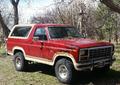
The Bronco just turned old enough it doesn't get the **** probe anymore, but she passed the sniffer test with an Edelbrock 4v, Offy intake, and cat. It just depends on how inspecty your visual inspector is, I reckon.
The Bronco just turned old enough it doesn't get the **** probe anymore, but she passed the sniffer test with an Edelbrock 4v, Offy intake, and cat. It just depends on how inspecty your visual inspector is, I reckon.
Junior User
Joined: Sep 2010
Posts: 59
Likes: 0
From: Carrollton, TX
I can give you the name of a shop in Dallas that does safety inspections. They work on lots of vintage rides.
The Bronco just turned old enough it doesn't get the **** probe anymore, but she passed the sniffer test with an Edelbrock 4v, Offy intake, and cat. It just depends on how inspecty your visual inspector is, I reckon.
The Bronco just turned old enough it doesn't get the **** probe anymore, but she passed the sniffer test with an Edelbrock 4v, Offy intake, and cat. It just depends on how inspecty your visual inspector is, I reckon.
That would be great! Thanks

Thread
Thread Starter
Forum
Replies
Last Post
newrider3
1980 - 1986 Bullnose F100, F150 & Larger F-Series Trucks
15
Aug 17, 2012 08:55 AM
RodSUT
Ford Inline Six, 200, 250, 4.9L / 300
4
Sep 23, 2010 09:50 AM
Gunsmoke460
Big Block V8 - 385 Series (6.1/370, 7.0/429, 7.5/460)
6
Dec 24, 2004 10:00 AM