






Leveling 2WD F250
Thread Starter
|
Laughing Gas


Joined: Aug 2003
Posts: 836
Likes: 9
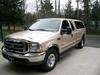
I don't think 2WD's look like crap! I would not mind a more level look so when I pull up to a Prius we are not eye to eye. I need to go 3" to be level. The pucks are 2 1/2". After researching I think I will leave it alone. 2WD's have their advantages, I think they ride and tow a little better plus better mpg's...
I am pretty happy with they way the Ole girl looks

I did replace the OEM headlights because they looked like Crap!


I am pretty happy with they way the Ole girl looks
I did replace the OEM headlights because they looked like Crap!

Hotshot
Joined: May 2005
Posts: 13,484
Likes: 42
From: Stevens Point, WI
Personally I like the low look of a 2wd. In fact if I were to level a 2wd truck I would just pull the blocks out from under the rear springs.
As far as raising the front end with springs, has anyone looked into the newer 4x4 super duty trucks with coil springs? I assume they are way to tall but can be cut down to personal preference. That is if they are the same diameter and will fit right.
As far as raising the front end with springs, has anyone looked into the newer 4x4 super duty trucks with coil springs? I assume they are way to tall but can be cut down to personal preference.
That is if they are the same diameter and will fit right.

Postmaster
Joined: Dec 2010
Posts: 2,951
Likes: 4
From: Gary,Indiana
Well I agree and I disagree.... I agree that a 2wd looks better when it level but I disagree with raising the front end of the truck. Since at stock ride height a 2wd (stock tire size) fills the fender wheelwells nicely. But the back end actually doesn't fill the wheelwells. The only reason I see for lifting a truck is to get bigger tires under it, and fill the wheelwells.
Now I myself plan on someday bringing the back end of my truck down 2 inches and adding air bags. Using spring shackles. http://www.ebay.com/itm/99-FORD-F250-F350-SUPER-DUTY-2-or-1-Rear-DROP-Lowering-Shackles-SHACKLE-2WD-4X2-/251245054424?pt=Motors_Car_Truck_Parts_Accessories&vxp=mtr&hash=item3a7f5f49d8#ht_2246wt_986Since lowering the rear 1.5 or 2 inches should lower the truck bed over the tires and help fill the wheelwells and hopefully still keep it off the helper spring. And by adding air bags I can keep the truck level even when pulling heavy loads. But in my case I am usually only towing my boat /8500lbs and it doesn't even move the rear bumper but a 1/2 to 1 inch at best. So I should be able to maintain a level ride with or without a load.
Here is the problem with setting your truck up level with NO load when you haul heavy the back end drops and now the front end is light. When that happens you go from having a negative camber to having NO camber when the front end is higher than the rear. Also when raising the front end or lowering the rear end you are changing the pinion / driveshaft angle which in theory can cause u joints and carrier bearings to wear out quicker. So if you go up with the front end you could fix that with a couple of shims above the carrier bearing. But honestly with only 2 inches of up or down I don't think pinion / driveshaft angle is not a real issue but it can play a factor in parts wearing out quicker.
Now I myself plan on someday bringing the back end of my truck down 2 inches and adding air bags. Using spring shackles. http://www.ebay.com/itm/99-FORD-F250-F350-SUPER-DUTY-2-or-1-Rear-DROP-Lowering-Shackles-SHACKLE-2WD-4X2-/251245054424?pt=Motors_Car_Truck_Parts_Accessories&vxp=mtr&hash=item3a7f5f49d8#ht_2246wt_986Since lowering the rear 1.5 or 2 inches should lower the truck bed over the tires and help fill the wheelwells and hopefully still keep it off the helper spring. And by adding air bags I can keep the truck level even when pulling heavy loads. But in my case I am usually only towing my boat /8500lbs and it doesn't even move the rear bumper but a 1/2 to 1 inch at best. So I should be able to maintain a level ride with or without a load.
Here is the problem with setting your truck up level with NO load when you haul heavy the back end drops and now the front end is light. When that happens you go from having a negative camber to having NO camber when the front end is higher than the rear. Also when raising the front end or lowering the rear end you are changing the pinion / driveshaft angle which in theory can cause u joints and carrier bearings to wear out quicker. So if you go up with the front end you could fix that with a couple of shims above the carrier bearing. But honestly with only 2 inches of up or down I don't think pinion / driveshaft angle is not a real issue but it can play a factor in parts wearing out quicker.

Molon Labe

Joined: Dec 2006
Posts: 5,272
Likes: 1
From: Alaska

I don't see how raising the front of a 2wd has any effect on drive line angle.
Lowering or raising the rear would, but when you raise the front suspension the engine, transmission, drive shafts, carrier bearing, and rear axle never move from the original configuration/ angle.
School me...
Lowering or raising the rear would, but when you raise the front suspension the engine, transmission, drive shafts, carrier bearing, and rear axle never move from the original configuration/ angle.
School me...

Laughing Gas
Joined: Apr 2007
Posts: 1,238
Likes: 2
From: North Port, Florida
I guess it makes sense, but then again I was raised in the midwest and all my family is hunters/farmers so in my way of thinking I never new why they even made a 2wd truck?? I honestly cant think of anyone I know with a 2wd. Just never really gave it much thought.
Thanks for the insight.
Thanks for the insight.
Thread Starter
|
Laughing Gas
Joined: Aug 2003
Posts: 836
Likes: 9
It's for us guys that don't hunt, fish or drive in the snow... I have to admit, I am in a minority. When I saw this truck 6 years ago with just 22k on it, I had to buy it. I have had several four wheel drives and never really used them.. For me, it's a tow rig...
Hotshot
Joined: May 2005
Posts: 13,484
Likes: 42
From: Stevens Point, WI
I hunt and fish and have a 2wd...


I owned a 4x4 for 10 years and never ever once had the need to use the 4wd. The only time I locked in the hubs is when I needed to lube the front end.
I just use common sense when driving a 2wd. Like the erectile disfunction commercial whith the guy and his horses that get stuck in the mud hole. The guy was in the middle of a field, not a tree or ditch miles around, drive AROUND the mud hole! lol
But I do also understand the need for 4wd at the same time. Just saying many people don't need 4wd but it is just pounded into their brain that there is no other way.
The main reasons I got a 2wd is because I was going for fuel mileage. But I am also happy with no 4x4 maintenance, lower to the ground (easy to get in and out), nicer ride, and no stupid sealed unit bearings! haha.
I owned a 4x4 for 10 years and never ever once had the need to use the 4wd. The only time I locked in the hubs is when I needed to lube the front end.
I just use common sense when driving a 2wd. Like the erectile disfunction commercial whith the guy and his horses that get stuck in the mud hole. The guy was in the middle of a field, not a tree or ditch miles around, drive AROUND the mud hole! lol
But I do also understand the need for 4wd at the same time. Just saying many people don't need 4wd but it is just pounded into their brain that there is no other way.
The main reasons I got a 2wd is because I was going for fuel mileage. But I am also happy with no 4x4 maintenance, lower to the ground (easy to get in and out), nicer ride, and no stupid sealed unit bearings! haha.
FTE Stories
Ford Trucks for Ford Truck Enthusiasts

10 Things Every Truck Owner NEEDS (2026 Edition)
Michael S. Palmer
Rezvani's Latest Post-Apocalyptic Monster Is a Ford F-150 Raptor Underneath
Verdad Gallardo
Top 10 Most Expensive Ford Trucks Ever Sold on Bring a Trailer
Joe Kucinski
2027 Ford Super Duty Buyer's Guide (Every Model, Engine, & Package)
Brett Foote
Top 10 Ford Truck Tragedies
Joe Kucinski
AEV FXL Super Duty - the Super Duty Raptor Ford Doesn't Make
Brett Foote
Lobo Vs Lobo: Proof the F-150 Lobo Should Be Even Lower!
Michael S. Palmer
Ford's 2001 Explorer Sportsman Concept Looks For a New Home
Verdad Gallardo
10 Best Ford Truck Engines We Miss the Most!
Joe Kucinski
Laughing Gas
Joined: Apr 2007
Posts: 1,238
Likes: 2
From: North Port, Florida
I dont disagree if it works for ya go with it. I dont use my 4x4 very much, however i do use it a few times a year at least. I never get to stupid because I know these heavy diesel like to sink, but every once in awhile hauling wood or hunting or just driving around my uncles ranch sometimes there is no way around it. On the other hand I would not be unhappy with some better mileage since I put 35k plus on a year.
Postmaster
Joined: Dec 2010
Posts: 2,951
Likes: 4
From: Gary,Indiana
I don't see how raising the front of a 2wd has any effect on drive line angle.
Lowering or raising the rear would, but when you raise the front suspension the engine, transmission, drive shafts, carrier bearing, and rear axle never move from the original configuration/ angle.
School me...
Lowering or raising the rear would, but when you raise the front suspension the engine, transmission, drive shafts, carrier bearing, and rear axle never move from the original configuration/ angle.
School me...
Now as far schooling I might not be the best at explaining this. Since I am sure I have forgotten more than I know. I say that since back in the late80's and early 90's I worked on many different projects from tubing, narrowed diff & 4 link set up's on drag cars and lift kits on 4x4's for living. But that was a long time ago.
Now just to be clear you have 2 different angles to keep in mind 1 pinion angle / diff pinion angle and 2:drive shaft angle / angle of drive shaft from trans to carrier bearing and drive shaft angle from carrier bearing to diff.
Let's start with some base #'s that I have from my stock F350 drw 2wd.
tire size 235/85/16 roughly a 30 1/2" tall tire so the center line of the axle is 15.25" from ground
The bottom of front frames rails are 20" to the ground and at the back of the truck the frame rails are 24" inches to the ground. So that means I have a 4" differences from front to back over 21 feet. No big deal since the truck is so long if going up or down only 2 inches. Since the carrier bearing would only move about an 1/2" to 1" inch up or down from the ground. So what I am trying to say is anytime you start changing the distance of the center line of axle/ spindles and frame by raising the suspension you could end up causing driveline issues. But if you are raising the suspension and putting taller tires on the truck you are moving center line of axle/ spindles up too. Keeping it closer to factory distances between the axle center line & frame ride height. It really does make a difference in the in the angle of the pinion angle and the driveshaft angle. And if I recall I think it should be in the area of no more than a 4* degree differences. So I hopes this helps explain the point I was trying to make. And this will help explain the problems you can run into Drive Shaft Harmonics
I just use common sense when driving a 2wd. Like the erectile disfunction commercial whith the guy and his horses that get stuck in the mud hole. The guy was in the middle of a field, not a tree or ditch miles around, drive AROUND the mud hole! lol
But I do also understand the need for 4wd at the same time. Just saying many people don't need 4wd but it is just pounded into their brain that there is no other way.
The main reasons I got a 2wd is because I was going for fuel mileage. But I am also happy with no 4x4 maintenance, lower to the ground (easy to get in and out), nicer ride, and no stupid sealed unit bearings! haha.
Also I agree that people are brain washed that you have to have 4wd. Now I use my truck to pull my boat and live where we do get alot of snow and I don't have any problems with only 2wd. And I love the ride of my 2wd & the mileage I get with it.

Thread
Thread Starter
Forum
Replies
Last Post