


Code 41 with/feedback carb

Thread Starter
|
Cross-Country
Joined: Mar 2013
Posts: 52
Likes: 0
Code 41 with/feedback carb
I have a 84 f250 4x4 w/300 inline 6. I am the third owner or so I think. The truck was in Limp mode obviously because everything was unhooked. When I brought it home, I couldnt even get the computer to give me codes. So i took my two wheel 84 f250s ECM and installed it into the 4x4.
So then I was able to retrieve codes. And yes i did get quite a few of them.
They were like ITS, MAP, TPS, and Low/High rpm not controllable.
So now, I get system pass in KOEO.
Here is the hard part.
During KOER, I get code 41.
I have Brand New exhaust manifold and oxygen sensor installed. New Intake/Exhaust gaskets. New egr spacer gasket. New egr and gasket. Previos owner said, it has had a tuneup. From wire to new fuel pump. they do look new. I have put a new inline see through filter before fuel pump. The choke is operational with the new manifolds choke stove. The fast idle sounds real good. The normal idle sounds good. The oxygen sensor responds when turning idle mixture screw in or out according to my DVM. My idle mixture, is 1.0 Volt. That is where is has the smoothest idle. I have ran the KOER cold and hot. Same result with code 41. I have unhooked everything and got codes, 12, 13, 21, 22, 23, 41 and 77. I stuck the original ECM back in even thou at first it would not throw codes. It shows the same code 41. I have cleaned the grounds, 19, 20, 40, and 60. 20 and 40 ground to the battery. 20 Grounds to the body. 19 grounds to the side of motor, then has a ground that runs to 20. My meter shows average less than 1 ohm from all the grounds to grounds. I even hooked up a ground wire to battery ran to ecm to check it to pins 19 20 40 60. Very little resistance. Stays less than 1 ohm. Resistance on oxygen sensor signal wire checks out good too less than 1 ohm. Key on engine off, 02 disconnected, there is MVs on signal wire. My manual says there is suppose to be less than 2 volts. One thing I was wondering about, with 02 disconnected, engine running there is 12 volts on signal wire to 02. There are some tests I dont understand concerning ECM connector. With pins, 58 20 40 46.
I think the problem is with both ECMs,?! What is the odds of that lol? That oxygen sensor is reporting to me a rich conditions.
I have read a bunch on google, which included links to this site. The most common problem I found with this code is, problems with the 02 ground wire. It is good, I cleaned and ohm checked. My meter could be bad lol. I need to pick up a resistor from radio shack and check it but right now i rolling along with my meters findings.
I even bought a EVTM by ford made in 1984. It does not have info in it concerning trouble shooting this code even thou it has a ton of info. The Haynes and Chilton manual has nothing for me. My pdf has a lot but some of it dont make since. It is not Genuine ford. It is Mitchell.
Anyone have any suggestions i might not have checked?
Oh and all power pins, I think 1, 37, and 57 have good battery voltage.
So then I was able to retrieve codes. And yes i did get quite a few of them.
They were like ITS, MAP, TPS, and Low/High rpm not controllable.
So now, I get system pass in KOEO.
Here is the hard part.
During KOER, I get code 41.
I have Brand New exhaust manifold and oxygen sensor installed. New Intake/Exhaust gaskets. New egr spacer gasket. New egr and gasket. Previos owner said, it has had a tuneup. From wire to new fuel pump. they do look new. I have put a new inline see through filter before fuel pump. The choke is operational with the new manifolds choke stove. The fast idle sounds real good. The normal idle sounds good. The oxygen sensor responds when turning idle mixture screw in or out according to my DVM. My idle mixture, is 1.0 Volt. That is where is has the smoothest idle. I have ran the KOER cold and hot. Same result with code 41. I have unhooked everything and got codes, 12, 13, 21, 22, 23, 41 and 77. I stuck the original ECM back in even thou at first it would not throw codes. It shows the same code 41. I have cleaned the grounds, 19, 20, 40, and 60. 20 and 40 ground to the battery. 20 Grounds to the body. 19 grounds to the side of motor, then has a ground that runs to 20. My meter shows average less than 1 ohm from all the grounds to grounds. I even hooked up a ground wire to battery ran to ecm to check it to pins 19 20 40 60. Very little resistance. Stays less than 1 ohm. Resistance on oxygen sensor signal wire checks out good too less than 1 ohm. Key on engine off, 02 disconnected, there is MVs on signal wire. My manual says there is suppose to be less than 2 volts. One thing I was wondering about, with 02 disconnected, engine running there is 12 volts on signal wire to 02. There are some tests I dont understand concerning ECM connector. With pins, 58 20 40 46.
I think the problem is with both ECMs,?! What is the odds of that lol? That oxygen sensor is reporting to me a rich conditions.
I have read a bunch on google, which included links to this site. The most common problem I found with this code is, problems with the 02 ground wire. It is good, I cleaned and ohm checked. My meter could be bad lol. I need to pick up a resistor from radio shack and check it but right now i rolling along with my meters findings.
I even bought a EVTM by ford made in 1984. It does not have info in it concerning trouble shooting this code even thou it has a ton of info. The Haynes and Chilton manual has nothing for me. My pdf has a lot but some of it dont make since. It is not Genuine ford. It is Mitchell.
Anyone have any suggestions i might not have checked?
Oh and all power pins, I think 1, 37, and 57 have good battery voltage.

Moderator


Joined: Nov 2007
Posts: 22,415
Likes: 92
From: Denver Metro Area, CO

First off, let me say that I agree with 1986's comments above, I appreciate the intelligence and throughness of your troubleshooting. 
I think you're going down the wrong path.
Really? Huh... never encountered that scenario before. *drip* *drip*
One of the problems with searching the Internet for code definitions from car computers made 30 years ago is that nobody that I've seen takes into account all of the possible definitions. Even the site I usually send people to (oldfuelinjectiondotcom) is sending people down a HEGO path for an error 41, nevermind the fact you don't even have a HEGO and I'm not even sure such a thing had been invented yet. A HEGO is a heated exhaust gas oxygen sensor, I don't think that thing was invented until the early/mid 90s at the earliest but that's just based on my experience and I could be wrong with the date.
You have an EGO, not a HEGO.
In any event, I looked this up in the Ford Engine/Emissions Diagnosis Manual, the 1986 version (FPS-365-126-326HL).
Code 41 has got several possible definitions in a light-truck application, all dependent on which engine and fuel system was installed.
Scroll across the definitions in the first picture below... they're all related to Fuel Control (all begin with H) but there are different paths to go down for different engines. You're needing for the 4.9L Feedback Carburetor (FBC) not one of the EFI or CFI variants.
It sends us to HB1 which has us doing some pre-requisite checks and verifying some things and, in addition to the oxygen sensor, has us looking at the feedback control solenoid (FCS) and its wiring.
Let me know if you need additional pages/steps, OK?
You might purchase one of these books of your own, they can generally be gotten pretty cheap on eBay or from one of the places that sells used automotive literature. The EVTM is great for some things, too, and so will be the Light Truck Shop Manual.
I think you're going down the wrong path.
Really? Huh... never encountered that scenario before. *drip* *drip*
One of the problems with searching the Internet for code definitions from car computers made 30 years ago is that nobody that I've seen takes into account all of the possible definitions. Even the site I usually send people to (oldfuelinjectiondotcom) is sending people down a HEGO path for an error 41, nevermind the fact you don't even have a HEGO and I'm not even sure such a thing had been invented yet. A HEGO is a heated exhaust gas oxygen sensor, I don't think that thing was invented until the early/mid 90s at the earliest but that's just based on my experience and I could be wrong with the date.
You have an EGO, not a HEGO.
In any event, I looked this up in the Ford Engine/Emissions Diagnosis Manual, the 1986 version (FPS-365-126-326HL).
Code 41 has got several possible definitions in a light-truck application, all dependent on which engine and fuel system was installed.
Scroll across the definitions in the first picture below... they're all related to Fuel Control (all begin with H) but there are different paths to go down for different engines. You're needing for the 4.9L Feedback Carburetor (FBC) not one of the EFI or CFI variants.
It sends us to HB1 which has us doing some pre-requisite checks and verifying some things and, in addition to the oxygen sensor, has us looking at the feedback control solenoid (FCS) and its wiring.
Let me know if you need additional pages/steps, OK?
You might purchase one of these books of your own, they can generally be gotten pretty cheap on eBay or from one of the places that sells used automotive literature. The EVTM is great for some things, too, and so will be the Light Truck Shop Manual.
Thread Starter
|
Cross-Country
Joined: Mar 2013
Posts: 52
Likes: 0
I appreciate the welcome and compliments. The Intelligence y'all speak of came from reading a bunch of posts from this site. Not only do i get my info from this site, I also use the Haynes and Chilton manuals. They also have a bunch of stuff to regarding these trucks. My previous comment in regard to the Haynes and Chilton manual was referring to the Lack of trouble shooting when concerning the trouble codes from these trucks. To be honest, the Haynes does have some trouble shooting for some codes but not all. More specifically It didnt have my code lol. But anyway both manuals are very valuable to anyone with these trucks. After purchasing this F250, i bought a Chilton manual. After reading about the differences in the manuals, i went to a big book store and bought the Haynes for 5 dollars. And this book is in real good condition. I am glad I bought the Haynes because it also covers my 95 f150 4x4. The chilton is more specific to the years 1980-1986 aka "Bullnose".
I really appreciate you taking pictures of the manual ctubutis. Im gonna take your advice and go looking for that book on ebay cause my nearest bookstore is too far away from me. If you dont mind and if I need some more pages, could you post them? If I buy that book it would probably be about a week before I would get it and I have been trying to fix this code for a couple of days. I want to put that f250 to work without a lean code. It came close to me installing my duraspark conversion kit lol. I figured If I couldnt get the help here, that would have been my next step.
I really appreciate you taking pictures of the manual ctubutis. Im gonna take your advice and go looking for that book on ebay cause my nearest bookstore is too far away from me. If you dont mind and if I need some more pages, could you post them? If I buy that book it would probably be about a week before I would get it and I have been trying to fix this code for a couple of days. I want to put that f250 to work without a lean code. It came close to me installing my duraspark conversion kit lol. I figured If I couldnt get the help here, that would have been my next step.

Moderator


Joined: Jan 2001
Posts: 56,995
Likes: 2,741
From: Virginia
This is what I have to do in my head each time I use the Ford troubleshooting method. I really like to know what they are doing, and most of the time they don't tell you, they just give you instructions to do this or that. I may need some help with this though;
HB1-they want the engine fully warmed up before trying to work on it, so the computer is in closed loop.
HB2-It looks like they are thinking the air pump system could be malfunctioning, causing too much air to go by the oxygen sensor giving it a lean code. I don't have access to the other pages to follow the other "what if" if you get a code 44. I am going to guess they will send you to a place to work on the air pump system?
HB3-They want to see if the fuel control solenoid on the carb is doing anything. They are saying you will get a code when you unplug it, but ignore that for now. If you unplug the fuel solenoid on the carb and the code 41 goes away, they are sending you to HB5, which is telling you to check for wiring problems, and if no wiring problems, then computer problems. I am guessing they are thinking the solenoid is turned on all the time, either by a wiring problem or a computer problem.
If you still have a code 41, they are sending you to HB4
HB4-They are going to see if they can get the the system to sense a rich condition. They want you to run the engine and hold the choke as closed as possible without stalling the engine. This would be a extreme rich condition and should get rid of code 41. If it does, and since you are messing with the carb, they are saying you have carb problems and are sending you to the carb part of the book.
If you are still getting a code 41, they are not believing the oxygen sensor, so they are sending you to HB6
HB6-They want you to hook your meter to the oxygen sensor, and do the choke thing again to see if you can get a rich reading with your DVOM. If not, they want you to replace the sensor. If you can, then the computer is not reading the sensor correctly, and they want you to check the wires going from the sensor to the computer. Then if that checks out, go to HB8
HB1-they want the engine fully warmed up before trying to work on it, so the computer is in closed loop.
HB2-It looks like they are thinking the air pump system could be malfunctioning, causing too much air to go by the oxygen sensor giving it a lean code. I don't have access to the other pages to follow the other "what if" if you get a code 44. I am going to guess they will send you to a place to work on the air pump system?
HB3-They want to see if the fuel control solenoid on the carb is doing anything. They are saying you will get a code when you unplug it, but ignore that for now. If you unplug the fuel solenoid on the carb and the code 41 goes away, they are sending you to HB5, which is telling you to check for wiring problems, and if no wiring problems, then computer problems. I am guessing they are thinking the solenoid is turned on all the time, either by a wiring problem or a computer problem.
If you still have a code 41, they are sending you to HB4
HB4-They are going to see if they can get the the system to sense a rich condition. They want you to run the engine and hold the choke as closed as possible without stalling the engine. This would be a extreme rich condition and should get rid of code 41. If it does, and since you are messing with the carb, they are saying you have carb problems and are sending you to the carb part of the book.
If you are still getting a code 41, they are not believing the oxygen sensor, so they are sending you to HB6
HB6-They want you to hook your meter to the oxygen sensor, and do the choke thing again to see if you can get a rich reading with your DVOM. If not, they want you to replace the sensor. If you can, then the computer is not reading the sensor correctly, and they want you to check the wires going from the sensor to the computer. Then if that checks out, go to HB8
Moderator
Joined: Nov 2007
Posts: 22,415
Likes: 92
From: Denver Metro Area, CO
An explanation
Before I begin, I want to explain... I wasn't able to find these definitions in the 1986 book, but the 1993 book says:
Code 41 in KOER = The right-side O2 sensor indicates system lean
Code 41 in CM = No O2 sensor switch detected (right side)
Code 42 in KOER = The right-side O2 sensor indicates system rich
Code 44 shows up only in KOER, and means: Secondary air injection system inoperative (right side)
We have only one O2 sensor, that's fine....
Code 41 in KOER = The right-side O2 sensor indicates system lean
Code 41 in CM = No O2 sensor switch detected (right side)
Code 42 in KOER = The right-side O2 sensor indicates system rich
Code 44 shows up only in KOER, and means: Secondary air injection system inoperative (right side)
We have only one O2 sensor, that's fine....
HB2-It looks like they are thinking the air pump system could be malfunctioning, causing too much air to go by the oxygen sensor giving it a lean code. I don't have access to the other pages to follow the other "what if" if you get a code 44. I am going to guess they will send you to a place to work on the air pump system?
Notice also on the first page of both the HB & KC stuff are lists of other, non-computer-related things that can cause or contribute to the error being seen, the presumption being you will first check these things and verify their correct operational abilities.
I am a computer techie by trade, have been in the industry since the mid-1970s and this approach makes perfect sense to me. IOW start with the underlying foundation, make sure that's all good before moving on.
For example, a common, user-reported problem with a home computer is, "My printer won't print." Sure, you could go investigating the versions of the driver software installed, swapping port connections and changing cables, but....
- Is it plugged in?
- Is it turned on?
- Is there paper in it?
The only way it can print is when those three conditions are true.
Verify the basics (foundation) as problems in those areas can be manifested any number of different ways.
Ralph (81-F-150-Explorer) uses an analogy I like a lot... You have a cavity in your tooth (Code 123)... your ear aches (Code 234)... your head aches (Code 345)... A cavity can cause all those things, fix that and the other symptoms will go away.
His example illustrates the importance of beginning troubleshooting with the first code present.
For example, a common, user-reported problem with a home computer is, "My printer won't print." Sure, you could go investigating the versions of the driver software installed, swapping port connections and changing cables, but....
- Is it plugged in?
- Is it turned on?
- Is there paper in it?
The only way it can print is when those three conditions are true.
Verify the basics (foundation) as problems in those areas can be manifested any number of different ways.
Ralph (81-F-150-Explorer) uses an analogy I like a lot... You have a cavity in your tooth (Code 123)... your ear aches (Code 234)... your head aches (Code 345)... A cavity can cause all those things, fix that and the other symptoms will go away.
His example illustrates the importance of beginning troubleshooting with the first code present.
First, create a known operational condition (engine warmed up, everything connected), then disconnect & cap the supply to the AIR pump, then pull all codes to see how the computer reacts.
If Code 41 is still present, this didn't fix it and is not the cause of the problem, so proceed onwards to HB3...
If Code 44 now appears due to your recent change, then goto Step 5.0B which basically means treat the Code 44 problem (which sends us to KC1, further below).
I am assuming it is written obtusely this way because whoever authored this section already had some templates set up and this was the easiest & fastest way of getting this procedure documented.

If Code 11 or 42 now comes up, then treat this as a Code 44 which sends us to KC1, which is the Air Management System - the AIR pump, TAB & TAD solenoids and their wiring to the computer, etc.:


I have to say, I didn't quite understand this at first... they are saying to force an error, then go treat the error you just forcefully created but treat it differently than merely reconnecting the air supply. But it occurred to me... this/these specific error(s) occurred here in these conditions and they apparently shouldn't, so, go investigate your foundation (search for the cavity) and then begin again if Code 41 persists.
HB3-They want to see if the fuel control solenoid on the carb is doing anything. They are saying you will get a code when you unplug it, but ignore that for now. If you unplug the fuel solenoid on the carb and the code 41 goes away, they are sending you to HB5, which is telling you to check for wiring problems, and if no wiring problems, then computer problems. I am guessing they are thinking the solenoid is turned on all the time, either by a wiring problem or a computer problem.
Presumably, you would take it upon yourself to look for an obvious problem with that specific harness - cut or burnt wires, for example - before going to the pains of hooking up a breakout box.
If Code 41 is still there, then, yes, goto HB4...
HB4-They are going to see if they can get the the system to sense a rich condition. They want you to run the engine and hold the choke as closed as possible without stalling the engine. This would be a extreme rich condition and should get rid of code 41. If it does, and since you are messing with the carb, they are saying you have carb problems and are sending you to the carb part of the book.
If you are still getting a code 41, they are not believing the oxygen sensor, so they are sending you to HB6
If you are still getting a code 41, they are not believing the oxygen sensor, so they are sending you to HB6
HB4 - force system rich with FCS and thermactor disconnected, then pull KOER codes... does this make 41 go away? If so, then replace the solenoid (the 1993 book is better in that they tell you what ohm readings you should get along what specific solenoid terminals and replace only if necessary, they don't do that here for some reason, maybe this was still too early in the game) and, if Error 41 again shows up, then do the carb diagnostics.
If 41 is still there, yes, HB6- force O2 sensor rich.
HB6-They want you to hook your meter to the oxygen sensor, and do the choke thing again to see if you can get a rich reading with your DVOM. If not, they want you to replace the sensor. If you can, then the computer is not reading the sensor correctly, and they want you to check the wires going from the sensor to the computer. Then if that checks out, go to HB8
HB8 is more checking of the wiring.
I'm sorry for not posting the last, remaining step the other day... I quite honestly wasn't reading this stuff real closely and was hoping the problem would have been found earlier. Some of these diagnostics go on for several pages....

And, that is basically it. Check/repair as necessary your basic foundation, then force some known conditions and see if/how the computer detects them (because they know how it should react), proceed onward by changing one thing at a time and seeing what happens as a result of each change. Follow down the chain of items that could be responsible for the reported error, look in order of probability.
These computers are really pretty dumb and are more of embedded controllers than anything... they get their input from a limited set of sensors and perform a limited set of actions based on their programming, but they do it very well and very quickly.
Personally, if it goes as far as suspecting the computer, I suggest opening it up and taking a look inside before merely swapping it out... I've seen some neato pictures here of computers with burnt-up components, although I'd guess leaking capacitors are more common:
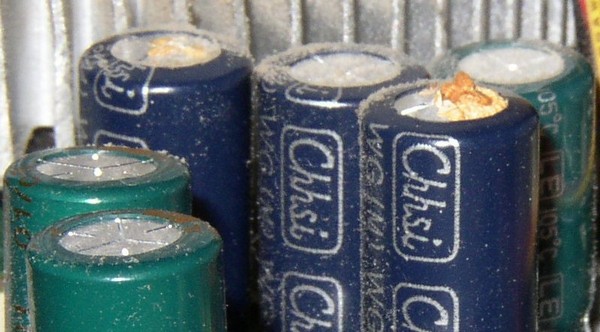

Nevertheless, these computers are pretty dang reliable and generally don't fail real often (but it can happen, especially after 30 years).
No, these OBD I computers are not going to tell you exactly what is wrong (as dort explained, an OBD I system knows relatively little about the fuel system), you still have to use your experience as a mechanic and your brain power to diagnose the problem, the book and the computer are only guides to help you since there is no way the book can accommodate each and every conceivable situation.
This is why I get irked at people who come onto here saying only that they got Code 123 (didn't say from where, just that they got it) so they replaced Part XYZ (and, oftentimes, also ABC, DEF, GHI, J, K, L - usually a bunch of tune-up parts) but the problem is still there. OBD I is very specific in how you pull codes and how it reports things, it's not as simple as plugging in some code reader and then replacing a part.
Worse are the people who don't even ask the computer, they throw hundreds of dollars of parts at a problem without even asking it for help.
It's, like, your kitchen oven overheats to 500° when trying to bake a pizza, so, let's go replace the stovetop burners, the ***** on the console, the light bulb in the overhead microwave oven, etc. etc. etc. Boggles the mind sometimes....
I have the 1986 version of the Volume H manual which covers both cars & trucks.

It's in an orange, hardcover, 3-ring binder and looks like so:

http://www.ebay.com/itm/1986-FORD-CAR-TRUCK-ENGINE-EMISSIONS-DIAGNOSIS-SHOP-MANUAL-BINDER-/160995420839?_trksid=p2047675.m1850&_trkparms=aid%3D222001%26algo%3DSIC.CURRENT%26ao%3D1%26asc%3D11%26meid%3D6471756190579734702%26pid%3D100011%26prg%3D1005%26rk%3D1%26sd%3D380583394952%26
I would think you should be looking for the 1984 version, although a later version will generally work.
Thread Starter
|
Cross-Country
Joined: Mar 2013
Posts: 52
Likes: 0
All the help and info is really appreciated! Some of these steps I have allready done and some I havent.
Today I have verified that during the Output check state, which happens after all codes have ran during KOEO, that the ECM would cycle power on and off to the FCS. And you could hear it clicking also. The ECM would cycle the ground on and off everytime the gas pedal is pushed. I also "tried" to check this with the engine running, and my meter showed there was 3.67volts. So I opened the throttle pretty wide, and the meter would jump up to 6.1 volts just for a second.
Funny thing is, I did try to check the FCS during KOER like i did earlier during normal running and I never showed it jumping up to 6 volts. It just stayed steady at 3.67 or so volts??? I am gonna double check that too after these Ford steps.
Now I understand the solenoid just cycles on and off and that I would probably need some other tool to test this cycle more closely but maybe this says it is working?
Now with that said I am following the Ford's books steps and am at step 4 Forcing system rich.
Like I mentioned earlier some stuff i have done but am redoing it following these steps.
I have question. Two of the steps listed, while checking for a short to ground, say that said meter would either say "Less than 10K ohms" or "More than 10K ohms". I remember checking some of these circuits resistance from the negative battery post to a circuit unplugged on both sides and the reading showing nothing or OL. And the action to take for less than 10K ohms says "service short circuit" Am i following those steps rights regarding checking the circuit for short to ground?
Hey thanks for the Link to the 86 Ford manual. I did look on ebay and seen that there were manuals for the 84 years but they didnt seem like they were in as good condition as the one you posted a link to. And the 84 manuals some of them were close to $70 while the 86 Manual was $37. So i checked my Paypal account and well looks like I have to wait about a week to get that 86 Edition. Shouldnt the 86 edition have everything the 84 has?
Well off I go I think if it quits raining. I may have to wait until tomorrow to try anymore steps..
Today I have verified that during the Output check state, which happens after all codes have ran during KOEO, that the ECM would cycle power on and off to the FCS. And you could hear it clicking also. The ECM would cycle the ground on and off everytime the gas pedal is pushed. I also "tried" to check this with the engine running, and my meter showed there was 3.67volts. So I opened the throttle pretty wide, and the meter would jump up to 6.1 volts just for a second.
Funny thing is, I did try to check the FCS during KOER like i did earlier during normal running and I never showed it jumping up to 6 volts. It just stayed steady at 3.67 or so volts??? I am gonna double check that too after these Ford steps.
Now I understand the solenoid just cycles on and off and that I would probably need some other tool to test this cycle more closely but maybe this says it is working?
Now with that said I am following the Ford's books steps and am at step 4 Forcing system rich.
Like I mentioned earlier some stuff i have done but am redoing it following these steps.
I have question. Two of the steps listed, while checking for a short to ground, say that said meter would either say "Less than 10K ohms" or "More than 10K ohms". I remember checking some of these circuits resistance from the negative battery post to a circuit unplugged on both sides and the reading showing nothing or OL. And the action to take for less than 10K ohms says "service short circuit" Am i following those steps rights regarding checking the circuit for short to ground?
Hey thanks for the Link to the 86 Ford manual. I did look on ebay and seen that there were manuals for the 84 years but they didnt seem like they were in as good condition as the one you posted a link to. And the 84 manuals some of them were close to $70 while the 86 Manual was $37. So i checked my Paypal account and well looks like I have to wait about a week to get that 86 Edition. Shouldnt the 86 edition have everything the 84 has?
Well off I go I think if it quits raining. I may have to wait until tomorrow to try anymore steps..
Trending Topics
Moderator
Joined: Jan 2001
Posts: 56,995
Likes: 2,741
From: Virginia
A short to ground would read near zero on your meter, but they are being safe in case there are some intermittent things going on, so they picked 10,000 ohms. But if it were a true short you would read zero(or usually .5 or less on a digital meter). OL is infinity or the resistance is higher than the meter can read. This is a open circuit. Again, Ford picked a number to fill in for all scenarios, but OL is usually what you will get.
Just because the fuel solenoid is clicking, and the voltage is working, doesn't mean that the passage in the carb is not clogged. That's why they want you to monitor the oxygen sensor while you are playing with the carb, to verify you really do have control over the fuel.
Just because the fuel solenoid is clicking, and the voltage is working, doesn't mean that the passage in the carb is not clogged. That's why they want you to monitor the oxygen sensor while you are playing with the carb, to verify you really do have control over the fuel.
FTE Stories
Ford Trucks for Ford Truck Enthusiasts

3 Best / 3 Worst Parts of Modern Ford Ownership
Brett Foote
10 Amazing Upgrades That Solve Common Ford Truck Owner Headaches
Pouria Savadkouei
Every 2026 Ford Engine Explained
Brett Foote
10 Ugly Ford Trucks That We Still Kinda Love
Joe Kucinski
10 Things Every Truck Owner NEEDS (2026 Edition)
Michael S. Palmer
Rezvani's Latest Post-Apocalyptic Monster Is a Ford F-150 Raptor Underneath
Verdad Gallardo
Top 10 Most Expensive Ford Trucks Ever Sold on Bring a Trailer
Joe Kucinski
2027 Ford Super Duty Buyer's Guide (Every Model, Engine, & Package)
Brett Foote
Top 10 Ford Truck Tragedies
Joe Kucinski
Moderator
Joined: Nov 2007
Posts: 22,415
Likes: 92
From: Denver Metro Area, CO
Hey thanks for the Link to the 86 Ford manual. I did look on ebay and seen that there were manuals for the 84 years but they didnt seem like they were in as good condition as the one you posted a link to. And the 84 manuals some of them were close to $70 while the 86 Manual was $37. So i checked my Paypal account and well looks like I have to wait about a week to get that 86 Edition. Shouldnt the 86 edition have everything the 84 has?

In general, books from later years will work for prior years, but Ford sometimes changes things like electrical connectors and power sources and whatnot, so the safest thing to do is get the book pertaining to your year. The feedback carb was used only a few years but I'm not sure what changes may have been made between years.
When I mentioned the 1993 book having better procedures because it has you measuring a solenoid with a meter instead of merely replacing it, that was with reference to the Idle Air Control solenoid on a Yamaha 3.0L engine in a 1993 Taurus SHO.
I'll bet that 1986 book is half price because somebody stole the Diesel section out of it; a good third of it is diesel-specific.
Send a PM to 81-F-150-Explorer and ask him to chime in on this thread (provide him a link to it), he knows an awful lot about this stuff and is in a better position to give an authoritative answer than I am.

Freshman User
Joined: Mar 2013
Posts: 31
Likes: 0
From: detroit motor city
Man i chased that code around the world. I ended up with a new ecu, o2 sensor, intake and carb.gaskets, deleting my.emissions equipment, and going through the vacuum lines real good. Gone now, wish i would of had that book!
Thread Starter
|
Cross-Country
Joined: Mar 2013
Posts: 52
Likes: 0
Thanks Ctubutis for the help. Last few days i haven't been able to work on the truck, but I am hoping this coming up week I can finish it up. After I exhaust all these Ford steps, Ill send him a PM.
And thanks to all you other guys as well for the help and info. I will be back and update this thread in a couple of days or so with the outcome or fix for my problem for any future people who come across this thread.
And thanks to all you other guys as well for the help and info. I will be back and update this thread in a couple of days or so with the outcome or fix for my problem for any future people who come across this thread.
Thread Starter
|
Cross-Country
Joined: Mar 2013
Posts: 52
Likes: 0
My code 41 was the result of a bad computer. As said earlier both computers were giving a code 41 at operating temp. So I took Ctubutis suggestion and opened the computer that wasnt hooked up to have a look. My first impression was that everything looked really good, like new. After looking I found one of those capacitors was bent over touching another and another was leaning. So I figured why not straighten them. Well I did and now the computer works really good.
Thanks Ctubutis! You saved me from having to hunt down a computer. I would have never thought about opening it up.
I would also like to thank everyone else that helped me with this problem. All the help was appreciated.
Now my code is "always running rich". That will be another thread!
Thanks Ctubutis! You saved me from having to hunt down a computer. I would have never thought about opening it up.
I would also like to thank everyone else that helped me with this problem. All the help was appreciated.
Now my code is "always running rich". That will be another thread!

Thread
Thread Starter
Forum
Replies
Last Post
Mic_bug
Explorer, Sport Trac, Mountaineer & Aviator
7
Aug 1, 2006 07:50 PM
KcinMI
Fuel Injection, Carburetion & Fuel System
12
Feb 5, 2005 07:13 PM