





Blew out a spark plug

Post Fiend
Joined: Mar 2009
Posts: 11,798
Likes: 14
From: Mt. Shasta California
Yep, don't put them in too tight or too loose. There is a fine line between the 2 because of the lack of the gasket.

Super Moderator


Joined: May 2004
Posts: 29,380
Likes: 118
From: Central Coast of CA

Stewart; I think I used the wrong term. I did ask them how it was to be repaired and he told me they were going to use an insert (kinda like a helicoil he said). After he said that I asked if this was in accordance with the ford directive and he claimed yes it is. Hopefully this ends up well for me and the truck.
It failed because Helicoil does not work on these applications. Helicoils just don't hold well in these Ford aluminum heads.
This is a helicoil. A coil inserted into the old plug hole, creating theads.

An insert, like Timesert, is a solid threaded bushing that mounts in the hole.

Yep, Ford dealerships have done quite a few. Do you know what was used before Lock-N-Stitch became the Ford Motor Company approved way of fixing spit plugs?
Dealerships would use a different insert, like Timesert.
Lock-N-Stitch really are excellent inserts, but if you don't have the cash for them, you can use a Timesert too.
Change your plugs on a cold engine and torque the plugs to 12 to 14 ft lbs of torque.
Stewart
This is a helicoil. A coil inserted into the old plug hole, creating theads.
An insert, like Timesert, is a solid threaded bushing that mounts in the hole.
Yep, Ford dealerships have done quite a few. Do you know what was used before Lock-N-Stitch became the Ford Motor Company approved way of fixing spit plugs?
Dealerships would use a different insert, like Timesert.
Lock-N-Stitch really are excellent inserts, but if you don't have the cash for them, you can use a Timesert too.
Change your plugs on a cold engine and torque the plugs to 12 to 14 ft lbs of torque.
Stewart

Logistics Pro


Joined: Jan 2007
Posts: 3,839
Likes: 108
From: Martinsburg, WV
While we are on this topic, what rig do you all use to get to the top of the motor easily, I have seen some of the overhead creepers, even one of those multi-fold ladders, I have 61k on mine, and I figure it's time to at least check the plugs.
Super Moderator
Joined: May 2004
Posts: 29,380
Likes: 118
From: Central Coast of CA
Shop Werner Aluminum Work Platform at Lowes.com
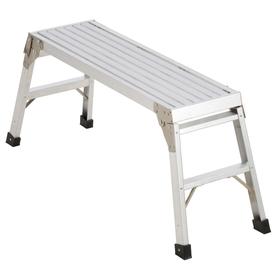
Stewart
Post Fiend
Joined: Mar 2009
Posts: 11,798
Likes: 14
From: Mt. Shasta California
When they get out to the last thread or 2 the compression pressure pushes out a little pfft of air/fuel mixture which sounds like a bad lifter or more like an exhaust leak but it's actually a cylinder leak. If you hear a noise like that it's way worth it to find out what it is right away even if it means checking all your plug torques.

Postmaster
Joined: Aug 2012
Posts: 2,737
Likes: 23
From: Westfield, Indiana
I can describe it for you in detail because I heard it for over a week (many years ago) until the moment I pressed the go pedal getting onto the interstate and the tick went KABOOM.
You will hear it when you start the truck, it's a soft tap, tap, tap in time with the engine. It will be most noticeable when truck is cold because the computer is running the truck "rich" when it's cold therefore more fuel in the cylinders and more noise as it fires. It can also be heard under the truck at idle but will be more noticeable topside with the engine open.
Often mistaken for an exhaust leak which are also louder on cold start and can often be heard under the truck and from the engine bay but the critical differences are:
1. Exhaust leak ticks will usually go away once the truck is warm.
2. Exhaust leak ticks will usually be louder under the truck.
3. Spark tick is there all the time but many describe they don't hear it while driving so assume it's gone once warm (hence the comments of "thought it was a minor exhaust leak") but it's there you just can't hear it once driving due to the sound proofing inside vehicle, increased engine and road noise. Listen carefully though and it's still there.
You hear a tick at start up - don't drive the truck until you determine what it is. Easy way to check if it is a plug is to take a stethoscope or even a piece of flexible piping or long screwdriver, start the truck and listen to each cylinder. Put the end on each coil and listen. You should hear at tap tap tap which is the injector taping and it should be the same on all 10, if you have a spark plug loose that one will sound a LOT louder. This usually means the plug has backed out of it's threads and you will hear an air tapping sound with each fire. At this point its just simple physics and a matter of when not if it will let go. When it goes at the very least you are replacing the coil $60 and the plug $5. More often you are also paying to have a timesert $400 installed, replacing some wiring maybe an injector $100 and well if it does ever happen you really should replace all your boots and plugs $100, unless they were recently done and then it probably happened because someone didn't properly torque them.
How to on spark plug replacement, if you have a tick and more than 60K on your current plugs I would seriously consider some routine maintenance. $100 in parts (maybe less) and an afternoon of your time can save you hundreds of dollars in repair bills.
https://www.ford-trucks.com/forums/1...-pictures.html
Here was my "redneck solution" added a foam pad on top with some duck tape. Topside creepers are expensive and this worked just fine and got me close enough to get the torque I needed. My "Little Giant Ladder"

You will hear it when you start the truck, it's a soft tap, tap, tap in time with the engine. It will be most noticeable when truck is cold because the computer is running the truck "rich" when it's cold therefore more fuel in the cylinders and more noise as it fires. It can also be heard under the truck at idle but will be more noticeable topside with the engine open.
Often mistaken for an exhaust leak which are also louder on cold start and can often be heard under the truck and from the engine bay but the critical differences are:
1. Exhaust leak ticks will usually go away once the truck is warm.
2. Exhaust leak ticks will usually be louder under the truck.
3. Spark tick is there all the time but many describe they don't hear it while driving so assume it's gone once warm (hence the comments of "thought it was a minor exhaust leak") but it's there you just can't hear it once driving due to the sound proofing inside vehicle, increased engine and road noise. Listen carefully though and it's still there.
You hear a tick at start up - don't drive the truck until you determine what it is. Easy way to check if it is a plug is to take a stethoscope or even a piece of flexible piping or long screwdriver, start the truck and listen to each cylinder. Put the end on each coil and listen. You should hear at tap tap tap which is the injector taping and it should be the same on all 10, if you have a spark plug loose that one will sound a LOT louder. This usually means the plug has backed out of it's threads and you will hear an air tapping sound with each fire. At this point its just simple physics and a matter of when not if it will let go. When it goes at the very least you are replacing the coil $60 and the plug $5. More often you are also paying to have a timesert $400 installed, replacing some wiring maybe an injector $100 and well if it does ever happen you really should replace all your boots and plugs $100, unless they were recently done and then it probably happened because someone didn't properly torque them.
How to on spark plug replacement, if you have a tick and more than 60K on your current plugs I would seriously consider some routine maintenance. $100 in parts (maybe less) and an afternoon of your time can save you hundreds of dollars in repair bills.
https://www.ford-trucks.com/forums/1...-pictures.html
Logistics Pro
Joined: Jan 2007
Posts: 3,839
Likes: 108
From: Martinsburg, WV
https://www.ford-trucks.com/forums/1...-pictures.html
Here was my "redneck solution" added a foam pad on top with some duck tape. Topside creepers are expensive and this worked just fine and got me close enough to get the torque I needed. My "Little Giant Ladder"
FTE Stories
Ford Trucks for Ford Truck Enthusiasts

Top 6 Best Deals Available on New Fords & Lincolns Right Now
Brett Foote
This Hennessey Takes the Expedition Tremor's Off-Roading Capability to the Next Level
Verdad Gallardo
Top 10 Fords at 2026 Carlisle Ford Nationals
Joe Kucinski
3 Best / 3 Worst Parts of Modern Ford Ownership
Brett Foote
10 Amazing Upgrades That Solve Common Ford Truck Owner Headaches
Pouria Savadkouei
Every 2026 Ford Engine Explained
Brett Foote
10 Ugly Ford Trucks That We Still Kinda Love
Joe Kucinski
10 Things Every Truck Owner NEEDS (2026 Edition)
Michael S. Palmer
Rezvani's Latest Post-Apocalyptic Monster Is a Ford F-150 Raptor Underneath
Verdad Gallardo
Postmaster
Joined: Aug 2012
Posts: 2,737
Likes: 23
From: Westfield, Indiana
Have tried that too - works pretty well. Used an old creeper took the wheels off added a little padding and put some blocks on the jack bars and zipped tied the entire thing down. You can kind of see in this photo on the truck and the another shot of it laying in my garage.
Post Fiend
Joined: Mar 2009
Posts: 11,798
Likes: 14
From: Mt. Shasta California
I can describe it for you in detail because I heard it for over a week (many years ago) until the moment I pressed the go pedal getting onto the interstate and the tick went KABOOM.
You will hear it when you start the truck, it's a soft tap, tap, tap in time with the engine. It will be most noticeable when truck is cold because the computer is running the truck "rich" when it's cold therefore more fuel in the cylinders and more noise as it fires. It can also be heard under the truck at idle but will be more noticeable topside with the engine open.
Often mistaken for an exhaust leak which are also louder on cold start and can often be heard under the truck and from the engine bay but the critical differences are:
1. Exhaust leak ticks will usually go away once the truck is warm.
2. Exhaust leak ticks will usually be louder under the truck.
3. Spark tick is there all the time but many describe they don't hear it while driving so assume it's gone once warm (hence the comments of "thought it was a minor exhaust leak") but it's there you just can't hear it once driving due to the sound proofing inside vehicle, increased engine and road noise. Listen carefully though and it's still there.
You hear a tick at start up - don't drive the truck until you determine what it is. Easy way to check if it is a plug is to take a stethoscope or even a piece of flexible piping or long screwdriver, start the truck and listen to each cylinder. Put the end on each coil and listen. You should hear at tap tap tap which is the injector taping and it should be the same on all 10, if you have a spark plug loose that one will sound a LOT louder. This usually means the plug has backed out of it's threads and you will hear an air tapping sound with each fire. At this point its just simple physics and a matter of when not if it will let go. When it goes at the very least you are replacing the coil $60 and the plug $5. More often you are also paying to have a timesert $400 installed, replacing some wiring maybe an injector $100 and well if it does ever happen you really should replace all your boots and plugs $100, unless they were recently done and then it probably happened because someone didn't properly torque them.
How to on spark plug replacement, if you have a tick and more than 60K on your current plugs I would seriously consider some routine maintenance. $100 in parts (maybe less) and an afternoon of your time can save you hundreds of dollars in repair bills.
https://www.ford-trucks.com/forums/1...-pictures.html
Here was my "redneck solution" added a foam pad on top with some duck tape. Topside creepers are expensive and this worked just fine and got me close enough to get the torque I needed. My "Little Giant Ladder"
You will hear it when you start the truck, it's a soft tap, tap, tap in time with the engine. It will be most noticeable when truck is cold because the computer is running the truck "rich" when it's cold therefore more fuel in the cylinders and more noise as it fires. It can also be heard under the truck at idle but will be more noticeable topside with the engine open.
Often mistaken for an exhaust leak which are also louder on cold start and can often be heard under the truck and from the engine bay but the critical differences are:
1. Exhaust leak ticks will usually go away once the truck is warm.
2. Exhaust leak ticks will usually be louder under the truck.
3. Spark tick is there all the time but many describe they don't hear it while driving so assume it's gone once warm (hence the comments of "thought it was a minor exhaust leak") but it's there you just can't hear it once driving due to the sound proofing inside vehicle, increased engine and road noise. Listen carefully though and it's still there.
You hear a tick at start up - don't drive the truck until you determine what it is. Easy way to check if it is a plug is to take a stethoscope or even a piece of flexible piping or long screwdriver, start the truck and listen to each cylinder. Put the end on each coil and listen. You should hear at tap tap tap which is the injector taping and it should be the same on all 10, if you have a spark plug loose that one will sound a LOT louder. This usually means the plug has backed out of it's threads and you will hear an air tapping sound with each fire. At this point its just simple physics and a matter of when not if it will let go. When it goes at the very least you are replacing the coil $60 and the plug $5. More often you are also paying to have a timesert $400 installed, replacing some wiring maybe an injector $100 and well if it does ever happen you really should replace all your boots and plugs $100, unless they were recently done and then it probably happened because someone didn't properly torque them.
How to on spark plug replacement, if you have a tick and more than 60K on your current plugs I would seriously consider some routine maintenance. $100 in parts (maybe less) and an afternoon of your time can save you hundreds of dollars in repair bills.
https://www.ford-trucks.com/forums/1...-pictures.html
Here was my "redneck solution" added a foam pad on top with some duck tape. Topside creepers are expensive and this worked just fine and got me close enough to get the torque I needed. My "Little Giant Ladder"
Postmaster
Joined: Aug 2012
Posts: 2,737
Likes: 23
From: Westfield, Indiana
You got it mostly right except for that a rich cylinder will have more pressure. Actually a rich mixture produces less pressure even though there is more gas. It's not like more gas on a bonfire makes a bigger flame. The cold temps change a lot of things including the clearances where the leak is and that's why the exhaust leaks are affected also.
Post Fiend
Joined: Mar 2009
Posts: 11,798
Likes: 14
From: Mt. Shasta California

Post Fiend
Joined: Mar 2009
Posts: 11,798
Likes: 14
From: Mt. Shasta California
A loose spark plug tick noise is louder when it is cold because the small gap in the last thread where the air rushes out is bigger when it is colder due to the expansion properties of the head and plug.