



Adding A Second Battery for Inverter
Thread Starter
|
Senior User
Joined: Feb 2009
Posts: 415
Likes: 1
From: Long Island - NY
Adding A Second Battery for Inverter
So after dealing with Sandy and no power for 2+ weeks, gas line shortages for generators etc... I'm prepping a little more. I already have 2 generators that I use, but night time noise can be an issue. I've decided that adding a second battery to the Ex may be a viable backup option for power.
I'd like to add a second battery. This second battery would be charged while the truck is running (driving to work/home ), but when I hook up my inverter to it - power is only drawn from that one battery. Anyone here done such an install for an inverter ? I'm looking at keeping the inverter under 1,500watts - nothing too huge. Any diagrams , parts list etc... is greatly appreciated !!! Hoping to make this part of my xmas project
And yes I did search and google, and spent more than a few hours sifting through pages and pages, but notinh I could find really complied for a complete install. Any help from a fellow memeber is definitly APPRECIATED !
I'd like to add a second battery. This second battery would be charged while the truck is running (driving to work/home ), but when I hook up my inverter to it - power is only drawn from that one battery. Anyone here done such an install for an inverter ? I'm looking at keeping the inverter under 1,500watts - nothing too huge. Any diagrams , parts list etc... is greatly appreciated !!! Hoping to make this part of my xmas project
And yes I did search and google, and spent more than a few hours sifting through pages and pages, but notinh I could find really complied for a complete install. Any help from a fellow memeber is definitly APPRECIATED !

Senior User
Joined: Apr 2010
Posts: 176
Likes: 0
From: Cambridge, United Kingdom
Just thinking out loud and it may be a stupid idea - but what about install it completely seperate to the truck battery, then run (if you have it) the trailer power charge output to it? - or just come straight off the alternator so it only charges but wont drain the original?

Senior User
Joined: Sep 2012
Posts: 111
Likes: 0
From: DFW
Dual Battery
Just thinking out loud and it may be a stupid idea - but what about install it completely seperate to the truck battery, then run (if you have it) the trailer power charge output to it? - or just come straight off the alternator so it only charges but wont drain the original?
Senior User
Joined: Apr 2010
Posts: 176
Likes: 0
From: Cambridge, United Kingdom
As far as I know the regulator on the alternator would do that - I know on my Expy it charges my TT batteries and doesn't overcharge - and it doesn't drain the car battery when the trailer is still hooked upto the car. I'm no expert though!

Freshman User
Joined: Nov 2012
Posts: 37
Likes: 0
From: Folsom,ca
I think you need some sort of regualtor or isolator... there are several companies that can sell you all the electronics to make it work perfectly... Painless Wiring is the first that comes to mind.
Trending Topics
Cargo Master


Joined: Mar 2005
Posts: 2,790
Likes: 24
From: Mount Royal, NJ

Unfortunately, this is probably going to be one of my long dissertations. I will try to keep it as brief as I can.
As I understand it, you wish to have two batteries, one for optional accessories, or House battery, and one for standard engine loads. Engine loads are the loads that the car came with, and are run by the Standard battery.
The unit that you wish to add, a 1.5kw inverter, will draw down one standard Excursion battery alone in about a hour or so. This is not a lot of time, really. If you had a winch, the loads would be extreme, running all the way up to 7kw, but only for a relatively short time, around 15 minutes max. Not enough to drain the battery down.
On top of that, you will have to recharge the battery somehow. The standard gas Excursion alternator is listed as a 130 amp unit. However, at idle, the OEM gasser alternator only puts out 65 amps at best when new and perfect. Putting a constant heavy draw on the battery and then on the alternator to try to charge it when it is depleted (and that is when the battery has the greatest acceptance to charge and sucks juice the fastest) will decrease their life to almost nill. Even while driving it around, It still will place a heavy load on the OEM alternator. if you just hooked both batteries together, with one of them drained, the current flow on the wire could become so great that it could become a fire and arc danger.
A battery charge isolator will do what you want in the most basic form. It consists of two high power diodes (electrical one way valves)That are arranged to allow power to flow from the alternator to the batteries, but not back. I'm gonna borrow pics from the net to describe this:

As you can see, the alternator can charge both batteries, but each battery is ISOLATED from the other by the one way diodes and cannot charge/discharge each other. This will allow the secondary battery to run the auxillary loads and protect the engine battery.
This apparoach has been used with varying degrees of success by many tens of thousands of people through the years. It is the most basic way to protect the main battery from drain out from auxillary loads. But, it has some limitations.
In the above setup, we have some issues. One cannot be eliminated, and the others are a matter of usefulness.
Each diode has a voltage drop of .7 volts. This means that if you measure the voltage on the alternator side, it may read 13.8 volts, but if you read it on the battery side it will read 13.1 volts. It does not sound like much, but it does steal power. Watts is heat made, and it is determined by a simple equation. Volts X Amps = Watts. If your OEM alternator is able to send 100 amps to the secondary load while driving around and charging, the diode set will get rather hot, since .7 volts * 100 amps = 70 watts. That is a lot of heat. So, how many amps were used to make that heat? Using another set of equations, it turns out to be baout 5 amps. So we are losing 5 amps when charging and inverting just due to heat inside the isolator. On top of this, we are losing voltage. That .7 volts does not seem much, but if your alternator is starting to fail and not putting out the proper voltage, that .7 volt drop could mean the difference between getting home or a tow.
This setup also does not allow you to use the secondary battery in case the house battery fails. You would need to put a red power wire between the batteries and install a switch of some kind in the middle of the wire so you could 'combine' the batteries when needed.
This type of setup with a switch is used a lot on small boats that have a battery for the engine and another 'house' battery. Here is an example of the switch:
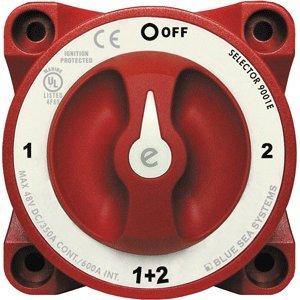
As you can see, a positive battery wire is connected from each battery to the terminals on the back of the switch. You manually choose battery one to operate the starter, battery two to operate the house loads, or both 1 and two together.
Again, borrowing from the net, a diagram showing how it is wired in:

Ahh, now we are talking. Flexibility. But we still have the diode isolator to allow charging and keep the batteries apart except when we want them to be hooked together.
PART TWO COMING UP
As I understand it, you wish to have two batteries, one for optional accessories, or House battery, and one for standard engine loads. Engine loads are the loads that the car came with, and are run by the Standard battery.
The unit that you wish to add, a 1.5kw inverter, will draw down one standard Excursion battery alone in about a hour or so. This is not a lot of time, really. If you had a winch, the loads would be extreme, running all the way up to 7kw, but only for a relatively short time, around 15 minutes max. Not enough to drain the battery down.
On top of that, you will have to recharge the battery somehow. The standard gas Excursion alternator is listed as a 130 amp unit. However, at idle, the OEM gasser alternator only puts out 65 amps at best when new and perfect. Putting a constant heavy draw on the battery and then on the alternator to try to charge it when it is depleted (and that is when the battery has the greatest acceptance to charge and sucks juice the fastest) will decrease their life to almost nill. Even while driving it around, It still will place a heavy load on the OEM alternator. if you just hooked both batteries together, with one of them drained, the current flow on the wire could become so great that it could become a fire and arc danger.
A battery charge isolator will do what you want in the most basic form. It consists of two high power diodes (electrical one way valves)That are arranged to allow power to flow from the alternator to the batteries, but not back. I'm gonna borrow pics from the net to describe this:
As you can see, the alternator can charge both batteries, but each battery is ISOLATED from the other by the one way diodes and cannot charge/discharge each other. This will allow the secondary battery to run the auxillary loads and protect the engine battery.
This apparoach has been used with varying degrees of success by many tens of thousands of people through the years. It is the most basic way to protect the main battery from drain out from auxillary loads. But, it has some limitations.
In the above setup, we have some issues. One cannot be eliminated, and the others are a matter of usefulness.
Each diode has a voltage drop of .7 volts. This means that if you measure the voltage on the alternator side, it may read 13.8 volts, but if you read it on the battery side it will read 13.1 volts. It does not sound like much, but it does steal power. Watts is heat made, and it is determined by a simple equation. Volts X Amps = Watts. If your OEM alternator is able to send 100 amps to the secondary load while driving around and charging, the diode set will get rather hot, since .7 volts * 100 amps = 70 watts. That is a lot of heat. So, how many amps were used to make that heat? Using another set of equations, it turns out to be baout 5 amps. So we are losing 5 amps when charging and inverting just due to heat inside the isolator. On top of this, we are losing voltage. That .7 volts does not seem much, but if your alternator is starting to fail and not putting out the proper voltage, that .7 volt drop could mean the difference between getting home or a tow.
This setup also does not allow you to use the secondary battery in case the house battery fails. You would need to put a red power wire between the batteries and install a switch of some kind in the middle of the wire so you could 'combine' the batteries when needed.
This type of setup with a switch is used a lot on small boats that have a battery for the engine and another 'house' battery. Here is an example of the switch:
As you can see, a positive battery wire is connected from each battery to the terminals on the back of the switch. You manually choose battery one to operate the starter, battery two to operate the house loads, or both 1 and two together.
Again, borrowing from the net, a diagram showing how it is wired in:
Ahh, now we are talking. Flexibility. But we still have the diode isolator to allow charging and keep the batteries apart except when we want them to be hooked together.
PART TWO COMING UP
FTE Stories
Ford Trucks for Ford Truck Enthusiasts

Top 6 Best Deals Available on New Fords & Lincolns Right Now
Brett Foote
This Hennessey Takes the Expedition Tremor's Off-Roading Capability to the Next Level
Verdad Gallardo
Top 10 Fords at 2026 Carlisle Ford Nationals
Joe Kucinski
3 Best / 3 Worst Parts of Modern Ford Ownership
Brett Foote
10 Amazing Upgrades That Solve Common Ford Truck Owner Headaches
Pouria Savadkouei
Every 2026 Ford Engine Explained
Brett Foote
10 Ugly Ford Trucks That We Still Kinda Love
Joe Kucinski
10 Things Every Truck Owner NEEDS (2026 Edition)
Michael S. Palmer
Rezvani's Latest Post-Apocalyptic Monster Is a Ford F-150 Raptor Underneath
Verdad Gallardo
Cargo Master
Joined: Mar 2005
Posts: 2,790
Likes: 24
From: Mount Royal, NJ
The above wiring example is a workable solution to your issue and desires. But is it a reasonable way? That type of isolation system was developed mostly for marine use. In the marine environment, batteries and charging systems are a high priority item for the skipper. They are watched constantly, as are their loads and charge conditions.
This is not what we find in the automotive environment usually. We are used to just using it and monioring it when needed. To install the above system you will have to be vigilant to ensure that you do not overload the alternator or wiring.
More modern technology has provided some drastic improvements on the old ideas, unfotunately at a higher cost. Again, thanks to our friends in the marine world.
There are devices called Automatic Charging Relays, or ACR's for short.
An ACR is a smart switch. It monitors the charge on both batteries, and will switch the entire charging circuit automatically to the battery with the lesser charge. This means that if the secondary is running a heavy load, as it gets drawn down and the voltage in the battery decreases, the ACR switches the charging dircuit to the auxillary, disconnects the main battery from charging and from the secondary battery, and monitors the charge.
When the auxillary battery is recharged enough, the ACR recombines them and the charging circuits to both. There are NO diodes, and that means no voltage drop. That means no lost amps or heat. ACR's also have a wire that detects when power is sent to the starter, and it then cuts out th secondary battery while starting. This is to protect sensitive secondary load items like radios, amps, radars, TV's, computers from electrical spikes from the starter, and also ensures full voltage is available on the engine battery.
In keeping with its job as a battery switch, Most ACR's have a dash switch that is wired in that allows the driver to choose battery a, battery b, toally isolate, or combine both.
So, as you can see, The ACR is the cat's meow for dual battery installations on land and sea.
Now someone will say that they have dual batteries in their diesel and it works just fine.
Yes it does. But those dual battery instalations are ENGINE batteries. They are not spit to provide a second 'house' circuit that keeps the engine battery from being drawn down.
Your desire, as I understand it is to have a second battery and circuit that prevents that undesirable situation.
To see more about how ACR's work, I refer you to the Blue Sea Systems company webpage on ACR's. Full installation information and diagrams are available there.
Remote Battery Management - PN - Blue Sea Systems
I also refer you to another thread, where you can find links to schematics (draft) of wiring and a ACR that I am about to do/finish on my Excursion during the next month or two. They are for reference only. Current schematics are different in many places, but the ACR hookup is the same.
https://www.ford-trucks.com/forums/1...fications.html
And here is another thread about dual batteries and installing a more powerful alternator.
https://www.ford-trucks.com/forums/1...or-wiring.html
Now about the alternator. I strongly suggest getting a alternator with a higher idle current (amps). The concept of charging the battery on the go while driving is great, but there is still that nagging problem of putting a heavy load on the alternator if your auxillary battery is drawn down heavily. That alternator will not be happy, and will overheat.
Every battery has a maximum amount of curent that it can possibly take up in a given time. The lead acid and AGM batteries (optima for example) can take up a ferocious amout of current every minute when they are severely depleted. This can be relieved somewhat by a higher amp alternator. The hi amp alt can not only charge the battery quicker with less strain and heat, but all those extra amps it puts out will reduce the charge time on your battery. Some hi amp alternators are so powerful that they can run the auxillary load by themselves with lots to spare.
Check DC Power company. They have the best when it comes to higher amps at idle.
https://www.dcpowerinc.com/
I know this was all a bit more than you really wanted to hear, but I feel that an informed decision is a good decision.
Sorry for being so verbose.
This is not what we find in the automotive environment usually. We are used to just using it and monioring it when needed. To install the above system you will have to be vigilant to ensure that you do not overload the alternator or wiring.
More modern technology has provided some drastic improvements on the old ideas, unfotunately at a higher cost. Again, thanks to our friends in the marine world.
There are devices called Automatic Charging Relays, or ACR's for short.
An ACR is a smart switch. It monitors the charge on both batteries, and will switch the entire charging circuit automatically to the battery with the lesser charge. This means that if the secondary is running a heavy load, as it gets drawn down and the voltage in the battery decreases, the ACR switches the charging dircuit to the auxillary, disconnects the main battery from charging and from the secondary battery, and monitors the charge.
When the auxillary battery is recharged enough, the ACR recombines them and the charging circuits to both. There are NO diodes, and that means no voltage drop. That means no lost amps or heat. ACR's also have a wire that detects when power is sent to the starter, and it then cuts out th secondary battery while starting. This is to protect sensitive secondary load items like radios, amps, radars, TV's, computers from electrical spikes from the starter, and also ensures full voltage is available on the engine battery.
In keeping with its job as a battery switch, Most ACR's have a dash switch that is wired in that allows the driver to choose battery a, battery b, toally isolate, or combine both.
So, as you can see, The ACR is the cat's meow for dual battery installations on land and sea.
Now someone will say that they have dual batteries in their diesel and it works just fine.
Yes it does. But those dual battery instalations are ENGINE batteries. They are not spit to provide a second 'house' circuit that keeps the engine battery from being drawn down.
Your desire, as I understand it is to have a second battery and circuit that prevents that undesirable situation.
To see more about how ACR's work, I refer you to the Blue Sea Systems company webpage on ACR's. Full installation information and diagrams are available there.
Remote Battery Management - PN - Blue Sea Systems
I also refer you to another thread, where you can find links to schematics (draft) of wiring and a ACR that I am about to do/finish on my Excursion during the next month or two. They are for reference only. Current schematics are different in many places, but the ACR hookup is the same.
https://www.ford-trucks.com/forums/1...fications.html
And here is another thread about dual batteries and installing a more powerful alternator.
https://www.ford-trucks.com/forums/1...or-wiring.html
Now about the alternator. I strongly suggest getting a alternator with a higher idle current (amps). The concept of charging the battery on the go while driving is great, but there is still that nagging problem of putting a heavy load on the alternator if your auxillary battery is drawn down heavily. That alternator will not be happy, and will overheat.
Every battery has a maximum amount of curent that it can possibly take up in a given time. The lead acid and AGM batteries (optima for example) can take up a ferocious amout of current every minute when they are severely depleted. This can be relieved somewhat by a higher amp alternator. The hi amp alt can not only charge the battery quicker with less strain and heat, but all those extra amps it puts out will reduce the charge time on your battery. Some hi amp alternators are so powerful that they can run the auxillary load by themselves with lots to spare.
Check DC Power company. They have the best when it comes to higher amps at idle.
https://www.dcpowerinc.com/
I know this was all a bit more than you really wanted to hear, but I feel that an informed decision is a good decision.
Sorry for being so verbose.

Tuned
Joined: Feb 2004
Posts: 255
Likes: 8
Car batteries are not a great solution for what you want to do. You would be better off finding the power pack from an electric forklift. Those batteries will take a whole lot more cycles to kill them, and they will last far longer, and work better for what you are trying to do.
Thread Starter
|
Senior User
Joined: Feb 2009
Posts: 415
Likes: 1
From: Long Island - NY
WOW -- That is some real great info guys !! Housedad - really super detail !
I wish I would have replaced my alternator with a bigger one last year when I swapped it out after the original one finally gave out For now I'd like to add a second battery ( preferably a higher Amp/hr AGM second batt ) that I could run a few hundred watts from the inverter for a few hours at night if needed. Mostly just a few 13w energy saving lamps, a small LCD TV, cable box, router and that's about it. Figure 400-500 watts, but would like to have the capability of going higher if needed for short periods of time. Probably wouldn't ever hit 1200-1500watts , but at least it would be there is needed.
I wish I would have replaced my alternator with a bigger one last year when I swapped it out after the original one finally gave out
For now I'd like to add a second battery ( preferably a higher Amp/hr AGM second batt ) that I could run a few hundred watts from the inverter for a few hours at night if needed. Mostly just a few 13w energy saving lamps, a small LCD TV, cable box, router and that's about it. Figure 400-500 watts, but would like to have the capability of going higher if needed for short periods of time. Probably wouldn't ever hit 1200-1500watts , but at least it would be there is needed.
Senior User
Joined: Apr 2010
Posts: 176
Likes: 0
From: Cambridge, United Kingdom
Wow, that's the most detailed reply I've ever seen
I think I understood most of it - but one thing I still don't understand is how my Expedition has the battery charge lead for my TT, and as far as I know it comes straight from a feed off of the alternator - and it charges my 4 leisure batteries really well - all 4 can be run low and just leaving the car on idle will charge them (obviously the lower the charge in them takes longer) - and also when they are full, I can drive for hours with the TT and the batteries don't seem to get over charged?
I think I understood most of it - but one thing I still don't understand is how my Expedition has the battery charge lead for my TT, and as far as I know it comes straight from a feed off of the alternator - and it charges my 4 leisure batteries really well - all 4 can be run low and just leaving the car on idle will charge them (obviously the lower the charge in them takes longer) - and also when they are full, I can drive for hours with the TT and the batteries don't seem to get over charged?
Cargo Master
Joined: Mar 2005
Posts: 2,790
Likes: 24
From: Mount Royal, NJ
The excursion trailer battery charge is off of a 20 amp fuse in the main fuse box. that line is switched on only when the engine is running via a relay. The wire then goes directly to the trailer connector.
The reason that they don't get overcharged is that the amount of current that is being distributed is so small that they never reach a overcharge level. On top of that, if the voltage regulator in the car is still working properly. it will not allow the system to get overcharged. There are no diodes on the wire to the trailer battery charge line.
I doubt that if you had 4 drained batteries in the trailer that they reached full charge after a few hours of driving with that small charge current. but they will have regained some of their charge back.
The reason that they don't get overcharged is that the amount of current that is being distributed is so small that they never reach a overcharge level. On top of that, if the voltage regulator in the car is still working properly. it will not allow the system to get overcharged. There are no diodes on the wire to the trailer battery charge line.
I doubt that if you had 4 drained batteries in the trailer that they reached full charge after a few hours of driving with that small charge current. but they will have regained some of their charge back.


Posting Guru
Joined: May 2012
Posts: 1,758
Likes: 3
From: Colorado
The above wiring example is a workable solution to your issue and desires. But is it a reasonable way? That type of isolation system was developed mostly for marine use. In the marine environment, batteries and charging systems are a high priority item for the skipper. They are watched constantly, as are their loads and charge conditions.
This is not what we find in the automotive environment usually. We are used to just using it and monioring it when needed. To install the above system you will have to be vigilant to ensure that you do not overload the alternator or wiring.
More modern technology has provided some drastic improvements on the old ideas, unfotunately at a higher cost. Again, thanks to our friends in the marine world.
There are devices called Automatic Charging Relays, or ACR's for short.
An ACR is a smart switch. It monitors the charge on both batteries, and will switch the entire charging circuit automatically to the battery with the lesser charge. This means that if the secondary is running a heavy load, as it gets drawn down and the voltage in the battery decreases, the ACR switches the charging dircuit to the auxillary, disconnects the main battery from charging and from the secondary battery, and monitors the charge.
When the auxillary battery is recharged enough, the ACR recombines them and the charging circuits to both. There are NO diodes, and that means no voltage drop. That means no lost amps or heat. ACR's also have a wire that detects when power is sent to the starter, and it then cuts out th secondary battery while starting. This is to protect sensitive secondary load items like radios, amps, radars, TV's, computers from electrical spikes from the starter, and also ensures full voltage is available on the engine battery.
In keeping with its job as a battery switch, Most ACR's have a dash switch that is wired in that allows the driver to choose battery a, battery b, toally isolate, or combine both.
So, as you can see, The ACR is the cat's meow for dual battery installations on land and sea.
Now someone will say that they have dual batteries in their diesel and it works just fine.
Yes it does. But those dual battery instalations are ENGINE batteries. They are not spit to provide a second 'house' circuit that keeps the engine battery from being drawn down.
Your desire, as I understand it is to have a second battery and circuit that prevents that undesirable situation.
To see more about how ACR's work, I refer you to the Blue Sea Systems company webpage on ACR's. Full installation information and diagrams are available there.
Remote Battery Management - PN - Blue Sea Systems
I also refer you to another thread, where you can find links to schematics (draft) of wiring and a ACR that I am about to do/finish on my Excursion during the next month or two. They are for reference only. Current schematics are different in many places, but the ACR hookup is the same.
https://www.ford-trucks.com/forums/1...fications.html
And here is another thread about dual batteries and installing a more powerful alternator.
https://www.ford-trucks.com/forums/1...or-wiring.html
Now about the alternator. I strongly suggest getting a alternator with a higher idle current (amps). The concept of charging the battery on the go while driving is great, but there is still that nagging problem of putting a heavy load on the alternator if your auxillary battery is drawn down heavily. That alternator will not be happy, and will overheat.
Every battery has a maximum amount of curent that it can possibly take up in a given time. The lead acid and AGM batteries (optima for example) can take up a ferocious amout of current every minute when they are severely depleted. This can be relieved somewhat by a higher amp alternator. The hi amp alt can not only charge the battery quicker with less strain and heat, but all those extra amps it puts out will reduce the charge time on your battery. Some hi amp alternators are so powerful that they can run the auxillary load by themselves with lots to spare.
Check DC Power company. They have the best when it comes to higher amps at idle.
https://www.dcpowerinc.com/
I know this was all a bit more than you really wanted to hear, but I feel that an informed decision is a good decision.
Sorry for being so verbose.
This is not what we find in the automotive environment usually. We are used to just using it and monioring it when needed. To install the above system you will have to be vigilant to ensure that you do not overload the alternator or wiring.
More modern technology has provided some drastic improvements on the old ideas, unfotunately at a higher cost. Again, thanks to our friends in the marine world.
There are devices called Automatic Charging Relays, or ACR's for short.
An ACR is a smart switch. It monitors the charge on both batteries, and will switch the entire charging circuit automatically to the battery with the lesser charge. This means that if the secondary is running a heavy load, as it gets drawn down and the voltage in the battery decreases, the ACR switches the charging dircuit to the auxillary, disconnects the main battery from charging and from the secondary battery, and monitors the charge.
When the auxillary battery is recharged enough, the ACR recombines them and the charging circuits to both. There are NO diodes, and that means no voltage drop. That means no lost amps or heat. ACR's also have a wire that detects when power is sent to the starter, and it then cuts out th secondary battery while starting. This is to protect sensitive secondary load items like radios, amps, radars, TV's, computers from electrical spikes from the starter, and also ensures full voltage is available on the engine battery.
In keeping with its job as a battery switch, Most ACR's have a dash switch that is wired in that allows the driver to choose battery a, battery b, toally isolate, or combine both.
So, as you can see, The ACR is the cat's meow for dual battery installations on land and sea.
Now someone will say that they have dual batteries in their diesel and it works just fine.
Yes it does. But those dual battery instalations are ENGINE batteries. They are not spit to provide a second 'house' circuit that keeps the engine battery from being drawn down.
Your desire, as I understand it is to have a second battery and circuit that prevents that undesirable situation.
To see more about how ACR's work, I refer you to the Blue Sea Systems company webpage on ACR's. Full installation information and diagrams are available there.
Remote Battery Management - PN - Blue Sea Systems
I also refer you to another thread, where you can find links to schematics (draft) of wiring and a ACR that I am about to do/finish on my Excursion during the next month or two. They are for reference only. Current schematics are different in many places, but the ACR hookup is the same.
https://www.ford-trucks.com/forums/1...fications.html
And here is another thread about dual batteries and installing a more powerful alternator.
https://www.ford-trucks.com/forums/1...or-wiring.html
Now about the alternator. I strongly suggest getting a alternator with a higher idle current (amps). The concept of charging the battery on the go while driving is great, but there is still that nagging problem of putting a heavy load on the alternator if your auxillary battery is drawn down heavily. That alternator will not be happy, and will overheat.
Every battery has a maximum amount of curent that it can possibly take up in a given time. The lead acid and AGM batteries (optima for example) can take up a ferocious amout of current every minute when they are severely depleted. This can be relieved somewhat by a higher amp alternator. The hi amp alt can not only charge the battery quicker with less strain and heat, but all those extra amps it puts out will reduce the charge time on your battery. Some hi amp alternators are so powerful that they can run the auxillary load by themselves with lots to spare.
Check DC Power company. They have the best when it comes to higher amps at idle.
https://www.dcpowerinc.com/
I know this was all a bit more than you really wanted to hear, but I feel that an informed decision is a good decision.
Sorry for being so verbose.
This is a common setup for boating so look in that area.
They always have 2 separate sources for power storage.
One for starting the engine, the other one for all other purposes on board.
They are deperated by diodes that prevent power flowing in the wrong directions (ie your house battery drains the starting battery)
Personally I think you'd be better of having a small generator on hand that always has enough fuel to run for a day or so.
Some of these generators are small enough to easily move around.
Plus you won't have to deal with worn out batteries. Replace the fuel once a year and you're good.

Thread
Thread Starter
Forum
Replies
Last Post