


F-250 -82 questions.


Thread Starter
|
New User
Joined: Jun 2012
Posts: 11
Likes: 0
F-250 -82 questions.
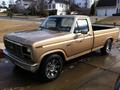
Hi, I'm new here, I live in Sweden and I just bought my first pickup, a 1982 Ford F-250 xlt Lariat. It runs good but I will have to fix the powerbrake unit because it is leaking and it sounds inside the car. I would like to fix the tachometer too.. it shows something about 4000rpm when it should be something around 500-700.. It shows too much all the time. Does anyone know what the problem could be? And where does the tach wires go too? The coil?
The previous owner told me the car had a 390 bigblock, but that isn't a original engine, is it? It should be a 400 if it's original bigblock if I understand it right. But how do I know witch engine I have?
Best regards, Olle
The previous owner told me the car had a 390 bigblock, but that isn't a original engine, is it? It should be a 400 if it's original bigblock if I understand it right. But how do I know witch engine I have?
Best regards, Olle

Moderator


Joined: Jan 2001
Posts: 56,846
Likes: 2,681
From: Virginia

A 390 would have to be cobbled up to fit. Problem is I do not know how to indentify a 390, except by pulling the valve cover and finding shaft mounted rockers. I do know the 400 has 8 bolts holding the valve cover on, but I do not know how many the 390 has.
Your tach problem could simply be from someone swapping the cluster out of a 6 cylinder truck, and the the tach is reading wrong for a v8. There is some sort of jumper on the circuit board near the tach that selects 6 cylinder or 8 cylinder engine, this would be the first thing I would check. It gets it's feed from some wiring out near the ignition module on the fender.
Your tach problem could simply be from someone swapping the cluster out of a 6 cylinder truck, and the the tach is reading wrong for a v8. There is some sort of jumper on the circuit board near the tach that selects 6 cylinder or 8 cylinder engine, this would be the first thing I would check. It gets it's feed from some wiring out near the ignition module on the fender.

Mountain Pass

Joined: Oct 2000
Posts: 180
Likes: 0
From: Backwoods Massachusetts
From below, the 390 is a deep-skirt, meaning the oil pan mounts below the centerline of the crank and is mostly flat at the mating surface, and the 400's oil pan mates at the center of the crank with a deep "U" front and rear.
Bear in mind it's been a long time since I've owned either series so don't be too surprised if someone comes along and corrects me, or better yet try google image search on the valve cover/oil pan to confirm but when I tried that I got myself even more confused!
Best,
- Jeff
Bear in mind it's been a long time since I've owned either series so don't be too surprised if someone comes along and corrects me, or better yet try google image search on the valve cover/oil pan to confirm but when I tried that I got myself even more confused!
Best,
- Jeff

Posting Guru
Joined: Jul 2010
Posts: 1,154
Likes: 2
From: Marysville, WA
Near the DuraSpark module, there is a plug with two wires. The Dark Green/Yellow dashed wire goes to the negative side of the coil, and the Black/Light Green wire goes to ground with a V-8. On a 6 cylinder the Black/Light Green wire is open.
But if it is reading 4k, then ther may be a problem with the tach itself.
But if it is reading 4k, then ther may be a problem with the tach itself.

Ford Parts Specialist
Joined: Nov 2006
Posts: 88,826
Likes: 778
From: Simi Valley, CA
Valve cover bolts per side: 5 = 352/360/390 and etc FE engines // 6 = 221/260/289/302/351W / 7 = 429/460 / 8 = 351C/351M/400.
1982 F250 available engines: 300 I-6 / 351W / 351M / 400.
The engine code is the 8th digit of the VIN / 1982: E = 300 I-6 / G = 351W / W = 351M / Z = 400.
F100/350: FE engines cancelled at the end of the 1976 model run.
351C/351M/400: There is no timing cover, per se on these engines, just a flat engine cover plate.
The fuel pump bolts to the left (drivers) side of the engine block, its unique bolt pattern: 6 & 12 o'clock.
All other V8 engines fuel pump bolt pattern: 3 & 9 o'clock.
1982 F250 available engines: 300 I-6 / 351W / 351M / 400.
The engine code is the 8th digit of the VIN / 1982: E = 300 I-6 / G = 351W / W = 351M / Z = 400.
F100/350: FE engines cancelled at the end of the 1976 model run.
351C/351M/400: There is no timing cover, per se on these engines, just a flat engine cover plate.
The fuel pump bolts to the left (drivers) side of the engine block, its unique bolt pattern: 6 & 12 o'clock.
All other V8 engines fuel pump bolt pattern: 3 & 9 o'clock.
Posting Guru
Joined: Jan 2012
Posts: 1,410
Likes: 1
From: Dallas, GA
Hey Bill...I thought it was just the 351C that had the integral timing cover, unlike the others. Also, I think the 351C has the thermostat located in the integral timing cover as the intake was dry.
I though the 351/400M had the separate timing gear cover like the windsors and 429/460 engines? I'm probably getting it all confused
EDIT: Looked it up in the Parts Catalog...of course you are right Bill
I though the 351/400M had the separate timing gear cover like the windsors and 429/460 engines? I'm probably getting it all confused
EDIT: Looked it up in the Parts Catalog...of course you are right Bill

Post Fiend
Joined: Jan 2000
Posts: 5,330
Likes: 17
From: Dryden, ON, Canada
Trending Topics
Moderator
Joined: Jan 2001
Posts: 56,846
Likes: 2,681
From: Virginia
351m/400 are very close to the same engine as the 351c. The 351c was the first engine of this family to be produced. After a few years building the 351c, they took the 351c block and made it taller. They changed the bellhousing pattern and motor mount locations also. The front of the engine wasn't changed, except they used the same distributor in the 351m/400 as the 351c. So when they made the block taller, they had to "sink" the 351m/400 dist mount down to the 351c height, so that is the famous "step" people talk about where the intake manifold mounts on the 351m/400.
Of course since the engine was made taller, the intake manifold is wider on a 351m/400. But on the taller 351m/400 block, sits the same 351c style heads. Also of note, the factory never produced a 4bbl version of the 351m/400, they were all 2 barrel carbed motors from the factory. The aftermarket does sell aluminum ones though.
I think they may have also changed the diameter of the crankshaft journals when they re-configured the 351c block, but I am not sure on this point. But they morphed the 351c into the 351m/400's just like the morphed the 289/302 into the 351w.
Of course since the engine was made taller, the intake manifold is wider on a 351m/400. But on the taller 351m/400 block, sits the same 351c style heads. Also of note, the factory never produced a 4bbl version of the 351m/400, they were all 2 barrel carbed motors from the factory. The aftermarket does sell aluminum ones though.
I think they may have also changed the diameter of the crankshaft journals when they re-configured the 351c block, but I am not sure on this point. But they morphed the 351c into the 351m/400's just like the morphed the 289/302 into the 351w.
Posting Guru
Joined: Jan 2012
Posts: 1,410
Likes: 1
From: Dallas, GA
351m/400 are very close to the same engine as the 351c. The 351c was the first engine of this family to be produced. After a few years building the 351c, they took the 351c block and made it taller. They changed the bellhousing pattern and motor mount locations also. The front of the engine wasn't changed, except they used the same distributor in the 351m/400 as the 351c. So when they made the block taller, they had to "sink" the 351m/400 dist mount down to the 351c height, so that is the famous "step" people talk about where the intake manifold mounts on the 351m/400.
Of course since the engine was made taller, the intake manifold is wider on a 351m/400. But on the taller 351m/400 block, sits the same 351c style heads. Also of note, the factory never produced a 4bbl version of the 351m/400, they were all 2 barrel carbed motors from the factory. The aftermarket does sell aluminum ones though.
I think they may have also changed the diameter of the crankshaft journals when they re-configured the 351c block, but I am not sure on this point. But they morphed the 351c into the 351m/400's just like the morphed the 289/302 into the 351w.
Of course since the engine was made taller, the intake manifold is wider on a 351m/400. But on the taller 351m/400 block, sits the same 351c style heads. Also of note, the factory never produced a 4bbl version of the 351m/400, they were all 2 barrel carbed motors from the factory. The aftermarket does sell aluminum ones though.
I think they may have also changed the diameter of the crankshaft journals when they re-configured the 351c block, but I am not sure on this point. But they morphed the 351c into the 351m/400's just like the morphed the 289/302 into the 351w.
Gotcha....thanks for that information. Some of it sounds familiar as I remember reading some of this at some point. I definately remember reading an article on how to tell the difference between the 351 C & W and that's were they talked about the integral front cover, I guess I took that as it was the only one with it.
You would think I would know, as I had a 78' F250 with the 400M. Luckily, I never had to work on it. Had it for 5 years and all ever had to do was change the oil
Ran like a champ.
Ford Parts Specialist
Joined: Nov 2006
Posts: 88,826
Likes: 778
From: Simi Valley, CA
Hey Bill...I thought it was just the 351C that had the integral timing cover, unlike the others. Also, I think the 351C has the thermostat located in the integral timing cover as the intake was dry.
I though the 351M/400M had the separate timing gear cover like the windsors and 429/460 engines? I'm probably getting it all confused
No such thing as a 400M, it's just plain 'ol 400.
EDIT: Looked it up in the Parts Catalog...of course you are right Bill
I though the 351M/400M
had the separate timing gear cover like the windsors and 429/460 engines? I'm probably getting it all confused No such thing as a 400M, it's just plain 'ol 400.
EDIT: Looked it up in the Parts Catalog...of course you are right Bill
Applications:
351C 2V/4V: 1970/74 Passenger Cars/Ranchero's.
351M 2V: 1975/79 Passenger Cars/Ranchero's / 1977/79 F100/350 / 1978/82 Bronco / 1980/82 F150/350.
400 2V: 1971/79 Passenger Cars/Ranchero's / 1977/79 F100/350 / 1978/82 Bronco / 1980/82 F150/350.

Thread
Thread Starter
Forum
Replies
Last Post
Handegard
1980 - 1986 Bullnose F100, F150 & Larger F-Series Trucks
6
Nov 2, 2011 10:32 AM
f250rangerexplorer
1973 - 1979 F-100 & Larger F-Series Trucks
2
Nov 18, 2004 07:00 AM
