


Some Basic Automotive Questions

Thread Starter
|
New User
Joined: May 2012
Posts: 10
Likes: 0
Some Basic Automotive Questions
Hey guys, I'm a teen looking to buy my first car and I am trying to learn as much as I can before I buy. I've only ever driven my mom's 07 Odyssey and my dad's '98 Accord. So here are my stupid questions: 
1. What's the difference between D and 2 or 1? I realize 1 and 2 are for steep hills or towing stuff, but shouldn't the Odyssey downshift to those gears automatically? If I put it in 1 or 2 is it then stuck in that gear?
2. What (part of the transmission?) allows the wheels to move freely of the engine's output. For example, I can put the Odyssey in drive and still fly backwards down a hill if I don't brake. Or as simple as braking while idling at a stop sign. Where is the connection between the crankshaft and wheels broken?
3. When a FWD car makes a turn, do the rear wheels slip since there's no differential and they rotate at different speeds? Or are the wheels not connected?
Thanks
1. What's the difference between D and 2 or 1? I realize 1 and 2 are for steep hills or towing stuff, but shouldn't the Odyssey downshift to those gears automatically? If I put it in 1 or 2 is it then stuck in that gear?
2. What (part of the transmission?) allows the wheels to move freely of the engine's output. For example, I can put the Odyssey in drive and still fly backwards down a hill if I don't brake. Or as simple as braking while idling at a stop sign. Where is the connection between the crankshaft and wheels broken?
3. When a FWD car makes a turn, do the rear wheels slip since there's no differential and they rotate at different speeds? Or are the wheels not connected?
Thanks

9 ECHO 1


Joined: Aug 2009
Posts: 12,467
Likes: 58
From: Missouri

2. What (part of the transmission?) allows the wheels to move freely of the engine's output. For example, I can put the Odyssey in drive and still fly backwards down a hill if I don't brake. Or as simple as braking while idling at a stop sign. Where is the connection between the crankshaft and wheels broken?
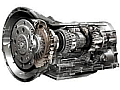
This type of fluid coupling has some pluses and minuses. Manual transmissions do NOT have a torque converter, which is why they must have the clutch in, or be out of gear to stop. Torque converters are the reason why manual transmission cars get better mileage than automatics. There is energy wasted in moving that fluid in order to get the transmission moving. After a specified speed or RPM most cars "lock" the torque converter with a clutch. This means that now there is a physical link from the engine to the transmission. This is done to remove that parasitic loss of the torque converter moving fluid. It will unlock again when speed dips below a threshold so the engine doesn't stall.
In a FWD vehicle the rear wheels are generally not connected to each other.

Fleet Owner


Joined: Aug 2010
Posts: 21,255
Likes: 1,657
From: Reynoldsburg, Ohio
Hey Phillip---welcome to FTE and the wonderful world of motor vehicles, those machines we love to hate but yet keep coming back time after time buying new ones! 
Just wanted to share something I once read: "there are no dumb questions but sure are plenty of dumb mistakes............!" We all have learned by asking questions--even if you think they're dumb ask anyway, avoid the mistakes that come from NOT asking!
BTW excellent answer A/Ox4! How's that apprentice welder/culinary student these days?
Just wanted to share something I once read: "there are no dumb questions but sure are plenty of dumb mistakes............!"
We all have learned by asking questions--even if you think they're dumb ask anyway, avoid the mistakes that come from NOT asking! BTW excellent answer A/Ox4! How's that apprentice welder/culinary student these days?
9 ECHO 1
Joined: Aug 2009
Posts: 12,467
Likes: 58
From: Missouri
She's doing well! We got her started riding the other day and now shes hooked!

Becky's Jump - YouTube
Becky's Jump - YouTube
Fleet Owner
Joined: Aug 2010
Posts: 21,255
Likes: 1,657
From: Reynoldsburg, Ohio
Some women take to horsepower just as much as us guys, sometimes they learn to ride a lot better too----don't teach her too much!
Phillip you're welcome and we look forward to helping if possible!

Post Fiend

Joined: Jun 2001
Posts: 5,228
Likes: 5
From: Running Springs CA
Let me answer #1 a little differently than A/Ox4. The transmission will not downshift automatically going downhill. It is important not to "ride the brakes" going downhill on steep grades. Manually select a gear that will slow you down just the right amount so you dont have to have your foot on the brakes most of the time. I live in the mountains and regularly smell burning brakes. Brakes that heat up may fade, that is, decrease effectiveness.
#2, minor point. A torque converter is different than a straight fluid coupling in that there is a third element between the two halves that redirects the oil flow to increase leverage, thus increases or "converts" torque.
#2, minor point. A torque converter is different than a straight fluid coupling in that there is a third element between the two halves that redirects the oil flow to increase leverage, thus increases or "converts" torque.
Trending Topics
Frmr Ford Trans Engr


Joined: Aug 1999
Posts: 24,739
Likes: 2,669
From: SE Florida
A slight clarification: A torque converter converts RPM to torque. When the converter is slipping the fluid coming off the driven fan hits the stator and is redirected back to the driven fan, adding force to the fan. The more slip the more fluid redirected, so the more force hitting the driven fan. This creates more torque at the output of the torque converter, with a loss of RPM. This is what a torque converter converts, RPM to torque.
FTE Stories
Ford Trucks for Ford Truck Enthusiasts

Top 6 Best Deals Available on New Fords & Lincolns Right Now
Brett Foote
This Hennessey Takes the Expedition Tremor's Off-Roading Capability to the Next Level
Verdad Gallardo
Top 10 Fords at 2026 Carlisle Ford Nationals
Joe Kucinski
3 Best / 3 Worst Parts of Modern Ford Ownership
Brett Foote
10 Amazing Upgrades That Solve Common Ford Truck Owner Headaches
Pouria Savadkouei
Every 2026 Ford Engine Explained
Brett Foote
10 Ugly Ford Trucks That We Still Kinda Love
Joe Kucinski
10 Things Every Truck Owner NEEDS (2026 Edition)
Michael S. Palmer
Rezvani's Latest Post-Apocalyptic Monster Is a Ford F-150 Raptor Underneath
Verdad Gallardo
Thread
Thread Starter
Forum
Replies
Last Post
baki-winnie
Clutch, Transmission, Differential, Axle & Transfer Case
4
Aug 25, 2014 11:44 AM
blue924.9
1987 - 1996 F150 & Larger F-Series Trucks
6
Jan 31, 2014 07:51 AM
Cowboylewis
Excursion - King of SUVs
7
Jul 2, 2013 03:57 PM
