



Understanding my torque converter?
Thread Starter
|
Senior User
Joined: Jun 2009
Posts: 147
Likes: 0
From: Maple- NE corner of NC
 Understanding my torque converter?
Okay, so I keep posting a bunch of dumb threads about stuff I should already know, but it's been about 15 years since I spent time on my own vehicles. I bought my new truck a couple of weeks ago and I wanted to understand a little more about my torque converter. So of course, I googled it. I didn't get as many answer as I thought I would, so I decided to make yet another thread requesting help with my truck. I guess the good side to all of it is that I have been giving people "positive feedback." for helping me with things (MODS - I love the feedback system!).
So a couple of quick questions:
What is the main purpose of my torque converter? Is it to push my bigger tires, or for towing, or...?
How do I know what torque converter I have and is it near my axles where the transition is between axle and drive shaft?
Any basic torque converter information would be helpful.
Thanks
So a couple of quick questions:
What is the main purpose of my torque converter? Is it to push my bigger tires, or for towing, or...?
How do I know what torque converter I have and is it near my axles where the transition is between axle and drive shaft?
Any basic torque converter information would be helpful.
Thanks
Postmaster
Joined: Jan 2009
Posts: 3,339
Likes: 0
From: Smithers, BC, Canada
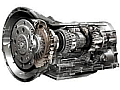
Let me start the advice by mentioning that the torq converter is in the bell housing between engine and transmission (where a clutch would be)
I read a really good article about torq converters, I will see if I can find it, as it will save me some typing
I read a really good article about torq converters, I will see if I can find it, as it will save me some typing

Post Fiend
Joined: May 2006
Posts: 10,007
Likes: 4
From: Central Florida
Think of the TC as a fluid coupling between the engine and transmission. The only time your engine output is exactly equal to the transmissions' input is when the clutches inside it engage. This is computer controlled and acts like a manual transmissions clutch, manually linking the engine to the transmission with clutch discs and clamping force.
There are a bunch of vanes in the TC, these move the fluid which moves other vanes. This is the limit of my knowledge, but I've read some articles that I can pass on some information I recall. Those vanes push the trans fluid which push another set of vanes which drive the transmission. There is a multiplication of torque that occurs from driving the fluid into the other vanes. So it can actually input more torque/hp than the engine produces, but I think this number is small. Then there is the "stall speed", basically it's the speed you want to spin the engine up to launch.
Check out http://www.converter.com/ These are heavily followed converters in some circles.
There are a bunch of vanes in the TC, these move the fluid which moves other vanes. This is the limit of my knowledge, but I've read some articles that I can pass on some information I recall. Those vanes push the trans fluid which push another set of vanes which drive the transmission. There is a multiplication of torque that occurs from driving the fluid into the other vanes. So it can actually input more torque/hp than the engine produces, but I think this number is small. Then there is the "stall speed", basically it's the speed you want to spin the engine up to launch.
Check out http://www.converter.com/ These are heavily followed converters in some circles.
Senior User
Joined: Mar 2005
Posts: 146
Likes: 0
From: Hanover Park, Illinois
Here is a YouTube Video that looks to be about 10-15 years old. It isn't the most informative video, but it gives you some more of an idea.<br>Torque Converter Video

Tuned

Joined: Mar 2007
Posts: 305
Likes: 0
From: Havana Fla
Postmaster
Joined: Jan 2009
Posts: 3,339
Likes: 0
From: Smithers, BC, Canada
http://auto.howstuffworks.com/auto-p...-converter.htm should be all you ever wanted to know


Thats the article that I saw in the past. I couldn't find it again.

FTE Leadership Emeritus


Joined: Sep 2000
Posts: 23,174
Likes: 1,678
From: Stephensville WI

Basically, imagine 2 fans. One is driven by a motor, the other is freewheeling. When air from the first one hits the second one, it causes the second fan to spin.
A torque converter is like that, but instead of fan bladed it uses impellers (turbine looking things). The coupling media is fluid instead of air, and the whole thing in encased in a metal donut. It sits between the transmission and the engine, coupling the engine torque to the transmission.
A torque converter is like that, but instead of fan bladed it uses impellers (turbine looking things). The coupling media is fluid instead of air, and the whole thing in encased in a metal donut. It sits between the transmission and the engine, coupling the engine torque to the transmission.
Trending Topics
Cargo Master
Joined: Jan 2007
Posts: 2,243
Likes: 79
From: Roman Forest, TX
Basically, imagine 2 fans. One is driven by a motor, the other is freewheeling. When air from the first one hits the second one, it causes the second fan to spin.
A torque converter is like that, but instead of fan bladed it uses impellers (turbine looking things). The coupling media is fluid instead of air, and the whole thing in encased in a metal donut. It sits between the transmission and the engine, coupling the engine torque to the transmission.
A torque converter is like that, but instead of fan bladed it uses impellers (turbine looking things). The coupling media is fluid instead of air, and the whole thing in encased in a metal donut. It sits between the transmission and the engine, coupling the engine torque to the transmission.
FTE Stories
Ford Trucks for Ford Truck Enthusiasts

10 Things Every Truck Owner NEEDS (2026 Edition)
Michael S. Palmer
Rezvani's Latest Post-Apocalyptic Monster Is a Ford F-150 Raptor Underneath
Verdad Gallardo
Top 10 Most Expensive Ford Trucks Ever Sold on Bring a Trailer
Joe Kucinski
2027 Ford Super Duty Buyer's Guide (Every Model, Engine, & Package)
Brett Foote
Top 10 Ford Truck Tragedies
Joe Kucinski
AEV FXL Super Duty - the Super Duty Raptor Ford Doesn't Make
Brett Foote
Lobo Vs Lobo: Proof the F-150 Lobo Should Be Even Lower!
Michael S. Palmer
Ford's 2001 Explorer Sportsman Concept Looks For a New Home
Verdad Gallardo
10 Best Ford Truck Engines We Miss the Most!
Joe Kucinski
Thread Starter
|
Senior User
Joined: Jun 2009
Posts: 147
Likes: 0
From: Maple- NE corner of NC
Okay thanks. From the information you guys gave it seems that every manual transmission has a TC. I thought TCs were usually added for increase torque. Guess I was wrong about that one.
My truck got a "new HD Torque converter" shortley before I bought it. What is the significance of the HD?
My truck got a "new HD Torque converter" shortley before I bought it. What is the significance of the HD?
Post Fiend
Joined: May 2006
Posts: 10,007
Likes: 4
From: Central Florida
All automatics (not sure about the constant velocity types) have torque converters. Manuals use a clutch/pressure plate setup to connect the engine to transmission.
HD can mean anything from better construction over the standard model to upgraded features. Now if it's a clutch, HD can be heavier a pressure pressure plate, better gripping clutch compound, hotter running clutch compound, different friction designs.
HD can mean anything from better construction over the standard model to upgraded features. Now if it's a clutch, HD can be heavier a pressure pressure plate, better gripping clutch compound, hotter running clutch compound, different friction designs.
Frmr Ford Trans Engr

Joined: Aug 1999
Posts: 24,725
Likes: 2,651
From: SE Florida


Frmr Ford Trans Engr
Joined: Aug 1999
Posts: 24,725
Likes: 2,651
From: SE Florida
There are a few ways it can fail. The torque converter clutch can wear out. The stator can fail, changing the torque converter into a fluid coupling. The third way I can think of is the blades can bend, making the torque converter just a large hunk of oil filled metal junk.