


double torque???

Thread Starter
|
Postmaster
Joined: Nov 2006
Posts: 2,609
Likes: 0
From: somerset KY
double torque???
ok, so when i thought i was starting to understand a little about an auto tranny, Two Guys Garage threw a kink in my knowledge! they were showing a cut-away of an Allison 2000 auto. they said something about a fluid lock-up for hte torque convertor. ok, i was half way on track till they said that depending on the lock-up system, and torque convertor type that the TC could DOUBLE the engines torque!! how the heck????????????????

Hotshot


Joined: Oct 2003
Posts: 17,799
Likes: 104
From: Ashland City, TN
You loose all your torque in the TQ.
its more of a transfer of horsepower and inirtia.
Torque is pure energy.
If you lock up the TQ, you transfer all the torque to the rear wheels.
This is why Manuel will out pull attiematic everday. =)
its more of a transfer of horsepower and inirtia.
Torque is pure energy.
If you lock up the TQ, you transfer all the torque to the rear wheels.
This is why Manuel will out pull attiematic everday. =)

Posting Guru
Joined: Sep 2004
Posts: 1,096
Likes: 2
From: Ohio
Most TC systems rely on percentage lockup. Thats why you se rpms drop more than the 4 speeds we have if you have a programmed chip;. I am not sure of it, but I think its like a 15 60 100 type deal. This is how we keep it from burning up. The reson you think it pulls better is that you gear ratios are closer together. TC really has nothing to do with it.
Hotshot
Joined: Oct 2003
Posts: 17,799
Likes: 104
From: Ashland City, TN
wasn't saying it like that at all.
Torque converter will always slip the same.
It's not an adjustable friction base.
I was saying a manual pulls better because there is no TQ slip, allowing all power to go to the rear wheels in lower gears.
TQ's could lock up in lower gears now, but I am totally unsure of that.
Generally you would hear or feel it lock up in a truck if it does at slow speeds with high rpm's pulling something. The difference would be undeniable.
Gear ratio's are another reason behind different RPM's.
So you cannot say it that way.
A different rear end ratio will also make a difference between the rpm's.
I was merly talking about the medium for power transfer from engine to transmission.
You either slip or you dont.
Simple as that =)
However 2strokeman, they missworded what they are saying, which doesn't supprize me on that show. Go watch GEARS, a real enthusiast show. =) Stacey David wont give you BS info.
You cannot "double" your torque from a torque converter.
The only way you are going to create more power is though a gear set, which really your not doubling your power, your just doubling your output.
I think they were trying to say that the torque converter on the allison allows more power to wheel ratio then standard TQ's.
Torque converter will always slip the same.
It's not an adjustable friction base.
I was saying a manual pulls better because there is no TQ slip, allowing all power to go to the rear wheels in lower gears.
TQ's could lock up in lower gears now, but I am totally unsure of that.
Generally you would hear or feel it lock up in a truck if it does at slow speeds with high rpm's pulling something. The difference would be undeniable.
Gear ratio's are another reason behind different RPM's.
So you cannot say it that way.
A different rear end ratio will also make a difference between the rpm's.
I was merly talking about the medium for power transfer from engine to transmission.
You either slip or you dont.
Simple as that =)
However 2strokeman, they missworded what they are saying, which doesn't supprize me on that show. Go watch GEARS, a real enthusiast show. =) Stacey David wont give you BS info.
You cannot "double" your torque from a torque converter.
The only way you are going to create more power is though a gear set, which really your not doubling your power, your just doubling your output.
I think they were trying to say that the torque converter on the allison allows more power to wheel ratio then standard TQ's.
Posting Guru
Joined: Sep 2004
Posts: 1,096
Likes: 2
From: Ohio
TC in lockup mode is not slipping. Its a one to one. If its slipping, then youll see it in your tranny gauge as it will build heat and melt down. If your doubling your tq, your gearing down. Rear end ratio is limiting rpm to speed. 3.55 less rpms, less tq. 4.10s, more rpm, and a torque multiplier. Once these trucks hit about 40 mph, tc is locked in a one to one output. Plain and simple. I was staing that since our autos are 4 speeds and you have a 5 speed and since the final drive ratio is the same, your gear ratio is closer in your tranny. Same as a big truck. This is why a 13 speed is better in the mountains than a 10 speed, even though they have the same final drive ratio. you have more to play with to keep the motor in the sweet spot. If this is what you menat, I am sorry. If it isnt, then now your informed. LOL

Posting Guru
Joined: Feb 2008
Posts: 1,526
Likes: 1
From: Grass Valley, CA
Calm down guys... LOL...
Manuals work better for towing because of gear ratios and the fact that the human brain is better at seeing all conditions.
when a TC locks up, it's just the same as having a locked up clutch. if you go over the rated torque, they'll both slip.
Maybe they were talking about Rated torque... the motor will put out so much, and all the tranny can do is effectively put it to the ground.
Manuals work better for towing because of gear ratios and the fact that the human brain is better at seeing all conditions.
when a TC locks up, it's just the same as having a locked up clutch. if you go over the rated torque, they'll both slip.
Maybe they were talking about Rated torque... the motor will put out so much, and all the tranny can do is effectively put it to the ground.
Trending Topics
Frmr Ford Trans Engr


Joined: Aug 1999
Posts: 24,739
Likes: 2,669
From: SE Florida
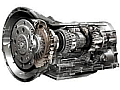
I haven't seen anything here yet that explains why a torque converter multiplies torque. It does multiply engine torque. HowStuffWorks - Learn How Everything Works! has a good explanation of how it works.
The executive summary is to think of two fans facing each other. One has power and one doesn't. The one with power will make the other fan spin from the air hitting it. That's how the impeller and turbine of a torque converter work. In a torque converter the fluid that comes off of the turbine blades it redirected by the stator back into the turbine blades. This energy is what doubles the torque.
As for stepped lockup like 15 60 100, that doesn't make any sense. There's nothing like that. Some torque converters are applied slower, and you may see the duty cycle of the solenoid as it's applying, but it's locked or it isn't.
And as for always slipping the same amount, that's equally wrong. The torque converter slip is a function of how much torque is going through it and how fast it's spinning. More torque equals more slip, and more speed equals less slip.
The executive summary is to think of two fans facing each other. One has power and one doesn't. The one with power will make the other fan spin from the air hitting it. That's how the impeller and turbine of a torque converter work. In a torque converter the fluid that comes off of the turbine blades it redirected by the stator back into the turbine blades. This energy is what doubles the torque.
As for stepped lockup like 15 60 100, that doesn't make any sense. There's nothing like that. Some torque converters are applied slower, and you may see the duty cycle of the solenoid as it's applying, but it's locked or it isn't.
And as for always slipping the same amount, that's equally wrong. The torque converter slip is a function of how much torque is going through it and how fast it's spinning. More torque equals more slip, and more speed equals less slip.
FTE Stories
Ford Trucks for Ford Truck Enthusiasts

Top 10 Fords at 2026 Carlisle Ford Nationals
Joe Kucinski
3 Best / 3 Worst Parts of Modern Ford Ownership
Brett Foote
10 Amazing Upgrades That Solve Common Ford Truck Owner Headaches
Pouria Savadkouei
Every 2026 Ford Engine Explained
Brett Foote
10 Ugly Ford Trucks That We Still Kinda Love
Joe Kucinski
10 Things Every Truck Owner NEEDS (2026 Edition)
Michael S. Palmer
Rezvani's Latest Post-Apocalyptic Monster Is a Ford F-150 Raptor Underneath
Verdad Gallardo
Top 10 Most Expensive Ford Trucks Ever Sold on Bring a Trailer
Joe Kucinski
2027 Ford Super Duty Buyer's Guide (Every Model, Engine, & Package)
Brett Foote
Posting Guru
Joined: Feb 2008
Posts: 1,526
Likes: 1
From: Grass Valley, CA
so, does a TC effectively act as a geardown?
that's really the only way it could multiply torque, because you cant get energy out of nothing. (stupid laws of thermodynamics...)
that's really the only way it could multiply torque, because you cant get energy out of nothing. (stupid laws of thermodynamics...)
Frmr Ford Trans Engr
Joined: Aug 1999
Posts: 24,739
Likes: 2,669
From: SE Florida
Yes, the torque converter acts like a gear down. It trades RPM for torque. The more slip across the torque converter the more it multiplies torque. Most torque converters are about 2:1 multiplication at maximum slip.
Posting Guru
Joined: Feb 2008
Posts: 1,526
Likes: 1
From: Grass Valley, CA
Torque converter - Wikipedia, the free encyclopedia
that gives a decent explanation of it...
That must have alot to do with the impressive take off on the drag strip...
that gives a decent explanation of it...
That must have alot to do with the impressive take off on the drag strip...
Posting Guru
Joined: Sep 2004
Posts: 1,096
Likes: 2
From: Ohio
In a torque converter the fluid that comes off of the turbine blades it redirected by the stator back into the turbine blades. This energy is what doubles the torque.
As for stepped lockup like 15 60 100, that doesn't make any sense. There's nothing like that. Some torque converters are applied slower, and you may see the duty cycle of the solenoid as it's applying, but it's locked or it isn't.
And as for always slipping the same amount, that's equally wrong. The torque converter slip is a function of how much torque is going through it and how fast it's spinning. More torque equals more slip, and more speed equals less slip.
As for stepped lockup like 15 60 100, that doesn't make any sense. There's nothing like that. Some torque converters are applied slower, and you may see the duty cycle of the solenoid as it's applying, but it's locked or it isn't.
And as for always slipping the same amount, that's equally wrong. The torque converter slip is a function of how much torque is going through it and how fast it's spinning. More torque equals more slip, and more speed equals less slip.
Secondly this is a quote, and I think you have your 60s chart confused with your 60s TC. here it is " In modern automotive applications, this problem is commonly avoided by use of a lock-up clutch that physically links the pump and turbine, effectively changing the converter into a purely mechanical coupling. The result is no slippage, and therefore virtually no power loss."
Notice the NO SLIPPAGE part.
Furthermore, your statements do not hod true to lockup mode. If running at 45 mph, your motor can almost make PEAK torque without kicking down. Your still at zero slip due to the lockup. When I had to order my converter, ATI insisted that the converter was a one to one. This would mean zero torque multiplication at final. I have yet to check on that. You could be correct on that, but I am thinking not.
I am not trying to be rude, but with these little things, I assume your the one in charge of the tranny coolers on our trucks too????LOL
Frmr Ford Trans Engr
Joined: Aug 1999
Posts: 24,739
Likes: 2,669
From: SE Florida
Todd,
You completely missed the point of my post. Maybe I wasn't clear enough.
The torque converter is not a digital device. It does not switch from stall to acceleration. It's analog, when the output is held when the truck is not moving it is in stall mode. As it starts to move it goes to accel mode, but that is not a percentage lockup, it's just that the output shaft starts to rotate. The converter is doing the exact same thing, but the input and output speeds have changed and that changes the torque multiplication. As I stated the faster the converter is spinning the less slip there is across the converter, and the more torque applied to the converter the more slip there is.
All of this changes when the torque converter clutch is applied. Then there is ZERO slip. There is also zero torque multiplication. I didn't mention lockup at all because the topic of this thread is torque multiplication. There is none when the converter is locked, so I didn't go there.
And no, I'm not in charge of trans coolers. I'm not in charge of anything at Ford. I quit Ford in February, 2007.
You completely missed the point of my post. Maybe I wasn't clear enough.
The torque converter is not a digital device. It does not switch from stall to acceleration. It's analog, when the output is held when the truck is not moving it is in stall mode. As it starts to move it goes to accel mode, but that is not a percentage lockup, it's just that the output shaft starts to rotate. The converter is doing the exact same thing, but the input and output speeds have changed and that changes the torque multiplication. As I stated the faster the converter is spinning the less slip there is across the converter, and the more torque applied to the converter the more slip there is.
All of this changes when the torque converter clutch is applied. Then there is ZERO slip. There is also zero torque multiplication. I didn't mention lockup at all because the topic of this thread is torque multiplication. There is none when the converter is locked, so I didn't go there.
And no, I'm not in charge of trans coolers. I'm not in charge of anything at Ford. I quit Ford in February, 2007.
Posting Guru
Joined: Feb 2008
Posts: 1,526
Likes: 1
From: Grass Valley, CA
OK, so in summary,
When the engine is spinning much faster than the tranny, the TC acts as a geardown that slowly comes to 1:1 as the two's speed comes closer. it will only completely make 1:1 if the TC locks up.
Sound about right?
When the engine is spinning much faster than the tranny, the TC acts as a geardown that slowly comes to 1:1 as the two's speed comes closer. it will only completely make 1:1 if the TC locks up.
Sound about right?