



Vacuum Question

Thread Starter
|
Cargo Master
Joined: Oct 2010
Posts: 2,339
Likes: 32
From: Lost In a Pit of Despair
Vacuum Question
Just had a question about my vacuum lines (I'm sure you guys get a lot of them)
I have these two canisters on the passenger side with 90% of the vacuum lines coming out of it. When the engine is running, the lines have no vacuum whatsoever. (one upper one lower canister)

Lines that go to them are all from the carb (sans dist vac advance), and one from water neck
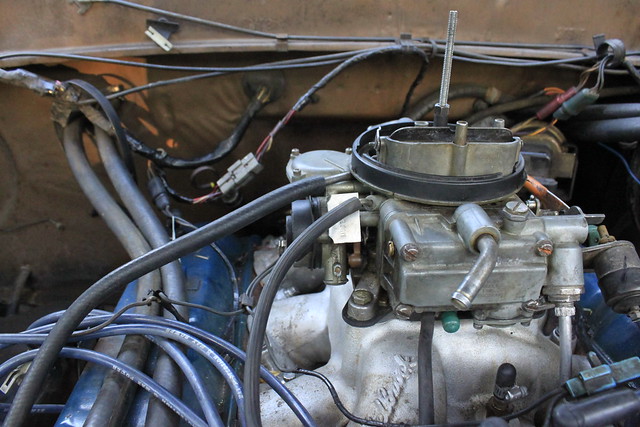
The largest ports on the carb (Front and rear) also have lines going to them, but I had them off for this.
So the question is, what are these canisters? And are these lines really vacuum lines? There are no lines heading to the manifold from there, so there is no source of vacuum.
Thanks
Jameson
I have these two canisters on the passenger side with 90% of the vacuum lines coming out of it. When the engine is running, the lines have no vacuum whatsoever. (one upper one lower canister)
Lines that go to them are all from the carb (sans dist vac advance), and one from water neck
The largest ports on the carb (Front and rear) also have lines going to them, but I had them off for this.
So the question is, what are these canisters? And are these lines really vacuum lines? There are no lines heading to the manifold from there, so there is no source of vacuum.
Thanks
Jameson
Hotshot


Joined: Apr 2009
Posts: 14,333
Likes: 247
From: Stanley, VA

This is part of you evaporative emissions control system. Most of the lines are vacuum lines. There should also be a line that goes to the fuel tank(s).
Here is an illustration from the Ford parts catalog to give you an idea of how its set up.
Also, some set ups used dual charcoal canisters. Sounds like that's what you have.
Click on the .pdf link to view.
Here is an illustration from the Ford parts catalog to give you an idea of how its set up.
Also, some set ups used dual charcoal canisters. Sounds like that's what you have.
Click on the .pdf link to view.
Thread Starter
|
Cargo Master
Joined: Oct 2010
Posts: 2,339
Likes: 32
From: Lost In a Pit of Despair
So i should get vacuum to those lines?
The line going to the tank was not attached when i bought it. I am not using any emissions controls (removed a.i.r pump, egr, ect.), so could i take those canisters out?
The line going to the tank was not attached when i bought it. I am not using any emissions controls (removed a.i.r pump, egr, ect.), so could i take those canisters out?
Hotshot
Joined: Apr 2009
Posts: 14,333
Likes: 247
From: Stanley, VA
I'd save them just incase you have to install them again in the future
 .
.

MSEE
Joined: Apr 2004
Posts: 10,386
Likes: 35
From: Austin, TX
If memory serves me correctly, the purge valve on top of the canister is sourced from ported vacuum. If that's the case, you won't have vacuum anywhere at idle in the first place.
Most of the lines in and out of the canister are evaporative lines and not vacuum lines. You'll have one from the tank (tank fumes) and one from the carburetor (fuel bowl fumes). The output of the purge valve dumps to the air cleaner to get burned.
Most of the lines in and out of the canister are evaporative lines and not vacuum lines. You'll have one from the tank (tank fumes) and one from the carburetor (fuel bowl fumes). The output of the purge valve dumps to the air cleaner to get burned.
Thread Starter
|
Cargo Master
Joined: Oct 2010
Posts: 2,339
Likes: 32
From: Lost In a Pit of Despair
So if I take the charcoal canisters out, and remove the emissions lines going to and from the carb, will I need to plug all the openings on the carb?
Thanks
Jameson

Posting Guru
Joined: Oct 2010
Posts: 1,199
Likes: 1
From: Missouri
If you don't cap them: A. The gas in the bowls will evaporate faster. B. You are more likely to get water/condensation in the float bowls. C. Since the bowls are already vented into the air cleaner it is possible that you may pull a draft through the float bowls and get dust/dirt in the carb.
Out of curiosisty where is that vacuum line running, the aluminum one that comes out directly above the choke cap? That is just a fresh air tube and does not pull a vacuum.
Trending Topics
Thread Starter
|
Cargo Master
Joined: Oct 2010
Posts: 2,339
Likes: 32
From: Lost In a Pit of Despair
The one in front of the ID tag goes to the water neck. The other one (larger of the two) goes to the top charcoal canister
FTE Stories
Ford Trucks for Ford Truck Enthusiasts

Rezvani's Latest Post-Apocalytic Monster Is a Ford F-150 Raptor Underneath
Verdad Gallardo
Top 10 Most Expensive Ford Trucks Ever Sold on Bring a Trailer
Joe Kucinski
2027 Ford Super Duty Buyer's Guide (Every Model, Engine, & Package)
Brett Foote
Top 10 Ford Truck Tragedies
Joe Kucinski
AEV FXL Super Duty - the Super Duty Raptor Ford Doesn't Make
Brett Foote
Lobo Vs Lobo: Proof the F-150 Lobo Should Be Even Lower!
Michael S. Palmer
Ford's 2001 Explorer Sportsman Concept Looks For a New Home
Verdad Gallardo
10 Best Ford Truck Engines We Miss the Most!
Joe Kucinski
2026 Shelby F-150 Off-Road: Better Than a Raptor R?
Brett Foote
Thread Starter
|
Cargo Master
Joined: Oct 2010
Posts: 2,339
Likes: 32
From: Lost In a Pit of Despair
Coming off the bent metal line from the tank, is a length of rubber tubing. On the end of that, there is a plug. The truck was that way when I bought it.
Hotshot
Joined: Apr 2009
Posts: 14,333
Likes: 247
From: Stanley, VA
Trucks with the charcoal canister vented the tank through the system so they used a non-vented cap.
Thread Starter
|
Cargo Master
Joined: Oct 2010
Posts: 2,339
Likes: 32
From: Lost In a Pit of Despair
You can leave that one uncapped. There is a check valve in the fuel tank. If you do cap it be sure to change your fuel cap to a vented cap or you'll start to have fuel delivery issues.
Trucks with the charcoal canister vented the tank through the system so they used a non-vented cap.
Trucks with the charcoal canister vented the tank through the system so they used a non-vented cap.
Oh I didn't realize that mattered. Since I don't have vented caps, should I uncap the fuel vapor line?

Thread
Thread Starter
Forum
Replies
Last Post
jasonzbtzl
1973 - 1979 F-100 & Larger F-Series Trucks
6
Oct 23, 2012 10:42 AM
mcguyver
335 Series- 5.8/351M, 6.6/400, 351 Cleveland
5
Jul 26, 2002 05:20 PM
