



Quadrajet anyone?
Moderator

Joined: Jan 2006
Posts: 1,779
Likes: 3
From: Waterloo IL

 Um, I think you mean the Ford Autolite 2100/4100 and Motorcraft 2150 are referred as the "poor man's fuel injection."
 The Autolite 2100/4100 and the Motorcraft 2150 carburetor used annular discharge boosters that were designed by FORD. This design is the most efficient and effective system ever developed to atomize the fuel charge. This superior booster design atomizes fuel almost as well as electronic fuel injection and the simplicity of this carburetor makes these the best mechanical fuel mixers ever made! In fact, Holley bought the annular discharge booster designed from Ford in the 1980s when Ford made the switch to electronic fuel injection.
You won't find many Quadrajets used off-road. In fact, you won't even see many GM guys using Quadrajets, either. For some reason, they tend to replace them with Holley's, which makes me wonder if they really are that great. However, the Autolite 2100/Motorcraft 2150 are HEAVILY used off-road, especially with the Jeep crowd. Unlike the Quadrajet and others, these carburetors work very well at steep inclines. If you see a carbureted Jeep off-road, 9 times out of 10 it will have either an Autolite 2100 or a Motocraft 2150.
Ford used the Autolite/Motorcraft design for almost THIRTY years. They were used on everything from full size Ford trucks to the Mustang GT. The annular booster design atomized fuel better than ANYTHING GM ever came out with. And unlike the Quadrajet ("Quadrajunk'), the Ford carburetors are very simple to set up and tune and will run almost forever or until dirt gets in it.
You sound like my brother. He is obsessed with Autolites. He runs them on everything and has a stock pile of 2 and 4 barrels. I've got a 2 barrel on all the vehicles in my sig other than the 1977 which has a 750 Demon.
Thread Starter
|
Lead Driver


Joined: Mar 2008
Posts: 7,182
Likes: 380
From: Near Los Angeles
I guess I'm breathing life into an old thread with this posting.
I finally got around to dialing in the QJ. Since it was going on a 250 hp I6, I was out there in no man's land. All the guides I read were for v8's, so I had to make slightly educated guesses with the calibrations. I ended up with the following settings:
I drilled the idle tube restrictions at .034"
idle air bleed at .064"
I plugged and drilled the bypass air at .036"
I drilled the idle down restriction at .046"
I opened the idle mix orifices to .070"
Also placed restrictions in the main air bleeds
Used the M hanger on the secondary m.rods
pri. jets are .071"
pri. m. rods are .041
Positives: What I have noticed is that the acceleration is a couple of steps above the Edelbrock 500 I had on it. It is noticeably faster. Also, at 45-50 mph, w/o a kick down, there is more throttle, more power left, more acceleration than the Eddy. Throttle response off the line is improved, and I have to be careful not to spin the tires, or 'tire'. I don't have exact numbers yet, because it is so much fun to get on it, but it seems to be doing better on mpg too. I'll know for certain latter. (It is just a blast to have an I6 that is faster and with every bit of towing/hauling power) of my previous 390 with a 2v carb and points ign.! The engine runs smoother, with less vibration, with this carb.
Negatives: The carb is louder than the Eddy. I think that b/c of the increased velocity of the a/f mix, due to the tiny primary bores, that sucking noise can be heard in the cab. I may have to go to an oem type filter.
Below you can see the restrictions being placed in the main air bleeds.

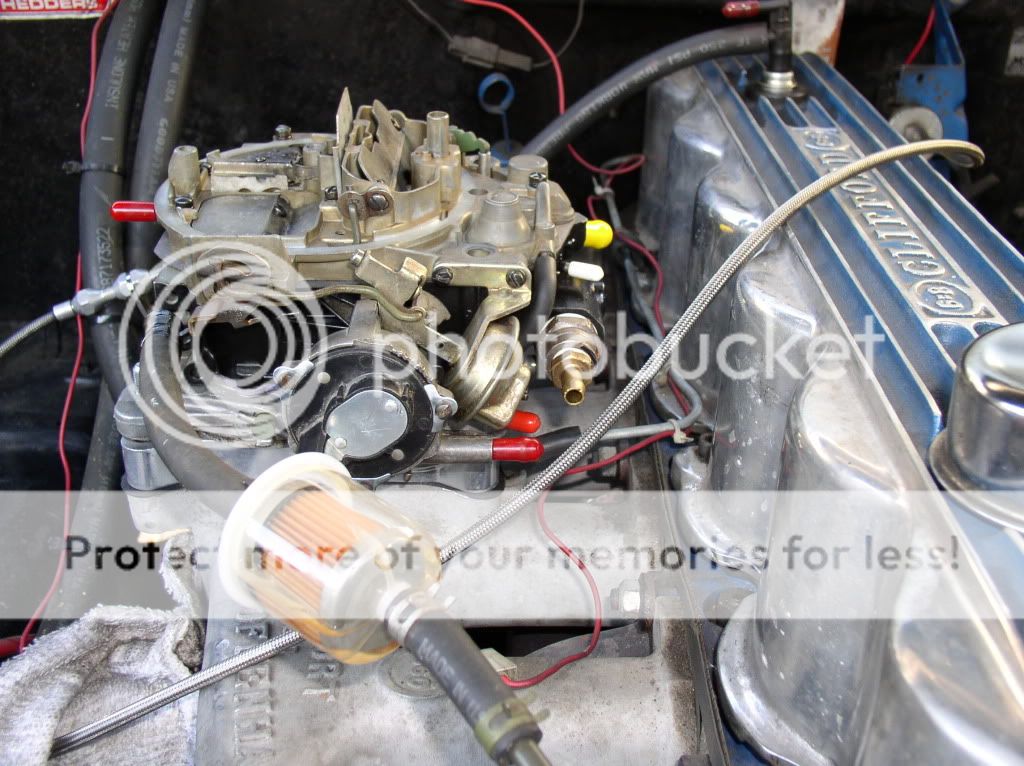
Here is a shot of the carb on the engine.
I'm thinking about trying this Caddy air cleaner system on my engine. I like the '4.9' emblem.

NOTICE: To anyone considering using/modifying a QJ: It's reputation is deserved. It is a very complicated carb, and took a tremendous about of time studying, and working on it, to get it dialed in. Unless you have minimum 10 days to work on it full time, don't bother. I also studied and read about it for about 3 weeks prior. It is a son-of-a-gun. But in the end the performance is leaps ahead of an Autolite 4100, and to a lesser degree ahead of an Edelbrock. Good luck. k
I finally got around to dialing in the QJ. Since it was going on a 250 hp I6, I was out there in no man's land. All the guides I read were for v8's, so I had to make slightly educated guesses with the calibrations. I ended up with the following settings:
I drilled the idle tube restrictions at .034"
idle air bleed at .064"
I plugged and drilled the bypass air at .036"
I drilled the idle down restriction at .046"
I opened the idle mix orifices to .070"
Also placed restrictions in the main air bleeds
Used the M hanger on the secondary m.rods
pri. jets are .071"
pri. m. rods are .041
Positives: What I have noticed is that the acceleration is a couple of steps above the Edelbrock 500 I had on it. It is noticeably faster. Also, at 45-50 mph, w/o a kick down, there is more throttle, more power left, more acceleration than the Eddy. Throttle response off the line is improved, and I have to be careful not to spin the tires, or 'tire'. I don't have exact numbers yet, because it is so much fun to get on it, but it seems to be doing better on mpg too. I'll know for certain latter. (It is just a blast to have an I6 that is faster and with every bit of towing/hauling power) of my previous 390 with a 2v carb and points ign.! The engine runs smoother, with less vibration, with this carb.
Negatives: The carb is louder than the Eddy. I think that b/c of the increased velocity of the a/f mix, due to the tiny primary bores, that sucking noise can be heard in the cab. I may have to go to an oem type filter.
Below you can see the restrictions being placed in the main air bleeds.
Here is a shot of the carb on the engine.
I'm thinking about trying this Caddy air cleaner system on my engine. I like the '4.9' emblem.
NOTICE: To anyone considering using/modifying a QJ: It's reputation is deserved. It is a very complicated carb, and took a tremendous about of time studying, and working on it, to get it dialed in. Unless you have minimum 10 days to work on it full time, don't bother. I also studied and read about it for about 3 weeks prior. It is a son-of-a-gun. But in the end the performance is leaps ahead of an Autolite 4100, and to a lesser degree ahead of an Edelbrock. Good luck. k
Senior User
Joined: May 2010
Posts: 252
Likes: 0
Congrats on sticking with it and successfully dialing it in.... I was a bit intimidated when I first started playing with them as well... Your pretty much an expert on the qjet now, putting yourself thru a self guided education of sorts... You'll have no problems breezing thru your next one... Now that you know what to do... My suggestion to someone looking to adapt one to there application is to start with a carb core from a similar cubic inch or larger engine, therefore the initial calibrations should be closer to start with... An air cleaner with cold air induction will help with power and economy as well... To many folks just throw on an open element type filter thinking the engine will breath better... not always the case...
The amount of horsepower an engine makes is directly related to the density of the air entering the engine.
The Ram Air Cleaner delivers higher density air by reducing the temperature and slightly increasing pressure at high speed.
For each 10° reduction in air temperature you can expect to increase horsepower by 1%.
Considering that under hood temperatures regularly reach 160° when the outside temperature is only 70°, the incoming air temperature may be reduced by up to 90° and gain 9% in horsepower.
On a 400 horsepower engine 9% is 36 horsepower! This cold-air intake made a 35 HP gain on a 466 HP Small Block Chevrolet!
The under hood temperature of the car was 118 degrees, with the SMW Cold Air Cleaner, the air temperature going into the carburetor was reduced to 68 degrees.
Quoted from -- Schmidt Motor Works Ram Air Cleaner
The amount of horsepower an engine makes is directly related to the density of the air entering the engine.
The Ram Air Cleaner delivers higher density air by reducing the temperature and slightly increasing pressure at high speed.
For each 10° reduction in air temperature you can expect to increase horsepower by 1%.
Considering that under hood temperatures regularly reach 160° when the outside temperature is only 70°, the incoming air temperature may be reduced by up to 90° and gain 9% in horsepower.
On a 400 horsepower engine 9% is 36 horsepower! This cold-air intake made a 35 HP gain on a 466 HP Small Block Chevrolet!
The under hood temperature of the car was 118 degrees, with the SMW Cold Air Cleaner, the air temperature going into the carburetor was reduced to 68 degrees.
Quoted from -- Schmidt Motor Works Ram Air Cleaner

Elder User
Joined: Jul 2004
Posts: 911
Likes: 2
From: Northern Virginia, USA
Thank you for your wonderful work and research! I bought my qjet fully rebuilt, but the truck went far down the priority list shortly thereafter. I will try your calibration when I get the chance!
Thread Starter
|
Lead Driver
Joined: Mar 2008
Posts: 7,182
Likes: 380
From: Near Los Angeles
After loads of wasted time and money I found a secret about Quadrajets: Rochester factory tunes each to a specific engine by changing internal fuel and air bleed restrictions. They look the same but flow way differently.
The trick is to target one close to the engine size you want to put it on. My was going on a ford 300. So I pulled one from a 231 Buick Regal with a turbo v6. That way you know you are in the ball park and it take minimal tuning with an a/f/r gauge.
I'm now amazed by the mpg.
Oh, and bull about the autolite boosters, that was Pony Carbs hype. The truth is they don't produce any better mpg than a Holly, plus you're lacking all the tuning ability. Wonk wonk wonk from Phony Pony Carbs.
The trick is to target one close to the engine size you want to put it on. My was going on a ford 300. So I pulled one from a 231 Buick Regal with a turbo v6. That way you know you are in the ball park and it take minimal tuning with an a/f/r gauge.
I'm now amazed by the mpg.
Oh, and bull about the autolite boosters, that was Pony Carbs hype. The truth is they don't produce any better mpg than a Holly, plus you're lacking all the tuning ability. Wonk wonk wonk from Phony Pony Carbs.

Its Comin Right for us!
Joined: Feb 2005
Posts: 12,158
Likes: 2,638
From: GA
Qjets are just as good if not better off road that autolites
I have run both.
Had great luck fine tuning a qjet on my last 460 and will be shortly on my 400
I noted the same differences, much better low end throttle response and torque in the bottom of gears, solid increase in mpg and carb will run at crazy angles
I have run both.
Had great luck fine tuning a qjet on my last 460 and will be shortly on my 400
I noted the same differences, much better low end throttle response and torque in the bottom of gears, solid increase in mpg and carb will run at crazy angles
Thread Starter
|
Lead Driver
Joined: Mar 2008
Posts: 7,182
Likes: 380
From: Near Los Angeles
The only area that the Autolite 4100 is better than a qjet is looks. I have to admit the qjet is just plain ugly, right? But, once the air cleaner is in place ... no one knows, but you do see results at the gas station.
Another thing that hinders the qjet is owners see it as a GM carb, just as the Autolite is perceived as a Ford carb. In reality, they are carbs produced by independent manufacturers, like Dana, ZF, Borg Warner, Holley, and many others.
Another thing that hinders the qjet is owners see it as a GM carb, just as the Autolite is perceived as a Ford carb. In reality, they are carbs produced by independent manufacturers, like Dana, ZF, Borg Warner, Holley, and many others.

Elder User
Joined: Apr 2008
Posts: 542
Likes: 0
From: Dixon, IL
Wow, all these years later I've done probably 10 Quadrajets for friends or Pontiac guys. I am just now finishing the 800 cfm one for my Dentside. Life happens and I got behind.
FTE Stories
Ford Trucks for Ford Truck Enthusiasts

Rezvani's Latest Post-Apocalytic Monster Is a Ford F-150 Raptor Underneath
Verdad Gallardo
Top 10 Most Expensive Ford Trucks Ever Sold on Bring a Trailer
Joe Kucinski
2027 Ford Super Duty Buyer's Guide (Every Model, Engine, & Package)
Brett Foote
Top 10 Ford Truck Tragedies
Joe Kucinski
AEV FXL Super Duty - the Super Duty Raptor Ford Doesn't Make
Brett Foote
Lobo Vs Lobo: Proof the F-150 Lobo Should Be Even Lower!
Michael S. Palmer
Ford's 2001 Explorer Sportsman Concept Looks For a New Home
Verdad Gallardo
10 Best Ford Truck Engines We Miss the Most!
Joe Kucinski
2026 Shelby F-150 Off-Road: Better Than a Raptor R?
Brett Foote
Thread
Thread Starter
Forum
Replies
Last Post
LGS
1997 - 2006 Expedition & Navigator
2
Sep 24, 2016 08:08 AM
