



Quadrajet anyone?
Thread Starter
|
Lead Driver


Joined: Mar 2008
Posts: 7,182
Likes: 380
From: Near Los Angeles
BTW, Supercabfreak, weren't you tinkering with an Autolite 4100 for a while? I could of sworn that I tried to point you in the right direction with one.
Progressing slowly with the rebuild--only only thumb, you see.
Progressing slowly with the rebuild--only only thumb, you see.
Thread Starter
|
Lead Driver
Joined: Mar 2008
Posts: 7,182
Likes: 380
From: Near Los Angeles
I got quite a bit done today. I figured out the choke and the linkage, and installed the new seals on the shaft, and the vacuum spacer/alignment aid. The trickiest part of the rebuild was to figure out how to hold the choke flap linkage end horizontal while down inside the carb. I did it by inserting a piece of copper wire into the two holes. (I didn't have a long-nosed needle nosed pliers!)
All the 4X and hot rod guys who I have read say the fail safe float setting for a QJ is 1/4" from the top. But in my literature it showed the level for a 350 sbc in a truck as being 15/32", so that is where I set them. That took me about an hour, but not because of the design; just b/c I'm slow and try to be exact. I also installed the longer of the acc. pump pistons. I thought that if it gave ample squirt for a 350 sbc, then that should be good enough for my 300!
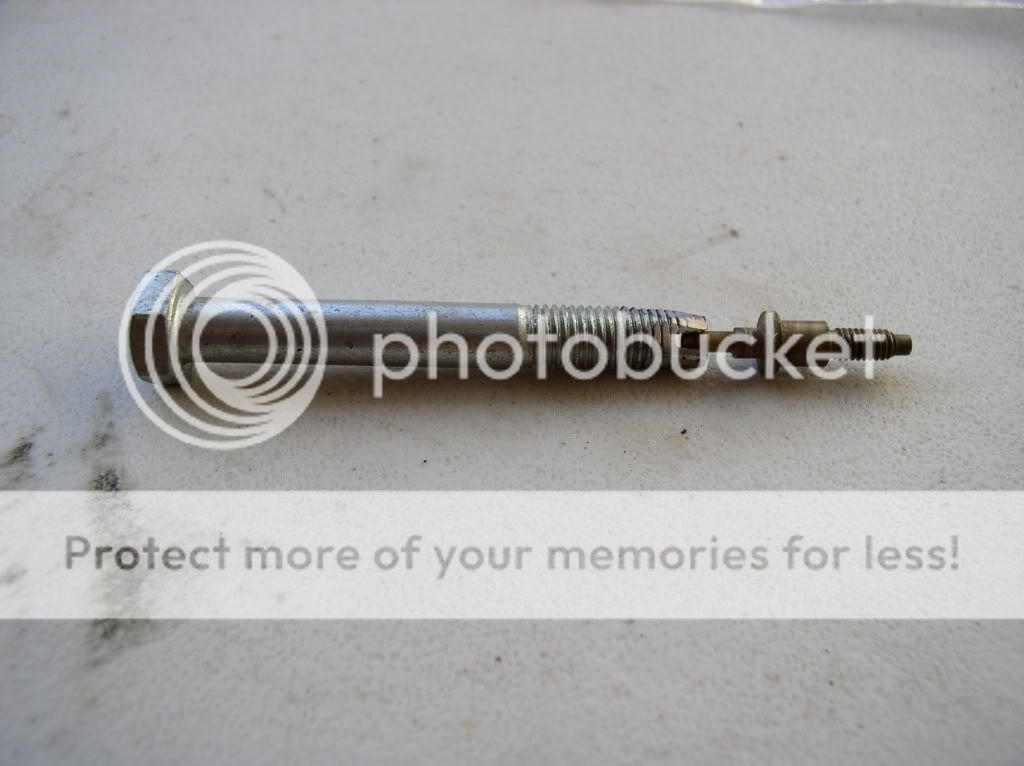
I also set the depth of the APT screw, and made a adjustment tool for it, so I can adjust it w/o pulling the top of the top of the carb off. To make this possible, I had to tap out the oem APT lead plug from the underside. To make the adj. tool, I just clamped a 5/16" bolt, about 5" long, in a vise, and cut a slot into the threaded end, then ground the threads back at an angle there where the slot was, so it would not bind on the rod that comes off the p.pistol and controls its depth.
At this point I have to say something: Just putting on the air horn gasket takes a f... act of congress, and to have double jointed fingers!! Not only do you have to hold one finger on the acc. pump and keep it compressed, but you have to fold the gasket down at the pre make slits, and side it under the p. piston's fragile arms, around the m. rods too. Then, to set the air horn in place, there are four fragile tubes hanging from it that have to go into the proper holes, and the choke linkage binds and has to be inserted simultaneously into its proper hole, all while holding the acc.pump rod. Without exaggeration, it took me at least an hour to put on the gasket. And another hour to place the air horn. AND THE CHEVY GUYS LAUGH ABOUT THE FORD DESIGNS???? The next time a Chevy guy says one little thing, I'm going to BLAST him with a load of s... about the QJ!!
As I was putting on the top, I was thinking about having to change the p. jets or rods, and when I realized that may be a possibility, my first reaction was: man, I hope I NEVER have to take this thing off again.
Now that it is nearly done I am noticing the diff. in the throttle linkages--hookups, and wondering how much I'll have to change my existing set up.
All the 4X and hot rod guys who I have read say the fail safe float setting for a QJ is 1/4" from the top. But in my literature it showed the level for a 350 sbc in a truck as being 15/32", so that is where I set them. That took me about an hour, but not because of the design; just b/c I'm slow and try to be exact. I also installed the longer of the acc. pump pistons. I thought that if it gave ample squirt for a 350 sbc, then that should be good enough for my 300!
I also set the depth of the APT screw, and made a adjustment tool for it, so I can adjust it w/o pulling the top of the top of the carb off. To make this possible, I had to tap out the oem APT lead plug from the underside. To make the adj. tool, I just clamped a 5/16" bolt, about 5" long, in a vise, and cut a slot into the threaded end, then ground the threads back at an angle there where the slot was, so it would not bind on the rod that comes off the p.pistol and controls its depth.
At this point I have to say something: Just putting on the air horn gasket takes a f... act of congress, and to have double jointed fingers!! Not only do you have to hold one finger on the acc. pump and keep it compressed, but you have to fold the gasket down at the pre make slits, and side it under the p. piston's fragile arms, around the m. rods too. Then, to set the air horn in place, there are four fragile tubes hanging from it that have to go into the proper holes, and the choke linkage binds and has to be inserted simultaneously into its proper hole, all while holding the acc.pump rod. Without exaggeration, it took me at least an hour to put on the gasket. And another hour to place the air horn. AND THE CHEVY GUYS LAUGH ABOUT THE FORD DESIGNS???? The next time a Chevy guy says one little thing, I'm going to BLAST him with a load of s... about the QJ!!
As I was putting on the top, I was thinking about having to change the p. jets or rods, and when I realized that may be a possibility, my first reaction was: man, I hope I NEVER have to take this thing off again.
Now that it is nearly done I am noticing the diff. in the throttle linkages--hookups, and wondering how much I'll have to change my existing set up.
Thread Starter
|
Lead Driver
Joined: Mar 2008
Posts: 7,182
Likes: 380
From: Near Los Angeles
Now I only need to adjust the fast idle, connect the choke flap to the linkage, install the secondary m.rods, and screw down the top. Of course I will go through all the adjustments listed in the rebuild paper work.
I also need to port the intake adapter, and port match it to the bottom of the carb.
I also need to port the intake adapter, and port match it to the bottom of the carb.
Thread Starter
|
Lead Driver
Joined: Mar 2008
Posts: 7,182
Likes: 380
From: Near Los Angeles
photos
I got everything buttoned up today, except for the choke. I tested it on 12v, and nothing, so I take it back to the bone yard tomorrow.
I'm a little perplexed about what to do with the APT plug. You can see the oem one I tapped out, and the hole it went in. The C. Ruggles kit I got came with an allen plug, but I had to tap out the hole, and I didn't want to spend $40 for a tap/die set. So, I'm wondering what to do. I may just use the oem plug and grind off the area that would interfere with the air filter gasket.

I also made a 'wrench' for the APT (adjustable part throttle), so I can adjust it w/o taking off the top of the carb.
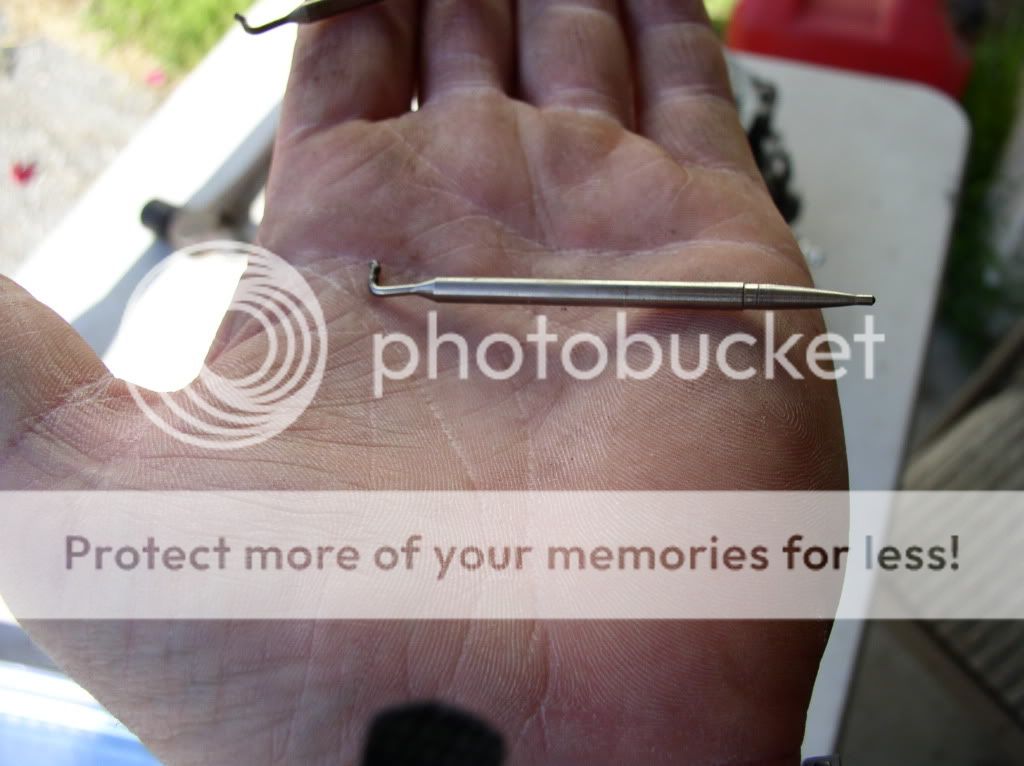
And I wanted to show the 'birthday candle size' secondary m.rods!! Every second they are open is like a taxi cab meter running ... in Scandinavia! and you can hear the dollars sucking out of your wallet.
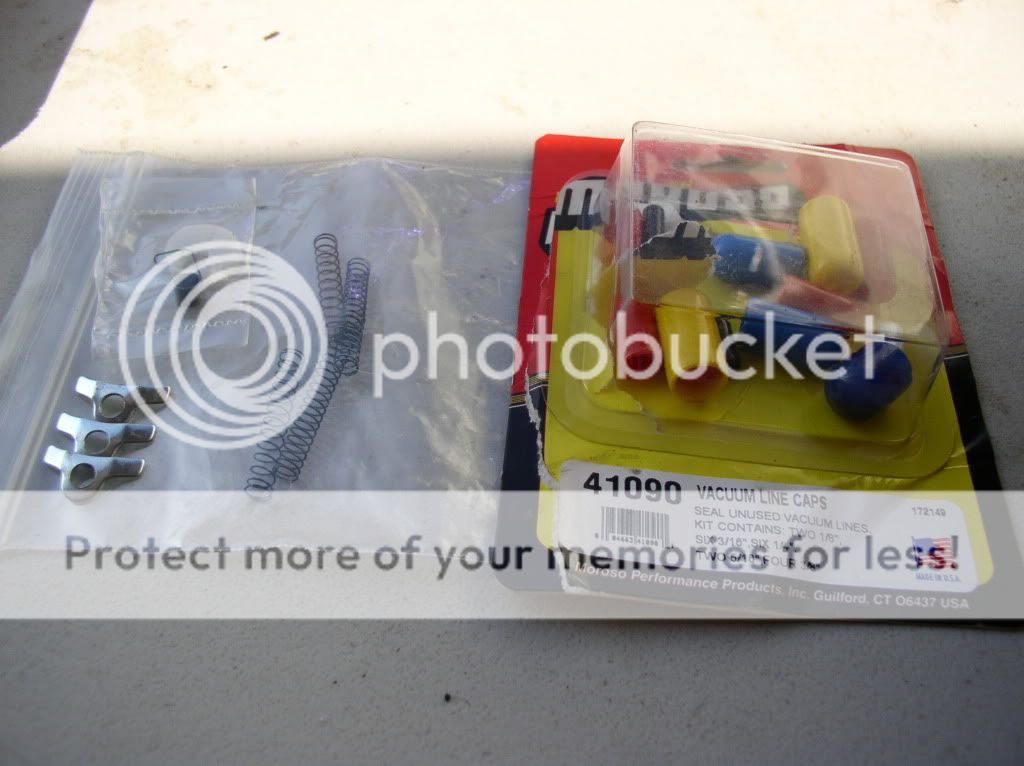
And here is shot of some useful things: some items in the Cliff Ruggles kit not found in others, like the choke torque down straps, the s. cam, the s. spring, hp acc. pump rod, and power piston seal (not in the photo). It also helps to have a selection of vacuum line plugs, like in the photo. Yes, all black would have been preferable to designer assortment, but that is what they had....
And the finished carb, minus the choke, air filter rod, and gas supply line.

I'm a little perplexed about what to do with the APT plug. You can see the oem one I tapped out, and the hole it went in. The C. Ruggles kit I got came with an allen plug, but I had to tap out the hole, and I didn't want to spend $40 for a tap/die set. So, I'm wondering what to do. I may just use the oem plug and grind off the area that would interfere with the air filter gasket.
I also made a 'wrench' for the APT (adjustable part throttle), so I can adjust it w/o taking off the top of the carb.
And I wanted to show the 'birthday candle size' secondary m.rods!! Every second they are open is like a taxi cab meter running ... in Scandinavia! and you can hear the dollars sucking out of your wallet.
And here is shot of some useful things: some items in the Cliff Ruggles kit not found in others, like the choke torque down straps, the s. cam, the s. spring, hp acc. pump rod, and power piston seal (not in the photo). It also helps to have a selection of vacuum line plugs, like in the photo. Yes, all black would have been preferable to designer assortment, but that is what they had....
And the finished carb, minus the choke, air filter rod, and gas supply line.
Thread Starter
|
Lead Driver
Joined: Mar 2008
Posts: 7,182
Likes: 380
From: Near Los Angeles
Well, I finally pulled this project off the shelf. You can read about it in this issue of True Blue Trucks magazine.
I just like to find the best product for the application. GM used this this carb design for about 20 years. That says bunches! It allowed them to claim high mpg with their v8's. The velocity of the tiny primary venturi atomizes the fuel extremely well;better than many carbs. Also, since it is a variable cfm carb, it only supplies the a/f mix any engine can take. GM put them 750 cfm on everything from small v6's to monster 500 ci caddy engines.
I just like to find the best product for the application. GM used this this carb design for about 20 years. That says bunches! It allowed them to claim high mpg with their v8's. The velocity of the tiny primary venturi atomizes the fuel extremely well;better than many carbs. Also, since it is a variable cfm carb, it only supplies the a/f mix any engine can take. GM put them 750 cfm on everything from small v6's to monster 500 ci caddy engines.

Senior User
Joined: Jul 2011
Posts: 151
Likes: 1
From: Nanaimo BC

Nice to see you made the apt accessible and adjustable. You don't need to buy a whole tap and die set. You can buy taps individually. I used a bottoming tap when I did mine. Only cut threads down far enough to get the plug to clear the top surface. Your tool will work for adjustment but a little tight to fit in. I just unscrewed the apt, touched the head on my grinder cause it's hardened and cut a slot dead centre to fit a small straight screwdriver. You'll always find a screwdriver to fit but never find your adjuster tool when you need it. When i put the apt back in I set it up 3 turns from bottom and then fine tuned from there. Usually 1.5 turns was optimum without having a tip in stumble but had to go up to 2 to 2.5 turns when it got colder out.
Nice work. Nice pics.
I just bought a quad that came from Cliff's shop. Guy who had it was a wood butcher. He thought it was a holley. It was like new outside and inside. Bought it for a buddy for his 305 in his rod. Paid 50 bucks for it. Black body matches his all black engine.
Excellent write up on the best carb out there.
Nice work. Nice pics.
I just bought a quad that came from Cliff's shop. Guy who had it was a wood butcher. He thought it was a holley. It was like new outside and inside. Bought it for a buddy for his 305 in his rod. Paid 50 bucks for it. Black body matches his all black engine.
Excellent write up on the best carb out there.
FTE Stories
Ford Trucks for Ford Truck Enthusiasts

Top 10 Most Expensive Ford Trucks Ever Sold on Bring a Trailer
Joe Kucinski
2027 Ford Super Duty Buyer's Guide (Every Model, Engine, & Package)
Brett Foote
Top 10 Ford Truck Tragedies
Joe Kucinski
AEV FXL Super Duty - the Super Duty Raptor Ford Doesn't Make
Brett Foote
Lobo Vs Lobo: Proof the F-150 Lobo Should Be Even Lower!
Michael S. Palmer
Ford's 2001 Explorer Sportsman Concept Looks For a New Home
Verdad Gallardo
10 Best Ford Truck Engines We Miss the Most!
Joe Kucinski
2026 Shelby F-150 Off-Road: Better Than a Raptor R?
Brett Foote
2027 Super Duty Carhartt Package First Look: 12 Things You NEED to Know!
Michael S. Palmer
Elder User
Joined: Jun 2010
Posts: 677
Likes: 2
From: High Point NC
yes i was working on a 4100 for a while and after seeing how worn it was i could never get it to stay tuned for more than a week, i found 3 rebuilt Qjets on the shelf in my grandpas workshop they were still in the rebuilders box. i decided that the 20 dollar adapter plate at napa was better than buying a new carb and turns out i realy like it and i gained about a mile and a half per gallon with the spread bore setup
Thread Starter
|
Lead Driver
Joined: Mar 2008
Posts: 7,182
Likes: 380
From: Near Los Angeles
I don't know how long I've been messing with the QJ project here. I will try to run it for a while,then pull it and put my Eddy 500 back on for a while when working on the QJ.
What I've learned is that the QJ is a ...bear. By that I simply mean that it is so complicated, and there are so many adjustments, that when something is not right it takes quite a bit of labor to pull the lid off and change something, write it in the book, put it back together and test it some more.
W/o exaggeration, I studied for two weeks b/f trying to rebuild it. The rebuild, working each day for 4-7 hours, took about six days! Since initial install I have had it off the vehicle three times to make changes. Aside from that I have removed the air horn (lid) at least 10 times to make changes. Each time I take the lid off it takes about 2-3 hours work.
Despite having read untold 'how-to' pages, I don't know that I am any closer to getting this carb to run well and economically. And yet, all the time my Eddy 500 has been waiting there, and each time I bolt it on it just purrs like a cat after lapping up some cream. My respect and admiration for the one carb is dropping as the other is rising.
So far I have spent well over $200 on the project. I have every rod, spring, hanger, air flap setting, gasket, filter, float setting, and jet size; each with different combos of the others, and with each remedy arises a diff. problem. I find it extremely frustrating to feel I am not getting anywhere and yet to spend so many hours working on it.
I hate to admit defeat, but I'm certainly getting close.
What I've learned is that the QJ is a ...bear. By that I simply mean that it is so complicated, and there are so many adjustments, that when something is not right it takes quite a bit of labor to pull the lid off and change something, write it in the book, put it back together and test it some more.
W/o exaggeration, I studied for two weeks b/f trying to rebuild it. The rebuild, working each day for 4-7 hours, took about six days! Since initial install I have had it off the vehicle three times to make changes. Aside from that I have removed the air horn (lid) at least 10 times to make changes. Each time I take the lid off it takes about 2-3 hours work.
Despite having read untold 'how-to' pages, I don't know that I am any closer to getting this carb to run well and economically. And yet, all the time my Eddy 500 has been waiting there, and each time I bolt it on it just purrs like a cat after lapping up some cream. My respect and admiration for the one carb is dropping as the other is rising.
So far I have spent well over $200 on the project. I have every rod, spring, hanger, air flap setting, gasket, filter, float setting, and jet size; each with different combos of the others, and with each remedy arises a diff. problem. I find it extremely frustrating to feel I am not getting anywhere and yet to spend so many hours working on it.
I hate to admit defeat, but I'm certainly getting close.

Laughing Gas
Joined: Dec 2003
Posts: 900
Likes: 3
I hear ya. The Q-jet is a wonderful carb once tuned properly. Do yourself a favor, if you have some extra change, and install a wideband O2 sensor. It will help to pinpoint problem areas and point you in the right direction on which way to tune it. I'd have a hard time tuning a carb with out one. I have an Edelbrock 600 on my daily driver and still have to tinker with it whenever the weather changes drastically.


Cargo Master

Joined: Dec 2004
Posts: 3,362
Likes: 22
From: Florence, SC
Originally Posted by montana_highboy
Those Q-jets make for great off-road carbs, in some circles they're referred to as "poor mans fuel injection" or "hillbilly fuel injection". 
 Um, I think you mean the Ford Autolite 2100/4100 and Motorcraft 2150 are referred to as the "poor man's fuel injection."
 The Autolite 2100/4100 and the Motorcraft 2150 carburetor used annular discharge boosters that were designed by FORD. This design is the most efficient and effective system ever developed to atomize the fuel charge. This superior booster design atomizes fuel almost as well as electronic fuel injection and the simplicity of this carburetor makes these the best mechanical fuel mixers ever made! In fact, Holley bought the annular discharge booster designed from Ford in the 1980s when Ford made the switch to electronic fuel injection.
You won't find many Quadrajets used off-road. In fact, you won't even see many GM guys using Quadrajets, either. For some reason, they tend to replace them with Holley's, which makes me wonder if they really are that great. However, the Autolite 2100/Motorcraft 2150 are HEAVILY used off-road, especially with the Jeep crowd. Unlike the Quadrajet and others, these carburetors work very well at steep inclines. If you see a carbureted Jeep off-road, 9 times out of 10 it will have either an Autolite 2100 or a Motocraft 2150.
Originally Posted by F-250 restorer
GM used this this carb design for about 20 years. That says bunches! It allowed them to claim high mpg with their v8's. The velocity of the tiny primary venturi atomizes the fuel extremely well;better than many carbs.
Ford used the Autolite/Motorcraft design for almost THIRTY years. They were used on everything from full size Ford trucks to the Mustang GT. The annular booster design atomized fuel better than ANYTHING GM ever came out with. And unlike the Quadrajet ("Quadrajunk'), the Ford carburetors are very simple to set up and tune and will run almost forever or until dirt gets in it.
Senior User
Joined: May 2010
Posts: 252
Likes: 0
Shouldn't take all that long to dial it in, once you know what your doing.. of all the people out there, you certainly have read and done more with the qjet than most... Why are you popping the top so much??? Once you have settled on the primary jetting, rods, and float height.. the rest can be done externally... secondary rods, flap tension, apt, choke settings, ect...
Once those are done, it's done....
What problems are you running into with it? Did you do the apt tip in procedure with it?
Here's the link to Cliff's forum - I suggest posting there for professional help - http://www.cliffshighperformance.com...machinesforum/
Once those are done, it's done....
What problems are you running into with it? Did you do the apt tip in procedure with it?
Here's the link to Cliff's forum - I suggest posting there for professional help - http://www.cliffshighperformance.com...machinesforum/