


 sometimes.

quick intake question

Postmaster
Joined: Dec 2006
Posts: 3,603
Likes: 10
From: Spokane, WA
Carbs with different cfm may have the same throttle bore but different venturi sizes. This is borne out by reading the Holley carb specification sheet and comparing the different carbs.
No disrespect smitty but I am not understanding the concept of an engine drawing from one barrel of a two barrel carb? (unless it is a progressive 2 barrel carb). I see it where half the engine draws from one primary barrel like on 80broncoman's split plenum but not the whole engine.
No disrespect smitty but I am not understanding the concept of an engine drawing from one barrel of a two barrel carb? (unless it is a progressive 2 barrel carb). I see it where half the engine draws from one primary barrel like on 80broncoman's split plenum but not the whole engine.

Senior User
Joined: Nov 2010
Posts: 458
Likes: 1
Baron, not to discourage you at all from trying those 2bbl carbs, so long as you report your findings to us , but generally a traditional non-progressive 2bbl is inferior to a spreadbore 4bbl even for fuel economy, 2bbls of that kind being used by Detroit because they were cheap, not better in any way. The very small primaries of a spreadbore 4bbl get a strong vacuum signal at the venturi boosters, thus good atomization and crisp throttle response. Your 2bbls have an in-between compromise size of throat to handle the whole rpm range, which it does less well than the spreadbore 4bbls. But, again, try it. Maybe you'll get a counter-intuitive result like AB has, and blow all the conventional wisdom to pieces.
Harte, with evident lack of clarity on my part, what I am trying to point out is the effect of a particular carb, on a particular manifold, UPON ANY ONE CYLINDER.
The cylinders operate separately. One cylinder at a time has to draw a vacuum past the valve during its partly/fully/partly-open period, through the turn and down the port, down a long (well, various lengths) manifold runner with its twists and turns, and ultimately draw down the air pressure inside whatever sized carb venturi(S) and venturi booster(S) are at the end of this whole intake tract.
(To keep things simple, I'm ignoring any possible resonance effects, "tuned" intakes, etc.)(I need things kept simple even if you don't!!).
All right, the single cylinder we're looking at has a given maximum displacement. As the piston starts down from TDC, drawing a vacuum on that entire intake tract, the volume of the tract makes a big difference. If you suck hard through a straw, you can draw a strong vacuum, which you can feel by putting a finger tip on and off the end of the straw; however, the straw is restrictive (maybe like the primary side of a Dual-Port manifold??). If you suck hard through a small length of 1/2" pipe, you can still draw a strong vacuum, and move a lot of air since the pipe is not very restrictive, but you'll feel less with you fingertip. If you put your mouth over the filler-hole of an empty 55gal. oil drum and suck hard, you'll be moving air but not drawing a detectable vacuum on the drum. Pretty weak!!
So what kind of a tract do you want your cylinder to have to draw against? For their V-8s, Detroit wanted an intake tract analogous to our piece of 1/2" pipe, that is, small enough that the cylinder could draw a serious vacuum, but not so small as to be restrictive. So they took their early V-8 manifold designs, which were single-plane, and cut the volume in half by making them all dual-plane. Each cylinder now only has to draw vacuum on half the volume of the manifold . . . and half the carburetor (the divider in the plenum runs right up to the base of the carb); one primary throat, then that primary and one secondary. No cylinder on a V-8, dual-plane, ever uses more than half the carb, nor draws on more than half the manifold volume.
But look at my Clifford single 4bbl manifold for a six. It's an oil drum!! Huge interior volume!! And if the cylinder manages to draw some kind of vacuum on that volume, the vacuum is finally divided among BOTH primary throats and ultimately ALL FOUR throats of whatever 4bbl we choose for it.
Now WHY?? Why would it be good for a cylinder on a V-8 to draw down on (analogously) a piece of 1/2" pipe to get a vacuum to the throats of a (effectively) progressive-openiing 2bbl carb, with one-half the maximum CFM of the rating for the 4bbl carb, BUT a cylinder on our six is supposed to do an equally efficient job drawing down (analogously) an oil drum on the way to getting some kind of vacuum to all throats of a progressive-opening 4bbl carb with its full rated CFM capability.
I don't know how to put this any better, Harte. Don't look at a 4bbl carb on a V-8 and see a 4bbl carb on a manifold; that's the illusion. The reality is that you are looking at TWO SEPARATE low-volume intake manifolds with TWO SEPARATE progressive-opening 2bbl carbs. (Maybe this paragraph was the only one needed ) YES, the entire carb is working for the entire engine, but each side works ONLY for half the engine. No cylinder on a V-8 ever uses more than half the rated CFM.
And though AB has provided an annoyingly contrary finding (thanks a lot ), I want my six to be like a V-8, with the 1/2" pipe and not the oil drum, . . . which is why I stuck a divider in the middle of the Clifford. Three cylinders are connected to each half-manifold and half-carb . . . but they still work one at a time. Like the V-8s, the visual illusion of my set-up will be one manifold and one big carb, but the actuality will be two manifolds with two half-carbs.
I wish I were a better explainer; talk about flogging a point to death
, but generally a traditional non-progressive 2bbl is inferior to a spreadbore 4bbl even for fuel economy, 2bbls of that kind being used by Detroit because they were cheap, not better in any way. The very small primaries of a spreadbore 4bbl get a strong vacuum signal at the venturi boosters, thus good atomization and crisp throttle response. Your 2bbls have an in-between compromise size of throat to handle the whole rpm range, which it does less well than the spreadbore 4bbls. But, again, try it. Maybe you'll get a counter-intuitive result like AB has, and blow all the conventional wisdom to pieces.Harte, with evident lack of clarity on my part, what I am trying to point out is the effect of a particular carb, on a particular manifold, UPON ANY ONE CYLINDER.
The cylinders operate separately. One cylinder at a time has to draw a vacuum past the valve during its partly/fully/partly-open period, through the turn and down the port, down a long (well, various lengths) manifold runner with its twists and turns, and ultimately draw down the air pressure inside whatever sized carb venturi(S) and venturi booster(S) are at the end of this whole intake tract.
(To keep things simple, I'm ignoring any possible resonance effects, "tuned" intakes, etc.)(I need things kept simple even if you don't!!).
All right, the single cylinder we're looking at has a given maximum displacement. As the piston starts down from TDC, drawing a vacuum on that entire intake tract, the volume of the tract makes a big difference. If you suck hard through a straw, you can draw a strong vacuum, which you can feel by putting a finger tip on and off the end of the straw; however, the straw is restrictive (maybe like the primary side of a Dual-Port manifold??). If you suck hard through a small length of 1/2" pipe, you can still draw a strong vacuum, and move a lot of air since the pipe is not very restrictive, but you'll feel less with you fingertip. If you put your mouth over the filler-hole of an empty 55gal. oil drum and suck hard, you'll be moving air but not drawing a detectable vacuum on the drum. Pretty weak!!
So what kind of a tract do you want your cylinder to have to draw against? For their V-8s, Detroit wanted an intake tract analogous to our piece of 1/2" pipe, that is, small enough that the cylinder could draw a serious vacuum, but not so small as to be restrictive. So they took their early V-8 manifold designs, which were single-plane, and cut the volume in half by making them all dual-plane. Each cylinder now only has to draw vacuum on half the volume of the manifold . . . and half the carburetor (the divider in the plenum runs right up to the base of the carb); one primary throat, then that primary and one secondary. No cylinder on a V-8, dual-plane, ever uses more than half the carb, nor draws on more than half the manifold volume.
But look at my Clifford single 4bbl manifold for a six. It's an oil drum!! Huge interior volume!! And if the cylinder manages to draw some kind of vacuum on that volume, the vacuum is finally divided among BOTH primary throats and ultimately ALL FOUR throats of whatever 4bbl we choose for it.
Now WHY?? Why would it be good for a cylinder on a V-8 to draw down on (analogously) a piece of 1/2" pipe to get a vacuum to the throats of a (effectively) progressive-openiing 2bbl carb, with one-half the maximum CFM of the rating for the 4bbl carb, BUT a cylinder on our six is supposed to do an equally efficient job drawing down (analogously) an oil drum on the way to getting some kind of vacuum to all throats of a progressive-opening 4bbl carb with its full rated CFM capability.
I don't know how to put this any better, Harte. Don't look at a 4bbl carb on a V-8 and see a 4bbl carb on a manifold; that's the illusion. The reality is that you are looking at TWO SEPARATE low-volume intake manifolds with TWO SEPARATE progressive-opening 2bbl carbs. (Maybe this paragraph was the only one needed
) YES, the entire carb is working for the entire engine, but each side works ONLY for half the engine. No cylinder on a V-8 ever uses more than half the rated CFM.And though AB has provided an annoyingly contrary finding (thanks a lot
), I want my six to be like a V-8, with the 1/2" pipe and not the oil drum, . . . which is why I stuck a divider in the middle of the Clifford. Three cylinders are connected to each half-manifold and half-carb . . . but they still work one at a time. Like the V-8s, the visual illusion of my set-up will be one manifold and one big carb, but the actuality will be two manifolds with two half-carbs.I wish I were a better explainer; talk about flogging a point to death
Moderator


Joined: Dec 2007
Posts: 7,987
Likes: 104
From: Boise, Idaho

To help illustrate the "1bbl per cylinder" of the standard DP.
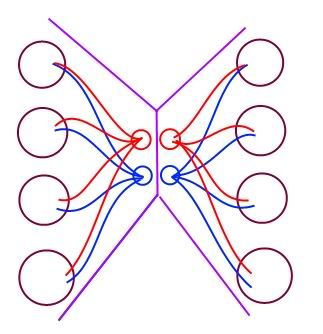
Since the manifold divides the carb in two, you can see that each cylinder only gets one primary (blue) and one secondary (red). So two barrels total, or half the carb.
Unlike the Offy C, which each cylinder gets two primary barrels and two secondary barrels, so four barrels each, or the whole carb.
More on the conundrum of the Offy C with a 600 CFM. This morning, in second gear, I was going 35mph in the flats and my vacuum needle read 19hg. That's maintaining speed and its pulling MORE vacuum than idle. Granted, it was at 2400 RPMs vs. the 700 at idle, but still.... Shifting to 3rd put it at 15hg. I'm puzzled too.
Since the manifold divides the carb in two, you can see that each cylinder only gets one primary (blue) and one secondary (red). So two barrels total, or half the carb.
Unlike the Offy C, which each cylinder gets two primary barrels and two secondary barrels, so four barrels each, or the whole carb.
More on the conundrum of the Offy C with a 600 CFM. This morning, in second gear, I was going 35mph in the flats and my vacuum needle read 19hg. That's maintaining speed and its pulling MORE vacuum than idle. Granted, it was at 2400 RPMs vs. the 700 at idle, but still.... Shifting to 3rd put it at 15hg. I'm puzzled too.
Senior User
Joined: Nov 2010
Posts: 458
Likes: 1
Worth a thousand words . . . and I feel I've run into the tens of thousands. You do that so nicely, AB; I guess I'll stop beating you on the head.
OOPS, you put the divider the wrong direction. No, now I see; you got it right.
OOPS, you put the divider the wrong direction. No, now I see; you got it right.

Postmaster
Joined: Mar 2005
Posts: 2,949
Likes: 6
From: Earth
Actually, each side of the carb on a dual plane feeds two cylinders on either bank of a V8. On your pic the driver's side of the carb should feed 1,3,6,8 instead of 1,2,3,4. Two stacked X-shapes cast together.
Easy since there are no exhaust ports. The Offy C and Clifford are more like a horizontal tunnel ram. The DP is its own breed of cat.
Regardless, the engine is pulling a steady vacuum. Each cylinder draws vacuum individually, but the intake valve is open on more than one cylinder at a time. Six straws to the plenum with each straw drawing sequentially ~5 times a second at idle.
A 1" 4-hole spacer did make a huge difference though, fwiw. 1" open spacer wasn't noticeably different than no spacer. 2" 4-hole spacer drove awful. The 2-bbl adapter plate I got is 3/4" and just for fun I'll try it with and without the 1" open spacer.
The 2-bbl may be a compromise, but on an otherwise stock engine I have no idea how much it gets into the secondaries anyway. Since any carb is a compromise to MPFI I figure to play around.
I think people worry too much about carb size. An Edelbrock 750 would be overkill but it's not so big it would be sloppy. A 750 Holley mechanical secondary with auto tranny? Yeah, lazy down low. Anything 600 cfm vacuum secondary should be no worries. Beyond that finding the right combo for the engine, truck, and driver is a matter of preference.
Or insanity. I'll cop a plea to that.
Easy since there are no exhaust ports. The Offy C and Clifford are more like a horizontal tunnel ram. The DP is its own breed of cat.
Regardless, the engine is pulling a steady vacuum. Each cylinder draws vacuum individually, but the intake valve is open on more than one cylinder at a time. Six straws to the plenum with each straw drawing sequentially ~5 times a second at idle.
A 1" 4-hole spacer did make a huge difference though, fwiw. 1" open spacer wasn't noticeably different than no spacer. 2" 4-hole spacer drove awful. The 2-bbl adapter plate I got is 3/4" and just for fun I'll try it with and without the 1" open spacer.
The 2-bbl may be a compromise, but on an otherwise stock engine I have no idea how much it gets into the secondaries anyway. Since any carb is a compromise to MPFI I figure to play around.
I think people worry too much about carb size. An Edelbrock 750 would be overkill but it's not so big it would be sloppy. A 750 Holley mechanical secondary with auto tranny? Yeah, lazy down low. Anything 600 cfm vacuum secondary should be no worries. Beyond that finding the right combo for the engine, truck, and driver is a matter of preference.
Or insanity. I'll cop a plea to that.
Senior User
Joined: Nov 2010
Posts: 458
Likes: 1
Baron, I think AB was trying to keep the drawing simple while still showing the two separated sets of cylinders and induction systems on a V-8. As far as overlapping intake-open events, I'M trying to keep the discussion simple; maybe I should have used an old Yamaha parallel twin with no overlap? And I ignored inertia effects in the intake tract to keep it simple.
The basic point, that we can end up trying to draw vacuum on an excessive volume, thereby getting a weak vacuum signal at the venturi, low charge velocity, dull throttle response, reduced fuel economy, etc., is the point that Holley, Carter, Rochester, and Weber have all been trying to pound into the heads of hot-rodders for the fifty years that I have been reading their recommendations. And for about the same span of years, Edlebrock, Offenhauser, Holley, and other manifold makers have been telling hot-rodders (who overwhelmingly work on V-8s) that dual-plane manifolds are for the street and single-plane manifolds are for the track. And that is despite the fact that the carb manufacturers make more money selling you a bigger carb, and the manifold makers charge more for a single-plane manifold, if you still insist on it.
Now I'm done You guys do it your way, I'll do it my way, and maybe before too long I can post pix and results.
The basic point, that we can end up trying to draw vacuum on an excessive volume, thereby getting a weak vacuum signal at the venturi, low charge velocity, dull throttle response, reduced fuel economy, etc., is the point that Holley, Carter, Rochester, and Weber have all been trying to pound into the heads of hot-rodders for the fifty years that I have been reading their recommendations. And for about the same span of years, Edlebrock, Offenhauser, Holley, and other manifold makers have been telling hot-rodders (who overwhelmingly work on V-8s) that dual-plane manifolds are for the street and single-plane manifolds are for the track. And that is despite the fact that the carb manufacturers make more money selling you a bigger carb, and the manifold makers charge more for a single-plane manifold, if you still insist on it.
Now I'm done
You guys do it your way, I'll do it my way, and maybe before too long I can post pix and results.
Postmaster
Joined: Dec 2006
Posts: 3,603
Likes: 10
From: Spokane, WA
"Now I'm done..." I hope not! Threads like this enhance the cussin and discussin of performance...much better than the "What can I bolt on..." type discussions.
FTE Stories
Ford Trucks for Ford Truck Enthusiasts

3 Best / 3 Worst Parts of Modern Ford Ownership
Brett Foote
10 Amazing Upgrades That Solve Common Ford Truck Owner Headaches
Pouria Savadkouei
Every 2026 Ford Engine Explained
Brett Foote
10 Ugly Ford Trucks That We Still Kinda Love
Joe Kucinski
10 Things Every Truck Owner NEEDS (2026 Edition)
Michael S. Palmer
Rezvani's Latest Post-Apocalyptic Monster Is a Ford F-150 Raptor Underneath
Verdad Gallardo
Top 10 Most Expensive Ford Trucks Ever Sold on Bring a Trailer
Joe Kucinski
2027 Ford Super Duty Buyer's Guide (Every Model, Engine, & Package)
Brett Foote
Top 10 Ford Truck Tragedies
Joe Kucinski
Thread
Thread Starter
Forum
Replies
Last Post
steve340
1967 - 1972 F-100 & Larger F-Series Trucks
2
May 29, 2016 07:53 PM
trucker01
1980 - 1986 Bullnose F100, F150 & Larger F-Series Trucks
16
May 10, 2014 09:23 PM
