


quick intake question

Laughing Gas
Joined: Nov 2003
Posts: 898
Likes: 1
From: southeren Oh
The thing i don't like about the DualPort is that that divider is taking away form the cross section of the intake runners. That is fine till you get to around to where the back of the carb is needed. Then you could really use more runner volume than the DP has.
There really are NO dual plane intakes for 240-300s Except for a few homeade ones. I made one it is very simple. all you do is split the plenum under the carb.
The divider goes right between runners 3 and 4. Then look at you firing order and you will see the pulses willtake turns on each side (just like the twin plenums on a dual plane intake on a V-6 or V-8) You must face the carb east-west if you go this route.
Do a search on the Fordsix.com forum for split plenum and you can find pics of the one I made.
There really are NO dual plane intakes for 240-300s Except for a few homeade ones. I made one it is very simple. all you do is split the plenum under the carb.
The divider goes right between runners 3 and 4. Then look at you firing order and you will see the pulses willtake turns on each side (just like the twin plenums on a dual plane intake on a V-6 or V-8) You must face the carb east-west if you go this route.
Do a search on the Fordsix.com forum for split plenum and you can find pics of the one I made.

Moderator


Joined: Dec 2007
Posts: 7,987
Likes: 104
From: Boise, Idaho

I think I remember seeing pictures of that setup 80bronc, it looks like it works really well. Yeah, the split fire of the 300 (front/rear/front/rear/front/rear) is why the dual EFI manifolds work so well too.

Senior User
Joined: Nov 2010
Posts: 458
Likes: 1
Yeah, Chris, if you're good at fab work (and this is pretty easy) you might consider this business of splitting a non-DP intake manifold.
Every production carbureted V-8 engine as sold by Detroit for forty years came with a dual-plane manifold . . . and that meant that while you often saw a 4bbl carb on top of these engines, effectively they were NOT 4bbl engines!! No cylinder ever was pulling from all four throats of that carb. All of those V-8s were really dual-2bbl engines. Since nearly all of the 4bbl carbs were progressive opening with vacuum secondaries, what each cylinder saw was a 1bbl carb at low speeds, and a 2bbl carb when it was putting out more power.
Now WHY do we think our sixes (and I might say, our poor little overworked sixes) will do their best with 4bbl carbs, and single-plane manifolds that have each cylinder using two throats at low speed and all 4 throats at higher output? To my knowledge, Detroit virtually never sold a V-8 with a single-plane manifold for any practical application.
WHY did almost all of Detroit's straight-sixes come with a (rather crude) log manifold (with a single 1bbl carb)?? Because it was the best choice for the engine? NO, they built 'em that way because it was CHEAP!!! Our beloved sixes were always the cheap, baseline, economy engine in any car or truck. If you wanted power, you paid for the optional V-8 . . . with its more expensive and sophisticated dual-plane manifold.
Now look at an Offy C or Clifford manifold. The runners, with considerably bigger cross-sections than anything in the factory manifold, also have big lovely sweeping curves. Without bothering to take any measurement, you can easily see that those aftermarket manifolds must have nearly twice the internal volume as the factory manifold . . . and maybe THREE times the volume of either half of a V-8 manifold!!! And THAT is the volume you are asking each cylinder in your poor little six to draw a vacuum against??!! It's a situation that no cylinder in any production V-8 engine ever had to face, not even close! So how on earth do you expect to get a good strong vacuum signal to the carb venturi and venturi booster, when the cylinder first has to draw on that enormous volume in the mainfold??!!
This was the situation the Offy Dual-Port addressed (if my elderly brain was working, I could remember the name of the Offenhauser engineer who devleoped it, but it's just out of reach . . . ). And the DP manifold was first developed for V-8 engines, which ALREADY HAD dual-plane manifolds, so you can see that Offy was trying to cut those half-manifolds by half or more again, so they must have felt that reducing internal volume, increasing charge velocity, and getting a crisp vacuum signal at the carb venturi were highly desirable to say the least!
So the Dual-Port is a vast improvement over the factory manifold. A Holley 390cfm would seem to be the right size. Think again about the fact that looks are deceiving and that each cylinder on a factory V-8 with, say, a Holley 750cfm, will never use more than one-half (375cfm) of that carburetor. BUT, each cylinder on our six, with the Dual-Port, will draw first from BOTH primaries, then from all four throats of our 390cfm Holley, so it works out pretty close to the same as a factory V-8.
(For fun, think what happens on our factory V-8 with the 750cfm Holley if we replace the factory dual-plane manifold with an Offy Dual-Port (also dual-plane) manifold; each cylinder will still be drawing from only one primary and one seecondary of the 4bbl carb, but now the internal volume of the manifold has been halved (roughly) again, so the charge velocities and the vacuum signals seen at the venturis are greatly increased even over the original dual-plane set-up).
Back to the six. I think the Dual-Port/Holley 390 is a good set-up for us (especially if we also replace the CHEAP original exhaust manifold with something better). It's probably better for a hauler than a "street performance" engine because the runners are maybe going to get restrictive and maybe reach a stall point at high rpm. What's a better choice? Setting fuel injection aside, the best carburetion would be three sidedraft Webers on individual runners, but that costs a wad or three. A far cheaper choice would be to split an Offy C or Clifford manifold in half.
Start with the fact that an inline six is essentially two inline triples connected end-to-end; 1-2-3 is an engine, 4-5-6 is an engine. Keep this in mind when thinking about either intake or exhaust systems, either of which can be split 1-2-3 and 4-5-6. (BTW, a V-8 is not two inline fours joined at an angle; it is four 90-degree V-twins joined end-to-end)(which is why each half of the dual-plane intake has to draw from cylinders on each side of the vee).
I had an early Clifford single-4bbl intake, bought second-hand (otherwise I might just have bought a DP). Nice curves, but huge internal volume, so it might have been good on a race or performance six on a small car, but I was building an engine for a van; I wanted low to midrange torque and fuel efficiency, plus the crisp throttle response you get when there's a good vacuum signal at the venturis.
So I took a chunk of aluminum and carved a "splitter," a barrier that divides the Clifford in halves, 1-2-3/4-5-6. It runs from the base of the carb to the bottom of the plenum, isolating each half. I did make provision for a "balance tube" between the front and rear halves of the mainfold, but have not experimented with it. The splitter is narrow, maybe 5/16" wide, at the top where the carb sits, then it flares out in smooth curves to give the charge a kick in the right general direction, fore and aft. As I said, pretty simple to do. And with that one stroke I halved the volume that any cylinder has to draw vacuum against. (Don't ask for pix; I don't have 'em and don't know how to post 'em. Learning how to do that is on my list of new year's resolutions . . . again).
The question then is what carb to use. Each half of my split manifold has to draw from one primary and one secondary of a single 4bbl (there wouldn't have been room for two 2bbl carbs). That means I'd have to mount a 4bbl with the floatbowl pointed to the vehicle's right side (or left, just not forward). Some carb makers don't like that, and prefer the bowl aimed forward so that hard accelleration or braking doesn't foul up their metering (whether making a hard sweeping corner fouls up the metering, I haven't heard . . .). I don't think it would be much of a problem in normal driving, especially with a low performance work-van, and I've seen many carbs mounted sideways, but you might ask the carb company tech guys. Anyway, if you go this route you might decide that a 390cfm Holley is too small, because again, each cylinder is now only pulling from half of the carb, like a V-8; my choice would have been one of the 600cfm spread-bores. But I went another direction.
I briefly considered trying a Predator carb, a very interesting unit, and internally splitting IT in half, too, because it's huge, like 930cfm or something.
But I had an easier and probably better option sitting on the shelf, a Holley 2bbl 670cfm Pro-Jection. Remember these? The off-road crowd loved them because they kept working at any altitude, and better yet, any ATTITIDE; those guys really get radical!! It's a self-contained, bolt-on, throttle-body injection unit, and can be had with a closed-loop option that gives it feedback from an O2 sensor. With no floatbowl, it doesn't care what direction it's pointed. Ordinarily, a 670cfm Pro-Jection 2bbl is waaay too big for a six, but one more time, each cylinder will only be pulling from one barrel (Sorry, I'm with the Department of Redundancy Dept.)
I haven't tried it. The new engine, mostly finished, is sitting in a plastic garbage bag gathering dust. I sold the van, and saved the engine for a vehicle I just bought, a 1968 Ford P350 bread truck (a step van). When I have done everything else I have to do to convert the bread truck (which has a running 300-six) for my purposes, the last step will be to install this motor.
I'll post pictures. I will, I will.
Every production carbureted V-8 engine as sold by Detroit for forty years came with a dual-plane manifold . . . and that meant that while you often saw a 4bbl carb on top of these engines, effectively they were NOT 4bbl engines!! No cylinder ever was pulling from all four throats of that carb. All of those V-8s were really dual-2bbl engines. Since nearly all of the 4bbl carbs were progressive opening with vacuum secondaries, what each cylinder saw was a 1bbl carb at low speeds, and a 2bbl carb when it was putting out more power.
Now WHY do we think our sixes (and I might say, our poor little overworked sixes) will do their best with 4bbl carbs, and single-plane manifolds that have each cylinder using two throats at low speed and all 4 throats at higher output? To my knowledge, Detroit virtually never sold a V-8 with a single-plane manifold for any practical application.
WHY did almost all of Detroit's straight-sixes come with a (rather crude) log manifold (with a single 1bbl carb)?? Because it was the best choice for the engine? NO, they built 'em that way because it was CHEAP!!! Our beloved sixes were always the cheap, baseline, economy engine in any car or truck. If you wanted power, you paid for the optional V-8 . . . with its more expensive and sophisticated dual-plane manifold.
Now look at an Offy C or Clifford manifold. The runners, with considerably bigger cross-sections than anything in the factory manifold, also have big lovely sweeping curves. Without bothering to take any measurement, you can easily see that those aftermarket manifolds must have nearly twice the internal volume as the factory manifold . . . and maybe THREE times the volume of either half of a V-8 manifold!!! And THAT is the volume you are asking each cylinder in your poor little six to draw a vacuum against??!! It's a situation that no cylinder in any production V-8 engine ever had to face, not even close! So how on earth do you expect to get a good strong vacuum signal to the carb venturi and venturi booster, when the cylinder first has to draw on that enormous volume in the mainfold??!!
This was the situation the Offy Dual-Port addressed (if my elderly brain was working, I could remember the name of the Offenhauser engineer who devleoped it, but it's just out of reach . . .
). And the DP manifold was first developed for V-8 engines, which ALREADY HAD dual-plane manifolds, so you can see that Offy was trying to cut those half-manifolds by half or more again, so they must have felt that reducing internal volume, increasing charge velocity, and getting a crisp vacuum signal at the carb venturi were highly desirable to say the least! So the Dual-Port is a vast improvement over the factory manifold. A Holley 390cfm would seem to be the right size. Think again about the fact that looks are deceiving and that each cylinder on a factory V-8 with, say, a Holley 750cfm, will never use more than one-half (375cfm) of that carburetor. BUT, each cylinder on our six, with the Dual-Port, will draw first from BOTH primaries, then from all four throats of our 390cfm Holley, so it works out pretty close to the same as a factory V-8.
(For fun, think what happens on our factory V-8 with the 750cfm Holley if we replace the factory dual-plane manifold with an Offy Dual-Port (also dual-plane) manifold; each cylinder will still be drawing from only one primary and one seecondary of the 4bbl carb, but now the internal volume of the manifold has been halved (roughly) again, so the charge velocities and the vacuum signals seen at the venturis are greatly increased even over the original dual-plane set-up).
Back to the six. I think the Dual-Port/Holley 390 is a good set-up for us (especially if we also replace the CHEAP original exhaust manifold with something better). It's probably better for a hauler than a "street performance" engine because the runners are maybe going to get restrictive and maybe reach a stall point at high rpm. What's a better choice? Setting fuel injection aside, the best carburetion would be three sidedraft Webers on individual runners, but that costs a wad or three. A far cheaper choice would be to split an Offy C or Clifford manifold in half.
Start with the fact that an inline six is essentially two inline triples connected end-to-end; 1-2-3 is an engine, 4-5-6 is an engine. Keep this in mind when thinking about either intake or exhaust systems, either of which can be split 1-2-3 and 4-5-6. (BTW, a V-8 is not two inline fours joined at an angle; it is four 90-degree V-twins joined end-to-end)(which is why each half of the dual-plane intake has to draw from cylinders on each side of the vee).
I had an early Clifford single-4bbl intake, bought second-hand (otherwise I might just have bought a DP). Nice curves, but huge internal volume, so it might have been good on a race or performance six on a small car, but I was building an engine for a van; I wanted low to midrange torque and fuel efficiency, plus the crisp throttle response you get when there's a good vacuum signal at the venturis.
So I took a chunk of aluminum and carved a "splitter," a barrier that divides the Clifford in halves, 1-2-3/4-5-6. It runs from the base of the carb to the bottom of the plenum, isolating each half. I did make provision for a "balance tube" between the front and rear halves of the mainfold, but have not experimented with it. The splitter is narrow, maybe 5/16" wide, at the top where the carb sits, then it flares out in smooth curves to give the charge a kick in the right general direction, fore and aft. As I said, pretty simple to do. And with that one stroke I halved the volume that any cylinder has to draw vacuum against. (Don't ask for pix; I don't have 'em and don't know how to post 'em. Learning how to do that is on my list of new year's resolutions . . . again).
The question then is what carb to use. Each half of my split manifold has to draw from one primary and one secondary of a single 4bbl (there wouldn't have been room for two 2bbl carbs). That means I'd have to mount a 4bbl with the floatbowl pointed to the vehicle's right side (or left, just not forward). Some carb makers don't like that, and prefer the bowl aimed forward so that hard accelleration or braking doesn't foul up their metering (whether making a hard sweeping corner fouls up the metering, I haven't heard . . .). I don't think it would be much of a problem in normal driving, especially with a low performance work-van, and I've seen many carbs mounted sideways, but you might ask the carb company tech guys. Anyway, if you go this route you might decide that a 390cfm Holley is too small, because again, each cylinder is now only pulling from half of the carb, like a V-8; my choice would have been one of the 600cfm spread-bores. But I went another direction.
I briefly considered trying a Predator carb, a very interesting unit, and internally splitting IT in half, too, because it's huge, like 930cfm or something.
But I had an easier and probably better option sitting on the shelf, a Holley 2bbl 670cfm Pro-Jection. Remember these? The off-road crowd loved them because they kept working at any altitude, and better yet, any ATTITIDE; those guys really get radical!! It's a self-contained, bolt-on, throttle-body injection unit, and can be had with a closed-loop option that gives it feedback from an O2 sensor. With no floatbowl, it doesn't care what direction it's pointed. Ordinarily, a 670cfm Pro-Jection 2bbl is waaay too big for a six, but one more time, each cylinder will only be pulling from one barrel (Sorry, I'm with the Department of Redundancy Dept.)
I haven't tried it. The new engine, mostly finished, is sitting in a plastic garbage bag gathering dust. I sold the van, and saved the engine for a vehicle I just bought, a 1968 Ford P350 bread truck (a step van). When I have done everything else I have to do to convert the bread truck (which has a running 300-six) for my purposes, the last step will be to install this motor.
I'll post pictures. I will, I will.
Laughing Gas
Joined: Nov 2003
Posts: 898
Likes: 1
From: southeren Oh
Here is the thread with pics of my intake.
FORDSIX PERFORMANCE • View topic - carb position on offy (not a DP intake)
I modded this intake back in 2004.
FORDSIX PERFORMANCE • View topic - carb position on offy (not a DP intake)
I modded this intake back in 2004.

Postmaster
Joined: Mar 2005
Posts: 2,949
Likes: 6
From: Earth
Interesting, I wonder how filling in the space cut out of the plenum divider on a C manifold and leaving the carb in the stock position would work. So it's completely split vertically like a V8 dual plane manifold. Surely someone has tried it...
OTOH, the folks who've switched from a DP to a C usually don't go back.
OTOH, the folks who've switched from a DP to a C usually don't go back.

Postmaster
Joined: Dec 2006
Posts: 3,603
Likes: 10
From: Spokane, WA
When I was in the hunt for an intake I would have taken a DP or C. It just so happened that the DP came up first at a good price and I took it...and haven't looked back. I would have done the same if a C had come up first and probably went with a divider. But, that didn't happen and I am not curious enough about the difference to expend the resources to find out. The DP is part of the overall performance of my engine that I am completely happy with. But, for those yet to buy I suggest the C as being more versatile with options the DP doesn't have.
Moderator
Joined: Dec 2007
Posts: 7,987
Likes: 104
From: Boise, Idaho
Seattle Smitty, thanks for writing all of that. I enjoyed reading it. Well written and interesting! Most of all, very informative. Thanks!
FTE Stories
Ford Trucks for Ford Truck Enthusiasts

10 Things Every Truck Owner NEEDS (2026 Edition)
Michael S. Palmer
Rezvani's Latest Post-Apocalyptic Monster Is a Ford F-150 Raptor Underneath
Verdad Gallardo
Top 10 Most Expensive Ford Trucks Ever Sold on Bring a Trailer
Joe Kucinski
2027 Ford Super Duty Buyer's Guide (Every Model, Engine, & Package)
Brett Foote
Top 10 Ford Truck Tragedies
Joe Kucinski
AEV FXL Super Duty - the Super Duty Raptor Ford Doesn't Make
Brett Foote
Lobo Vs Lobo: Proof the F-150 Lobo Should Be Even Lower!
Michael S. Palmer
Ford's 2001 Explorer Sportsman Concept Looks For a New Home
Verdad Gallardo
10 Best Ford Truck Engines We Miss the Most!
Joe Kucinski
Posting Guru

Joined: Jan 2001
Posts: 2,357
Likes: 3
From: S. Mississippi
Just as a quick question without going to a full bore thread hijacking. I have a Clifford intake that looks a lot like the Offenhauser DP, but i noticed on the carb mounting pad that there appears to be an adapter bolted to it. This "adapter" appears to switch the manifold from an open plenum to 4 port "DP" style intake.
My main question here is, did Clifford ever make a dual plane manifold, or is this something that the previous owner bolted onto the intake?
My main question here is, did Clifford ever make a dual plane manifold, or is this something that the previous owner bolted onto the intake?
Moderator
Joined: Dec 2007
Posts: 7,987
Likes: 104
From: Boise, Idaho
Is it just a 4 hole spacer that's bolted to it?

If so, it's still an Offy C, and will respond like one. The DP has internal runners that separate the top of the intake from the bottom.
You can see them on the six ports in this picture:
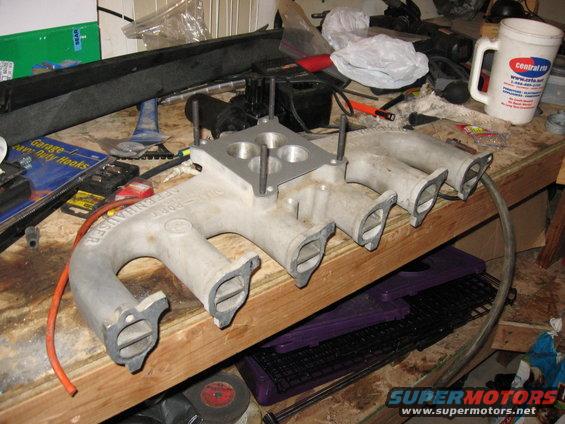
The back two holes are for the secondaries and come through the bottom, and the front two holes are for the primaries and come out the top.
If so, it's still an Offy C, and will respond like one. The DP has internal runners that separate the top of the intake from the bottom.
You can see them on the six ports in this picture:
The back two holes are for the secondaries and come through the bottom, and the front two holes are for the primaries and come out the top.
Posting Guru
Joined: Jan 2001
Posts: 2,357
Likes: 3
From: S. Mississippi
Apparently my manifold is a single plane, because it has none of the port dividers. Makes me wonder why they put a 4 hole carb adapter on a single plane manifold.
Thanks for the info, I really appreciate it.
Thanks for the info, I really appreciate it.
Moderator
Joined: Dec 2007
Posts: 7,987
Likes: 104
From: Boise, Idaho
I think the spacer helps to atomize the fuel a little bit, but I'm not sure. I have one on my Offy C as well. Currently, it spaces the carburetor away from the intake and helps line up the accelerator cable linkage and keeps the throttle from hitting the intake, so I've left it on there. Don't know if it really helps or not. 
Postmaster
Joined: Dec 2006
Posts: 3,603
Likes: 10
From: Spokane, WA
Some have put a 4 hole spacer on a Clifford or C for the reasons AB just stated. Some engines just don't respond as well when the base of the carb sets on the big open space of the Clifford or C. The spacer moves the base of the carb away from turbulence and allows for a more columnar flow through the carb.
Senior User
Joined: Nov 2010
Posts: 458
Likes: 1
Glad you posted that link, 80B; I hadn't seen an Offy C. The factory divider, coming halfway up, is a little bit of a head-scratcher. It surely didn't extend very far to either side of the plenum, and wouldn't begin to turn the manifold into a dual-anything. My guess is that the factory ran the prototype manifold on an engine and found that some cylinders were running richer, some leaner. Lots of manifolds get fine-tuned by putting in little air-dams and such to even up the flows to the cylinders, and that's probably what that original half-a-splitter was for. By dividing the mainfold in half as you and I have done, it's a new ballgame. When I get my engine into service, I won't be at all surprised to find rich and lean cylinders, and have to do my own fine-tuning to persuade the flows to go where I want 'em. Now, as Harte points out, spacers can make a difference, one which you can't really predict very well and just have to try. The serious engine builders tell us that some engines are really touchy about spacers, and they might end up testing 1/2", 1", 4-hole, 2-hole, and no-hole spacers. I think the thing is to try various spacers first, and see what the effect is not only on power but on cylinder-to-cylinder mixture differences, before trying to fix those differences with air-dams and such. Under the category "and such" I'm thinking of the way I made my splitter, not just a plate but flaring out at the bottom (about a 1" radiused curve); Changing the shape and directionality of this feature might have some effect on mixture evenness.
Luckily for me, there's a guy with a chassis dyno nearby, but the way to test this stuff, initially at least, is with oxygen sensors in each header tube (tell me you're NOT going to use that cheapo factory exhaust!). You weld bungs into each tube and get six sensors, one meter, and a six-position range switch so you can go back and forth checking cylinders. Now, the poor man's way to do this (and the only way I've ever done it before now) is to drill a little sighting hole in the top of each header tube a couple of inches out from the flange. After dark, with everything all ready to go and the engine completely warmed up, you run the engine at various throttle setting and look at the flame color in the holes: orange is rich, white is lean, and blue is what you want. Airline flight engineers on the big DC-6s and Constellations in the Fifties often set the mixtures on those big Wrights and Pratts at night in just this way. Later you can weld the little holes closed; what I did was weld a big nut above each hole so I could screw in a plug that I could remove later if I wanted another look.
Luckily for me, there's a guy with a chassis dyno nearby, but the way to test this stuff, initially at least, is with oxygen sensors in each header tube (tell me you're NOT going to use that cheapo factory exhaust!). You weld bungs into each tube and get six sensors, one meter, and a six-position range switch so you can go back and forth checking cylinders. Now, the poor man's way to do this (and the only way I've ever done it before now) is to drill a little sighting hole in the top of each header tube a couple of inches out from the flange. After dark, with everything all ready to go and the engine completely warmed up, you run the engine at various throttle setting and look at the flame color in the holes: orange is rich, white is lean, and blue is what you want. Airline flight engineers on the big DC-6s and Constellations in the Fifties often set the mixtures on those big Wrights and Pratts at night in just this way. Later you can weld the little holes closed; what I did was weld a big nut above each hole so I could screw in a plug that I could remove later if I wanted another look.

Tuned
Joined: Nov 2007
Posts: 386
Likes: 3
From: Whitmore lake Mi
Glad you posted that link, 80B; I hadn't seen an Offy C. The factory divider, coming halfway up, is a little bit of a head-scratcher. It surely didn't extend very far to either side of the plenum, and wouldn't begin to turn the manifold into a dual-anything. My guess is that the factory ran the prototype manifold on an engine and found that some cylinders were running richer, some leaner. Lots of manifolds get fine-tuned by putting in little air-dams and such to even up the flows to the cylinders, and that's probably what that original half-a-splitter was for. By dividing the mainfold in half as you and I have done, it's a new ballgame. When I get my engine into service, I won't be at all surprised to find rich and lean cylinders, and have to do my own fine-tuning to persuade the flows to go where I want 'em. Now, as Harte points out, spacers can make a difference, one which you can't really predict very well and just have to try. The serious engine builders tell us that some engines are really touchy about spacers, and they might end up testing 1/2", 1", 4-hole, 2-hole, and no-hole spacers. I think the thing is to try various spacers first, and see what the effect is not only on power but on cylinder-to-cylinder mixture differences, before trying to fix those differences with air-dams and such. Under the category "and such" I'm thinking of the way I made my splitter, not just a plate but flaring out at the bottom (about a 1" radiused curve); Changing the shape and directionality of this feature might have some effect on mixture evenness.
Luckily for me, there's a guy with a chassis dyno nearby, but the way to test this stuff, initially at least, is with oxygen sensors in each header tube (tell me you're NOT going to use that cheapo factory exhaust!). You weld bungs into each tube and get six sensors, one meter, and a six-position range switch so you can go back and forth checking cylinders. Now, the poor man's way to do this (and the only way I've ever done it before now) is to drill a little sighting hole in the top of each header tube a couple of inches out from the flange. After dark, with everything all ready to go and the engine completely warmed up, you run the engine at various throttle setting and look at the flame color in the holes: orange is rich, white is lean, and blue is what you want. Airline flight engineers on the big DC-6s and Constellations in the Fifties often set the mixtures on those big Wrights and Pratts at night in just this way. Later you can weld the little holes closed; what I did was weld a big nut above each hole so I could screw in a plug that I could remove later if I wanted another look.
Luckily for me, there's a guy with a chassis dyno nearby, but the way to test this stuff, initially at least, is with oxygen sensors in each header tube (tell me you're NOT going to use that cheapo factory exhaust!). You weld bungs into each tube and get six sensors, one meter, and a six-position range switch so you can go back and forth checking cylinders. Now, the poor man's way to do this (and the only way I've ever done it before now) is to drill a little sighting hole in the top of each header tube a couple of inches out from the flange. After dark, with everything all ready to go and the engine completely warmed up, you run the engine at various throttle setting and look at the flame color in the holes: orange is rich, white is lean, and blue is what you want. Airline flight engineers on the big DC-6s and Constellations in the Fifties often set the mixtures on those big Wrights and Pratts at night in just this way. Later you can weld the little holes closed; what I did was weld a big nut above each hole so I could screw in a plug that I could remove later if I wanted another look.

I think that may be it.
Jim