



CPS Teardown
Thread Starter
|
Cargo Master


Joined: May 2010
Posts: 3,047
Likes: 9
From: Snohomish, WA

I tested the black one to the grey and dark blue magnet strength. I found the black one would pick up a 1/4 drive socket. The black one could lift a 12mm and the other two could only pickup a 6 or 7mm. I don't remember if it was a deep or shallow right now. When I get home I will try it again.

Junior User
Joined: Aug 2009
Posts: 61
Likes: 0
From: Arlington, WA
This whole thing still fascinates me. Why did portsample's BW CPS fail after a few hours and mine hasnt had a single blip yet...
If we can find out why the BW CPS fails perhaps we could find a fix, then we would have a great CPS that wont fail. No doubt the BW is better than the Grey, but its reputation is awful.
If we can find out why the BW CPS fails perhaps we could find a fix, then we would have a great CPS that wont fail. No doubt the BW is better than the Grey, but its reputation is awful.
Ken, great pictures. Thanks for tearing into that.

Tuned


Joined: Aug 2008
Posts: 276
Likes: 9
From: Alaska (not Anchorage)
Just got my unit from Navistar, (part #1876736C91, and one from Motorcraft, (part #F4TZ-12K073-C). They are identical units: both have the International part number (#1876736C91) stamped on the barrel. Installed the International unit. The idle seems smoother and the motor keeps running when the wipers are switched on. We'll see how significant the mpg change is.
Tuned
Joined: Aug 2008
Posts: 276
Likes: 9
From: Alaska (not Anchorage)
I've been running the Navistar unit since March with no noticeable problems. The idle is acceptably smooth to my ear. Mileage may have improved somewhat as the result of installing this unit, however all of the other variables that affect mileage are certainly masking any effect the swap had. Below is my mileage to date showing,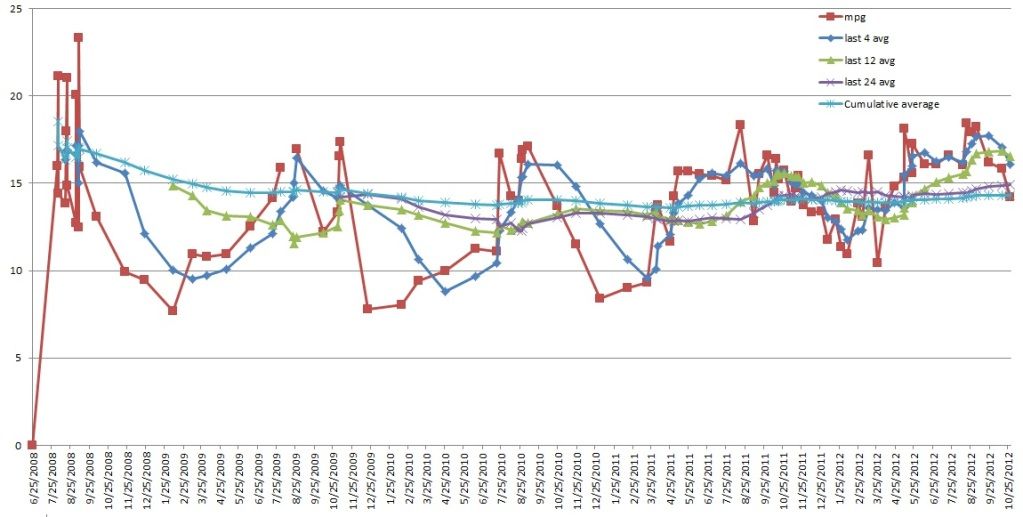
The big driver for me regarding mileage is likely temperature and road conditions. Worsening mileage in the fall and early winter as the temps drop and I start using 4WD and driving on icy roads, terrible mileage in January when I'm most often pushing through deep snow. Interestingly, this year the road to town (approx 1/3 of the overall distance that I drive on a given tank) was resurfaced and made scary smooth, so much so that I noticed that rolling resistance decreased and it took less throttle to hold the 45mph speed limit...consequently mileage this summer was great...I'd like to attribute this increase to the CPS, but I think that other factors may have a greater influence.
-actual mpg per fill-up,
-average mpg of last 4 fill-ups,
-average mpg of last 12 fill-ups,
-average mpg of last 24 fill-ups,
-average mpg of all fill-ups since I've had the truck.
-average mpg of last 4 fill-ups,
-average mpg of last 12 fill-ups,
-average mpg of last 24 fill-ups,
-average mpg of all fill-ups since I've had the truck.
The big driver for me regarding mileage is likely temperature and road conditions. Worsening mileage in the fall and early winter as the temps drop and I start using 4WD and driving on icy roads, terrible mileage in January when I'm most often pushing through deep snow. Interestingly, this year the road to town (approx 1/3 of the overall distance that I drive on a given tank) was resurfaced and made scary smooth, so much so that I noticed that rolling resistance decreased and it took less throttle to hold the 45mph speed limit...consequently mileage this summer was great...I'd like to attribute this increase to the CPS, but I think that other factors may have a greater influence.

Senior User
Joined: Sep 2011
Posts: 203
Likes: 1
From: Delaware
Ken. In my bus fleet I have T444E and DT 466 engines. They take different CPS's. When I have a 444E that is a little sluggish, usually with high milage I put a DT CPS in it and see if it acts better. The one from the DT advances the timing slightly and compensates for gear wear. "Not recomended by Navistar" These sensors are Hall effect design. Meaning they count the windows on the gear and when the wide window passes the sensor the ECM see's #1 cyl. Thats why different suppliers CPS's do differnt things. They fool around with magnet positioning.
Senior User
Joined: May 2011
Posts: 454
Likes: 0
From: Portland, OR
Thanks very much for the information. Like a lot of people I'd guess, my spare CPS living in the glove box came from a previous troubleshooting part spraying session, so being able to compare the pin resistances to what you've found is a great way to make sure that one won't let you down when you need it!
Elder User
Joined: Mar 2004
Posts: 580
Likes: 0
From: Chippewa Falls, WI
FTE Stories
Ford Trucks for Ford Truck Enthusiasts

AEV FXL Super Duty - the Super Duty Raptor Ford Doesn't Make
Brett Foote
Lobo Vs Lobo: Proof the F-150 Lobo Should Be Even Lower!
Michael S. Palmer
Ford's 2001 Explorer Sportsman Concept Looks For a New Home
Verdad Gallardo
10 Best Ford Truck Engines We Miss the Most!
Joe Kucinski
2026 Shelby F-150 Off-Road: Better Than a Raptor R?
Brett Foote
2027 Super Duty Carhartt Package First Look: 12 Things You NEED to Know!
Michael S. Palmer
10 Most Surprising 2026 Ford Truck Features!
Joe Kucinski
Top 10 Ford Trucks Coming to Mecum Indy 2026
Brett Foote
5 Best / 5 Worst Ford Truck Wheels of All Time
Joe Kucinski
Post Fiend
Joined: Nov 2007
Posts: 9,549
Likes: 14
From: Payson, AZ
I posted this in another thread already today but this is another good place for it.
"This is a Ford Special Service Message posted by Nolan (4inchlovin) about "Phantom Codes" after running a CCT".

"This is a Ford Special Service Message posted by Nolan (4inchlovin) about "Phantom Codes" after running a CCT".
Hotshot


Joined: Jan 2011
Posts: 18,849
Likes: 179
From: Puget Sound
Ken. In my bus fleet I have T444E and DT 466 engines. They take different CPS's. When I have a 444E that is a little sluggish, usually with high milage I put a DT CPS in it and see if it acts better. The one from the DT advances the timing slightly and compensates for gear wear. "Not recomended by Navistar" These sensors are Hall effect design. Meaning they count the windows on the gear and when the wide window passes the sensor the ECM see's #1 cyl. Thats why different suppliers CPS's do differnt things. They fool around with magnet positioning.


Fleet Mechanic

Joined: Feb 2007
Posts: 1,852
Likes: 39
Ken, like everyone else here, I appreciate your efforts in providing this information. The only thing that I might add is that when taking resistance readings on semiconductor devices, it is helpful to make the measurement, then reverse the meter leads and make the measurement again, and provide both numbers. This will identify where diode or transistor junctions exist in a device, and which whey they are polarized.
The blue part appears to be a ceramic capacitor.
The blue part appears to be a ceramic capacitor.

Postmaster
Joined: Dec 2010
Posts: 2,951
Likes: 4
From: Gary,Indiana
Ken. In my bus fleet I have T444E and DT 466 engines. They take different CPS's. When I have a 444E that is a little sluggish, usually with high milage I put a DT CPS in it and see if it acts better. The one from the DT advances the timing slightly and compensates for gear wear. "Not recomended by Navistar" These sensors are Hall effect design. Meaning they count the windows on the gear and when the wide window passes the sensor the ECM see's #1 cyl. Thats why different suppliers CPS's do differnt things. They fool around with magnet positioning.
I might be interested in trying that since I am still running stock tunes with a 1.0 turbine housing. I am in need of a little bottom end. So if it advances the injection timing by a 1.0* degree or less I can see that being helpful in my case.
But like Rich said if you are running tunes it might not be a good idea since too much advancement injection timing could mean a burned up piston or worse.

New User
Joined: Nov 2009
Posts: 15
Likes: 2
I know this is an old thread but wanted to update a fix I used for the wiper issue with the BWD CPS as well as others causing stalling or stubbling. Apparently, the issue is trash interference from the wiper motor which is magnified on intermittent setting. This can actually happen with all CPS but some are more sensitive than others. The wiper motor according to TPS is going bad. THe "correct" fix is to repalce the wiper motor. IMO a good fix until the dam thing dies, if ever, is to cut the ground wire coming from the wiper motor which happens to use the same main ground wire as the PCM and few other things which is why it causes the issue. Cut the ground wire and then rewire it to its own ground somewhere else.
All I can say is this fixed the issue in one truck a friend had the issue with and was also a suggested suggested solution I read in a TPS. This should allow people to use the BW as well as I think people had issue with the bosch unit and others as well from this.
The issue with the Ford and IH new CPS, as well as it seems every one I have seen cut open that has the recessed or stepped in end instead of the full sized housing to the tip of the unit, is the plastic end is about 3/16"-1/4" thick even a tad more and the hall sensor itself is actually off set a bit (about 1/8")
The original Ford/IH (blacks), BWD, and the Delphi units that had the large ends seems to all have the halls sensor directly in the center. The end cap plastic was so thin that the hall sensor actually caused a protrusion that can be seen if you angle it in good light (like a ghosting image). Further when you test the magnetic strength at the tip by pickup up different weight objects the ones with the larger housing, thin cover, and centered halls all are significantly stronger, picking up heaiver items.
Consider what the effect is of having two units both with the same over all length that they protrude into the front cover to the cam gear but one has the actual sensor 1/4" farther away because of the extra plastic so the sensor is actually deeper into the CPS than the one with it right at the the surface.
Then consider what the effect of sloppy placement of the hall sensor does so that it is no longer centered but slightly off set. This has the same effect as changing the time of SOI (start of the injection). 1/8" offset equals about a 2.4 degree change in timing if it consider a tangent off centerline. Adjusting timing that amount in a diesel or gas for that matter has a significant effect. It would be one thing is the engine was some how updated for this change or the engine was setup for the specs of these new sensors. The issue is it was setup for the original sensors. That means a centered sensor. That sensor was suppose to be what .25-.30 off the cam gear. If the plastic cover itself on the new ones is .25 thick it would almost have to be touching the actual cam gear to be at the correct distance. Not even taking into account its not centers up as it should.
This is all from a collection of reading what others have found and some testing I did. IN no way do I take credit for all these findings I just wanted to put them in one place for everyone here as I know these CPS are frustrating. They are one of the the most critical pieces to our engines performance. Without it there is no timing for fuel, knowing rpm, diagnositc trouble shooting etc. All of the various systems accuracy is based off accurate readings from the CPS. SO if its not perfect nothing based off it can be.
So what you want is a unit with the larger housing end. The hall sensor centered and the thinnest amount of plastic covering the hall sensor on the tip end. If the plastic is thin you should get a slight impression of the hall sensor when you angle it back and forth in the light. THe color of the aftermarket sensors is meaningless do not refer to any by color. It will only screw you and everyone that reads it up. Take the BWD. They were black now they are grey. But everything is the same only the color of plastic changed as it was likely a cheaper cost for it. Further you can not just rely on names either IMO you need to look at the sensor if you can before buying them or check with other than have in relatively recent time. Delphi I purchased from Advanced Auto came as identical to the ford upgraded ones that all call the greys. It was also grey in color. It no longer had the full sized end and had the same weak magnetic strength. Total crap. Either they have changed design or had a shortage and bought from the same manf Ford used. SO maybe this will change back or its only some in circulation but I know of at least one more that reported the same thing from a amazon online purchase.
So moral of the story is have the CPS is hand and make usre it has the large end and if you can try to see the hall sensor ghosted imprint on the end.
A drill bit will also tend to roughly center to the center of the magnet of the hall sensor. But all the large end ones from Delphi (delphi now has small end ones out there as well, be careful) and BWD have been perfectly centered and very thin plastic covering.
I put dielectric grease in and around the connector to ensrue no moisture issues.
What amazes me is that Ford has the gall to call these failures on contribution tests and perdels that spike on numerous cylinders as nothijng but phantoms. Sorry but it measures electrical inputs exactly how is that phantom of anything. Its total BS to not have to be responsible for another 1 million unit recall on 10+ yr old vehicles. They are getting these readings because they used cheapo manf tolerances and design. It clearly has an effect on the engine no different than adusting the time by 2.4 degrees on a gas engine would. Duh That is just from the offset which I bet can vary as well. Then missed pickup of teeth from the fact the magnet is about 1/4" farther away from the cam gear than it should be. Then take into account wear variations in the various engines out there. Some will obviously be effected far worse than others. But this is anything but phantom issues that the PCM or CPS is somehow sending out. There is no way my basic brain is smarter than those ford techs at corp so its a real good bet they know this quite well.
All I can say is this fixed the issue in one truck a friend had the issue with and was also a suggested suggested solution I read in a TPS. This should allow people to use the BW as well as I think people had issue with the bosch unit and others as well from this.
The issue with the Ford and IH new CPS, as well as it seems every one I have seen cut open that has the recessed or stepped in end instead of the full sized housing to the tip of the unit, is the plastic end is about 3/16"-1/4" thick even a tad more and the hall sensor itself is actually off set a bit (about 1/8")
The original Ford/IH (blacks), BWD, and the Delphi units that had the large ends seems to all have the halls sensor directly in the center. The end cap plastic was so thin that the hall sensor actually caused a protrusion that can be seen if you angle it in good light (like a ghosting image). Further when you test the magnetic strength at the tip by pickup up different weight objects the ones with the larger housing, thin cover, and centered halls all are significantly stronger, picking up heaiver items.
Consider what the effect is of having two units both with the same over all length that they protrude into the front cover to the cam gear but one has the actual sensor 1/4" farther away because of the extra plastic so the sensor is actually deeper into the CPS than the one with it right at the the surface.
Then consider what the effect of sloppy placement of the hall sensor does so that it is no longer centered but slightly off set. This has the same effect as changing the time of SOI (start of the injection). 1/8" offset equals about a 2.4 degree change in timing if it consider a tangent off centerline. Adjusting timing that amount in a diesel or gas for that matter has a significant effect. It would be one thing is the engine was some how updated for this change or the engine was setup for the specs of these new sensors. The issue is it was setup for the original sensors. That means a centered sensor. That sensor was suppose to be what .25-.30 off the cam gear. If the plastic cover itself on the new ones is .25 thick it would almost have to be touching the actual cam gear to be at the correct distance. Not even taking into account its not centers up as it should.
This is all from a collection of reading what others have found and some testing I did. IN no way do I take credit for all these findings I just wanted to put them in one place for everyone here as I know these CPS are frustrating. They are one of the the most critical pieces to our engines performance. Without it there is no timing for fuel, knowing rpm, diagnositc trouble shooting etc. All of the various systems accuracy is based off accurate readings from the CPS. SO if its not perfect nothing based off it can be.
So what you want is a unit with the larger housing end. The hall sensor centered and the thinnest amount of plastic covering the hall sensor on the tip end. If the plastic is thin you should get a slight impression of the hall sensor when you angle it back and forth in the light. THe color of the aftermarket sensors is meaningless do not refer to any by color. It will only screw you and everyone that reads it up. Take the BWD. They were black now they are grey. But everything is the same only the color of plastic changed as it was likely a cheaper cost for it. Further you can not just rely on names either IMO you need to look at the sensor if you can before buying them or check with other than have in relatively recent time. Delphi I purchased from Advanced Auto came as identical to the ford upgraded ones that all call the greys. It was also grey in color. It no longer had the full sized end and had the same weak magnetic strength. Total crap. Either they have changed design or had a shortage and bought from the same manf Ford used. SO maybe this will change back or its only some in circulation but I know of at least one more that reported the same thing from a amazon online purchase.
So moral of the story is have the CPS is hand and make usre it has the large end and if you can try to see the hall sensor ghosted imprint on the end.
A drill bit will also tend to roughly center to the center of the magnet of the hall sensor. But all the large end ones from Delphi (delphi now has small end ones out there as well, be careful) and BWD have been perfectly centered and very thin plastic covering.
I put dielectric grease in and around the connector to ensrue no moisture issues.
What amazes me is that Ford has the gall to call these failures on contribution tests and perdels that spike on numerous cylinders as nothijng but phantoms. Sorry but it measures electrical inputs exactly how is that phantom of anything. Its total BS to not have to be responsible for another 1 million unit recall on 10+ yr old vehicles. They are getting these readings because they used cheapo manf tolerances and design. It clearly has an effect on the engine no different than adusting the time by 2.4 degrees on a gas engine would. Duh That is just from the offset which I bet can vary as well. Then missed pickup of teeth from the fact the magnet is about 1/4" farther away from the cam gear than it should be. Then take into account wear variations in the various engines out there. Some will obviously be effected far worse than others. But this is anything but phantom issues that the PCM or CPS is somehow sending out. There is no way my basic brain is smarter than those ford techs at corp so its a real good bet they know this quite well.
Senior User
Joined: Sep 2011
Posts: 203
Likes: 1
From: Delaware
Have you ever run live data on one of your bus before and after the swapping in a DT466 cps? And when you have swapped in a DT cps on a unit do you have any of them with over 50k-100k on the DT cps? And next time you do so can you please take a photo of both cps and please post up the part # you are using from the DT.
I might be interested in trying that since I am still running stock tunes with a 1.0 turbine housing. I am in need of a little bottom end. So if it advances the injection timing by a 1.0* degree or less I can see that being helpful in my case.
But like Rich said if you are running tunes it might not be a good idea since too much advancement injection timing could mean a burned up piston or worse.
I might be interested in trying that since I am still running stock tunes with a 1.0 turbine housing. I am in need of a little bottom end. So if it advances the injection timing by a 1.0* degree or less I can see that being helpful in my case.
But like Rich said if you are running tunes it might not be a good idea since too much advancement injection timing could mean a burned up piston or worse.
But when you drive it and it feels better and it starts quicker you just leave it. We do not run any tunes. These engines run hot and work hard. The GVWR is 33K LBS with air brakes and rear air ride. Many components between the DT466 and the T444E are the same in the buses. Like radiators, steering boxes, ECM's (just programmed for it's application).