


Should the tailpipe be black?

Postmaster
Joined: Feb 2006
Posts: 3,201
Likes: 4
From: waynesville, mo.

Senix - I hear what you are saying but even if the truck had a leaky injector or EGT issues, the DPF should still catch the resulting soot particulates and the regen would occur make more frequently and burn of the excessive fuel. If you have soot build up down stream of the DPF filter and even more so, if you can visibly see smoke coming out of your pipe, the DPF is faulty.
The underlying problem (i.e. Leaky injector, EGT issues, etc...) could be what caused the DPF filter to fail so it would need to be addressed as well as the DPF replacement.
The underlying problem (i.e. Leaky injector, EGT issues, etc...) could be what caused the DPF filter to fail so it would need to be addressed as well as the DPF replacement.

Junior User
Joined: Jul 2010
Posts: 69
Likes: 0
From: Boise, Idaho
So your saying that the tail pipe from the muffler to the exhaust tip cleaned itself? How did it do that? The DPF and DOC have catalysts in them that promote increased temperatures sufficient enough to burn off the particulates and break them down to a molecular level. A tail pipe is just a piece of pipe.....unless your truck is one of those flame throwers seen on the You Tube videos.
Junior User
Joined: Jul 2010
Posts: 69
Likes: 0
From: Boise, Idaho
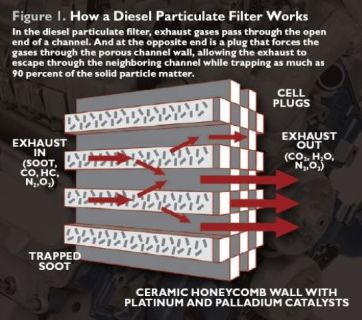
Think of the DPF not so much as a filter, but more like a storage unit. It "stores" the unburned soot until the backpressure causes a regen to occur. Problems upstream can cause the DPF to be "overloaded" and excess soot can get through. A crack, or a broken substrate in the DPF will also be noticed with the backpressure sensor. It (the pcm) knows there will be a certain amount of backpressure, and if theres an "open" exhaust, or a dramatic loss of backpressure, it will see it. If its minor, it may or may not set a dtc. Theres been a lot of "cracked" or defective DPFs charged back to the dealers because there was nothing wrong with them on further inspection.
How was it determined that the DPF's that were replaced under warranty were not defective? The only way to do this is to do a destructive cause analysis and to do this you have to cut it open. That in itself would most likely destroy any feasable proof that the filter medium had a crack in it prior to cutting it open unless you are lucky enough to find a crack in the undamaged material. However, the crack may even be so small that the human eye can not see it or it may be located deep within the material in the vast honeycomb of surface area in the DPF....
With that said.....the current technology of the filters are only 90% efficient so there is some particulate material than can make it thru the filter....

Tuned

Joined: Jul 2007
Posts: 413
Likes: 1
From: Tennessee
My DPF was replaced at 30000 due to me complaining and complaining about the pipes being black. I kept telling them that the DPF must be bad since it is supposed to be trapping the soot. It was replaced. It didnt stop the soot problem. The brand new DPF let through soot just like the one they took off. So either there was another problem, or they put on another bad DPF. They said they replaced my first one due to some guidelines put out for black tail pipes and not necessarily because it was cracked. I think there is another problem in addition to the DPF. Yes, it is SUPPOSED to catch the soot. And it DOES, at least SOME of it, cause it regens every 3 or 4 hundred miles, but it smokes just like the OP's does and I'm about ready to drive this thing to the dealer and leave it, or at least let it run in the Service Bay til someone fixes it. Im sick of this crap.
Postmaster
Joined: Feb 2006
Posts: 3,201
Likes: 4
From: waynesville, mo.
Not sure I agree with your thought process but rather than argue about it, we are all free to have an opinion whether it is factual or theoretical.
How was it determined that the DPF's that were replaced under warranty were not defective? The only way to do this is to do a destructive cause analysis and to do this you have to cut it open. That in itself would most likely destroy any feasable proof that the filter medium had a crack in it
How was it determined that the DPF's that were replaced under warranty were not defective? The only way to do this is to do a destructive cause analysis and to do this you have to cut it open. That in itself would most likely destroy any feasable proof that the filter medium had a crack in it
Junior User
Joined: Jul 2010
Posts: 69
Likes: 0
From: Boise, Idaho
Ok, If you introduce a measured flow of air into one end, and you know how much backpressure the DPF will have, you should be able to judge how much air flow should be exiting. There was no "cutting it in half " either. If what you say is true, a "crack" large enough to allow soot to escape readily, should alter this airflow, correct? If the crack is miniscule how much soot will escape, and how will this miniscule crack alter the flow of test air?
Make sense to me....I guess you have a point....

Lead Driver

Joined: Jul 2007
Posts: 7,868
Likes: 9
From: Rhode Island
Ok, If you introduce a measured flow of air into one end, and you know how much backpressure the DPF will have, you should be able to judge how much air flow should be exiting. There was no "cutting it in half " either. If what you say is true, a "crack" large enough to allow soot to escape readily, should alter this airflow, correct? If the crack is miniscule how much soot will escape, and how will this miniscule crack alter the flow of test air?
FTE Stories
Ford Trucks for Ford Truck Enthusiasts

Rezvani's Latest Post-Apocalytic Monster Is a Ford F-150 Raptor Underneath
Verdad Gallardo
Top 10 Most Expensive Ford Trucks Ever Sold on Bring a Trailer
Joe Kucinski
2027 Ford Super Duty Buyer's Guide (Every Model, Engine, & Package)
Brett Foote
Top 10 Ford Truck Tragedies
Joe Kucinski
AEV FXL Super Duty - the Super Duty Raptor Ford Doesn't Make
Brett Foote
Lobo Vs Lobo: Proof the F-150 Lobo Should Be Even Lower!
Michael S. Palmer
Ford's 2001 Explorer Sportsman Concept Looks For a New Home
Verdad Gallardo
10 Best Ford Truck Engines We Miss the Most!
Joe Kucinski
2026 Shelby F-150 Off-Road: Better Than a Raptor R?
Brett Foote
Postmaster
Joined: Feb 2006
Posts: 3,201
Likes: 4
From: waynesville, mo.
Ya know, I think Ford Motor Company is smart enough to clean them before testing. Besides, that still rules out a "crack".......Right? Think about it, soot on the DPF will make more backpressure. Look in the ends, one end sooty and nasty, other end somewhat clean. That sounds like a DPF with nothing wrong. Cracked or broken substrate (free flowing exhaust....free flowing exhaust shouldnt stop soot) Should be sooty on both ends (this is your arguement), this should register on flow readings as well, before and after cleaning. None have required "cutting apart".
Lead Driver
Joined: Jul 2007
Posts: 7,868
Likes: 9
From: Rhode Island
I doubt that you would be able to fully clean a DPF to the point where you could consider back pressure measurements accurate. This is why trucks that have had cracked DPFs don't even trigger an engine light.
Either way, any soot at all in the tail pipe means the DPF has been compromised. There is no way around it! Modern DPFs are closer to 97-98% efficient at catching soot, and their effeciency goes up as they fill up with soot. You'd have to have a lot of miles before soot began collecting on the tailpipes. There are guys with 50,000+ miles on their trucks and the tail pipes are still clean.
Either way, any soot at all in the tail pipe means the DPF has been compromised. There is no way around it! Modern DPFs are closer to 97-98% efficient at catching soot, and their effeciency goes up as they fill up with soot. You'd have to have a lot of miles before soot began collecting on the tailpipes. There are guys with 50,000+ miles on their trucks and the tail pipes are still clean.
Postmaster
Joined: Feb 2006
Posts: 3,201
Likes: 4
From: waynesville, mo.
I doubt that you would be able to fully clean a DPF to the point where you could consider back pressure measurements accurate. This is why trucks that have had cracked DPFs don't even trigger an engine light.
Either way, any soot at all in the tail pipe means the DPF has been compromised. There is no way around it! Modern DPFs are closer to 97-98% efficient at catching soot, and their effeciency goes up as they fill up with soot. You'd have to have a lot of miles before soot began collecting on the tailpipes. There are guys with 50,000+ miles on their trucks and the tail pipes are still clean.
Either way, any soot at all in the tail pipe means the DPF has been compromised. There is no way around it! Modern DPFs are closer to 97-98% efficient at catching soot, and their effeciency goes up as they fill up with soot. You'd have to have a lot of miles before soot began collecting on the tailpipes. There are guys with 50,000+ miles on their trucks and the tail pipes are still clean.
Lead Driver
Joined: Jul 2007
Posts: 7,868
Likes: 9
From: Rhode Island
Because the computer constantly calibrates the sensors and can establish a range of back pressures for a high limit and a low limit. There is also code probably written in there to figure for gradual permanent DPF loading.
Modern automatic transmissions also have similar code. As the clutch packs wear, the computer will compensate by gradually commanding higher line pressures.
Modern automatic transmissions also have similar code. As the clutch packs wear, the computer will compensate by gradually commanding higher line pressures.
Postmaster
Joined: Feb 2006
Posts: 3,201
Likes: 4
From: waynesville, mo.
BZZZZT....WRONG! The sensors are constant. The pcm has a set of values to look at KOEO, hot idle, and higher range (I say higher range because some are 1500/2000 rpm and some are WOT, depending on which sensor is being monitored) My arguement is that its not cut and dry like some say it is, many other things can cause sooty pipes. Actually, the very last thing that you condemn is the DPF.

Thread Starter
|
Cargo Master

Joined: Jan 2002
Posts: 2,079
Likes: 11
From: LA and CO
Been reading it all.
How does the tech determine what is wroing if all checks OK when he plugs in hius test equipment to the truck and all reads fine?
Basically, I'm tired of dealing with guys who have been trained only so much by the factory. If it all "looks good" but has sooty pipes something must be wrong. I think we all agree on this but the dealers simply say "It's all good!!!"
How does the tech determine what is wroing if all checks OK when he plugs in hius test equipment to the truck and all reads fine?
Basically, I'm tired of dealing with guys who have been trained only so much by the factory. If it all "looks good" but has sooty pipes something must be wrong. I think we all agree on this but the dealers simply say "It's all good!!!"
Lead Driver
Joined: Jul 2007
Posts: 7,868
Likes: 9
From: Rhode Island
BZZZZT....WRONG! The sensors are constant. The pcm has a set of values to look at KOEO, hot idle, and higher range (I say higher range because some are 1500/2000 rpm and some are WOT, depending on which sensor is being monitored) My arguement is that its not cut and dry like some say it is, many other things can cause sooty pipes. Actually, the very last thing that you condemn is the DPF.
The computer DOES have to calibrate each sensor to some degree as well. Perhaps not constantly calibrate, but it has to learn that sensor's reading range. Automotive sensors are not made to be the most accurate or precise measuring devices. There can be quite a bit of variation between the exact same sensors and the computer has to compensate for that.
How can anything else cause sooty tail pipes. It is just not possible unless the DPF has been compromised! You can dump buckets of soot into the DPF and its not supposed to let any get by. Yes it will get plugged up, but shouldn't pass it through to the tailpipe. It doesn't matter if you have an EGR, injector , etc.. problem causing excessive soot, all of it should get trapped by the dpf