




New look(s)
FTE Chapter Leader


Joined: May 2006
Posts: 11,273
Likes: 100
From: North Dakota

Did your old traction bars only attach to the rear axle at one point?
Because if they did, and u had a shackle on the frame end, they didn't do any good at all. In order to make use of the shackle u have to have two attachment points at the axle. One on top of the axle and one in front or on the bottom of the axle. That will keep it from rotating. Yes they way u have it set up now will work, but if u flex it at all, there is a chance of bending the bars.
Because if they did, and u had a shackle on the frame end, they didn't do any good at all. In order to make use of the shackle u have to have two attachment points at the axle. One on top of the axle and one in front or on the bottom of the axle. That will keep it from rotating. Yes they way u have it set up now will work, but if u flex it at all, there is a chance of bending the bars.
Postmaster
Joined: Oct 2005
Posts: 3,083
Likes: 4
From: Victoria , BC
Here's a good qoute from Billa Vista from his article:
How to chose a Driveshaft for your Rig.
This is actually a fairly easy one to answer.
First - buy the absolute best you can possibly afford. Why? It is almost impossible to overstate the massive annoyance of a bad driveshaft. Driveshaft vibration is horrendously annoying - street queen or trail-only rig. Believe me, I know. My current buggy, the Wolf, is always trailered, and spends 90% of it's time below 10mph - occasionally it may get to 40mph. I had NO IDEA how bad my cobbled-together shaft was until I replaced it with a High Angle driveshaft. Even at slow speeds, a crappy driveshaft will EASILY suck the fun out of driving your rig. I figured - it's trail buggy - it's loose and noisy anyway - who cares. Well, I learned....it is Sooooooooo much nicer with a decent balanced shaft, operating within it's angle capabilities - and of course - the peace of mind for the components that actually put the power to the axles is priceless.
Do you need a a CV shaft, or will a standard single-cardan style do? Well, in my opinion, unless your rig is only an inch or 2 over stock suspension height, with minimal wheel travel / flex, the answer is definitely YES!
The CV driveshaft offers several HUGE advantages to the off-road vehicle.
First, the pinion and pinion yoke can be rotated up out of harms way, where it will be less susceptible to damage from rocks and other obstacles.
Secondly, the only limit to our operating angle at the CV joint (and thus how much suspension height we can run) is the limit of the double-cardan joint itself. A stock Spicer double cardan CV joint can run successfully at about 22°, and a High Angle Driveline double-cardan CV joint can be run successfully at as much as 32° !!! This allows for successful driveshaft installations in vehicles with much more suspension height than a simple single-cardan shaft can accommodate. Even if you matched the angles on a single cardan shaft exactly, you could never run it safely and vibration free at 30°!
Thirdly, the double-cardan CV joint assembly is simply better and more efficient at reducing or eliminating driveshaft vibration. Even at smaller angles, and even with correct matched-angle geometry, the single-cardan shaft is still susceptible to vibration. The CV shaft will always run smoother, quieter, and with less stress on the u-joints, and transfer case and pinion shafts, bearings, and seals.
The only advantage the single-cardan shaft has is that it is cheaper to manufacture / buy, and you don't have to buy a centering yoke or a third u-joint when rebuilding it. As always - the best costs a little more!
How to chose a Driveshaft for your Rig.
This is actually a fairly easy one to answer.
First - buy the absolute best you can possibly afford. Why? It is almost impossible to overstate the massive annoyance of a bad driveshaft. Driveshaft vibration is horrendously annoying - street queen or trail-only rig. Believe me, I know. My current buggy, the Wolf, is always trailered, and spends 90% of it's time below 10mph - occasionally it may get to 40mph. I had NO IDEA how bad my cobbled-together shaft was until I replaced it with a High Angle driveshaft. Even at slow speeds, a crappy driveshaft will EASILY suck the fun out of driving your rig. I figured - it's trail buggy - it's loose and noisy anyway - who cares. Well, I learned....it is Sooooooooo much nicer with a decent balanced shaft, operating within it's angle capabilities - and of course - the peace of mind for the components that actually put the power to the axles is priceless.
Do you need a a CV shaft, or will a standard single-cardan style do? Well, in my opinion, unless your rig is only an inch or 2 over stock suspension height, with minimal wheel travel / flex, the answer is definitely YES!
The CV driveshaft offers several HUGE advantages to the off-road vehicle.
First, the pinion and pinion yoke can be rotated up out of harms way, where it will be less susceptible to damage from rocks and other obstacles.
Secondly, the only limit to our operating angle at the CV joint (and thus how much suspension height we can run) is the limit of the double-cardan joint itself. A stock Spicer double cardan CV joint can run successfully at about 22°, and a High Angle Driveline double-cardan CV joint can be run successfully at as much as 32° !!! This allows for successful driveshaft installations in vehicles with much more suspension height than a simple single-cardan shaft can accommodate. Even if you matched the angles on a single cardan shaft exactly, you could never run it safely and vibration free at 30°!
Thirdly, the double-cardan CV joint assembly is simply better and more efficient at reducing or eliminating driveshaft vibration. Even at smaller angles, and even with correct matched-angle geometry, the single-cardan shaft is still susceptible to vibration. The CV shaft will always run smoother, quieter, and with less stress on the u-joints, and transfer case and pinion shafts, bearings, and seals.
The only advantage the single-cardan shaft has is that it is cheaper to manufacture / buy, and you don't have to buy a centering yoke or a third u-joint when rebuilding it. As always - the best costs a little more!
Thread Starter
|
Posting Guru
Joined: Apr 2006
Posts: 1,218
Likes: 0
From: Fl
Alot of usefull info there. Like I said, I would love to have the setup like you showed but I'm gonna see how these do for now.
And I have 1410's on the transfer case as well as the rear end. But thanks for the info.
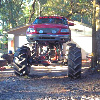
My old bars mounted at 2 points, they were homemade by the previous owner of the truck. It had a piece of square tubing that mounted to a perch welded onto the axle and the u-bolt around the axle to hold in in place. So technically they were mounted with 2-ponts i guess.
And I have 1410's on the transfer case as well as the rear end. But thanks for the info.
My old bars mounted at 2 points, they were homemade by the previous owner of the truck. It had a piece of square tubing that mounted to a perch welded onto the axle and the u-bolt around the axle to hold in in place. So technically they were mounted with 2-ponts i guess.
Thread Starter
|
Posting Guru
Joined: Apr 2006
Posts: 1,218
Likes: 0
From: Fl
yup.
It was fine til I put on the 44's. Thats when I started snapping ujoints.
It was fine til I put on the 44's. Thats when I started snapping ujoints.
FTE Stories
Ford Trucks for Ford Truck Enthusiasts

Top 6 Best Deals Available on New Fords & Lincolns Right Now
Brett Foote
This Hennessey Takes the Expedition Tremor's Off-Roading Capability to the Next Level
Verdad Gallardo
Top 10 Fords at 2026 Carlisle Ford Nationals
Joe Kucinski
3 Best / 3 Worst Parts of Modern Ford Ownership
Brett Foote
10 Amazing Upgrades That Solve Common Ford Truck Owner Headaches
Pouria Savadkouei
Every 2026 Ford Engine Explained
Brett Foote
10 Ugly Ford Trucks That We Still Kinda Love
Joe Kucinski
10 Things Every Truck Owner NEEDS (2026 Edition)
Michael S. Palmer
Rezvani's Latest Post-Apocalyptic Monster Is a Ford F-150 Raptor Underneath
Verdad Gallardo
Thread Starter
|
Posting Guru
Joined: Apr 2006
Posts: 1,218
Likes: 0
From: Fl
Had a piece on 1x1 square tubing that met up with a perch welded onto the axle. Attached using a large U-bolt that went through the tubing.

Thread
Thread Starter
Forum
Replies
Last Post
TheTinian
Offroad & 4x4
39
Apr 30, 2009 09:31 AM
TheTinian
1973 - 1979 F-100 & Larger F-Series Trucks
49
Jul 5, 2008 06:08 PM
