


302 Head Swap Problem

Senior User
Joined: Jan 2009
Posts: 318
Likes: 3
From: Brampton, On. Can.
So that explains it. When I was researching the AFR185 heads, it stated that only the '86 302 pistons would require notching for valve clearance. I wondered why just the '86 needed it. That's great info to remember. Thanks.

FTE Legend


Joined: Jun 2006
Posts: 31,930
Likes: 1,499
From: Ottawa, Ontario
I don't think so, that would be a roller motor and they use shorter pushrods(because the roller lifters are taller). You're looking at custom pushrods here.. which isn't a big expense you'll just have to wait for them to be delivered.
FTE Legend
Joined: Jun 2006
Posts: 31,930
Likes: 1,499
From: Ottawa, Ontario
The '86 motor also used true flat top pistons with no valve reliefs at all, so when an aftermarket head is installed P-V clearance becomes a problem at much lower valve lifts. All the other Mustang motors had dished pistons or flat tops with valve reliefs.
FTE Legend
Joined: Jun 2006
Posts: 31,930
Likes: 1,499
From: Ottawa, Ontario
And that's not an entirely bad thing. I had a set of these on my 5.8 and it certainly was torquey, I laid back the combustion chamber around the intake valve and fully ported the exhaust, If they are shaved down after this CR will remain at roughly 9:1 on a stock bottom end. All the performance heads now use some variation on this chamber design so these aren't a total loss like some would have you believe, just a ruby that needs a fair amount grinding and polishing. I wouldn't use these on a 5.8 again though.. go straight to the GT40's and start porting, everything else is WAY too small.

Thread Starter
|
Posting Guru

Joined: Jun 1999
Posts: 2,415
Likes: 3
From: Comox Valley, Canada
So any preference for places to order the custom rods. Thanks again.

Cargo Master


Joined: May 2007
Posts: 2,071
Likes: 36
From: British Columbia
Pushrods
I think the valve train difference in the E6SE heads is in the valves, not the pushrods. I checked Rock Auto and they list the same 302/5.0 pushrod for the 1986 Mustang, 1987 Mustang and 1998 Explorer. So it appears that all 302s with roller cams use the same pushrods. The OAL is given as 6.25".
However, the pushrods to use are the type used with flat tappet cams and pedestal type rocker arms. They are longer to suit the shorter, non-roller lifters. The correct pushrod:
SEALED POWER Part # RP3167, 6.876" O.A.L. $1.13 each.
If you wish to spend more money:
SEALED POWER Part # RP3223R, Chrome-Moly; 6.885" O.A.L. $6.06 each.
However, the pushrods to use are the type used with flat tappet cams and pedestal type rocker arms. They are longer to suit the shorter, non-roller lifters. The correct pushrod:
SEALED POWER Part # RP3167, 6.876" O.A.L. $1.13 each.
If you wish to spend more money:
SEALED POWER Part # RP3223R, Chrome-Moly; 6.885" O.A.L. $6.06 each.
FTE Legend
Joined: Jun 2006
Posts: 31,930
Likes: 1,499
From: Ottawa, Ontario
I did some measuring today to see what differences I could find... I have a set of E5 and E6 heads in the shop. The valves from the E5 heads measure 5.06" in length while those from the E6 heads are 4.92". I couldn't get an exact measurement but the valve seat on the E6 head is about 0.150" below the deck surface while the seat on the E5 is essetially flush. That's quite a bit of difference to make up, I don't know if the E6 heads had unique rockers or not, but that would certainly be a possibility.
FTE Stories
Ford Trucks for Ford Truck Enthusiasts

Top 10 Fords at 2026 Carlisle Ford Nationals
Joe Kucinski
3 Best / 3 Worst Parts of Modern Ford Ownership
Brett Foote
10 Amazing Upgrades That Solve Common Ford Truck Owner Headaches
Pouria Savadkouei
Every 2026 Ford Engine Explained
Brett Foote
10 Ugly Ford Trucks That We Still Kinda Love
Joe Kucinski
10 Things Every Truck Owner NEEDS (2026 Edition)
Michael S. Palmer
Rezvani's Latest Post-Apocalyptic Monster Is a Ford F-150 Raptor Underneath
Verdad Gallardo
Top 10 Most Expensive Ford Trucks Ever Sold on Bring a Trailer
Joe Kucinski
2027 Ford Super Duty Buyer's Guide (Every Model, Engine, & Package)
Brett Foote
Thread Starter
|
Posting Guru
Joined: Jun 1999
Posts: 2,415
Likes: 3
From: Comox Valley, Canada
Well the rockers never came with the heads so I can't answer that......... I was over today doing some measuring for longer pushrods.... the stock flat tappet ones are too short so he ordered .060" over length ones...I hope they are correct but the Parts Store only listed these ones for the 302 so.......... supposed to be here Tuesday so we will see.
Thread Starter
|
Posting Guru
Joined: Jun 1999
Posts: 2,415
Likes: 3
From: Comox Valley, Canada
Another thought.... since the E5 heads had valves 5.06" long and were not recessed into the heads and the E6 heads had valves 4.92" long but are recessed .150" into the head...wouldn't that make them essentially the same length/ distance from the deck surface???? 4.92 +.150 = 5.07 so they would both use the same 6.25" rods and roller lifters....... I guess what I am trying to say is the end of the valve would be at the same height from the deck on both heads............or am I off in left field 
Thread Starter
|
Posting Guru
Joined: Jun 1999
Posts: 2,415
Likes: 3
From: Comox Valley, Canada
Well the car has sat for a few months.... but I pulled the lifters and they weren't collapsed... meaning I could barely get them to move by pushing on them... I know not very scientific but hey hangovers are hell 
The loose rods were the ones on the closed valves the ones that on open/partly opened valves were OK.... duh they have pressure on them
.060" would seem to take away the slop that I am sure would sound real nice on a running engine........tried again talking him into a rebuild of the lower end as well or taking one of my low hour 302's but........
I hope after all is said and done the rings do not start leaking due to the increased pressure from the new heads.......... but not my car just helping a friend out
The loose rods were the ones on the closed valves the ones that on open/partly opened valves were OK.... duh they have pressure on them
.060" would seem to take away the slop that I am sure would sound real nice on a running engine........tried again talking him into a rebuild of the lower end as well or taking one of my low hour 302's but........
I hope after all is said and done the rings do not start leaking due to the increased pressure from the new heads.......... but not my car just helping a friend out
Cargo Master
Joined: May 2007
Posts: 2,071
Likes: 36
From: British Columbia
Pushrod length
Well at least we're making headway with this, but please post the part number and manufacturer of the the pushrods you ordered. 
In looking up more part numbers, it turns out that the same pushrods are listed for the "rail type" rocker arms as the pedestal mount rocker arms. I had assumed that the length was different between the two.
Conanski:
That's an excellent chart you included in your early post. It has the look of a genuine Ford item, hence much more reliable than most. Where did it come from, and are more like it available?
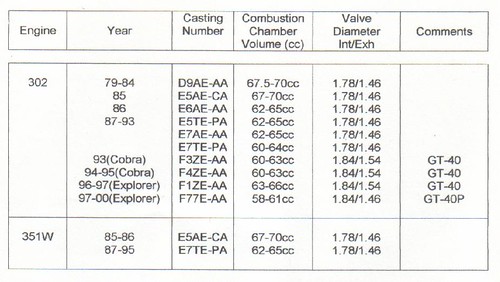
In looking up more part numbers, it turns out that the same pushrods are listed for the "rail type" rocker arms as the pedestal mount rocker arms. I had assumed that the length was different between the two.
Conanski:
That's an excellent chart you included in your early post. It has the look of a genuine Ford item, hence much more reliable than most. Where did it come from, and are more like it available?
Thread Starter
|
Posting Guru
Joined: Jun 1999
Posts: 2,415
Likes: 3
From: Comox Valley, Canada
These are the ones he ordered:
Crane 36661-16 - Crane Cams Energizer Performance Pushrods - JEGS
Of course not with Jegs because that Free Trade thing is a farce
Ordered them from the local LordCo..... $42 Cdn plus taxes... hopefully they work.. .060" is a lot longer to a push rod..... did not see any other longer ones so I am hoping these are made especially for a roller head on to a flat tappet motor...... find out next week.
Crane 36661-16 - Crane Cams Energizer Performance Pushrods - JEGS
Of course not with Jegs because that Free Trade thing is a farce
Ordered them from the local LordCo..... $42 Cdn plus taxes... hopefully they work.. .060" is a lot longer to a push rod..... did not see any other longer ones so I am hoping these are made especially for a roller head on to a flat tappet motor...... find out next week.
FTE Legend
Joined: Jun 2006
Posts: 31,930
Likes: 1,499
From: Ottawa, Ontario
I don't remember where I got that chart but it does seem to be pretty accurate. The fact it shows a range of combustion chamber volumes reflects variances in castings and the amount of machineing a part may need, and that better corresponds to what is found on a motor.