





My Fuel Leak Write-up
Thread Starter
|
Senior User
Joined: May 2005
Posts: 238
Likes: 1
From: Southwest Ohio
My Fuel Leak Write-up
I noticed a fuel leak when I went out to start my truck the other day, so I popped the hood and found the valley of the motor full of fuel. The next day I got started:

1. It is difficult to find any leak when there is fuel sitting everywhere, so I took some paper shop towels and shoved them in every crevice to soak up the fuel.
2. I started the truck, climbed up in the engine compartment with a flashlight, and started looking for the leak. I was pretty lucky, the leak was very evident, at the vacuum switch located on the side of the fuel bowl:
3. I removed the switch and installed the new one.
4. Next I decided I was going to do some preventative maintenance on the fuel system. I purchased the little blue fuel lines and a control that typically leaks (Rubberduck posted some part #'s for these a few days ago):


5. I removed the "Y" pipe that comes off the turbo, and the little metal cover that shields the fuel lines:


6. Once the lines were uncovered, I began removing them. Here is a picture of the (3) blue fuel lines:

7. In order to remove the bottom-most line (hard to see, there in the center), I decided to unbolt the fuel bowl, which allowed me to wriggle it far enough back (toward the front of the motor) to loosen the clamp. Once removed, you can see what kind of shape they were in:

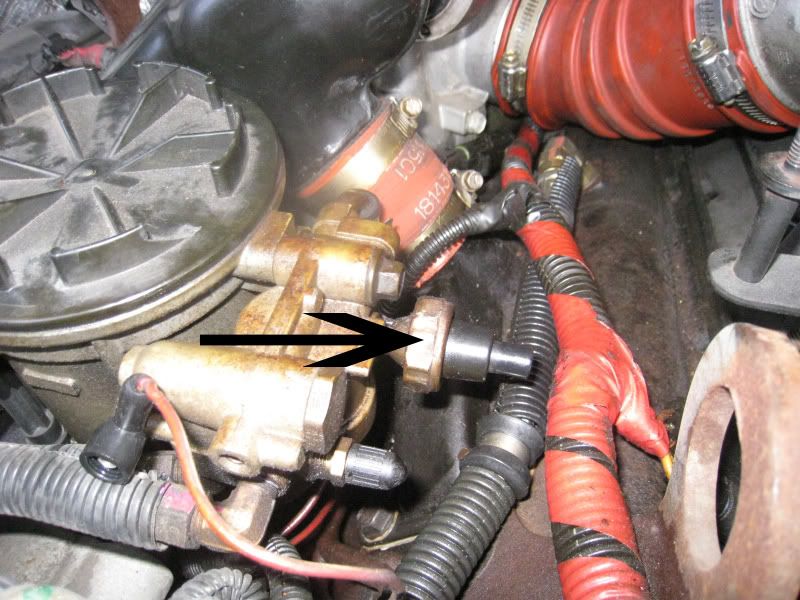
8. After replacing these three lines (and they took a while) I decided to replace a little "control" (I use this term because I am not exactly what it is called, or what it does, just that it is prone to leaking, and this is what the Ford schematic calls it) (maybe someone can shed some light on what this is called). Here's what I'm talking about: The "control" is labeled with the left arrow, and the fourth fuel line (the black one) is labeled with the arrow on the right. I went ahead and replaced that line.

9. You should be able to fit a wrench in there to remove it.

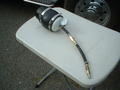
10. Here is the old control next to the new one. The O-ring looks a little so-so, and I guess if you didnt want to replace the whole control you could just replace the o-ring, but since I had one on hand, I just replaced the control.

11. Remember to lube up the o-ring before you put it back in there (so it doesn't get pinched). And be careful when tightening it up, very fragile.

12. This is one other possible leaking spot, but I did not have time to mess with it. This is the nut on the back of the fuel pump, and from what I have been told there is a copper washer that becomes deformed from heat and time. Someone may know more about it, but I did not do anything with it at this time.

13. Once everything was checked and re-checked, I started it back up, let it run for a few minutes and checked for leaks - none! But it's a good idea to check it again the next day, just to be sure.
13. After everything was back together I went ahead and replaced the fuel filter.

Well that's as far as I went this day. Please feel free to correct me if I made any mistakes, or add to it.

1. It is difficult to find any leak when there is fuel sitting everywhere, so I took some paper shop towels and shoved them in every crevice to soak up the fuel.
2. I started the truck, climbed up in the engine compartment with a flashlight, and started looking for the leak. I was pretty lucky, the leak was very evident, at the vacuum switch located on the side of the fuel bowl:

3. I removed the switch and installed the new one.
4. Next I decided I was going to do some preventative maintenance on the fuel system. I purchased the little blue fuel lines and a control that typically leaks (Rubberduck posted some part #'s for these a few days ago):


5. I removed the "Y" pipe that comes off the turbo, and the little metal cover that shields the fuel lines:


6. Once the lines were uncovered, I began removing them. Here is a picture of the (3) blue fuel lines:

7. In order to remove the bottom-most line (hard to see, there in the center), I decided to unbolt the fuel bowl, which allowed me to wriggle it far enough back (toward the front of the motor) to loosen the clamp. Once removed, you can see what kind of shape they were in:

8. After replacing these three lines (and they took a while) I decided to replace a little "control" (I use this term because I am not exactly what it is called, or what it does, just that it is prone to leaking, and this is what the Ford schematic calls it) (maybe someone can shed some light on what this is called). Here's what I'm talking about: The "control" is labeled with the left arrow, and the fourth fuel line (the black one) is labeled with the arrow on the right. I went ahead and replaced that line.

9. You should be able to fit a wrench in there to remove it.

10. Here is the old control next to the new one. The O-ring looks a little so-so, and I guess if you didnt want to replace the whole control you could just replace the o-ring, but since I had one on hand, I just replaced the control.

11. Remember to lube up the o-ring before you put it back in there (so it doesn't get pinched). And be careful when tightening it up, very fragile.

12. This is one other possible leaking spot, but I did not have time to mess with it. This is the nut on the back of the fuel pump, and from what I have been told there is a copper washer that becomes deformed from heat and time. Someone may know more about it, but I did not do anything with it at this time.

13. Once everything was checked and re-checked, I started it back up, let it run for a few minutes and checked for leaks - none! But it's a good idea to check it again the next day, just to be sure.
13. After everything was back together I went ahead and replaced the fuel filter.

Well that's as far as I went this day. Please feel free to correct me if I made any mistakes, or add to it.
Postmaster
Joined: Jun 2007
Posts: 2,795
Likes: 1
From: Rogue River, OR
I thought your write up was out standing. You must be short on love as I was able to send you some rep points.
As to the washers on the rear of the fuel pump at the "Banjo Fitting" they are soft brass and some of the members have successfully annealed them and re-used them. They in them selves do not appear to be a troublesome area and should they start to leak a 1/4 turn on the banjo bolt usually fixes the problem. Once again....Nice job.
Rog
As to the washers on the rear of the fuel pump at the "Banjo Fitting" they are soft brass and some of the members have successfully annealed them and re-used them. They in them selves do not appear to be a troublesome area and should they start to leak a 1/4 turn on the banjo bolt usually fixes the problem. Once again....Nice job.
Rog
Senior User
Joined: May 2008
Posts: 124
Likes: 0
From: OR
Very nice writeup. Reps sent.
The part that your calling the "control" is the water in fuel sensor.
There are also about a half dozen o-rings on the fuel bowl that are easy to change once you have the bowl out.
BTW it's a good idea to cover the air intake plenum's while working down there.
The part that your calling the "control" is the water in fuel sensor.
There are also about a half dozen o-rings on the fuel bowl that are easy to change once you have the bowl out.
BTW it's a good idea to cover the air intake plenum's while working down there.
Trending Topics

Senior User
Joined: Oct 2005
Posts: 400
Likes: 0
From: Jeffersonville IN

FTE Stories
Ford Trucks for Ford Truck Enthusiasts

Top 6 Best Deals Available on New Fords & Lincolns Right Now
Brett Foote
This Hennessey Takes the Expedition Tremor's Off-Roading Capability to the Next Level
Verdad Gallardo
Top 10 Fords at 2026 Carlisle Ford Nationals
Joe Kucinski
3 Best / 3 Worst Parts of Modern Ford Ownership
Brett Foote
10 Amazing Upgrades That Solve Common Ford Truck Owner Headaches
Pouria Savadkouei
Every 2026 Ford Engine Explained
Brett Foote
10 Ugly Ford Trucks That We Still Kinda Love
Joe Kucinski
10 Things Every Truck Owner NEEDS (2026 Edition)
Michael S. Palmer
Rezvani's Latest Post-Apocalyptic Monster Is a Ford F-150 Raptor Underneath
Verdad Gallardo

Senior User
Joined: Apr 2005
Posts: 128
Likes: 0
From: KS
Very good write up. In your next to the last picture, put an arrow pointing below the pump but on the front right side of it and put in the notation that is where the weep hole is for the fuel pump. 2 of mine were leaking from that location. I could only see it with a well placed mechanic's mirror and a flashlight.
Kelly
Kelly

Lead Driver


Joined: Oct 2003
Posts: 8,476
Likes: 37
From: Madison, WI
Does anyone know what's so special about those blue fuel lines? Higher pressure tolerance? Is there any bulk like that's rated for that pressure?
Oh, and that trapezoid-y plate is a new one on me. What year is your truck? My wife's '95 doesn't have it, but it could've been removed in-service under the PO.
Very good photos. Reps to send momentarily.
Thread Starter
|
Senior User
Joined: May 2005
Posts: 238
Likes: 1
From: Southwest Ohio
Thanks for the compliments. VERY good idea about covering up the intake holes and the turbo, I came close once or twice to losing something in there.
My truck is a 97. I'm not sure if the 95's had these plates or not. Maybe someone else can chime in...
My truck is a 97. I'm not sure if the 95's had these plates or not. Maybe someone else can chime in...
