



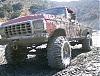
 Here is my "rollbar."


mounting rollbars

Thread Starter
|
Senior User
Joined: Nov 2008
Posts: 186
Likes: 0
 mounting rollbars
So over the spring I'm going to try building & mounting bolt-on 4-point rollbars. The idea isn't to make the truck racing legal or anything, just a) think they look cool and b) want to add a slight measure of protection in the event of a rollover since I've never driven anything so top-heavy (I have a 3" lift & 33" tires).
As I'm sure most of you know, there's nothing ready-made available other than the Go Rhino! bars, which I'm not interested in, so I'm gonna go the DIY approach. Not sure I'll want them forever, so don't want to weld them directly onto the frame. From what I've gathered, the best solution is to weld "outriggers" (right word?) onto the frame with mounting holes; then just drill 16 small holes through the bed & mount 'em up, with rubber (either washers or a plate) below the feet.
I know that for looks alone I could just bolt 'em directly to the bed, but will the design below be sufficient to tie them to the frame such that they won't just fly off (or worse, into the cab) during an accident? Don't worry, I won't come sue you if you're wrong (not least b/c I'll be dead), I'm just looking for feedback from folks who understand the physics better than I do.
Sorry for the crappy image, hope it makes sense.


As I'm sure most of you know, there's nothing ready-made available other than the Go Rhino! bars, which I'm not interested in, so I'm gonna go the DIY approach. Not sure I'll want them forever, so don't want to weld them directly onto the frame. From what I've gathered, the best solution is to weld "outriggers" (right word?) onto the frame with mounting holes; then just drill 16 small holes through the bed & mount 'em up, with rubber (either washers or a plate) below the feet.
I know that for looks alone I could just bolt 'em directly to the bed, but will the design below be sufficient to tie them to the frame such that they won't just fly off (or worse, into the cab) during an accident? Don't worry, I won't come sue you if you're wrong (not least b/c I'll be dead), I'm just looking for feedback from folks who understand the physics better than I do.
Sorry for the crappy image, hope it makes sense.


Post Fiend
Joined: Jul 2006
Posts: 6,948
Likes: 44
Is this going to be a "show style" bar that sits outside of the cab, inside of the bed?
Where exactly do you want to attach these feet for the bars?
The floor of the bed sits rather high so your "outriggers" or frame plates will have to have some elevation, and sit pretty high. This will require quite a bot of fabrication.
andwich through the bed and attach to the frame, why not penetrate the body and extend the tube with another tube to attach to the frame. This eliminates large bulky plates. If you sandwich the body between two plates just make sure that you use different size plates on either end of the body. In other words do not make your plates from the same sized piece. This will act like a sheer and cut the body. While it really wont make a structural diffrence, it will ruin the body. By making the plates slightly different sizes you will eliminate this problem.
Attaching directly to the frame will be the strongest.
Where exactly do you want to attach these feet for the bars?
The floor of the bed sits rather high so your "outriggers" or frame plates will have to have some elevation, and sit pretty high. This will require quite a bot of fabrication.
andwich through the bed and attach to the frame, why not penetrate the body and extend the tube with another tube to attach to the frame. This eliminates large bulky plates. If you sandwich the body between two plates just make sure that you use different size plates on either end of the body. In other words do not make your plates from the same sized piece. This will act like a sheer and cut the body. While it really wont make a structural diffrence, it will ruin the body. By making the plates slightly different sizes you will eliminate this problem.
Attaching directly to the frame will be the strongest.
Hotshot
Joined: Dec 2003
Posts: 18,423
Likes: 9
From: iowa
DO NOT weld the outriggers to the frame, especially the stock frame (tube frames setup for race vehicles is a different setup) instead weld them with braces to a flat plate and bolt them to the frame.
Here is a picture of how I did mine on the race truck to give you an idea of what I am talking about and it DID survive a rollover. It's not real clear but you can see it to get the idea

Then the tube of the roll bar extends through the floor board and is welded directly to the outrigger part.
Here is a picture of how I did mine on the race truck to give you an idea of what I am talking about and it DID survive a rollover. It's not real clear but you can see it to get the idea
Then the tube of the roll bar extends through the floor board and is welded directly to the outrigger part.
Thread Starter
|
Senior User
Joined: Nov 2008
Posts: 186
Likes: 0
monsterbaby- only saw your response after i'd posted. makes a lot of sense. am I right that to remove the bars later you'd need to cut through them before removing the bolts? i don't have a problem with that, just trying to get the picture in my head.
Hotshot
Joined: Dec 2003
Posts: 18,423
Likes: 9
From: iowa
In the case of my setup yes you would need to cut the roll bar tubes loss from the out rigger part to before unbolting it from the frame, BUT in the case of that particular mount it is also the body mount so you don't want to unbolt it.
BUT like I siad that is on my truck which doesn't translate perfectly since it is a race only vehicle, but the idea for the outrigger will work for you.
BUT like I siad that is on my truck which doesn't translate perfectly since it is a race only vehicle, but the idea for the outrigger will work for you.
Postmaster

Joined: Aug 2000
Posts: 3,312
Likes: 1
From: Eldorado Ca. USA
Trending Topics

Lead Driver
Joined: May 2007
Posts: 6,993
Likes: 15
From: Costa Mesa, CA
Adding a plate at the attachment point will spread the load applied to the outrigger end/frame and will prevent the ripping holes in the frame.
A bolt on outrigger setup is still a good idea if you think you will change your design at some point. I try and make most everything I do to my trucks a "bolt on" type deal. It makes it easier to change later after a re-design, or rebuild after a roll over.
Also - if you have a tube from your outrigger ending at a plate that is bolted or welded to the frame - don't forget to gusset the attachment point!
FTE Stories
Ford Trucks for Ford Truck Enthusiasts

3 Best / 3 Worst Parts of Modern Ford Ownership
Brett Foote
10 Amazing Upgrades That Solve Common Ford Truck Owner Headaches
Pouria Savadkouei
Every 2026 Ford Engine Explained
Brett Foote
10 Ugly Ford Trucks That We Still Kinda Love
Joe Kucinski
10 Things Every Truck Owner NEEDS (2026 Edition)
Michael S. Palmer
Rezvani's Latest Post-Apocalyptic Monster Is a Ford F-150 Raptor Underneath
Verdad Gallardo
Top 10 Most Expensive Ford Trucks Ever Sold on Bring a Trailer
Joe Kucinski
2027 Ford Super Duty Buyer's Guide (Every Model, Engine, & Package)
Brett Foote
Top 10 Ford Truck Tragedies
Joe Kucinski
Thread
Thread Starter
Forum
Replies
Last Post
KIKKUP
1973 - 1979 F-100 & Larger F-Series Trucks
4
Mar 27, 2013 09:18 AM
skunk250
1999 - 2016 Super Duty
5
Oct 5, 2008 03:12 PM