




Need new head. Your ideas?

Thread Starter
|
Postmaster
Joined: Jun 2008
Posts: 2,564
Likes: 11
From: Wayyy NoCal, USA
Well, that motorhome deal turned into a deal I couldn't pass up. I now have the complete engine, accessory drive, ecm, wiring harness, intake plumbing, exhaust manifolds, starter, everything. So here we gooooo! I'll be starting a new thread.
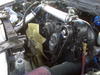
One last question for this thread: What are the obvious indicators between a 2V and 3V engine?
This one has aluminum diecast valve covers vs. the black plastic on my '99.
There is at least one additional bolt holding on the left side valve covers - on the front edge, pretty much exactly in the middle. The '99 is smooth there.
This definitely has a much more complex/bulky plastic intake manifold.
These make me pretty sure it is a 3V. I know the Class C motorhomes continued to use the 2V as they were based on E chassis, but perhaps the monster Class A chassis were swapped to 3V?
Thanks for all your help!
One last question for this thread: What are the obvious indicators between a 2V and 3V engine?
This one has aluminum diecast valve covers vs. the black plastic on my '99.
There is at least one additional bolt holding on the left side valve covers - on the front edge, pretty much exactly in the middle. The '99 is smooth there.
This definitely has a much more complex/bulky plastic intake manifold.
These make me pretty sure it is a 3V. I know the Class C motorhomes continued to use the 2V as they were based on E chassis, but perhaps the monster Class A chassis were swapped to 3V?
Thanks for all your help!
Elder User
Joined: Nov 2007
Posts: 528
Likes: 1
From: Canada, ON New Market
Well, that motorhome deal turned into a deal I couldn't pass up. I now have the complete engine, accessory drive, ecm, wiring harness, intake plumbing, exhaust manifolds, starter, everything. So here we gooooo! I'll be starting a new thread.
One last question for this thread: What are the obvious indicators between a 2V and 3V engine?
This one has aluminum diecast valve covers vs. the black plastic on my '99.
There is at least one additional bolt holding on the left side valve covers - on the front edge, pretty much exactly in the middle. The '99 is smooth there.
This definitely has a much more complex/bulky plastic intake manifold.
These make me pretty sure it is a 3V. I know the Class C motorhomes continued to use the 2V as they were based on E chassis, but perhaps the monster Class A chassis were swapped to 3V?
Thanks for all your help!
One last question for this thread: What are the obvious indicators between a 2V and 3V engine?
This one has aluminum diecast valve covers vs. the black plastic on my '99.
There is at least one additional bolt holding on the left side valve covers - on the front edge, pretty much exactly in the middle. The '99 is smooth there.
This definitely has a much more complex/bulky plastic intake manifold.
These make me pretty sure it is a 3V. I know the Class C motorhomes continued to use the 2V as they were based on E chassis, but perhaps the monster Class A chassis were swapped to 3V?
Thanks for all your help!
A quick way to tell is to look for the IMRC its a black box that will be located at the very front of the intake on the passanger side
If your old 2v needs a new home , let me know how much you want for it, PM with your answer please


FTE Leadership Emeritus
Joined: Jul 2002
Posts: 42,561
Likes: 423
From: Long Island USA

To go even further into the 90 degree block used on both 2-valve and 3-valve, Ford shows the same block for '99 through 2007. And that's probably only because y2kford hasn't updated their online parts manuals for the 2008 SD yet ...
Elder User
Joined: Nov 2007
Posts: 528
Likes: 1
From: Canada, ON New Market
*JL cleared it up it is an error in the service manual*
Last edited by Skoda; Dec 1, 2008 at 04:06 PM. Reason: because I can
Thread Starter
|
Postmaster
Joined: Jun 2008
Posts: 2,564
Likes: 11
From: Wayyy NoCal, USA
You officially have first dibs if I am successful and want to sell the old block.
Thread Starter
|
Postmaster
Joined: Jun 2008
Posts: 2,564
Likes: 11
From: Wayyy NoCal, USA
Just a thought - - You might check out the BigSert insert that is made by TimeSert. It is made specifically for cases where a previous insert has blown. I THINK the literature says if you can clean up the old hole to no more than .640 then you can use this insert. That's over 5/8 inch - - pretty good sized. Would sure beat replacing a head - - or heads - - in terms of money and effort.
This is the third recent post about a blown repair insert. Makes you wonder if all inserts are created equal?
This is the third recent post about a blown repair insert. Makes you wonder if all inserts are created equal?
This was a great suggestion and worth commenting on. The mechanics claimed they tried the BigSert as well (they tried 5 or 6 different kits!) and felt even it was not getting enough bite to be reliable. This is why we are now thinking there was some kind of botched up insert in there already. When I get the engine out, I will be looking very closely to see what I can learn. And share.
And I just recently heard from a service manager that they are starting to see more insert failures. They are suspecting there are some better versions and some not so good. Metallurgy compatibility issues? Weak inserts? Improper installations? Jury is still out. Sucks. Fortunately, it is still a very, very tiny minority of engines having issues. I still suspect improper torquing as the leading root cause.
FTE Stories
Ford Trucks for Ford Truck Enthusiasts

10 Ugly Ford Trucks That We Still Kinda Love
Joe Kucinski
10 Things Every Truck Owner NEEDS (2026 Edition)
Michael S. Palmer
Rezvani's Latest Post-Apocalyptic Monster Is a Ford F-150 Raptor Underneath
Verdad Gallardo
Top 10 Most Expensive Ford Trucks Ever Sold on Bring a Trailer
Joe Kucinski
2027 Ford Super Duty Buyer's Guide (Every Model, Engine, & Package)
Brett Foote
Top 10 Ford Truck Tragedies
Joe Kucinski
AEV FXL Super Duty - the Super Duty Raptor Ford Doesn't Make
Brett Foote
Lobo Vs Lobo: Proof the F-150 Lobo Should Be Even Lower!
Michael S. Palmer
Ford's 2001 Explorer Sportsman Concept Looks For a New Home
Verdad Gallardo
FTE Leadership Emeritus
Joined: Jul 2002
Posts: 42,561
Likes: 423
From: Long Island USA

A 90 degree is bad enough to deal with, having to make a split-pin crank with 18 degrees separation (72 + 18 = 90). Can you imagine a 60 degree block? It would make more sense to make it 72 degrees, but hey, they didn't ask me


Freshman User
Joined: Apr 2008
Posts: 31
Likes: 0
plug thread repair
I'm trying to be careful about how I say this. I don't want to sound like I'm endorsing one particular brand of insert system, and condemning another. In one case, I am specifically talking about the Timesert system, which is the one I used to do all ten cylinders in my 2001 E450. In the other case, I think we may be mostly talking about "Brand H." Brand H may unfairly get more blame than it deserves, because it has been around so long that people refer to it in the same way as Kleenex is used to describe a jillion brands of facial tissue. I think it is also only fair to say there must be 4 or 5 other brands of insert that are "more complicated" than Brand H. The kits are a lot more spendy, and involve many more operations to install an insert. So maybe we should be comparing "X" kits that are basically a sort of one tool does it all (reams, threads, etc.), with the "Y" kits that have several different tools and several different separate installation operations.
My impression is that the X kits can be had for as little as 40 bucks, but the Y kits are 400 bucks or so. So we can see the attraction to putting the 40 dollar one in the glove box "just in case."
But - - we have at least 3 or 4 pretty active threads (forum threads, that is) running presently that all have to do with the inserts "not holding." A couple of them sound like heat transfer problems, resulting (apparently) in the plug getting so hot it actually melts - - Thus screwing up threads and insert when you try to remove it. Additionally, there are one or two cases where the insert has simply lost its grip and come out.
The point of all this: We've all heard some users touting the 40 buck glovebox/roadside fix version of the plug thread insert. Regardless of which brand or brands these may be, it appears that some of these may not hold well, or do an adequate job of heat transfer.
On the other hand, some of the more complicated (and expensive) systems seem to work very well and constitute a permanent repair. I do know this about "Brand T" which is the one I used - - ten times: The steel insert, when new, has the internal thread for the spark plug cut in a tapered fashion - - much like a regular tapered pipe thread. The final operation of installation uses a fairly long threaded tool (with a constant diameter thread - not tapered) which is liberally lubricated, and then driven clear thru the tapered insert. This forces the tapered insert thread to "bell out" and expand - - leaving a straight spark plug thread of uniform diameter. The expansion process, along with Lok-Tite on the outer thread (between the insert and the cylinder head) assures that the insert will have excellent heat transfer, and NOT back out.
Bottom line is that there may be evidence that points to real problems with the less expensive and less time consuming fixes. When the alternatives involve pulling and even replacing heads, it may be that a few more bucks up front are very well spent. My apologies for the length of this post.
My impression is that the X kits can be had for as little as 40 bucks, but the Y kits are 400 bucks or so. So we can see the attraction to putting the 40 dollar one in the glove box "just in case."
But - - we have at least 3 or 4 pretty active threads (forum threads, that is) running presently that all have to do with the inserts "not holding." A couple of them sound like heat transfer problems, resulting (apparently) in the plug getting so hot it actually melts - - Thus screwing up threads and insert when you try to remove it. Additionally, there are one or two cases where the insert has simply lost its grip and come out.
The point of all this: We've all heard some users touting the 40 buck glovebox/roadside fix version of the plug thread insert. Regardless of which brand or brands these may be, it appears that some of these may not hold well, or do an adequate job of heat transfer.
On the other hand, some of the more complicated (and expensive) systems seem to work very well and constitute a permanent repair. I do know this about "Brand T" which is the one I used - - ten times: The steel insert, when new, has the internal thread for the spark plug cut in a tapered fashion - - much like a regular tapered pipe thread. The final operation of installation uses a fairly long threaded tool (with a constant diameter thread - not tapered) which is liberally lubricated, and then driven clear thru the tapered insert. This forces the tapered insert thread to "bell out" and expand - - leaving a straight spark plug thread of uniform diameter. The expansion process, along with Lok-Tite on the outer thread (between the insert and the cylinder head) assures that the insert will have excellent heat transfer, and NOT back out.
Bottom line is that there may be evidence that points to real problems with the less expensive and less time consuming fixes. When the alternatives involve pulling and even replacing heads, it may be that a few more bucks up front are very well spent. My apologies for the length of this post.

Thread
Thread Starter
Forum
Replies
Last Post
porky1980
Performance & General Engine Building
0
Dec 29, 2015 04:43 PM
