



Quick Timing by Hand - Advice Needed

Elder User
Joined: Apr 2004
Posts: 970
Likes: 3
The light is on with the points open as it is the path for the current in the primary winding to reach ground, when the points close it reaches ground thru the points which have less resistance then the light bulb. When the points are closed a magnetic field is built up in the core of the coil. When the points open the field collapses and the magnetic lines of force cut thru the secondary winding produceing the secondary current. The condenser acts as a dampner to prevent excess arcing at the points, and I was told by one engineer that it also causes a small reverse flow in the primary to collapse the field more quickly. I suppose you could see that on a lab scope if you knew what your looking for.
Think about the rule of electricty which states current seeks the easiest path to ground. kotzy
Think about the rule of electricty which states current seeks the easiest path to ground. kotzy

Logistics Pro

Joined: Jan 2002
Posts: 4,907
Likes: 39
From: suburban atlanta
It all depends....
How is the test light hooked into the system?
Where is it supplied with voltage? From the battery or from the ignition switch?
Where is it grounded? On the battery/frame or on the points?
If you use the points to supply a ground, connecting to the + of the battery on one end and to the points + wire on the points, the light will come on when the points close, as the light has a direct path to ground through the points to the dist body. (ignition off)
If you use the points to supply the +, connecting the other end to ground, the light will come on when the points open, as the easiest path to ground is now the bulb, instead of through the points to ground. (ignition on)
I don't particularly like using a bulb as I can hear the points spark when the points open, and I don't have to remember all the stuff about when the ignition is on or off and when the bulb should light and which wire to hook up where.... I just listen.
My choice.
tom
How is the test light hooked into the system?
Where is it supplied with voltage? From the battery or from the ignition switch?
Where is it grounded? On the battery/frame or on the points?
If you use the points to supply a ground, connecting to the + of the battery on one end and to the points + wire on the points, the light will come on when the points close, as the light has a direct path to ground through the points to the dist body. (ignition off)
If you use the points to supply the +, connecting the other end to ground, the light will come on when the points open, as the easiest path to ground is now the bulb, instead of through the points to ground. (ignition on)
I don't particularly like using a bulb as I can hear the points spark when the points open, and I don't have to remember all the stuff about when the ignition is on or off and when the bulb should light and which wire to hook up where.... I just listen.
My choice.
tom
Elder User
Joined: Apr 2004
Posts: 970
Likes: 3
One lead of the test lamp is connected to the distributor side of the the coil itself or the terminal at the points and the other terminal of the light to ground. Regardless of what the polarity is, the bulb forms the easiest path to ground when the points are open and lights not when the points closed as there is little resistance thru the closed points. kotzy
Logistics Pro
Joined: Jan 2002
Posts: 4,907
Likes: 39
From: suburban atlanta
Yup. Kidz these days just don't know. It was at least 15 miles each way to and from school, uphill both ways, with at least 3 feet of snow year 'round. Ha.
I never did fiddle with a dual points system, but have some idea of how they worked. Simple is best, IMO. First time I did a tune up on my Dads 292, I replaced the points per the instructions on the three-part points pack. Points, rotor, condenser and a little purple capsule with rubbing block grease. Then had to use a crow-bar to break the distributor free of the block. Dad was an AIRCRAFT engineer and looked down on maintenance for ground vehicles, after all, the did not have to run that well as they could always pull over to the side of the road... which was not an option at 25000 feet. (At least that is what I think he thought)
I had no idea what I was doing, and tried to use a 'neon' timing light in series with the #1 plug, but could not see it in daylight. I learned about static timing when putting engines back together as they normally had batteries that were not the best... and wouldn't crank a tight engine very well, especially if the timing was off. Better to get it pretty close using static, and you avoided losing eyebrows when it backfired through the carb. Oh, carb? Yeah, they used to have carbs on cars. Heck, I used to pre-fill the float bowl to avoid all that crank time. Back when money was more valuable than time.
tom
I never did fiddle with a dual points system, but have some idea of how they worked. Simple is best, IMO. First time I did a tune up on my Dads 292, I replaced the points per the instructions on the three-part points pack. Points, rotor, condenser and a little purple capsule with rubbing block grease. Then had to use a crow-bar to break the distributor free of the block. Dad was an AIRCRAFT engineer and looked down on maintenance for ground vehicles, after all, the did not have to run that well as they could always pull over to the side of the road... which was not an option at 25000 feet. (At least that is what I think he thought)
I had no idea what I was doing, and tried to use a 'neon' timing light in series with the #1 plug, but could not see it in daylight. I learned about static timing when putting engines back together as they normally had batteries that were not the best... and wouldn't crank a tight engine very well, especially if the timing was off. Better to get it pretty close using static, and you avoided losing eyebrows when it backfired through the carb. Oh, carb? Yeah, they used to have carbs on cars. Heck, I used to pre-fill the float bowl to avoid all that crank time. Back when money was more valuable than time.
tom

Thread Starter
|
Laughing Gas

Joined: Oct 2007
Posts: 773
Likes: 1
Huge Revelation
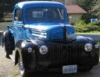
Okay, I just went through a pretty big revelation. My 292 had only been running on 6 cylinders ever since I got it started (about half a year ago). After I discovered the problem yesterday, and realized what I had to do to set everything straight, I got it pumping gas on all 8 pistons today.
Let me explain.
A very very long story made short: Spark plug wires #1 and #4 were reversed on the distributor cap, therefore it wasn't igniting the gas anywhere near the appropriate time. This also explained why I couldn't time the ignition off of cylinder #1, because the rotor wasn't anywhere close to where it should be, screwing up everything. I got so frustrated because I could never figure it out.
I finally realized the problem after I sat back, and decided to start from the very beginning. "Okay" I said to myself, "let's start with the firing order." Sure enough, my firing order was 1-8-6-3-7-2-4-5 while the manual (and everybody I've ever met) said it was supposed to be 1-5-4-8-6-3-7-2. I then decided to be absolutely sure that my order was messed up by checking the location of each piston every quarter of a turn of the crankshaft beginning with TDC on #1. I confirmed that it was correct, and that I wasn't imagining things (as it was getting pretty late). I swapped #1 wire with #4, turned the key, and after properly timing the ignition and tuning up the carb, I was off to the road for testing.
All I can say is HELL YEAH! The truck is a LOT more "punchy" and accelerates a hell of a ton faster. I was shocked at how much of a difference 2 cylinders made. Now they were being dragged along by the engine, but were instead contributing to cranking over that crankshaft. The engine sounded loads better, and I had ZERO issues with backfiring or popping/clicking through the carb. The truck can really bolt off the line now, and it is also quite a noticable bit faster, as compared to previously, where the engine (with the help of a LOT of gas) could barely get the truck rolling.
Goes to show how much engine maintenance and understanding can really pay off. Two cylinders really makes the difference.
Let me just say that I am one happy camper right now. The truck starts quicker, idles smoother, revs faster, and doesn't make any problem noises!
Let me explain.
A very very long story made short: Spark plug wires #1 and #4 were reversed on the distributor cap, therefore it wasn't igniting the gas anywhere near the appropriate time. This also explained why I couldn't time the ignition off of cylinder #1, because the rotor wasn't anywhere close to where it should be, screwing up everything. I got so frustrated because I could never figure it out.
I finally realized the problem after I sat back, and decided to start from the very beginning. "Okay" I said to myself, "let's start with the firing order." Sure enough, my firing order was 1-8-6-3-7-2-4-5 while the manual (and everybody I've ever met) said it was supposed to be 1-5-4-8-6-3-7-2. I then decided to be absolutely sure that my order was messed up by checking the location of each piston every quarter of a turn of the crankshaft beginning with TDC on #1. I confirmed that it was correct, and that I wasn't imagining things (as it was getting pretty late). I swapped #1 wire with #4, turned the key, and after properly timing the ignition and tuning up the carb, I was off to the road for testing.
All I can say is HELL YEAH! The truck is a LOT more "punchy" and accelerates a hell of a ton faster. I was shocked at how much of a difference 2 cylinders made. Now they were being dragged along by the engine, but were instead contributing to cranking over that crankshaft. The engine sounded loads better, and I had ZERO issues with backfiring or popping/clicking through the carb. The truck can really bolt off the line now, and it is also quite a noticable bit faster, as compared to previously, where the engine (with the help of a LOT of gas) could barely get the truck rolling.
Goes to show how much engine maintenance and understanding can really pay off. Two cylinders really makes the difference.
Let me just say that I am one happy camper right now. The truck starts quicker, idles smoother, revs faster, and doesn't make any problem noises!
Postmaster
Joined: Jul 2003
Posts: 2,688
Likes: 4
From: Southern Oregon
It sure improves your confidence when you solve a problem like this yourself. Ditto on the congrats!
FTE Stories
Ford Trucks for Ford Truck Enthusiasts

Top 10 Fords at 2026 Carlisle Ford Nationals
Joe Kucinski
3 Best / 3 Worst Parts of Modern Ford Ownership
Brett Foote
10 Amazing Upgrades That Solve Common Ford Truck Owner Headaches
Pouria Savadkouei
Every 2026 Ford Engine Explained
Brett Foote
10 Ugly Ford Trucks That We Still Kinda Love
Joe Kucinski
10 Things Every Truck Owner NEEDS (2026 Edition)
Michael S. Palmer
Rezvani's Latest Post-Apocalyptic Monster Is a Ford F-150 Raptor Underneath
Verdad Gallardo
Top 10 Most Expensive Ford Trucks Ever Sold on Bring a Trailer
Joe Kucinski
2027 Ford Super Duty Buyer's Guide (Every Model, Engine, & Package)
Brett Foote
Thread
Thread Starter
Forum
Replies
Last Post
DougieWebb
1973 - 1979 F-100 & Larger F-Series Trucks
2
Mar 27, 2013 12:33 PM
ErrorS
335 Series- 5.8/351M, 6.6/400, 351 Cleveland
4
Nov 7, 2007 07:04 AM