


Front Fenders

Thread Starter
|
Senior User
Joined: Apr 2007
Posts: 125
Likes: 0
From: Kershaw, South Carolina
Front Fenders
Well I'm taking one of the front fenders to a friends body shop today to see if they can be fixed. You know the R word is a nasty thing here in South Carolina. Wish me luck. I want to keep the steel. I don't want fiberglass.

Fleet Owner


Joined: Jul 2004
Posts: 27,294
Likes: 1,055
From: NM
I was quoted $500+ apiece to fix (with steel) relatively decent '52 front fenders. Torn at the running boards, "usual" rust at the lower front extension, etc. I would get a committment on price before they get into it!!

Posting Guru
Joined: Jan 2007
Posts: 1,527
Likes: 2
From: Grande Prairie, Alberta
I spent 3K in labor and another 500 in materials on my front fenders. Mine were also widened 4" each and the PO had them fricked up pretty bad. Also added fender flares to the wheel openings so they aren't really what you would call typical rebuild......Man its getting dark......

Hotshot
Joined: Oct 2004
Posts: 15,882
Likes: 88
From: Durham NC
How bad are they? I've not looked at a set of bonus built front fenders, but they can't be too difficult to repair.
The only bodywork that is difficult is when you can't get at the back side ,and since the front's unbolt getting at the back is not a problem.
The only bodywork that is difficult is when you can't get at the back side ,and since the front's unbolt getting at the back is not a problem.
Last edited by AXracer; Nov 9, 2007 at 06:50 PM.

Hotshot


Joined: Jan 2001
Posts: 16,882
Likes: 3,126
From: SE Wisc. (the Rust Belt)
Bonus Built fenders are inherent rot buckets. The have huge debris traps where the fender brace touches the top inside of the fender, the double wall of metal where the fender bolts to the running boards and especially where the top and bottom pieces bolt together and where the fenders bolt to the center valance under the grill. Even if the fender look solid where the two halves meet there's a good chance the metal is thin and will open up once you hit it with a grinder or sander.
I have worked on quite a few. The last front clip I bought for $30 was for the F-2 and up models. It had extensive rot out but I like to repair rust and do metal work. I hate to see old sheet metal get scrapped if there's a chance it can be saved. I don't know how much time I have in these fender but I would guess to get them as far as I have them I spent about 30+ hours on them. The lip on the upper left was the most fun to do, I had to reconstruct almost the entire area. They still need to primed with filler primer and block sanded a few times which will probably be another 20+ hours.
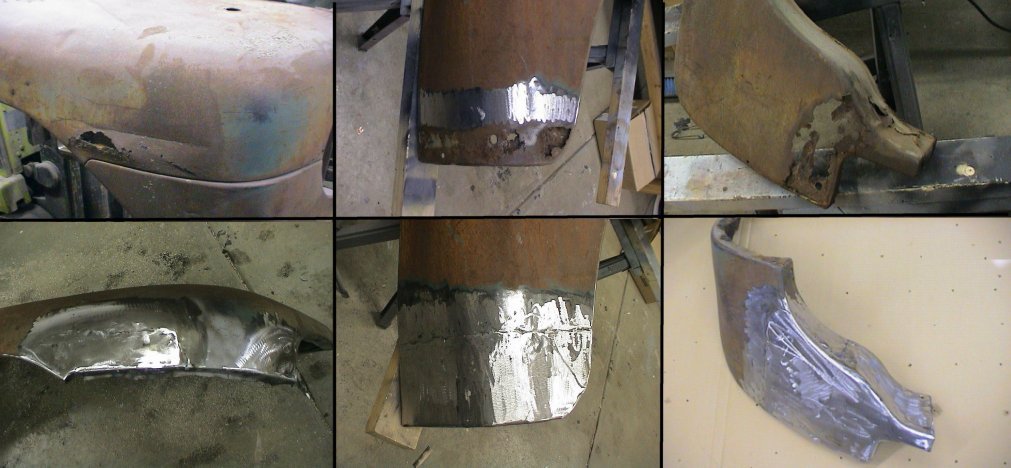
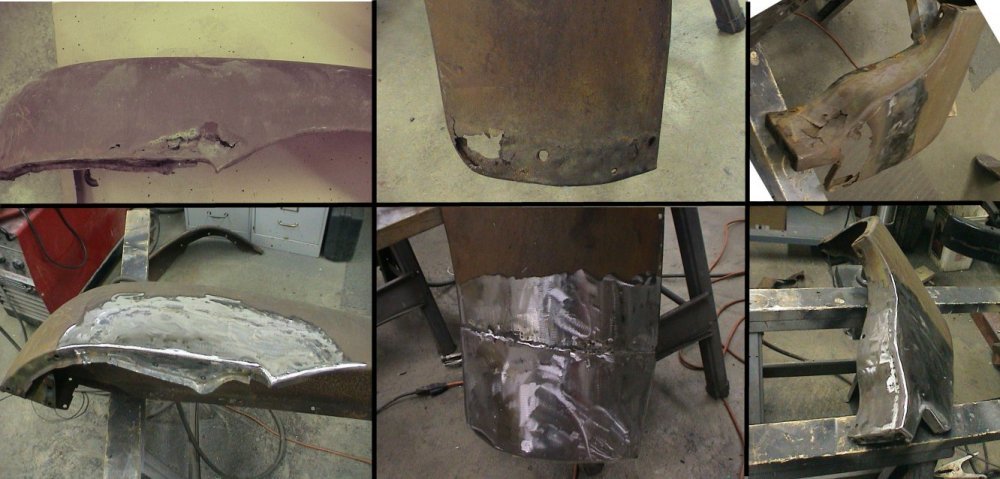
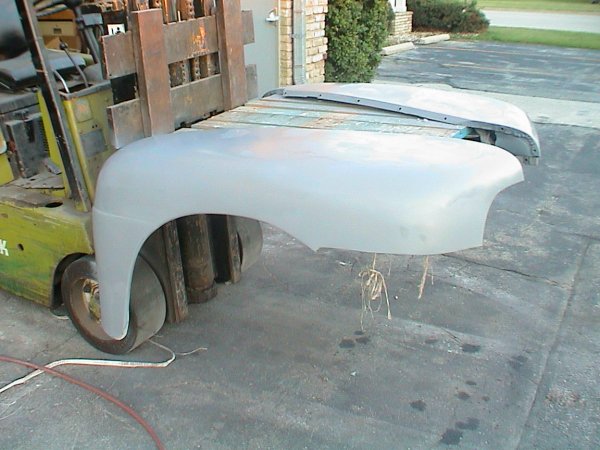
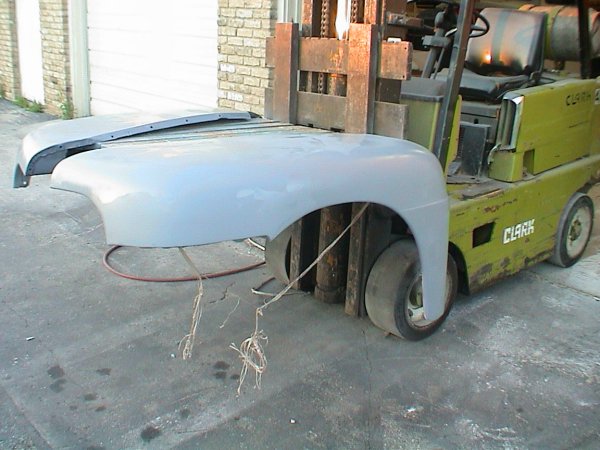
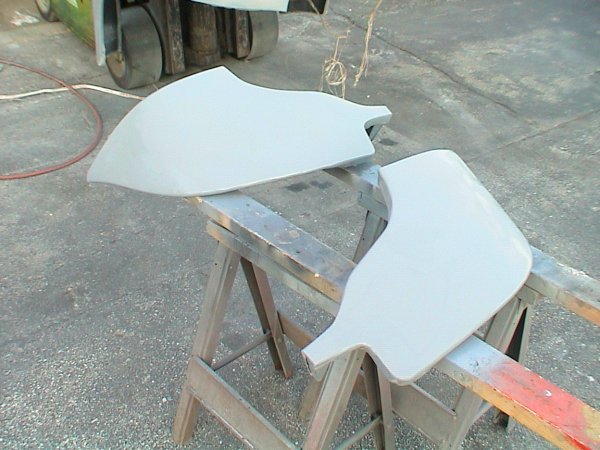
I have worked on quite a few. The last front clip I bought for $30 was for the F-2 and up models. It had extensive rot out but I like to repair rust and do metal work. I hate to see old sheet metal get scrapped if there's a chance it can be saved. I don't know how much time I have in these fender but I would guess to get them as far as I have them I spent about 30+ hours on them. The lip on the upper left was the most fun to do, I had to reconstruct almost the entire area. They still need to primed with filler primer and block sanded a few times which will probably be another 20+ hours.
Logistics Pro

Joined: Jan 2001
Posts: 3,789
Likes: 26
From: Connecticut
Hey Bob, (and others) I shoud have the dies cut for the front part on the fender extender (section under the grille) by next week! So rear cab corners, Lower fender-to-running board, and now the front of the lower extender now have available patches! What's next on you list?
Reamer
Reamer
Trending Topics
Hotshot
Joined: Oct 2004
Posts: 15,882
Likes: 88
From: Durham NC
Way to go Reamer! There are very few body panels that can't be repaired it's just a matter of time and/or money. There are a number of shops that are capable of building an entire body from scratch.
FTE Stories
Ford Trucks for Ford Truck Enthusiasts

10 Things Every Truck Owner NEEDS (2026 Edition)
Michael S. Palmer
Rezvani's Latest Post-Apocalyptic Monster Is a Ford F-150 Raptor Underneath
Verdad Gallardo
Top 10 Most Expensive Ford Trucks Ever Sold on Bring a Trailer
Joe Kucinski
2027 Ford Super Duty Buyer's Guide (Every Model, Engine, & Package)
Brett Foote
Top 10 Ford Truck Tragedies
Joe Kucinski
AEV FXL Super Duty - the Super Duty Raptor Ford Doesn't Make
Brett Foote
Lobo Vs Lobo: Proof the F-150 Lobo Should Be Even Lower!
Michael S. Palmer
Ford's 2001 Explorer Sportsman Concept Looks For a New Home
Verdad Gallardo
10 Best Ford Truck Engines We Miss the Most!
Joe Kucinski
Senior User
Joined: Sep 2007
Posts: 106
Likes: 0
I actually have a set up in New York state being saved at a guyI met a Carlisle Pa. fall swap. The guys name is Dutch Comstock # 315-866-3034. Rearly a nice guy and is one of the old timers that do it right the first time and takes his time doing it. hopefully this can help some one out there. Hell I even baught a 2 pair just so I have them if my father gets hit when i give him the truck, good to have spair. Now i jsut have to go get them. have fun Casey
Hotshot
Joined: Jan 2001
Posts: 16,882
Likes: 3,126
From: SE Wisc. (the Rust Belt)
Reamer,
How about patches for the area where the two parts meet?

Of course you'd have to make two styles to accomodate the F-1s and one for the larger trucks. You'd also have to make the two inner braces that are welded inside each piece. This is also a problem area, as you can see from the pictures of my fenders.
How about patches for the area where the two parts meet?
Of course you'd have to make two styles to accomodate the F-1s and one for the larger trucks. You'd also have to make the two inner braces that are welded inside each piece. This is also a problem area, as you can see from the pictures of my fenders.

Cargo Master
Joined: Sep 2004
Posts: 2,757
Likes: 138
From: Alberta Canada
Bob; you do nice work. I have front lowers that need work but was reluctant to start on them, I bought glass lowers for now. How have you been forming your patch panels, using a english wheel.
another area that seems a problem is the lower tire opening profile. One old timer I talked to, has used rod to fill this area.
another area that seems a problem is the lower tire opening profile. One old timer I talked to, has used rod to fill this area.
Hotshot
Joined: Jan 2001
Posts: 16,882
Likes: 3,126
From: SE Wisc. (the Rust Belt)
I don't have any fancy tools, just basic body tools. I use whatever I can to form the metal, an old railroad rail is very handy to hammer metal over. I also built a simple sheet metal brake. I use cardboard to make templates of patch pieces and then trace them on sheet metal. For flange bends around curves I cut slits in the metal, hammer the metal over and them weld the slitted flange. I like to use basic tools because most people don't have the need or budget to buy all the expensive tools like English wheels and flange formers.
Hotshot
Joined: Oct 2004
Posts: 15,882
Likes: 88
From: Durham NC
An English wheel is nice to have if you are making a lot of large shallow compound curved panels or are charging by the hour for your time. They are overkill for shaping repair patches and outside the needs of most hobbyists as well as outside their budget and space restrictions. Anything you can do with an EW can be done with simple hand tools, it is just a bit more labor intensive and time consuming. It's like the difference in building a building with a skill saw and hammer vs. using a compound miter saw and air framing nailer.

Fleet Mechanic
Joined: Mar 2005
Posts: 1,511
Likes: 1
From: peyton, colorado

Bob, my fenders were in similar shape, once I ground the bondo out...Hopefully, Reamer will produce some good panels for the next guys, but I had to make my own. Like you said, sheet metal and basic hand tools were all I had, and I was able to patch them very nicely. No idea of the hours I spent, but the material cost was very low.