


Towing two trailers??

Posting Guru
Joined: Nov 2004
Posts: 2,155
Likes: 1
From: sunny fla sometimes windy
You should get those anti sway hitch deal, I forgot what they are called now.
Also keep your tires at the reccomended pressure and get as many sidewall ply as you can to minimize sway. A steering stabilizer on the truck might even help to keep from over correcting.
Also keep your tires at the reccomended pressure and get as many sidewall ply as you can to minimize sway. A steering stabilizer on the truck might even help to keep from over correcting.

Fleet Owner


Joined: Jun 2004
Posts: 25,090
Likes: 1,112
From: Rio Rico, AZ.
Originally Posted by fireman660r
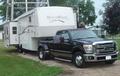
Well, I made my first trip last weekend with two trailers. I pulled my 26' 5th wheel and a 16' enclosed trailer that is 20' from hitch to back. Altogether I was right around 63-64'. The key to this as I quickly found was to drive around 60 mph and make no sudden moves on the steering wheel. The power of the truck completely stock was not an issue at all, I caught myself going 70 on the flats and didn't realize it. Braking also was not a problem, the truck in tow/haul has some kind of set-up that makes the tranny start to slow the truck as soon as you let out on the throttle. Both trailer have brakes on both axles, all of which were wired together and not once didn't I have a problem slowing or stopping. I was quite impressed with everything and will definitely start doing it more.

Tuned
Joined: Jun 2006
Posts: 338
Likes: 0
From: Boulder City, Nevada
Before you get an anti-sway bar tow your double load first. I was told by a guy at the trailer shop that sway would be a problem for my long load (63 feet). He said going downhill could be a real problem with my setup. So before I went on my first trip I towed the load with my girlfriend following me. We went down some steep hills with me turning the steering wheek back and forth. Both trailers towed straight and true. I have never had a sway problem with my setup and all I have for the rear trailer is a simple ball hitch.
Randy
Randy
Fleet Owner
Joined: Jun 2004
Posts: 25,090
Likes: 1,112
From: Rio Rico, AZ.
Originally Posted by ronwilll
Hitching anything to an RV trailer invalides the warranty.
Warranties aren't worth much anyway, but that will put the kibosh on it for sure.
Warranties aren't worth much anyway, but that will put the kibosh on it for sure.
On what, the frame? If a dump valve goes out or the AC leaks all it's freon, how could a hitch on the back of the trailer affect those components.
I can understand a cracked pinbox due to overloading and would pay to have that fixed without any arguement.

Senior User
Joined: Oct 2007
Posts: 178
Likes: 0
Point is, the manufacturer will deny coverage on virtually anything if you hitch anything to the frame.
ACs on RVs are not rechargeable. When the freon goes, so goes the unit.
Why wouldn't they refuse coverage? It's the easy way out.
Trailers are meant to be towed only and are not structurally designed to tow another vehicle.
I suppose they would overlook the spare tire that comes with the vehicle or a bike rack on the rear bumper, but if you hang a motorcycle on a bumper rack, it can not only disturb the suspension or bend the frame, but can cause stability problems by lightening the load on the hitch pin. The hitch pin should have around 12 to 15% of the trailer weight on it and other weights on the rear would disturb that.
Aside from the above, when a second trailer is towed, the effect of a minor twitch in the tow vehicle can result in a major swerve in the rear trailer. The movement in the tow vehicle is multiplied by a factor or 3 or 4 in the rear trailer.
I wouldn't want to be in the opposite lane from such a vehicle when the driver looked away for a second and then pulled back quickly resulting in a "whiplash" effect that brought me into contact with his second trailer.
But that's just my opinion. You're entitled to yours.
ACs on RVs are not rechargeable. When the freon goes, so goes the unit.
Why wouldn't they refuse coverage? It's the easy way out.
Trailers are meant to be towed only and are not structurally designed to tow another vehicle.
I suppose they would overlook the spare tire that comes with the vehicle or a bike rack on the rear bumper, but if you hang a motorcycle on a bumper rack, it can not only disturb the suspension or bend the frame, but can cause stability problems by lightening the load on the hitch pin. The hitch pin should have around 12 to 15% of the trailer weight on it and other weights on the rear would disturb that.
Aside from the above, when a second trailer is towed, the effect of a minor twitch in the tow vehicle can result in a major swerve in the rear trailer. The movement in the tow vehicle is multiplied by a factor or 3 or 4 in the rear trailer.
I wouldn't want to be in the opposite lane from such a vehicle when the driver looked away for a second and then pulled back quickly resulting in a "whiplash" effect that brought me into contact with his second trailer.
But that's just my opinion. You're entitled to yours.
Last edited by ronwilll; Oct 20, 2007 at 11:18 PM.

Posting Guru
Joined: Dec 2006
Posts: 2,498
Likes: 3
From: Windsor, Colorado
Originally Posted by ronwilll
Point is, the manufacturer will deny coverage on virtually anything if you hitch anything to the frame.
ACs on RVs are not rechargeable. When the freon goes, so goes the unit.
Why wouldn't they refuse coverage? It's the easy way out.
Trailers are meant to be towed only and are not structurally designed to tow another vehicle.
I suppose they would overlook the spare tire that comes with the vehicle or a bike rack on the rear bumper, but if you hang a motorcycle on a bumper rack, it can not only disturb the suspension or bend the frame, but can cause stability problems by lightening the load on the hitch pin. The hitch pin should have around 12 to 15% of the trailer weight on it and other weights on the rear would disturb that.
Aside from the above, when a second trailer is towed, the effect of a minor twitch in the tow vehicle can result in a major swerve in the rear trailer. The movement in the tow vehicle is multiplied by a factor or 3 or 4 in the rear trailer.
I wouldn't want to be in the opposite lane from such a vehicle when the driver looked away for a second and then pulled back quickly resulting in a "whiplash" effect that brought me into contact with his second trailer.
But that's just my opinion. You're entitled to yours.
ACs on RVs are not rechargeable. When the freon goes, so goes the unit.
Why wouldn't they refuse coverage? It's the easy way out.
Trailers are meant to be towed only and are not structurally designed to tow another vehicle.
I suppose they would overlook the spare tire that comes with the vehicle or a bike rack on the rear bumper, but if you hang a motorcycle on a bumper rack, it can not only disturb the suspension or bend the frame, but can cause stability problems by lightening the load on the hitch pin. The hitch pin should have around 12 to 15% of the trailer weight on it and other weights on the rear would disturb that.
Aside from the above, when a second trailer is towed, the effect of a minor twitch in the tow vehicle can result in a major swerve in the rear trailer. The movement in the tow vehicle is multiplied by a factor or 3 or 4 in the rear trailer.
I wouldn't want to be in the opposite lane from such a vehicle when the driver looked away for a second and then pulled back quickly resulting in a "whiplash" effect that brought me into contact with his second trailer.
But that's just my opinion. You're entitled to yours.
As far as warranty goes, I have had our big sky montana in warranty work with not even a mention of the reciever hitch except for the service manager noting how clean the install was.
Moderator


Joined: May 2004
Posts: 6,524
Likes: 926
From: Home Base Nebraska


Originally Posted by ronwilll
Point is, the manufacturer will deny coverage on virtually anything if you hitch anything to the frame.
ACs on RVs are not rechargeable. When the freon goes, so goes the unit.
Why wouldn't they refuse coverage? It's the easy way out.
Trailers are meant to be towed only and are not structurally designed to tow another vehicle.
I suppose they would overlook the spare tire that comes with the vehicle or a bike rack on the rear bumper, but if you hang a motorcycle on a bumper rack, it can not only disturb the suspension or bend the frame, but can cause stability problems by lightening the load on the hitch pin. The hitch pin should have around 12 to 15% of the trailer weight on it and other weights on the rear would disturb that.
Aside from the above, when a second trailer is towed, the effect of a minor twitch in the tow vehicle can result in a major swerve in the rear trailer. The movement in the tow vehicle is multiplied by a factor or 3 or 4 in the rear trailer.
I wouldn't want to be in the opposite lane from such a vehicle when the driver looked away for a second and then pulled back quickly resulting in a "whiplash" effect that brought me into contact with his second trailer.
But that's just my opinion. You're entitled to yours.
ACs on RVs are not rechargeable. When the freon goes, so goes the unit.
Why wouldn't they refuse coverage? It's the easy way out.
Trailers are meant to be towed only and are not structurally designed to tow another vehicle.
I suppose they would overlook the spare tire that comes with the vehicle or a bike rack on the rear bumper, but if you hang a motorcycle on a bumper rack, it can not only disturb the suspension or bend the frame, but can cause stability problems by lightening the load on the hitch pin. The hitch pin should have around 12 to 15% of the trailer weight on it and other weights on the rear would disturb that.
Aside from the above, when a second trailer is towed, the effect of a minor twitch in the tow vehicle can result in a major swerve in the rear trailer. The movement in the tow vehicle is multiplied by a factor or 3 or 4 in the rear trailer.
I wouldn't want to be in the opposite lane from such a vehicle when the driver looked away for a second and then pulled back quickly resulting in a "whiplash" effect that brought me into contact with his second trailer.
But that's just my opinion. You're entitled to yours.
Some brands have a receiver hitch as a option our HH for one.
RV A/C units are rechargeable but most RV servicemen don't know how to do it.
If your manufacture wants to refuse coverage coverage its time to find a different brand.
Again some trailers are designed to tow behind them.
The normal 5ver pin is between 15 to 20%, 5vers are designed to have varying pin weights a little hitch weight makes very little difference if any at all.
I have been double towing a boat for 20 years with a 5th wheel and you get very little sway out of the second trailer but a TT is a different animal.
Denny
FTE Stories
Ford Trucks for Ford Truck Enthusiasts

3 Best / 3 Worst Parts of Modern Ford Ownership
Brett Foote
10 Amazing Upgrades That Solve Common Ford Truck Owner Headaches
Pouria Savadkouei
Every 2026 Ford Engine Explained
Brett Foote
10 Ugly Ford Trucks That We Still Kinda Love
Joe Kucinski
10 Things Every Truck Owner NEEDS (2026 Edition)
Michael S. Palmer
Rezvani's Latest Post-Apocalyptic Monster Is a Ford F-150 Raptor Underneath
Verdad Gallardo
Top 10 Most Expensive Ford Trucks Ever Sold on Bring a Trailer
Joe Kucinski
2027 Ford Super Duty Buyer's Guide (Every Model, Engine, & Package)
Brett Foote
Top 10 Ford Truck Tragedies
Joe Kucinski
Thread Starter
|
Tuned

Joined: Mar 2007
Posts: 342
Likes: 1
From: South central kansas
Well, my 5th wheel is a "Heavy Frame" camper. That is what the dealer I bought it from told me. He said typically anymore, the lighter a camper is the less you want to tow behind, which makes good sense. If a manufacturer wants to lighten a camper they put lighter weight materials in the frame and everywhere else. I am pretty sure that they are not using titanium or high dollar lightweight materials such as that. This means that in effect they are weaking the structure of the trailer. My buddy has a 5th wheel 1 foot longer than mine. His empty weight is somewhere around 4600 lbs. My 5th wheel empty weighs 7300 lbs. That is quite a difference in weight. My 5ver came with a reciever already on it, it is a 10 year old unit that I bought used. I plan on beefing the hitch up this winter, but the 1 load I towed this fall pulling doubles everything worked well, I just had to go slow, 60 mph. At that speed and paying very close attention to what was going on around me and getting into the mind set to not make sudden moves on the wheel I had no troubles. I see a ton of people going to the lake every weekend pulling doubles, I have even seen 1/2 tons doing it, and as safely as possible. I don't recommend a 1/2 ton for it, slowing down might not work to well, LOL. Just my 2 cents.

Senior User
Joined: Sep 2007
Posts: 265
Likes: 1
Originally Posted by hayfarmer550
It also helps backing doubles when you have experience backing farm wagons. They are a pain in the neck.
"Mifflin Clay"
Joined: Jul 2005
Posts: 3,177
Likes: 4
From: Mifflin, PA

Originally Posted by Chance_Thomas
I tow trailer 5th wheel and wave runner with no problems. Weight is around 20,000 I think in texas the length is 75 feet. My friends tow a little longer with no problems.

Thread Starter
|
Tuned
Joined: Mar 2007
Posts: 342
Likes: 1
From: South central kansas
I have backed header trailers Jonbass. They held 30' flex heads and had the narrow front dolly axle. They suck. Just go straight, and yeah they will make you a pro real quick, that or you'll f(*& up the back of your truck. LOL
Senior User
Joined: Sep 2007
Posts: 265
Likes: 1
Originally Posted by fireman660r
I have backed header trailers Jonbass. They held 30' flex heads and had the narrow front dolly axle. They suck. Just go straight, and yeah they will make you a pro real quick, that or you'll f(*& up the back of your truck. LOL
"Mifflin Clay"
Joined: Jul 2005
Posts: 3,177
Likes: 4
From: Mifflin, PA
Originally Posted by mudmaker
I think that subject has aleady been beat to death in other threads!!

At least two posts appear to be beyond the limits......????
____________________Max towing
F250 _(2004)__________capacity,
_____________________properly .............Maximum
_____________________equipped ..............GCWR
5.4L, 3.73:1 axle _________7800 ................13,500
5.4L, 4.10:1 axle _________9300 ................15,000
6.8L, 3.73:1 axle ________11,200 ...............17,000
6.8L, 4.30:1 axle ________14,200 ...............20,000
6.0L diesel, 3.73:1 axle ___13,700............... 20,000
6.0L diesel, 4.10:1 axle ___13,400............... 20,000
Or am I missing something????


Last edited by alchymist; Oct 24, 2007 at 08:24 PM.