


'51 COE sheet metal

Thread Starter
|
New User
Joined: Oct 2006
Posts: 17
Likes: 0
From: Smithfield, Va
'51 COE sheet metal
What are the options for sheet metal repair on a '51 COE? There are a couple rust spots that I hope can be patched. Is there replacement sheet metal? It doesn't look like anything is the same as my '48 F6.

Hotshot


Joined: Jan 2001
Posts: 16,902
Likes: 3,141
From: SE Wisc. (the Rust Belt)
I don't know of any mass produced reproduction parts for a COE, there aren't many for conventional cabs. I think Reamer, from this board, has made patch panels for the cab corners that will work on COEs. Check with him. I personall make my own metal patches for my trucks, I'm cheap and I also like making them.
Hotshot
Joined: Jan 2001
Posts: 16,902
Likes: 3,141
From: SE Wisc. (the Rust Belt)
If it's a difficult panel I use a piece of thin cardboard to make a template. If the patch goes around a curve or corner I cut slits following the conture and bend the "fingers" over and weld the slits shut. I don't have an English wheel, I use basis body hand tools and and MIG welder.
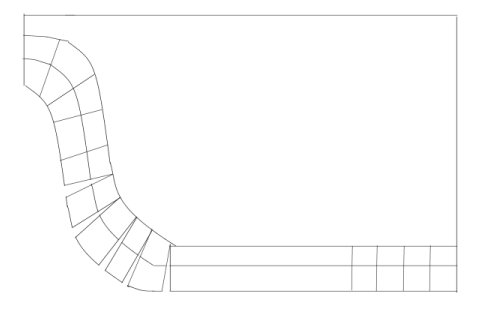
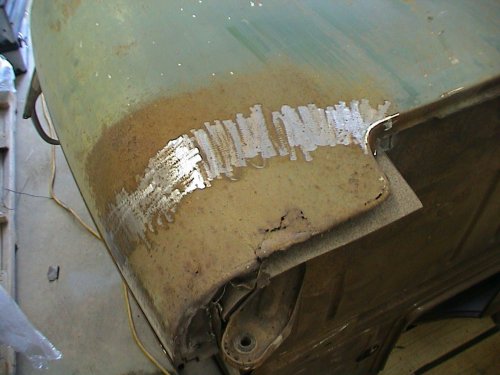
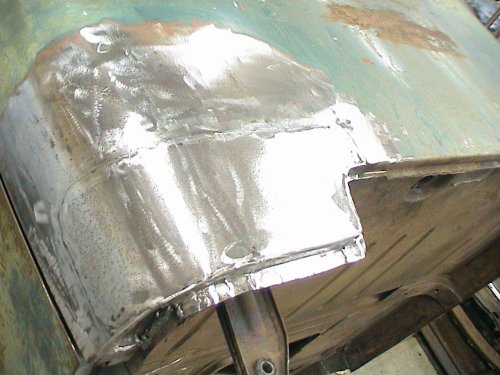
I had to reconstruct the inside of the the corners also but like I said, I like doing metal patches.
I had to reconstruct the inside of the the corners also but like I said, I like doing metal patches.

Junior User
Joined: Sep 2006
Posts: 92
Likes: 0
Wow, you are killing me here. I am supposed to be finsihing up two homework assignments due today but here I am admriing you work. Nice stuff. If I may ask another question, where do you buy your sheet metal and what gauage and composition of steel is it? I'm a newbie at this. Cool pics though and nice work
Hotshot
Joined: Jan 2001
Posts: 16,902
Likes: 3,141
From: SE Wisc. (the Rust Belt)
I use whatever I have around. I wouidn't use anything thinner than 22 ga. I use the thickest metal I can work with. I run a control panel shop and work with a lot of 14ga metal which is fairly thick and I have a lot of scrap from cutting holes out of the control panels. I have also bought metal from any place that sells body shop supplies and places that sell sheet metal to the industrial market.
BTW, I should be working too instead of playing around on the computer
BTW, I should be working too instead of playing around on the computer
Lead Driver

Joined: Dec 2004
Posts: 7,669
Likes: 13
From: San Jose, CA
The COE fenders and grille are different than F1 and F2-F6 trucks. COE's share front end parts with F7-F8 trucks. So, if you're looking for replacements or patch panels, you need to find yourself fenders from a 51/52 F7 or F8. You might be able to use fenders (for patching) from a 48-50 F7, F8 or even a COE depending on what you need to patch on yours.
I wish I had a 51 or 52 COE. A COE and a fire truck are my Bonus Built trucks holy grail.
Ilya
I wish I had a 51 or 52 COE. A COE and a fire truck are my Bonus Built trucks holy grail.
Ilya
Trending Topics

Hotshot

Joined: Oct 2004
Posts: 15,882
Likes: 88
From: Durham NC
For bodywork you want 18-20ga cold rolled sheet steel. It should be silver in color rather than black (indicates hot rolled, a cheaper harder to work steel. It can be used for simple repairs, but the black surface needs to be sanded off before welding or painting) The best metal is called Aluminum Killed Steel or Deep Drawing Steel, it is soft and easily worked, but it is hard to find. Avoid galvanized or coated steels. If you haunt the local sheetmetal fabricators shops (I usually look for a back door or loading door directly into the shop rather going thru the office door and talk to one of the guy working inside) that work with these type metals and ask if you might scrounge thru their "drops" (cutoffs too small to be of use to them) pile for useable to you pieces. They will often give them to you or charge a small amount for them. If they give them to you and/or are especially friendly, I'd bring them back a box of donuts the next visit!
Carry a wire gauge or cheap micrometer with you to check thicknesses.
I've mentioned it many times in the past, but an excellent source of info for the novice bodyman is Ron Covell's video: Basic Techniques for Working with Steel. www.covell.biz
Much better to SEE the work being done. Don't try to cut corners when repairs are needed, remove and replace any rust out, including any underlying structure.
Do a search for my posts, I have posted a lot of info on doing bodywork in various topics.
Carry a wire gauge or cheap micrometer with you to check thicknesses.
I've mentioned it many times in the past, but an excellent source of info for the novice bodyman is Ron Covell's video: Basic Techniques for Working with Steel. www.covell.biz
Much better to SEE the work being done. Don't try to cut corners when repairs are needed, remove and replace any rust out, including any underlying structure.
Do a search for my posts, I have posted a lot of info on doing bodywork in various topics.
FTE Stories
Ford Trucks for Ford Truck Enthusiasts

Top 6 Best Deals Available on New Fords & Lincolns Right Now
Brett Foote
This Hennessey Takes the Expedition Tremor's Off-Roading Capability to the Next Level
Verdad Gallardo
Top 10 Fords at 2026 Carlisle Ford Nationals
Joe Kucinski
3 Best / 3 Worst Parts of Modern Ford Ownership
Brett Foote
10 Amazing Upgrades That Solve Common Ford Truck Owner Headaches
Pouria Savadkouei
Every 2026 Ford Engine Explained
Brett Foote
10 Ugly Ford Trucks That We Still Kinda Love
Joe Kucinski
10 Things Every Truck Owner NEEDS (2026 Edition)
Michael S. Palmer
Rezvani's Latest Post-Apocalyptic Monster Is a Ford F-150 Raptor Underneath
Verdad Gallardo

Thread Starter
|
New User
Joined: Oct 2006
Posts: 17
Likes: 0
From: Smithfield, Va

Thanks guys for all the help. I'm learning allot about these trucks. Looks like whenever I get them home and can get started, I'll have to do some cutting and welding. It's great to know that reamer is making the patches I'm going to need. I have most of the equipment I think I'll need to do most of the work, but I'm a rookie. I have a large compressor, pressure pot blaster, blast cabinet, mig welder, torch set up, 20T press, engine hoist, fork lift, etc. I'll have to get a gas set up for the welder and get some practice work in. I'll also probably need to get some painting equipment so I can at least prime what I blast. Oh well, first things first. I need to get 'em home. Thanks again!
Hotshot
Joined: Oct 2004
Posts: 15,882
Likes: 88
From: Durham NC
definitely want shielding gas for the mig for sheetmetal. A 4" or 4 1/2" angle grinder with a quantity of cutoff wheels for trimming, some 60 grit flap wheels for knocking down the welds, a pickhammer with a round face other end plus a universal and/or toe dolly for stretching weld shrinkage and shrinking any stretched areas. A small tip for your torch for shrinking. 6" pneumatic DA sander, right angle die grinder, a decent gravity feed HVLP spraygun with tip for epoxy primer.
That should get you started, do we ever have enough tools?
That should get you started, do we ever have enough tools?
Hotshot
Joined: Jan 2001
Posts: 16,902
Likes: 3,141
From: SE Wisc. (the Rust Belt)
Ilya, Ilya,
I am surprised at you. The COE is a '51 but has a '48-50 hood. I blew the image of the front fender to offer as evidence:

Note 1: One of horns of the grill is sticking out
Note 2: The head light on the '51-52 protrude further out than the '48-50
Note 3: The bottom line of the fender, '48-50 don't have this ridge.
I rest my case
Would you believe my wife thinks I'm obsessive about these old trucks?
One more tool that comes in extremely handy, especially for big, straight panels , is a in-line air file. It will really helps when it comes to doors and the big, wide fenders on the Bonus Built trucks.

Make sure you get a dual cylinder unit.
I am surprised at you. The COE is a '51 but has a '48-50 hood. I blew the image of the front fender to offer as evidence:
Note 1: One of horns of the grill is sticking out
Note 2: The head light on the '51-52 protrude further out than the '48-50
Note 3: The bottom line of the fender, '48-50 don't have this ridge.
I rest my case
Would you believe my wife thinks I'm obsessive about these old trucks?
One more tool that comes in extremely handy, especially for big, straight panels , is a in-line air file. It will really helps when it comes to doors and the big, wide fenders on the Bonus Built trucks.
Make sure you get a dual cylinder unit.
Thread Starter
|
New User
Joined: Oct 2006
Posts: 17
Likes: 0
From: Smithfield, Va
Originally Posted by 51PanelMan
Nice trucks! However, your COE is not a 51. It's a 48-50. Same as the other truck.
Ilya
Ilya