



TTB X-Over Steering?

Thread Starter
|
Posting Guru
Joined: Dec 2004
Posts: 1,023
Likes: 0
 TTB X-Over Steering?
I've been pondering the idea of converting my stock steering setup to a x-over setup, but i'm not sure if my first idea is safe. I was thinking of turning the stock draglink around so that the hole for the driverside tie rod was down by the passanger wheel and then getting either another draglink or a really long tie rod to connect into it and go back to the driverside.
I'm never putting big enough tires on my truck to warrant doing a SAS, and I like the TTB except for the bump steer, so thats how I came upon this thought.
I'm never putting big enough tires on my truck to warrant doing a SAS, and I like the TTB except for the bump steer, so thats how I came upon this thought.

New User
Joined: Aug 2006
Posts: 21
Likes: 0
Nope
no traditional x-over steering will not work. especially if u off road the truck, being as each side moves independently of the other a solid bar will cause the apposing wheel to move when the suspension does. causing a lot of unwanted movment while driving. even on paved surfaces it will cause the wheels to toe in and out as the suspension moves destroying your tires. and possibly other things. i would highly advise agains it.

Postmaster
Joined: Dec 2005
Posts: 2,604
Likes: 2
On the TTB, each side of the axle moves independently of the other, making it necessary for the steering linkage to do the same. On the solid axle, the linkage can go straight across for crossover because the axle doesn't pivot in the middle. It's hard to explain, but if you take a good look at diagrams of both set ups you will see what we're trying to say.
I'm with you on wishing there was a better steering setup for the TTB. Thats the main reason I did the sas on my 94.
Tony
I'm with you on wishing there was a better steering setup for the TTB. Thats the main reason I did the sas on my 94.
Tony

Lead Driver


Joined: Sep 2002
Posts: 9,182
Likes: 12
From: Gateway to the West

Superlift already makes this setup... check out their Superunner steering steup for TTB trucks. The geometry IS better and your idea is sound. The "bump-steer" associated with the TTB is all but eliminated with the Superunner setup. However, it requires that the truck be lifted a minimum of 4" via the suspension. Now, the whole reason that the lift is required is because when Superlift designed the system, the idler arm for the center drag link is mounted to the axle pivot drop bracket on the passenger side of the truck. If you can figure out how to fabricate a mount for the idler arm and keep the susepnsion at the stock height, you are on to something! http://www.superlift.com/accessories/superunner.asp The PDF instruction file details the way the system mounts to the truck. Might be worth a look to see how it could be modified to work on an unlifted truck.
Postmaster
Joined: Dec 2005
Posts: 2,604
Likes: 2
Trending Topics

Posting Guru
Joined: Apr 2006
Posts: 1,274
Likes: 1
Yea, I would say your bump steer would get worse, not better. As far as the super runner system goes, I looked at one installed and it didnt look much better than the stock setup. The owner said it worked a little better.
FTE Stories
Ford Trucks for Ford Truck Enthusiasts

2027 Ford Super Duty Buyer's Guide (Every Model, Engine, & Package)
Brett Foote
Top 10 Ford Truck Tragedies
Joe Kucinski
AEV FXL Super Duty - the Super Duty Raptor Ford Doesn't Make
Brett Foote
Lobo Vs Lobo: Proof the F-150 Lobo Should Be Even Lower!
Michael S. Palmer
Ford's 2001 Explorer Sportsman Concept Looks For a New Home
Verdad Gallardo
10 Best Ford Truck Engines We Miss the Most!
Joe Kucinski
2026 Shelby F-150 Off-Road: Better Than a Raptor R?
Brett Foote
2027 Super Duty Carhartt Package First Look: 12 Things You NEED to Know!
Michael S. Palmer
10 Most Surprising 2026 Ford Truck Features!
Joe Kucinski
Lead Driver
Joined: Sep 2002
Posts: 9,182
Likes: 12
From: Gateway to the West
Superunner Steering system: It puts the steering linkage pivot points much closer to the axle pivot points through a greater range of steering motion which alleviates the bump-steer condition. Its geometry folks. When the pivots in the steering linkage and the pivots for the TTB axle halves are better aligned with each other during steering maneuvers, the bump-steer goes away.

Junior User
Joined: Aug 2005
Posts: 74
Likes: 0
The Superrunner system is poorly designed at best. All it does is makes the toe change a little more even between the two wheels.
The passenger wheel already has pretty good steering geometry from the factory. It's the Drivers wheel that suffers the most from bumpsteer. The Superlift kit does improve the steering geometry for the drivers wheel a bit. BUT, it takes the steering geometry for the passenger wheel from good to terrible.
A common misconception is that the steering pivot for the coresponding tie rod should be directly in front of the beam pivot. This is not true. Ideally, the radius arm, beam and steering pivot should all intersect the same line.
Here's a pic to illustrate what I'm talking about:
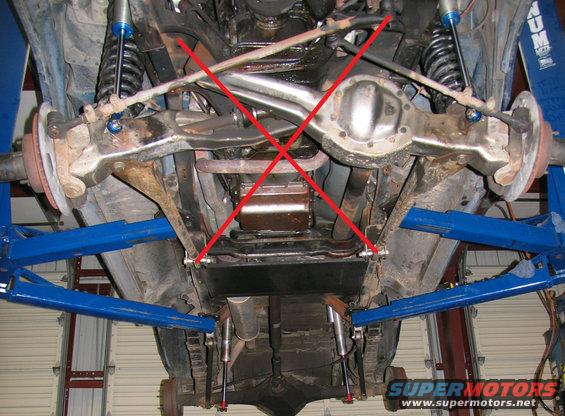
The passenger wheel already has pretty good steering geometry from the factory. It's the Drivers wheel that suffers the most from bumpsteer. The Superlift kit does improve the steering geometry for the drivers wheel a bit. BUT, it takes the steering geometry for the passenger wheel from good to terrible.
A common misconception is that the steering pivot for the coresponding tie rod should be directly in front of the beam pivot. This is not true. Ideally, the radius arm, beam and steering pivot should all intersect the same line.
Here's a pic to illustrate what I'm talking about:
Lead Driver
Joined: Sep 2002
Posts: 9,182
Likes: 12
From: Gateway to the West
Originally Posted by steveg3
A common misconception is that the steering pivot for the coresponding tie rod should be directly in front of the beam pivot. This is not true. Ideally, the radius arm, beam and steering pivot should all intersect the same line.
Junior User
Joined: Aug 2005
Posts: 74
Likes: 0
Originally Posted by greystreak92
Ideally, the pivot points in the steering system will remain in phase with the location of the axle pivot points or the bump-steer condition will still be there. However, since the ONLY way to achieve that would be to make the steering fully hydraulic the best anyone can hope for is to place the linkage pivots so that when the steering is hard-over the pivots are as close to being aligned with the axle pivots as possible. This means placing them so that they stay as close to the location of the axle pivots as possible throughout the entire range of steering motion. The misconception is that the only time the pivot locations matter is when the truck is pointed straight ahead.
If you're saying that the radius arm pivot can be ignored and that you only need to worry about the axle pivot then we're on opposite sides here. I've seen a lot of trucks with the steering pivots directly in front of the beam that had a ton of bumpsteer.
My truck spends more time close to centered or "straight ahead" than full lock. Personally I want the geometry to be ideal in the straight ahead position and not at full lock where it spends very little time.
Junior User
Joined: Aug 2005
Posts: 74
Likes: 0
I just thought of something. If you're saying to place the steering pivot (Let's use the passenger beam for example) in front of the axle pivot at full right lock. then we might be saying the same thing in a round about way. when you return to "straight ahead" the steering pivot is back to where I was suggesting which was intersecting an imaginary line drwan through the radius arm pivot and axle pivot.
For the sake of our discussion maybe you could clarify what you mean by "in phase with the location of the axle pivot point".
For the sake of our discussion maybe you could clarify what you mean by "in phase with the location of the axle pivot point".

Thread
Thread Starter
Forum
Replies
Last Post
52 F1 Stocker
1948 - 1956 F1, F100 & Larger F-Series Trucks
23
Oct 23, 2015 10:13 AM
F-250 restorer
1973 - 1979 F-100 & Larger F-Series Trucks
24
Sep 8, 2015 03:36 PM
SunBum
Audio & Video Systems, Navigation, Satellite Radio & Mobile Electronics
2
Mar 18, 2005 02:26 PM