


Efi 400

Thread Starter
|
Postmaster
Joined: Aug 2001
Posts: 4,270
Likes: 5
From: Delaware
Originally Posted by roger dowty
 this is cool chit! Now I'm wondering why your cam, with a longer overlap and quite a bit more lift is only draining 2 pts off compression when my relatively rv'ish roller cam drains the same to a bit more?? Also, whats with the ohio pistons- I like the height..I take it theyre bushed clevelands? putting this thread to favotites for sure!
thanks and
 HNY
HNYOhio pistons are flattops like Badgers. These are no longer made.

Posting Guru
Joined: Mar 2005
Posts: 2,068
Likes: 0
From: western montana
Originally Posted by danlee
My cam has a lot of lift, but a fast ramp rate, so the IVC is only 66 degrees. My effective stroke is about 3.0". An RV cam with 53 degrees IVC will have an effective stroke of about 3.4", but with lower ramp rates will have lower lift. My cam loses 2 points of CR, but all cams lose some..
Posting Guru
Joined: Mar 2005
Posts: 2,068
Likes: 0
From: western montana
special grind: HR of course
264/270 advertised with 212/218 at .050. The lift would be 521/521 and it would have 110 lobe. ((I was thinking of a prev special grind that I didn't use))
You did your dyno on it and I did drop less than you...10.4 to 8.75 (1.75)
I was surpirsed that porting the heads got me 397 hp and stock oz flow was 335.
I am working my hiney porting those heads and putting in 4v valves just cause.
264/270 advertised with 212/218 at .050. The lift would be 521/521 and it would have 110 lobe. ((I was thinking of a prev special grind that I didn't use))
You did your dyno on it and I did drop less than you...10.4 to 8.75 (1.75)
I was surpirsed that porting the heads got me 397 hp and stock oz flow was 335.
I am working my hiney porting those heads and putting in 4v valves just cause.
Last edited by roger dowty; Jan 2, 2006 at 11:56 PM.

Elder User

Joined: Sep 2000
Posts: 936
Likes: 0
From: Bay area
Originally Posted by danlee
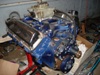
Here is the latest photo of my EFI 400. I have had it running, but it needs a lot of tuning yet.

Dan, I am wondering if some of your problemd might be with the maf being so far away from your tb?
FTE Stories
Ford Trucks for Ford Truck Enthusiasts

Top 6 Best Deals Available on New Fords & Lincolns Right Now
Brett Foote
This Hennessey Takes the Expedition Tremor's Off-Roading Capability to the Next Level
Verdad Gallardo
Top 10 Fords at 2026 Carlisle Ford Nationals
Joe Kucinski
3 Best / 3 Worst Parts of Modern Ford Ownership
Brett Foote
10 Amazing Upgrades That Solve Common Ford Truck Owner Headaches
Pouria Savadkouei
Every 2026 Ford Engine Explained
Brett Foote
10 Ugly Ford Trucks That We Still Kinda Love
Joe Kucinski
10 Things Every Truck Owner NEEDS (2026 Edition)
Michael S. Palmer
Rezvani's Latest Post-Apocalyptic Monster Is a Ford F-150 Raptor Underneath
Verdad Gallardo
Thread Starter
|
Postmaster
Joined: Aug 2001
Posts: 4,270
Likes: 5
From: Delaware
I was running Calcon today. I had the idle set at 672 RPM, and the MAF Volts read about 1.0 volts. Since my cam needs a few more RPM at idle, I set the idle up to 800 RPM. At that point the MAF jumped to 4.7 Volts, and the tach on Calcon started jumping all over. I can switch the tweecer from 800 RPM and back to 672 and the jumping stops. Also the rightand left HEGO readings are steady at < 0.1 volt when idling at 672 RPM. When I switch to 800 RPM, the left HEGO jumps all over, but the right one stays at < 0.1 volt. LambSe and KAM also jump around at the higher RPM for the left side only. Calcon reports the battery voltage as about 5 Volts.
This sounds like a noise or grounding problem. I think that the MAF is an integrating device, also the large plenum in my manifold will smooth out the air flow.
This sounds like a noise or grounding problem. I think that the MAF is an integrating device, also the large plenum in my manifold will smooth out the air flow.
Thread Starter
|
Postmaster
Joined: Aug 2001
Posts: 4,270
Likes: 5
From: Delaware
Bill,
You have two choices in an EFI conversion. The first is to buy what someone else is offering, and the second is to DIY. With the DIY approach come more and bigger problems, but it is probably cheaper, and it is definitely more rewarding.
Don,
I believe that I have found my problem. I opened the case of the ECU and put a
clip on pin #43(Left HEGO) and ran the motor. I read about 0.14V on
pin #43. This agreed with what Calcon was reporting. Then I stuck a
pin into the rear of the connector at pin #43. I again ran the
motor. The meter attached to the pin read 0.55V, while Calcon
reported much lower. So I think that all of my problems are
connector related. I will try to replace the sockets in the female
connector and see if that fixes the problem. It could be the pins in
the male end in the ECU. I may have to cut the 60 pin connector off
and completly replace all the sockets.
I saved a bunch of money on a used Mustang Harness, and ECU, but now I am paying the price. These and the Cobra TB are the only used items in the project. The TB was late model, but the harness and ECU are '89 vintage. That is not so bad when you consider that my truck is a '53, but my truck had more TLC.
That jumping around cleared up, and my MAF reading came down to normal. This was another symptom of connector problems.
It is running rich, and the HEGOs are reporting it lean because of bad connections.
You have two choices in an EFI conversion. The first is to buy what someone else is offering, and the second is to DIY. With the DIY approach come more and bigger problems, but it is probably cheaper, and it is definitely more rewarding.
Don,
I believe that I have found my problem. I opened the case of the ECU and put a
clip on pin #43(Left HEGO) and ran the motor. I read about 0.14V on
pin #43. This agreed with what Calcon was reporting. Then I stuck a
pin into the rear of the connector at pin #43. I again ran the
motor. The meter attached to the pin read 0.55V, while Calcon
reported much lower. So I think that all of my problems are
connector related. I will try to replace the sockets in the female
connector and see if that fixes the problem. It could be the pins in
the male end in the ECU. I may have to cut the 60 pin connector off
and completly replace all the sockets.
I saved a bunch of money on a used Mustang Harness, and ECU, but now I am paying the price. These and the Cobra TB are the only used items in the project. The TB was late model, but the harness and ECU are '89 vintage. That is not so bad when you consider that my truck is a '53, but my truck had more TLC.
That jumping around cleared up, and my MAF reading came down to normal. This was another symptom of connector problems.
It is running rich, and the HEGOs are reporting it lean because of bad connections.
Posting Guru
Joined: Aug 2000
Posts: 2,416
Likes: 4
From: PacNW
Originally Posted by danlee
Bill,
You have two choices in an EFI conversion. The first is to buy what someone else is offering, and the second is to DIY. With the DIY approach come more and bigger problems, but it is probably cheaper, and it is definitely more rewarding.
You have two choices in an EFI conversion. The first is to buy what someone else is offering, and the second is to DIY. With the DIY approach come more and bigger problems, but it is probably cheaper, and it is definitely more rewarding.

Thread Starter
|
Postmaster
Joined: Aug 2001
Posts: 4,270
Likes: 5
From: Delaware
You also get to say LMAF and caledit.
BTW, I am thinking that I want to bring this to the National Rally in June. If it is running real good, and the gas mileage is decent, I might drive it. Otherwise I will trailer it.
BTW, I am thinking that I want to bring this to the National Rally in June. If it is running real good, and the gas mileage is decent, I might drive it. Otherwise I will trailer it.
Last edited by danlee; Jan 23, 2006 at 08:31 PM.

Laughing Gas

Joined: Aug 2004
Posts: 964
Likes: 1
From: Roseburg, OR
LambSe is of course, the milder version of goatse (and you will only google that term if you have a really, really, really strong stomach and aren't offended easily...) 
This is DEFINITELY what I do for my Summer project. Looking back, I really can't believe I spent the money for a new carb when I built my motor... I should have just put the money toward this.
DAN... how did you wire your HEGOs? That is... did you use solder? Believe it or not, I've heard that it is actually a bad idea to solder the connection to your O2 sensors. Supposedly (and I know this sounds weird, but I've got it from good sources and have a few web pages that say the same) the O2 sensor actually gets a reference air supply by drawing air down through the gaps between the strands in the actual wire that connects to the sensor. Like I said, weird, but I've heard it a number of times from people who seem to know fuel injection pretty well.
This is DEFINITELY what I do for my Summer project. Looking back, I really can't believe I spent the money for a new carb when I built my motor... I should have just put the money toward this.
DAN... how did you wire your HEGOs? That is... did you use solder? Believe it or not, I've heard that it is actually a bad idea to solder the connection to your O2 sensors. Supposedly (and I know this sounds weird, but I've got it from good sources and have a few web pages that say the same) the O2 sensor actually gets a reference air supply by drawing air down through the gaps between the strands in the actual wire that connects to the sensor. Like I said, weird, but I've heard it a number of times from people who seem to know fuel injection pretty well.