


toyota power steering conversion kits

Hotshot


Joined: Oct 2004
Posts: 15,882
Likes: 88
From: Durham NC
The mounting point on the chevy frame is much narrower than the ford frame, restricting the box to mounting on top the frame rather than thru the frame. The column angle would need to be changed if the box was mounted on top the frame it would need to come thru the vertical part of the firewall otherwise the U joint would be at too great an angle to work properly. Raising the box would either require a longer pitman arm which would increase the steering sensitivity or would cause bump steer if the drag link was angled relative to the ground. Ford correctly designed the location of the pitman shaft to be as close as possible to and in line with the rear spring pivot, to keep bump steer to a minimum. Any changes to this position will make a dramatic change in the steering geometry that may not be correctable. There is no good reason I can see for moving the steering box to the top of the frame on our trucks and the risk of being detrimental is high.

Posting Guru
Joined: May 2010
Posts: 1,057
Likes: 2
From: Kalamazoo MI
Man, AX (Chuck) when you speak steering you really know your stuff. Glad to see you are on the FTE side of life. I did want ask, you mentioned earlier in this post about the mounting bracket. To me the "V" angled bracket seems like an item that, if properly fabbed, could be done in my shop instead of paying big bucks to the suppliers. Any thoughts on fabbing a subtle "V" bracket? Must the bracket be solid bar stock or would using 1/4" walled rectangle tubing suffice? How much force is really exerted on the bracket/frame in that area. Any thoughts? Thanks.
New User
Joined: Apr 2012
Posts: 14
Likes: 0
From: Bakersfield CA
No reason in the world you can't make your own bracket. Plop the gear in the hole, pay a buddy a 6-pack of Sam Adams to hold it in position and make yourself some carboard templates. Cut them out of 1/4" steel (should be plenty strong) w/ adequate gusseting, weld 'em up and bolt 'em in. If you are nervous, make them out of 3/8" steel and be extra safe. I call myself 'bracket man' since I build mostly cars that no one makes after-market parts for - '36 ****** coupe, '39 ****** pickup (B4 they became popular), '36 Pontiac sedan, Nash Metropolitan. Either make the brackets yourself or don't build the car are the options. In fact even if they do make parts for a car I am building, I still like making my own stuff; saves $$$$$$$$$$$$$$$$ and doesn't look belly-button like the stuff bought out of rod magazine ads.
Hotshot
Joined: Oct 2004
Posts: 15,882
Likes: 88
From: Durham NC
You definitely could make your own bracket. I've actually designed a bracket that is different than the ones on the market after I bought the aftermarket V style. The advantage of the V style is that it bolts right into the stock mounting holes, so little frame modification is needed to install. If you have some 3/4x2" bar stock sitting around, taps and tap drills and a way to accurately cut the bar and a large enough welder to weld it, it wouldn't be very difficult to make once you saw one. To me I don't have a heavy enough welder, or a way to accurately cut that heavy of stock. Buying a minimum order of that size bar stock would be expensive. Drilling and tapping would be time consuming as well, so the price for the ready made mount wasn't far out of line. The mount I designed is made from 2x2 x 1/4" angle iron with just a small amount of welding that can be done with a home welder. The disadvantage is that a few new holes need to be drilled in the frame. No tapping is required tho so all the drilling can be done with a portable electric drill.
There is a company making a mount out of several pieces of 1/4 or 3/8 strap iron. No offense to that company, but to me it looks cobbled together and not strong enough.
There is a LOT of stress on the mount and frame in use.
Teardropty, contact me offline if you are interested in making your own mount. Thanks for the compliment, I have managed to absorb some useful info in 50+ years of building hot rods and race cars. The mechanics are especially interesting to me, I like to know why things are designed the way they are, and suspension setup is extremely important in autocross racing on the national level.
There is a company making a mount out of several pieces of 1/4 or 3/8 strap iron. No offense to that company, but to me it looks cobbled together and not strong enough.
There is a LOT of stress on the mount and frame in use.
Teardropty, contact me offline if you are interested in making your own mount. Thanks for the compliment, I have managed to absorb some useful info in 50+ years of building hot rods and race cars. The mechanics are especially interesting to me, I like to know why things are designed the way they are, and suspension setup is extremely important in autocross racing on the national level.
Cargo Master


Joined: Sep 2010
Posts: 3,427
Likes: 48
From: Hot AZ (Phoenix Valley)

I haven't found one that is designed for the 48-52. I've been looking at all the options... And liked the idea of not having to grind down the side of the toyota box to mount it thru the frame. Also like the design that someone had that uses the orignal mounting holes.
Hotshot
Joined: Oct 2004
Posts: 15,882
Likes: 88
From: Durham NC
I haven't found one that is designed for the 48-52. I've been looking at all the options... And liked the idea of not having to grind down the side of the toyota box to mount it thru the frame. Also like the design that someone had that uses the orignal mounting holes.
See my article link in post # 46 above for all the details on using the box on the 48-52.
New User
Joined: Apr 2012
Posts: 14
Likes: 0
From: Bakersfield CA
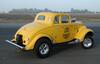
One day I saw a strange looking spare tire panel sticking out of a schoolmate's garage and asked him what kind of car that was. When he told me it was a ******, I didn't believe him, all I knew was the '40-'42 style. Went to the mags and sure enough, it was a '36 ******. '33 thru '36 have the same bodies, different front sheetmetal. Most of the racing '33s were actualy '35s and '36s with the earlier 'glas hood. ****** produced a bunch more of the later models. ****** 'experts' can tell the difference. I offered to buy it for $75 and he agreed. Another classmate sold me a 331 hemi for $25. Had to work all summer to raise the $100. My next-door neighbor had an old mecury with a transplanted hydramatic so I got that for free. My tranny adaptor was my HS graduation present!
Hacked the car together and drove it during college. Surprisingly I survived that build and tore it down in '72 whe I got my first oilfield engieering job. Didn't get it built 'til ~95 when my family was grown and I had the $$, skills, and tools to do it right.
331 bored 1/8" over to 354, put B&M hydro guts in the tranny, 8" narrowed Olds rear, finned Buick brakes adapted to rear, stock drilled and chromed front beam axle and spindles 4" riser blocks (any hot rod with the front wheels inside the fenders is not a hot rod!!), steel body, home made 'glas tilt front made from a mold of the stock sheet metal, Holley 3-bbl, MII shifter, Torino disk brakes adapted to ****** spindles, 'Vair aluminum steering gear. All the good old gasser parts. It has been my daily driver (in good weather) ever since.

FTE Stories
Ford Trucks for Ford Truck Enthusiasts

10 Ugly Ford Trucks That We Still Kinda Love
Joe Kucinski
10 Things Every Truck Owner NEEDS (2026 Edition)
Michael S. Palmer
Rezvani's Latest Post-Apocalyptic Monster Is a Ford F-150 Raptor Underneath
Verdad Gallardo
Top 10 Most Expensive Ford Trucks Ever Sold on Bring a Trailer
Joe Kucinski
2027 Ford Super Duty Buyer's Guide (Every Model, Engine, & Package)
Brett Foote
Top 10 Ford Truck Tragedies
Joe Kucinski
AEV FXL Super Duty - the Super Duty Raptor Ford Doesn't Make
Brett Foote
Lobo Vs Lobo: Proof the F-150 Lobo Should Be Even Lower!
Michael S. Palmer
Ford's 2001 Explorer Sportsman Concept Looks For a New Home
Verdad Gallardo
Hotshot
Joined: Oct 2004
Posts: 15,882
Likes: 88
From: Durham NC
SWEEET! That's even older than me! Being from Buffalo originally I saw a lot of the NE gassers and really loved the ****** and the gasser wars: Ohio George, Hurudka Bros, Stone Woods and Cook, Jim Zakia etc.
