When you click on links to various merchants on this site and make a purchase, this can result in this site earning a commission. Affiliate programs and affiliations include, but are not limited to, the eBay Partner Network.
I’m gonna start a “mini build thread” here for a truck that my son and I are doing. I say a “mini thread” as I don’t plan on doing long & detailed posts (I’m busy enough doing the posts on my own build). It’s his first truck that qualifies as “really old”, and he is a newbie at this stuff so he is learning a ton. I’ve already posted a few of the pics that will appear in this new thread as I was gathering technical info to help us out, as well as getting some guidance from you guys.
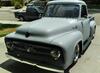
As a background my son is a stonemason who specializes in heritage buildings, and he wanted a heritage style truck for advertising his business as well as for going to shows and just having fun. He of course wanted a truck with a heavy duty look (despite me repeatedly telling him that half-tons are way easier for parts), so after a ton of searching he found this:
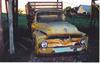
It's a 1950 F68 (Canadian F3) from western Canada. Body wise it is in fairly good shape, with rust in the usual spots, mostly where panels overlap and trap water. The worst spots are the driver side floor at the toe panel, as well as the rear fenders where the heavy steel support sandwiches the rear of the fenders to the bedsides.
Before sinking any money into the truck we did a careful inventory/inspection of what we were faced with. As I knew the body was fairly good, my number one concern was the engine. The previous owner advised that he was able to turn the engine using the fan blades a couple of years ago but I suspect he was merely turning the fan blades while the belt slipped on the crank pulley. I spent weeks doing the usual stuff like filling the cylinders with acetone/ATF, prying on the ring gear, towing it while dumping the clutch, etc. all to no avail.
I eventually gave up on “just freeing it up” and opened things up for a proper inspection. This engine has not turned over in decades. It was completely rusted up inside, with pits in the cylinder walls nearly ⅛ of an inch deep. I was able to scoop out entire handfuls of rust from inside the cylinders.
This engine was toast. I did however have another seized flatty on hand from my 1950 half ton build, so I dragged it inside and opened it up to see what I had. Here’s a few pics:
I managed to get a few pistons out, but it remained seized which prevented access to some of the connecting rod bolts (thereby thwarting my attempts to fully tear it down). A number of valves were obviously seized, but the overall condition inside the block was quite good. No cracks at all that I could find, a relatively minor lip at the tops of the cylinders, and decent cylinder walls.
The engine appeared to be an excellent candidate for a rebuild, however that’s a pricey thing to do these days so I oiled everything up and reassembled the works for now.
Visual inspection of the mechanical systems showed things to be in not too bad shape. The front springs are garbage due to damage caused by the pins wearing out, and I unfortunately could not get one of the rear drums off so I don't know about the condition of that side of the rear axle. The steering box also had a lot of slop in it. Typical stuff for an old truck that may have sat for quite a while (actually for one heck of a long while based on the rusted up engine).
I’ll post some pics of the progress as my son and I work through it.
Things are happening now in this build! For the longest time, the truck had sat on my hoist as my son’s work is somewhat seasonal. He works as long as the weather (and family obligations) will allow, however a while back I decided to light a fire under him by posting this pic and sending it to him:
A week or 2 later he was up in my shop and we started blasting away. Because he is a complete newbie at metal work, we started easy. The truck came with an aftermarket floor pan, so he cut out the piece we needed from it and got to work fixing the area around the drivers feet. I handled the welding, but he got everything cut and prepped and in no time the bad floor section was done:
Since he works with power tools and hand tools all day long, he picked things up awfully fast. I set him to other tasks involving areas of flat steel that were bad and he removed the bad stuff and made patches that we tossed in:
While he kept busy that way, I decided to deal with the rear fenders which had rotted out where the fender and the inner steel brace sandwich together (happily trapping water/mud/salt/etc). Here’s what we were faced with:
We only had 1 inner steel brace, but since parts are mirror images we could use the existing brace to fab up a replacement for the other side:
Next came forming a new fender edge:
And then we tossed things together:
My son returned to put in another half day and by the end of that we had the floor, 1 rear fender lip & brace and 2 flat patches on the box accomplished. My son insisted that I update the tally sheet before he left:
I was impressed with how quickly he picked up metal working skills!
It's good to try to hand down our metal working skills. My son is very handy as well, him only being 16 and completely tearing down a 5 speed transmission by himself was impressive. I try to get him interested in the sheet metal work I do but he has little interest other than when his 76 ford tailgate needed patched. I let him to the welding and helped him create the complex patch panels. Anyway, I guess I'm saying, it's good to see others working with their kid and seeing other generations picking up the rare skills nowadays...
Things are happening now in this build! For the longest time, the truck had sat on my hoist as my son’s work is somewhat seasonal. He works as long as the weather (and family obligations) will allow, however a while back I decided to light a fire under him by posting this pic and sending it to him:
A week or 2 later he was up in my shop and we started blasting away. Because he is a complete newbie at metal work, we started easy. The truck came with an aftermarket floor pan, so he cut out the piece we needed from it and got to work fixing the area around the drivers feet. I handled the welding, but he got everything cut and prepped and in no time the bad floor section was done:
Since he works with power tools and hand tools all day long, he picked things up awfully fast. I set him to other tasks involving areas of flat steel that were bad and he removed the bad stuff and made patches that we tossed in:
While he kept busy that way, I decided to deal with the rear fenders which had rotted out where the fender and the inner steel brace sandwich together (happily trapping water/mud/salt/etc). Here’s what we were faced with:
We only had 1 inner steel brace, but since parts are mirror images we could use the existing brace to fab up a replacement for the other side:
Next came forming a new fender edge:
And then we tossed things together:
My son returned to put in another half day and by the end of that we had the floor, 1 rear fender lip & brace and 2 flat patches on the box accomplished. My son insisted that I update the tally sheet before he left:
I was impressed with how quickly he picked up metal working skills!
Good start! Nice work! I look forward to seeing your project's progression. Great to see father/son projects!
Thanks guys! It truly is a blast to spend time with my kid in this hobby. I’m constantly amazed by how quickly he picks up the manual skills in metalwork, but I suppose that shouldn’t be that surprising. His work involves shaping/carving stone with a careful eye to the proper lines and curves that are needed. Metal is just a new material that he had adjusted to.
Since our first goal was to get the body into presentable condition, we continued to blast away. Nothing fancy here, as he wants the truck to continue to look old, and visible repairs are fine as long as they don’t look like they were done with an arc welder and sledge hammer.
We continued along with those beat up and rusted rear fenders, but we got smart on one patch and found a piece of sheet steel that had surface rust that matched the truck:
Unfortunately we didn’t have much more of that old steel so it was back to the shiny stuff. We will decide later if we try to blend the patches using various paint colours and scuffing pads. I personally am not a fan of faux patina over an entire vehicle, but I’ll make exceptions to blend in patches. Here’s a few more pics of fender work:
The rear of the box has seen some serious abuse, and of course the requisite angle iron farmer fix. Since that fix was nice and heavy and obviously a good half century old, my son wanted to keep it.
Things were however a bit wonky, with lots of cracks, failed spot welds, and some out of square stuff so we got to work on those repairs:
By time our last day ended, things looked like this:
I'm pleased with the progress, as our current project time board looks like this:
Those hours are the time we spent together at my place. He lives 1 1/2 hours away, so it's not that simple to just pop over to do a mornings work. He has dealt with this by taking parts home and working on them as little bits of available time pop up.
Thanks for the update. With your son 1½ hours away makes it tough.
I know what you mean by faux patina. There was a guy on here several years ago from the Philly area. He had a 55 F100 that had rust holes in the usual spots. He replaced the metal with new patches and blended them in nicely to match the patina of the truck.
I don't remember his user name. He hadn't been on here for years.
A short while back we realized that an engine was going to be needed and we had determined that the old engine from my build would be a good candidate, but the cost would be pretty tough on my son’s finances. I knew all this for quite a while, so I had spent a half year checking facebook and kijiji ads as well as talking to countless people at cruise nights and shows. I have a fairly good network of contacts in this hobby, but so far I had struck out. There were only a couple of engines I located, and the owners wanted more money than a rebuild of mine would have cost. My son was aware of my lack of progress, so he asked me to send him a detailed description of the engine we need. Keep in my that my son has zero experience with vehicles, and has no idea of what he was looking for.
I of course wanted to encourage him, so I gave him a description and pictures of what he needed and sent him off on what was obviously a hopeless snipe hunt. One week later he calls me up and says he found one. Not only did he find one, but it was a mile down the road from his place! He had seen old vehicles at a farm nearby, and stopped in to see if they may know about any candidate engines and it turned out that they had one right there. I couldn’t believe it. That kid has horseshoes up a certain body part. Here is what he dragged home:
By weird coincidence, he and I had seen that truck (before the body was stripped off) at a different location, but we ignored it as this was back when we were looking for a project truck. We had been checking out an old Dodge and this Ford was sitting beside it, but it was obviously a heavy truck and we paid it no attention. That happened at a property a few miles away from his place, at the residence of the previous-previous owner. Once my son found the truck at his neighbours place, he made some inquiries and it appears that the truck was being driven around the property of the previous-previous owner just last summer. It still can be turned over by spinning the fan blades and with any luck it may just be a good runner.
I explained the need to clean things up so that we are not dealing with parts covered in grease and baked on crap, so my son said he’d start to get things a little cleaner for us. Since it was parked at his place, he could spend lots of little bits of available time on it, and before long I started receiving texts with pictures like these:
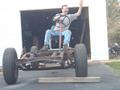
Now we will try to do a test run to ensure it works OK, and also try to figure out which parts from all that will fit his F68. This rolling chassis has a 2 speed rear end, a transmission mounted parking brake, and a VIN stamped on the frame that so far I have not been able to decipher:
Since it’s a Canadian truck, VIN info is hard to figure out (why did we have to do it differently from the way it was done in the States?).
What a great find! The engine and everything else looks super all cleaned up. I can't wait for the news that it runs and compression is up on all 8 cylinders! Best of luck to you both.
This rolling chassis has a 2 speed rear end, a transmission mounted parking brake, and a VIN stamped on the frame that so far I have not been able to decipher:
Since it’s a Canadian truck, VIN info is hard to figure out (why did we have to do it differently from the way it was done in the States?).
Your serial number decodes as follows;
GM is the series code, 158" wheelbase F155, the same as an F6 in the states.
81 is the code for cab and chassis
H is the assembly plant code, Home Office, Windsor, Ontario
48 = 1948
5786 consecutive unit number.
Interesting that it's had an engine swap to the 8BA at some point in its life as the 48 Fords in Canada still used the old 59AB flathead up to serial number H48-20,000.