When you click on links to various merchants on this site and make a purchase, this can result in this site earning a commission. Affiliate programs and affiliations include, but are not limited to, the eBay Partner Network.
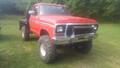
I just bought a 1979 F150. It has dual shocks on the front. There is a lot of play in the steering. Everything seems fine except the stabilizer bar that goes from the shock tower down to the axle housing. It has a ton of play. First, does that have anything to do with the steering? Also, what is that bar called and where do I get another or at least maybe a bushing for it? Here is a picture. I’m pointing to the area that has play.
79 F150 4wd.... so that is the axle end of the "trac bar" you are pointing to. Insp the other end, that is where you normally get a worn out bushing and worn out trac bar bracket bolt holes. Bronco Graveyard, Dennis Carpenter, Blue oval truck parts, NPD, Green auto sales, LMC. Energy Suspension poly bushings.
Check out the Parts Vendors & Resources list in the above link.
It will steer like crap with worn out trac bar bushings. The axle and body will go different directions. With it parked and not running, move the steering wheel back and forth, do you have ALOT of play in it? Do the axle and frame up move in different directions? Bushing time.
And or your steering box is/can be shot. Red Head or Blue Top time.
Also I see red coil springs, how much lift does it have, and if it has a lot and a stock trac bar (instead of an adjustable one) that could also be an issue. But new bushings (each end) is quick fast and easy.
Well I am not a 4wd F150 4" lift 100% knowing component kinda guy, but you should have a drop pitman arm, and pretty sure an adjustable trac bar. Or maybe a trac bar drop bracket also? Also with that lift you might need to have changed the C bushings a few * to keep the pinion angle correct. Excess shock tower movement is a moot point at the moment, you have bigger issues to contend with.
Yes, that track bar and having no play is just as important to steering as is the drag link and the two end joints. It's also important that the track bar and draglink are parallel with each other. Lots of these trucks got lifted and no corrections made for track bar or pitman arm to lower the drag link a little. Polyurethane bushings are what you need in that track bar.
Pretty well pronounced in that last photo, but you might have a look at your front differential, it is pointing toward the ground with the yoke pointed up in the air and by the looks of it, the angle seems on the extreme side for your front driveshaft yoke. C bushings are in your future I'm thinking.
I can see now why there was so much play in steering. The bushing was shot in the trac bar at the axle and I had to cut the bolt off. Maybe I should get a tapered stud for it.
Last edited by Shaun_000; Jun 4, 2021 at 06:55 PM.
It looks like the PO just installed lift springs and that's it. You need a drop pitman arm and either a trac-arm drop bracket (less recommended) or an adjustable trac-arm (highly recommended, link below). Any worn out or loose bushing on the front end will cause loose steering and the dreaded "death wobble". I just replaced my stock trac-arm bar and drop bracket for an adjustable trac-arm (Superlift 1080, cost $100 and worth it). When I lifted my truck seven years ago, I used a 7 degree bushing kit for Wild Horses (link below) with no issues so far. Ball joints, tie rods, rag joints, wheel bearings, and steering column bearings can cause lose steering as well. These are easy to check without spending any money. How do you plan of using your truck? Daily driver, offroad fun, farm truck, etc?
Just occasional driving. I’m changing everything that needs changed. Today I put new axle shaft u joints and new ball joints and new brake callipers. I ordered a bunch more parts.
I got the drop pitman arm on. I put in 7 degree C bushings and the adjustable trac bar. With the adjustable track turned all the way in to its shortest, the tire was sticking out a little bit more on the passenger side. I tried taking the trac bar apart and removing the nut in the middle that locks it. I put it back together and was able to make it slightly shorter. Now the tires are perfect. But I’m sure it’s not meant to be that way. Everything seems fine otherwise. Any idea why I need the bar so short?
Last edited by Shaun_000; Jun 13, 2021 at 03:01 PM.
Until the angles get fixed, it'll not drive well. More in your other thread: (Adjustable trac bar - Ford Truck Enthusiasts Forums (ford-trucks.com).
You want the line between the track bar and frame bracket bolt centers and a line through the drag link to be as near parallel as possible.
Last edited by tbear853; Jun 16, 2021 at 12:11 PM.
Reason: added link to thread
I forgot to add in the other thread that another advantage to the adjustable trackbar is it allows you to match the angle of the upper eye to the angle of the frame bracket. In cases of suspension lift the axle tilts down forward like was mentioned earlier. Offset C-bushings do tilt it back, but not always getting it back to the same as factory original. This twist puts extra stress on the mounts. And the lower mount on these was a well known wear area even back in the day.
As early as the mid-80's a company called Ingalls Alignment Products had a kit that included a new long bolt with tapered sleeves and included a tapered reamer for you to open up the usually wallowed out hole and lock the new bolt down solidly. Great kit. Even back then it was in the $80 buck range which was a real wallet killer to most in those days. But it was a killer product!
Sounds like you got it fixed up nice though. Great news.
Oh, and regarding your original "almost parallel" look, remember that the important part of this equation is not necessarily the bar itself, but the relationship between the upper and lower pivot points. So that little J-bend in the lower end of the bar is what makes it look out of parallel when the actual pivot points are still at equal distances.
Never was quite sure what the purpose of that bend/curve was, but it definitely looked "purposeful" anyway.
This Hennessey Takes the Expedition Tremor's Off-Roading Capability to the Next Level
Slideshow: The VelociRaptor Expedition gains a lift, upgraded suspension, Brembo brakes, and trail-ready equipment while retaining the stock 440-horsepower EcoBoost V6.
Rezvani's Latest Post-Apocalyptic Monster Is a Ford F-150 Raptor Underneath
Slideshow: Called the Fortress, the 850-horsepower pickup combines Raptor underpinnings with military-inspired features, survival equipment, and a starting price of $285,000.