





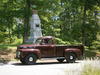


rear drums sticking

Thread Starter
|
More Turbo
Joined: Sep 2011
Posts: 559
Likes: 8
rear drums sticking
On my 1955 ford f100 I rolled it'd out into the driveway brakes worked fine. Went to put the truck back into the garage there is a small incline. When applying the brakes I noticed the rear drums dragging. I stepped on the brakes again and they released. But applying the brakes again the same thing happened. I have bled the brakes and adjusted the rear shoes. And it happened again. Any ideas? Maybe springs need replacement? This truck has been upgraded to power brakes from cpp. Also when I pulled on the emergency brake lever it doesn't hold the truck as well as it should I really have to pull hard on the lever. Any ideas will be appreciated.
Thanks
Jerry
Thanks
Jerry

Tuned


Joined: Nov 2017
Posts: 302
Likes: 44
From: Cicero, IN
Leading vs. Trailing Shoes
As I recall, the trailing brake shoe (facing the vehicle rear) has more friction material than the leading shoe because of the dynamics of apply. Could you maybe have these shoes installed opposite of the correct orientation? That could a shoe sticking on.
Thread Starter
|
More Turbo
Joined: Sep 2011
Posts: 559
Likes: 8
On the rear drums the bottom spring I’d hitting the adjusting wheel on adjuster. When I adjusted the rear brakes I made it a little loose. Should I adjust it tighter? When I loosened up the adjustment you had to pull up on the emergency brake lever a lot. I guess I should start by adjusting the brakes a little tighter. Now on the the brake shoes how do you tell primary shoes?
thanks
jerry
thanks
jerry

Elder User
Joined: Apr 2016
Posts: 645
Likes: 10
The primary brake shoe is the front shoe and is should have a shorter length of lining material ion it than the secondary (rear) shoe. Each drum brake is set up that way. The secondary (rear) shoe has more lining because it does more of the braking. When moving forward and the brakes are applied, when the front (primary) shoe contacts the brake drum, the rotation of the drum will rotate the shoes putting additional force between the rear (secondary) shoe and the drum. I think they called this brake shoe arrangement duo-servo. To get an idea of what happens, after the shoes and all springs and parts are installed on the backing plate grab the brake shoes near the bottom in the adjuster area and rock the assembly front to back.
When adjusted correctly there should be a very slight amount of rubbing between the brake shoes and the drum. Better off a little loose than a little tight so ease into it. The shoes will burn up if the adjustment is too tight (they will not wear in). When adjusting the rear drum brakes make certain there is slack in the emergency brake cable.
Another thing to look for are wear grooves in the backing plate where the shoes rub. It's very common and the shoes can potentially get stuck in those grooves. Wear grooves usually need to be welded then ground and blended to repair them.
The bottom spring hitting the adjuster wheel is correct. It prevents the adjuster from rotating on its own.
If you end up needing any springs I have some Reybestos spring kit part numbers. They are for 1960's F100's with the same size drum brakes and were identical to the old springs I removed on my 1956. Plus you can get them most anywhere and much less expensive than purchasing springs one at a time from Mid-Fifty.
When adjusted correctly there should be a very slight amount of rubbing between the brake shoes and the drum. Better off a little loose than a little tight so ease into it. The shoes will burn up if the adjustment is too tight (they will not wear in). When adjusting the rear drum brakes make certain there is slack in the emergency brake cable.
Another thing to look for are wear grooves in the backing plate where the shoes rub. It's very common and the shoes can potentially get stuck in those grooves. Wear grooves usually need to be welded then ground and blended to repair them.
The bottom spring hitting the adjuster wheel is correct. It prevents the adjuster from rotating on its own.
If you end up needing any springs I have some Reybestos spring kit part numbers. They are for 1960's F100's with the same size drum brakes and were identical to the old springs I removed on my 1956. Plus you can get them most anywhere and much less expensive than purchasing springs one at a time from Mid-Fifty.
Tuned
Joined: Nov 2017
Posts: 302
Likes: 44
From: Cicero, IN
The primary brake shoe is the front shoe and is should have a shorter length of lining material ion it than the secondary (rear) shoe. Each drum brake is set up that way. The secondary (rear) shoe has more lining because it does more of the braking. When moving forward and the brakes are applied, when the front (primary) shoe contacts the brake drum, the rotation of the drum will rotate the shoes putting additional force between the rear (secondary) shoe and the drum. I think they called this brake shoe arrangement duo-servo. To get an idea of what happens, after the shoes and all springs and parts are installed on the backing plate grab the brake shoes near the bottom in the adjuster area and rock the assembly front to back.
When adjusted correctly there should be a very slight amount of rubbing between the brake shoes and the drum. Better off a little loose than a little tight so ease into it. The shoes will burn up if the adjustment is too tight (they will not wear in). When adjusting the rear drum brakes make certain there is slack in the emergency brake cable.
Another thing to look for are wear grooves in the backing plate where the shoes rub. It's very common and the shoes can potentially get stuck in those grooves. Wear grooves usually need to be welded then ground and blended to repair them.
The bottom spring hitting the adjuster wheel is correct. It prevents the adjuster from rotating on its own.
If you end up needing any springs I have some Reybestos spring kit part numbers. They are for 1960's F100's with the same size drum brakes and were identical to the old springs I removed on my 1956. Plus you can get them most anywhere and much less expensive than purchasing springs one at a time from Mid-Fifty.
When adjusted correctly there should be a very slight amount of rubbing between the brake shoes and the drum. Better off a little loose than a little tight so ease into it. The shoes will burn up if the adjustment is too tight (they will not wear in). When adjusting the rear drum brakes make certain there is slack in the emergency brake cable.
Another thing to look for are wear grooves in the backing plate where the shoes rub. It's very common and the shoes can potentially get stuck in those grooves. Wear grooves usually need to be welded then ground and blended to repair them.
The bottom spring hitting the adjuster wheel is correct. It prevents the adjuster from rotating on its own.
If you end up needing any springs I have some Reybestos spring kit part numbers. They are for 1960's F100's with the same size drum brakes and were identical to the old springs I removed on my 1956. Plus you can get them most anywhere and much less expensive than purchasing springs one at a time from Mid-Fifty.
Trending Topics
Thread Starter
|
More Turbo
Joined: Sep 2011
Posts: 559
Likes: 8
Hi thanks everyone for all the information. I took off all my tires and looked at everything. The rear brakes needed to be adjusted they had to much play. And the shoes where installed correctly. The short shoes where mounted towards the front and the rear has the larger shoe. The front disc brakes had a high spot on the rotor. The rotor had rust so I sanded it a little. Now the rotor turns smoothly. Then I backed the truck and went forward and no sticking. I’m going to drive it a little and see if all goes well.
thanks
jerry
thanks
jerry
FTE Stories
Ford Trucks for Ford Truck Enthusiasts

Rezvani's Latest Post-Apocalytic Monster Is a Ford F-150 Raptor Underneath
Verdad Gallardo
Top 10 Most Expensive Ford Trucks Ever Sold on Bring a Trailer
Joe Kucinski
2027 Ford Super Duty Buyer's Guide (Every Model, Engine, & Package)
Brett Foote
Top 10 Ford Truck Tragedies
Joe Kucinski
AEV FXL Super Duty - the Super Duty Raptor Ford Doesn't Make
Brett Foote
Lobo Vs Lobo: Proof the F-150 Lobo Should Be Even Lower!
Michael S. Palmer
Ford's 2001 Explorer Sportsman Concept Looks For a New Home
Verdad Gallardo
10 Best Ford Truck Engines We Miss the Most!
Joe Kucinski
2026 Shelby F-150 Off-Road: Better Than a Raptor R?
Brett Foote
Elder User
Joined: Apr 2016
Posts: 645
Likes: 10
Another item with drum brakes, there should be a small amount of white lithium grease on the backing plates where the brakes shoes rub. I've seen some people use anti-seize compound instead of white lithium grease. Consequently, these are the areas on the backing plates that get grooves worn into them from the brake shoes.

Thread
Thread Starter
Forum
Replies
Last Post
68F100351W
1967 - 1972 F-100 & Larger F-Series Trucks
6
Oct 26, 2020 01:15 AM