


Help with error codes
Thread Starter
|
Senior User
Joined: Aug 2008
Posts: 132
Likes: 1
Help with error codes
The other day ran a couple errands and the truck stalled when I was backing it into the driveway and wouldn't start back up until it was cold.
Pulled the codes and I got the following when it was running again:
41
32
77
25
Any suggestions?
Pulled the codes and I got the following when it was running again:
41
32
77
25
Any suggestions?

Fleet Mechanic
Joined: Nov 2006
Posts: 1,664
Likes: 219
From: Northwest

Moderator


Joined: Jan 2001
Posts: 56,992
Likes: 2,741
From: Virginia

Code 41 is the oxygen sensor. The computer saw the voltage was low for a extended period of time. Vacuum leaks, ignition problems, or a actual bad sensor could be the problem.
Code 32 is the sensor on top of the EGR valve. The valve did not move like it was supposed to. If you have a bunch of vacuum lines disconnected, you will get that code. If the EGR happens to stick, you will get that code. If the sensor on top of the EGR is bad, you will get that code.
Code 77 us usually caused because during the test when it told you to, you did not goose the throttle. You have 10 seconds to goose the throttle after it signals you to do so. If you have a code reader, it should have instructions to tell you when it occurs.
Code 25 is for the knock sensor. It checks this sensor when you goose the throttle, so if you do that part correct this code may go away with the other one.
Code 32 is the sensor on top of the EGR valve. The valve did not move like it was supposed to. If you have a bunch of vacuum lines disconnected, you will get that code. If the EGR happens to stick, you will get that code. If the sensor on top of the EGR is bad, you will get that code.
Code 77 us usually caused because during the test when it told you to, you did not goose the throttle. You have 10 seconds to goose the throttle after it signals you to do so. If you have a code reader, it should have instructions to tell you when it occurs.
Code 25 is for the knock sensor. It checks this sensor when you goose the throttle, so if you do that part correct this code may go away with the other one.
Thread Starter
|
Senior User
Joined: Aug 2008
Posts: 132
Likes: 1
So I was able to go out and test again and did what the directions said  and blipped the throttle after it flashed the 10 code.
This time code 77 went away and I was left with
41
32
25
I also pulled out my multimeter and tested the egr sensor and got 5 volts in the plugs with the KOEO. Then measured resistance across the poles on the egr valve and got about 5ohms.
Sounding more like a vaccuum leak somewhere based on what Franklin suggested?
and blipped the throttle after it flashed the 10 code.This time code 77 went away and I was left with
41
32
25
I also pulled out my multimeter and tested the egr sensor and got 5 volts in the plugs with the KOEO. Then measured resistance across the poles on the egr valve and got about 5ohms.
Sounding more like a vaccuum leak somewhere based on what Franklin suggested?
Code 41 is the oxygen sensor. The computer saw the voltage was low for a extended period of time. Vacuum leaks, ignition problems, or a actual bad sensor could be the problem.
Code 32 is the sensor on top of the EGR valve. The valve did not move like it was supposed to. If you have a bunch of vacuum lines disconnected, you will get that code. If the EGR happens to stick, you will get that code. If the sensor on top of the EGR is bad, you will get that code.
Code 77 us usually caused because during the test when it told you to, you did not goose the throttle. You have 10 seconds to goose the throttle after it signals you to do so. If you have a code reader, it should have instructions to tell you when it occurs.
Code 25 is for the knock sensor. It checks this sensor when you goose the throttle, so if you do that part correct this code may go away with the other one.
Code 32 is the sensor on top of the EGR valve. The valve did not move like it was supposed to. If you have a bunch of vacuum lines disconnected, you will get that code. If the EGR happens to stick, you will get that code. If the sensor on top of the EGR is bad, you will get that code.
Code 77 us usually caused because during the test when it told you to, you did not goose the throttle. You have 10 seconds to goose the throttle after it signals you to do so. If you have a code reader, it should have instructions to tell you when it occurs.
Code 25 is for the knock sensor. It checks this sensor when you goose the throttle, so if you do that part correct this code may go away with the other one.
Moderator
Joined: Jan 2001
Posts: 56,992
Likes: 2,741
From: Virginia
Guy in the book says when it tells you to blip the throttle, you need to make sure you get above 2000 rpm. If you want to make double sure about code 25, he says when the test tells you to blip the throttle, instead take a small hammer and peck rapidly on the exhaust manifold. That should make code 25 go away. If not, there is something wrong with the knock sensor or it's wiring or wiring plug. I would not worry about that too much though.
You can try the oxygen sensor and see if that fixes 41. If you are getting hints that the engine is not idling very well, you might want to try to fix that first.
On the EGR valve, see if you can get your fingers underneath and move the valve. If you can, see if it's stuck. If you can move it, put your meter on ohms and then measure the sensor terminals while you are moving the valve and see if it changes smoothly.
You can try the oxygen sensor and see if that fixes 41. If you are getting hints that the engine is not idling very well, you might want to try to fix that first.
On the EGR valve, see if you can get your fingers underneath and move the valve. If you can, see if it's stuck. If you can move it, put your meter on ohms and then measure the sensor terminals while you are moving the valve and see if it changes smoothly.
Thread Starter
|
Senior User
Joined: Aug 2008
Posts: 132
Likes: 1
New o2 sensor fixed code 41, thanks Franklin. 25 is also gone since I hit 3000rpms during the test.
However,
Still have 32. I was able to move the egr valve and watch the resistance move smoothly. Not sure on this one.
Also got a new code - 44.
However,
Still have 32. I was able to move the egr valve and watch the resistance move smoothly. Not sure on this one.
Also got a new code - 44.
Guy in the book says when it tells you to blip the throttle, you need to make sure you get above 2000 rpm. If you want to make double sure about code 25, he says when the test tells you to blip the throttle, instead take a small hammer and peck rapidly on the exhaust manifold. That should make code 25 go away. If not, there is something wrong with the knock sensor or it's wiring or wiring plug. I would not worry about that too much though.
You can try the oxygen sensor and see if that fixes 41. If you are getting hints that the engine is not idling very well, you might want to try to fix that first.
On the EGR valve, see if you can get your fingers underneath and move the valve. If you can, see if it's stuck. If you can move it, put your meter on ohms and then measure the sensor terminals while you are moving the valve and see if it changes smoothly.
You can try the oxygen sensor and see if that fixes 41. If you are getting hints that the engine is not idling very well, you might want to try to fix that first.
On the EGR valve, see if you can get your fingers underneath and move the valve. If you can, see if it's stuck. If you can move it, put your meter on ohms and then measure the sensor terminals while you are moving the valve and see if it changes smoothly.
Moderator
Joined: Jan 2001
Posts: 56,992
Likes: 2,741
From: Virginia
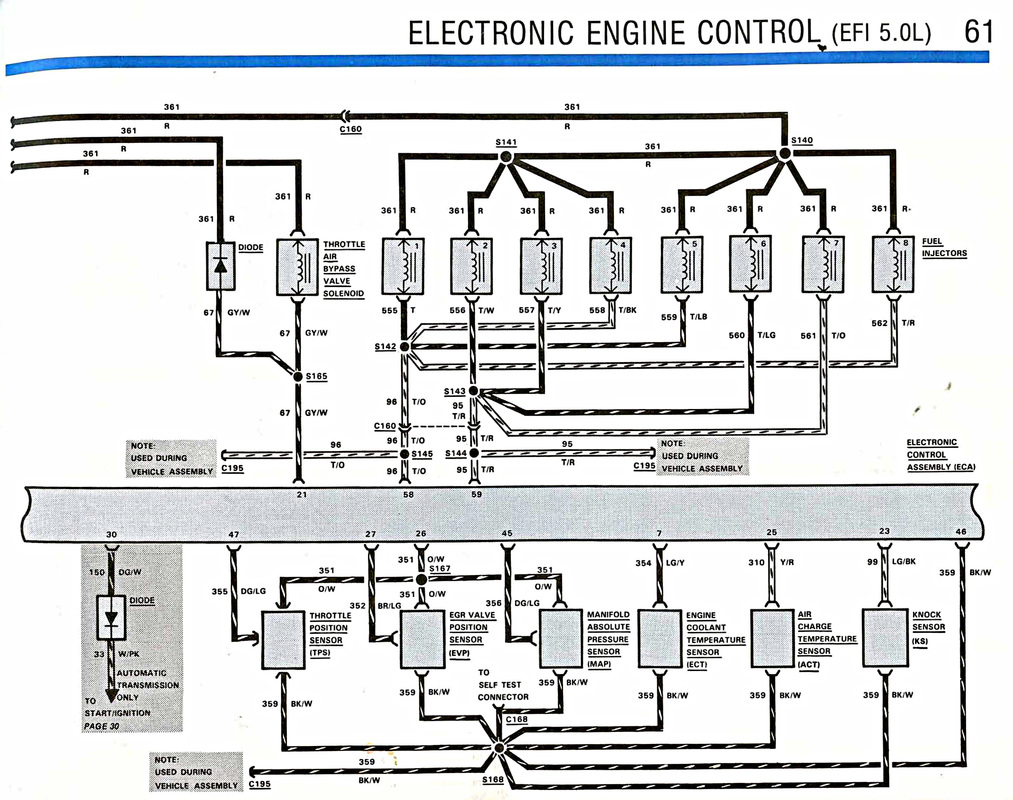
A lot of things can happen with the EGR system, a lot of places for failure. Code 32 means the voltage from the sensor on top of the EGR valve (the EVP sensor) was below .29 volts. You didn't say, but I am going to assume you have a 1986 302 fuel injected engine. The diagram for the EGR is below. The common 5v supply is the orange/white wire. The common ground wire is black/white. The signal wire to the computer for the EVP sensor is the brown/lightgreen wire going to pin 27. With the key on, engine off, take your meter and put the black lead on the black/white wire and the red lead on the brown/lightgreen. See what voltage you get. If it's below .29 volts that is what is causing the code. If the wiring and the connector are good the guy in the book says to replace the EGR valve.
Trending Topics
Thread Starter
|
Senior User
Joined: Aug 2008
Posts: 132
Likes: 1
Yes it is a 302 efi, sorry I didn't mention that.
When I'm testing this
"With the key on, engine off, take your meter and put the black lead on the black/white wire and the red lead on the brown/lightgreen"
am I backprobing the connection while it's on the egr valve or do I remove the connector and test it?
When I'm testing this
"With the key on, engine off, take your meter and put the black lead on the black/white wire and the red lead on the brown/lightgreen"
am I backprobing the connection while it's on the egr valve or do I remove the connector and test it?
A lot of things can happen with the EGR system, a lot of places for failure. Code 32 means the voltage from the sensor on top of the EGR valve (the EVP sensor) was below .29 volts. You didn't say, but I am going to assume you have a 1986 302 fuel injected engine. The diagram for the EGR is below. The common 5v supply is the orange/white wire. The common ground wire is black/white. The signal wire to the computer for the EVP sensor is the brown/lightgreen wire going to pin 27. With the key on, engine off, take your meter and put the black lead on the black/white wire and the red lead on the brown/lightgreen. See what voltage you get. If it's below .29 volts that is what is causing the code. If the wiring and the connector are good the guy in the book says to replace the EGR valve.
FTE Stories
Ford Trucks for Ford Truck Enthusiasts

3 Best / 3 Worst Parts of Modern Ford Ownership
Brett Foote
10 Amazing Upgrades That Solve Common Ford Truck Owner Headaches
Pouria Savadkouei
Every 2026 Ford Engine Explained
Brett Foote
10 Ugly Ford Trucks That We Still Kinda Love
Joe Kucinski
10 Things Every Truck Owner NEEDS (2026 Edition)
Michael S. Palmer
Rezvani's Latest Post-Apocalyptic Monster Is a Ford F-150 Raptor Underneath
Verdad Gallardo
Top 10 Most Expensive Ford Trucks Ever Sold on Bring a Trailer
Joe Kucinski
2027 Ford Super Duty Buyer's Guide (Every Model, Engine, & Package)
Brett Foote
Top 10 Ford Truck Tragedies
Joe Kucinski
Moderator
Joined: Jan 2001
Posts: 56,992
Likes: 2,741
From: Virginia
Should not matter if the engine is cold for that test. .52 volts is good. Either there is something wrong with that signal wire to the computer and the .52 is not getting back to pin 27, or there is something wrong with the computer. You might want to pull the battery cable off for a minute and then reconnect it. Then drive it normally and then pull the codes again.

Thread
Thread Starter
Forum
Replies
Last Post