When you click on links to various merchants on this site and make a purchase, this can result in this site earning a commission. Affiliate programs and affiliations include, but are not limited to, the eBay Partner Network.
Hi all
I am investigating a 3. gen E series build as camper. For the danish authorities I need to document the engine the car was born with. Type, power rating etc. From the VIN I have decoded that the engine was a 300 CID I6.
I also need to document that the models with a 300 CID are identical (suspension and brakes) to a model with a V8 or the V8 has lees than 20% more power than the 300 CID.
The situation is that the car has been retrofitted with the V8 and this is no go in Denmark unless you can document either
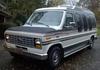
that that power increase is less than 20 % or that the variant with the V8 is technically identical especially the brakes. I am no Ford expert and I am nor sure which V8 is actually in the car. Maybe some of you can tell from the picture?
How do I find this documentation? Wikipedia is not hard evidence :-) Preferably Ford original spec sheet or similar. Is it possible to request this from Ford?
The VIN is E27BHBJ8663, its a 1978 petrol. The reg says E250 but the german plate says E240? Curb weight 2800 kg, total 3500 kg
Rather than this "generation" nonsense list the year, fuel type and chassis weight rating---those facts might affect the information results you're seeking.
Thank's. Post edited with details: The VIN is E27BHBJ8663, its a 1978 petrol. The reg says E250 but the german plate says E240? Curb weight 2800 kg, total 3500 kg
Do you know what size v8 engine is in the van now? If you measure across the front of the intake manifold, a 302 intake is about 9 inches wide, a 351W's about 11 inches.
The 351w is a wider engine.
Thank you for your replies, much appreciated. Is it possible to find online or scanned spareparts catalogs covering this model? Both with inline 6 and V8 engine.
This probably won't be much help but I bought what's called a "crash book" by body repair shops---my particular version is called Mitchell 2010 Collision Estimating & Reference Guide for Ford, Lincoln & Mercury vehicles. I has pages of documents like this:
For your year you'd need to locate something similar the covered the 1978 year----such publications tend to cover different ranges of years depending on the vehicle. The one I have covers back to 1997 for some models only because they didn't change too much from then until the book was published--in this case 2010.
eBay would be a good start, the search parameters being "collision estimating guide". Not sure if you'd find something converted to a digital copy or an actual publication. The Mitchell brand name is widely recognized as a good product here in the USA.
This is a demo version of the 1973- 1979 Ford Master Parts Catalog. It covers light trucks and vans. It takes some practice and time to learn how to use it but it should have all of the parts and part numbers you might need. This full manual is available to download on line, also on paperback, also on CD
Thanks for the info. Does these books also cover parts like brakes and suspension components or is it only body?
Probably not to the level I believe you're seeking. It would cover the most common parts typically damaged in a collision but it would not be a complete list of engine and drive line parts.
I've not yet looked at Annaleigh's link but I'm sure its well worth checking out to see if it's helpful.
It looks like a wonderful book to have and gives you the Ford part numbers which is important when tracking down original parts. Being in Denmark I imagine that unlike here in the USA, you cant just run down to the salvage yard or local parts store and find parts for American made vans...
As to the E100, E150, E250, and E350 Also think there was a E200 and E300.. There are others here that can tell you much more but higher the heavier the frame, axles, suspension ect. My mom has a 1978 E100. it is a 1/2 ton rating. My E150 is also a 1/2 ton rating but the E200 and E250 I believe is a 3/4 to rating. I am not sure about the E300 but the E350 is a 1 ton rating. Regardless of the weight rating, you will find a mix of engines and transmissions in each one.
Another explanation for the newb: The number in the model? E250 or E350, what is the difference?
Under normal circumstances those model numbers refer mostly to the vehicle's gross vehicle weight it can safely sustain as daily driven. For example the E250 is listed as 8,600 pounds where the E350 is listed as 9,200 pounds. In some instances the only real difference is in the suspension springs---in other cases there are very different frames and axles installed. E150's and E450/550's are examples where the bodies are the same but different suspensions are installed from the factory.
Here are two stickers highlighting the difference between an E250 and an E350:
Keep in mind these specifications are accurate only if the owner hasn't changed or enhanced any parts. My rear springs for each of these vans is not as the factory built them, they've had extra leaves added to handle extra weight a bit more safely. Those modifications don't enhance the axles etc, they're just for cargo control up to the gross vehicle weight limit.
This Hennessey Takes the Expedition Tremor's Off-Roading Capability to the Next Level
Slideshow: The VelociRaptor Expedition gains a lift, upgraded suspension, Brembo brakes, and trail-ready equipment while retaining the stock 440-horsepower EcoBoost V6.
Rezvani's Latest Post-Apocalyptic Monster Is a Ford F-150 Raptor Underneath
Slideshow: Called the Fortress, the 850-horsepower pickup combines Raptor underpinnings with military-inspired features, survival equipment, and a starting price of $285,000.