When you click on links to various merchants on this site and make a purchase, this can result in this site earning a commission. Affiliate programs and affiliations include, but are not limited to, the eBay Partner Network.
I think at this point I am going to try to get it in somewhere that specializes in transfer cases and rear ends this next week. All the driveshaft u joints are new. Driveshaft was balanced. Rear wheel bearings are new. So that leaves differential bearings or something in the transfer case.
This all sounds extremely familiar, as I did everything you've mentioned. The play in the slip yoke is what was causing mine, and the only way I could confirm it was to take the measurements I mentioned. Just because you can't really feel it, doesn't mean it isn't there. Mine was bad enough I could feel it. I'd have to go back to thread, but I'm thinking it was 1/16 or so of an inch.
I had two mechanics and a Ford dealership look at mine, and said nothing was wrong with it. Had my driveshaft rebalanced, at a cost of $120, on top of the new diff and ALL bearings.
Is the blue coating on the splines worn or worn off? That could be enough, over time, to cause play in that worn area and cause a vibration.
Don't get me wrong, I'm not saying the solution to your problem will be what mine was. Hope it's something more simple and less expensive.
This all sounds extremely familiar, as I did everything you've mentioned. The play in the slip yoke is what was causing mine, and the only way I could confirm it was to take the measurements I mentioned. Just because you can't really feel it, doesn't mean it isn't there. Mine was bad enough I could feel it. I'd have to go back to thread, but I'm thinking it was 1/16 or so of an inch.
I had two mechanics and a Ford dealership look at mine, and said nothing was wrong with it. Had my driveshaft rebalanced, at a cost of $120, on top of the new diff and ALL bearings.
Is the blue coating on the splines worn or worn off? That could be enough, over time, to cause play in that worn area and cause a vibration.
Don't get me wrong, I'm not saying the solution to your problem will be what mine was. Hope it's something more simple and less expensive.
It still looked ok when I greased it. I would have hoped the driveshaft shop that redid the cv and balanced it would have looked at that but I can't say that I asked specifically. I would guess that would have shown up when they spun it up to balance it but who knows. I have a sneaking suspission that its pinion bearings. When I swapped in the new springs I also put in a different axle because what was in there was rusted so bad huge chunks were coming off. This different axle had the pinion nut loose and I tightened it up a 1/4 turn to take the play out of it.. Unfortunately I am at the point where I just need this thing to work so off to a shop it goes.
I am fairly certain it is something in the rear diff. I had to bring a trailer over to my dads house today and tried make sure I paid really close attention to what it did. The first 2-3 miles there wasn't much of anything. Did not notice any vibration until after that. After that the vibration did not start until what seemed like 53 MPH and I could feel it in my seat and the floorboards until 57. At 59 I could no longer feel it but I could hear it. Above 60 I could still hear it but any vibration was not very noticeable. It had a very low sound to it. After I got home and in the garage I could tell something had a hot smell to it. I felt the diff and it was definitely HOT. I did not check the wheel hubs since it was hard with the wheels on but the rotors were not hot. So to me it sounds like a diff bearing issue. If it was still driveshaft related either slip joint or angle it would have started before a couple of miles. A couple of miles would be enough for the diff to get hot enough especially towing. So off to a shop it goes for their opinion-thats the risk you take buying an axle from a salvage yard....
I am fairly certain it is something in the rear diff. I had to bring a trailer over to my dads house today and tried make sure I paid really close attention to what it did. The first 2-3 miles there wasn't much of anything. Did not notice any vibration until after that. After that the vibration did not start until what seemed like 53 MPH and I could feel it in my seat and the floorboards until 57. At 59 I could no longer feel it but I could hear it. Above 60 I could still hear it but any vibration was not very noticeable. It had a very low sound to it. After I got home and in the garage I could tell something had a hot smell to it. I felt the diff and it was definitely HOT. I did not check the wheel hubs since it was hard with the wheels on but the rotors were not hot. So to me it sounds like a diff bearing issue. If it was still driveshaft related either slip joint or angle it would have started before a couple of miles. A couple of miles would be enough for the diff to get hot enough especially towing. So off to a shop it goes for their opinion-thats the risk you take buying an axle from a salvage yard....
From the sounds of it, you needed the axle housing anyway. With my driveshaft problem, I didn't have to wait for anything to warm up, it was just there. For the pinion bearing, I didn't get a vibration, just the roaring sound of the bearing self destructing.
So I had it into the transmission and axle shop and they can't find anything wrong with the transfer case and rear end. They said they had it up on a hoist even and ran it and watched underneath and the driveshaft was smooth as could be. They were able to replicate the noise/vibration and they said its the tires because they could make it change by swerving.
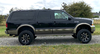
Well had new tires put on and wouldn't you know the vibration was still there. Smooth as glass up to 50 and above 63+. It has always had a vibration before I changed springs and axles but not like this. It is better than it was before the shims were removed but I can't say it was any different with the driveshaft rebuilt and balanced. I took the wheel hub covers off and I am going to check all 4 hubs after I drive to work tomorrow and see if any one is hotter than the others to rule out wheel bearings. The rears were new about 1000 miles ago but the fronts are original. I did need tires before winter anyways but its still irritating. I stepped up from 285/70/17 to 315/70/17 and at least it fills out the wheel wells better
It is not wheel bearings. All 4 hubs were barely warm after driving an hour into work. Any other thoughts or suggestions?
I'm tempted to just leave it until something changes significantly. I had a jeep one time that had a thumping noise that was clearly something in the front wheel/hub/tire and had it into a reputable shop that never found anything wrong and replaced a whole lot of stuff at their expense and after 6 months the thumping stopped and we drove the vehicle for another 50 k miles with no issues before we got rid of it.
I decided to take another crack at greasing the slip joint. The local ford dealer has a bunch of that special blue stuff in stock so its worth a shot at being able to rule something out since its cheap and easy. I'll pick that up tonight. Otherwise I'm not sure what else there would be for me to try that doesn't cost a lot of money. Due to the low sound of the vibration noise that would lead me to think that it isn't pinion bearings . I guess it still could be differential carrier bearings but I would think it would continue as the speed increases.
I decided to take another crack at greasing the slip joint. The local ford dealer has a bunch of that special blue stuff in stock so its worth a shot at being able to rule something out since its cheap and easy. I'll pick that up tonight. Otherwise I'm not sure what else there would be for me to try that doesn't cost a lot of money. Due to the low sound of the vibration noise that would lead me to think that it isn't pinion bearings . I guess it still could be differential carrier bearings but I would think it would continue as the speed increases.
You've already determined that towing has a, effect on the vibration. Does the addition of say 300 pounds in the back have any effect? The addition of the angle shims made my vibration worse as well. When you're adding grease to that yoke, check the condition of the splines and the blue coating on the splines. If it's worn off, depending on the tolerances, that could be contributing to the vibration. I'm also gonna fall back to one of my original suggestions - check the run-out at the pinion and at the slip-yoke, and also check for play:
With the Ex rear axle on jack stand, front wheels chocked and the Ex in neutral, place the base somewhere it's solid, with the indicator tip pushed in about .100 of an inch. Wherever you place the indicator tip, zero it out, then slowly rotate the driveshaft. At the pinion and transfer case ends, I had the tip riding on the yoke and watched the needle every 45 degrees rotation of the driveshaft, and also pushed up on the assembly at those 45 degree increments to check for play. I also did the same on each side of the slip-yoke. This will tell you not only how much the rotational mass has the potential to be off-center, but will also tell you just how much potential for play there is in the assembly by showing the deflection of the mass - all of which could be the cause of your vibration. While .060" may not sound like much, when you're dealing with a driveshaft that weight 40 pounds spinning at 1,000 rpm, if it's got the type of play like mine did in that slip yoke, you're gonna get a vibration.
Your new tires - did you add spacers at the front wheels (looks like they're spaced out a bit)? Mine has the same size tires, and they would not fit and allow the Ex to turn properly without 2" spacers.
I did not use wheel spacers. The wheels have just enough back spacing where I did not have any frame or fender rubbing but don't stick out really at all past the fenders. I did have the passenger side brake line rubbing the tire at full lock to the right that I had to address.
I cleaned everything up and removed the excess grease from the slip joint and used half a tube of the ford xg-8 Teflon spline grease. Well see what that does this weekend when I head out of town for the weekend with all of the family and our stuff so we'll have a full load and a full tank of fuel. The first time I towed it did make a difference having a load on the tongue compressing the springs, but I also had the shims in still at that time. The last time I towed without the shims it still did vibrate. It was not as heavy as the first load but its was an empty 14k lb rated equipment trailer so it has some heft to it. Ithas seemed like one time I can get it to stop by making a high speed corner and the next time doing the same thing in the same spot it won't do it. More often than not it seemed like it took a couple of miles to show up, yesterday leaving work it did it immediately once I got up to speed. I could not detect any play in the splines when twisting both parts of the driveshaft in opposite directions but that doesn't necessarily mean anything.
I could not detect any play in the splines when twisting both parts of the driveshaft in opposite directions but that doesn't necessarily mean anything.
The play in mine was not rotational. There was a sweet spot, for lack of a better term, where I had, I believe, .045 - .060" play in mine when pushing up or down. When more weight was added, and the yoke moved father up the splines, that play was reduced, but not gone.
As long as all the caps are properly aligned along the entirety of the shaft, you should be in phase.
So, front flange with the cap facing up (vertical), rear flange with cap facing up, driveshaft end (rear at pinion) with cap facing up, then front shaft end cap facing left/right (horizontal), and double cardan caps facing left/right. Then if you have all that put together, then the slip joint needs to make sure that the flanges on either end are in alignment.
you can assemble it 180* out of phase.
Ask me how I know. It almost works, it looks perfect. But it vibrates at high speed.
OP. The driveshaft was balanced from the factory with the slip joint assembled one way. In my case it mattered. According to a Jeep video I saw that recommended punching the shaft and joint to make sure it always goes back same orientation it matters.
So loaded down for our out of town trip still vibrated. Maybe had an extra couple hundred lbs of gear. Going to take the whole truck in next week and get the splines checked out. I can push up on it and it moves.
So loaded down for our out of town trip still vibrated. Maybe had an extra couple hundred lbs of gear. Going to take the whole truck in next week and get the splines checked out. I can push up on it and it moves.
Mine did too. What I noticed was, with a couple hundred pounds of camping gear, six people and a full tank of gas, the speed range of the vibration changed. For example, with just me and gas in the Ex, vibration was from 48 - 58, then came back around 68 - 77. When everything was loaded up, the vibration came on about 50 - 60, and I could cruise at 70 with no vibration until I went thru a half tank of gas, then I'd have to start dropping my cruising speed to keep it from vibrating. Fully loaded it didn't start vibrating at the higher speeds until around 74 IIRC.
Rezvani's Latest Post-Apocalytic Monster Is a Ford F-150 Raptor Underneath
Slideshow: Called the Fortress, the 850-horsepower pickup combines Raptor underpinnings with military-inspired features, survival equipment, and a starting price of $285,000.




 I had to bring a trailer over to my dads house today and tried make sure I paid really close attention to what it did. The first 2-3 miles there wasn't much of anything. Did not notice any vibration until after that. After that the vibration did not start until what seemed like 53 MPH and I could feel it in my seat and the floorboards until 57. At 59 I could no longer feel it but I could hear it. Above 60 I could still hear it but any vibration was not very noticeable. It had a very low sound to it. After I got home and in the garage I could tell something had a hot smell to it. I felt the diff and it was definitely HOT. I did not check the wheel hubs since it was hard with the wheels on but the rotors were not hot. So to me it sounds like a diff bearing issue. If it was still driveshaft related either slip joint or angle it would have started before a couple of miles. A couple of miles would be enough for the diff to get hot enough especially towing. So off to a shop it goes for their opinion-thats the risk you take buying an axle from a salvage yard....