


Wiring light question

Thread Starter
|
Fleet Mechanic


Joined: Feb 2007
Posts: 1,252
Likes: 113
From: Mandan, ND

I was wondering about the fuses, but in all of my vehicles that I've actually fiddled with the brake wiring, the brake lights were powered through the headlight switch so are not fused in the fuse panel.
Instead they are protected by the headlight's built in circuit-breaker.
Glad you found the initial issue. Hopefully it was just a fluke and you won't end up with other blown fuses.
And if we did not mention it here in your thread (it's been brought up a couple of times in the last couple of weeks though) it's a good practice with any glass-tube fuse panels to remove all the fuses periodically and clean the contacts. Then put them back in.
Just doing this keeps the contacts in much better shape for passing electricity through them.
Paul
Instead they are protected by the headlight's built in circuit-breaker.
Glad you found the initial issue. Hopefully it was just a fluke and you won't end up with other blown fuses.
And if we did not mention it here in your thread (it's been brought up a couple of times in the last couple of weeks though) it's a good practice with any glass-tube fuse panels to remove all the fuses periodically and clean the contacts. Then put them back in.
Just doing this keeps the contacts in much better shape for passing electricity through them.
Paul
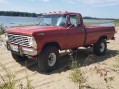
Some strange things about this 1967. No idea if the cab is for a F-250 or not. The wiring pretty much follows the wiring diagrams on Fordification, BUT there is only one flasher for both hazard and turn. It is under the dash, to the left of the ashtray. The wiring diagrams show a turn signal flasher attached to the cluster (cluster side of the big plug) and the emergency flasher over by the glove box. The connector for the emergency flasher switch is present over there (glove box) but no provision for a flasher.
What is weird is the turn signals are powered via the fuse labeled "Emergency Warn Brake" and are hot all the time. As are the brake lights (like they should be). Perhaps this was an early 67 and they change it later on? Or not a cab for a 100-350? The wiring definitely looks original.
But...it is all working now. Just have to remember to to leave the truck with a turn signal flashing. They do cancel, so that is something!
Ford Parts Specialist
Joined: Nov 2006
Posts: 88,826
Likes: 784
From: Simi Valley, CA

Early 1967's used a different flasher than late 1967's.
Late 1967's have two flashers, T/S plugs into the back of the instrument cluster. 4 way flasher nestles into a bracket that attaches to the back side of the dash w/a screw.
Both of these flashers are round with two prongs, but the 4 way flasher is a H/D unit, has a louder CLICK.
Late 1967's have two flashers, T/S plugs into the back of the instrument cluster. 4 way flasher nestles into a bracket that attaches to the back side of the dash w/a screw.
Both of these flashers are round with two prongs, but the 4 way flasher is a H/D unit, has a louder CLICK.

Cross-Country
Joined: Nov 2019
Posts: 71
Likes: 3
I have close to the same problem. I have no lights in the rearend at all. No brake lights or running lights or blinkers in the back. I know the blinker and brake should be on the same circuit. I have working blinkers, running lights and headlights up front. I have removed the glovebox and the flasher switch, because it was falling apart, and I needed to fix a leak in the heater box. I have done no troubleshooting with a meter, only attempted to do a visual. I also looked at the fuse box but the small fuse box under the dash, above my left foot, doesnt have any fuses that seemed relevant. Could the flasher switch being out be my problem?
I figured using the search function was better than starting another thread.
I figured using the search function was better than starting another thread.

Lead Driver


Joined: Jul 2017
Posts: 9,580
Likes: 1,162
From: San Jose, CA
There is usually a flasher fuse, so at least check that. But as we've said many times (or at least I've said it!) it's always a good practice with any new-to-you old vehicle with glass fuses, to remove all the fuses, check them, clean them, clean the contact clamps, and put them back in.
Just doing this will sometimes cure electrical gremlins right off the bat. And even if it doesn't, it almost always allows more current to pass more easily through the now-clean contact points. All good things.
I'm in the habit of doing just that about every other year now, since I've seen the effects of the teeny tiny layer of corrosion that builds up on the surfaces. My very first car all of a sudden had headlights and a horn just from pulling the firewall (more of a bulkhead connector) connector apart and then putting it back together. I did not even clean it that time. Just separated the two halves, then put them back together.
Same thing for glass fuses.
But back to the basic issue (for either of you) this could be either one problem, or multiple problems acting up all at once. You need to follow the wires and find out where the power stops.
A brake switch is a common failure point.
A headlight switch (and it's connector) are not as common, but certainly capable of failing. Turn signal switches wear out just as often as brake light switches.
Even if your front turn signals work the signal switch could still be at fault because the fronts and rears are no separate circuits. The fronts also handle the indicators in the dash. The brake light power passes through the turn-signal switch first, so a bad switch can also stop the brake lights from working.
Same for the hazard switch asked about previously. Not sure if it would stop the brakes, but they are often the same circuit and pass through the hazard switch, depending on the way it was wired at the factory.
So follow those electrons and find out where they stop. Test lights are helpful, but a volt-meter is even better.
Good luck.
Paul
Just doing this will sometimes cure electrical gremlins right off the bat. And even if it doesn't, it almost always allows more current to pass more easily through the now-clean contact points. All good things.
I'm in the habit of doing just that about every other year now, since I've seen the effects of the teeny tiny layer of corrosion that builds up on the surfaces. My very first car all of a sudden had headlights and a horn just from pulling the firewall (more of a bulkhead connector) connector apart and then putting it back together. I did not even clean it that time. Just separated the two halves, then put them back together.
Same thing for glass fuses.
But back to the basic issue (for either of you) this could be either one problem, or multiple problems acting up all at once. You need to follow the wires and find out where the power stops.
A brake switch is a common failure point.
A headlight switch (and it's connector) are not as common, but certainly capable of failing. Turn signal switches wear out just as often as brake light switches.
Even if your front turn signals work the signal switch could still be at fault because the fronts and rears are no separate circuits. The fronts also handle the indicators in the dash. The brake light power passes through the turn-signal switch first, so a bad switch can also stop the brake lights from working.
Same for the hazard switch asked about previously. Not sure if it would stop the brakes, but they are often the same circuit and pass through the hazard switch, depending on the way it was wired at the factory.
So follow those electrons and find out where they stop. Test lights are helpful, but a volt-meter is even better.
Good luck.
Paul

Thread
Thread Starter
Forum
Replies
Last Post
SocialDistortionFan
1961 - 1966 F-100 & Larger F-Series Trucks
9
May 14, 2013 08:18 PM
angrymade
1961 - 1966 F-100 & Larger F-Series Trucks
9
Apr 29, 2013 12:15 AM
ToughestTruckBuilt
1973 - 1979 F-100 & Larger F-Series Trucks
3
Jul 16, 2009 06:12 PM






