


Timing Curve

Thread Starter
|
Cargo Master


Joined: Jan 2019
Posts: 3,369
Likes: 16
From: Caraway, AR
Timing Curve
All the examples of timing curves I have seen are stepped... Not round. I have been reading up on recurving duraspark distributors for weeks. Took two weeks to find anything worth reading.
So now I have it in my head that the advance should be linear. Just a straight diagonal line. Can someone with a deep personal understanding of this stuff explain why that's wrong so we can go on to talk about nice smooth(not stepped) CURVES that would exist in a perfect world?
I went a little crazy in the third week of reading up on this. Pretty sure I redesigned the advance mechanism in the distributor, both mechanical and vacuum about a dozen times in my head. Even put a couple on paper. But I really don't have enough of an understand about it. Although it does excite me. I really am looking forward to tuning my truck when I eventually get it put back together. Really want to try some of those ideas I had, I'd love to squeeze as much HP and economy out of this truck.
So, can I talk anyone into kicking around theory with me?
Also, shout out to @AbandonedBronco It was your post on the fordsix site that got me started on this. I couldn't find anything on timing until I found your post. Gave me a pretty good understanding and more search terms.
So now I have it in my head that the advance should be linear. Just a straight diagonal line. Can someone with a deep personal understanding of this stuff explain why that's wrong so we can go on to talk about nice smooth(not stepped) CURVES that would exist in a perfect world?
I went a little crazy in the third week of reading up on this. Pretty sure I redesigned the advance mechanism in the distributor, both mechanical and vacuum about a dozen times in my head. Even put a couple on paper. But I really don't have enough of an understand about it. Although it does excite me. I really am looking forward to tuning my truck when I eventually get it put back together. Really want to try some of those ideas I had, I'd love to squeeze as much HP and economy out of this truck.
So, can I talk anyone into kicking around theory with me?
Also, shout out to @AbandonedBronco It was your post on the fordsix site that got me started on this. I couldn't find anything on timing until I found your post. Gave me a pretty good understanding and more search terms.

Postmaster
Joined: Dec 2006
Posts: 3,603
Likes: 10
From: Spokane, WA
You might try that question on https://fordsix.com/index.php?sid=38...f157e3cb29aad0. wsa111, a member on that board, is an ignition/distributor guru and could probably answer your question.

Moderator


Joined: Dec 2007
Posts: 7,987
Likes: 104
From: Boise, Idaho

This is a post I did a little while back, but I think it'd be good info here (since that thread was not timing related).
Timing is definitely something that I didn't understand when I started in, so I totally understand.
You have two completely separate systems when it comes to mechanical advance and vacuum advance, and they don't correlate. They work at the same time, but they don't work together.
When gas explodes, the explosion travels at the same speed (for a given AFR) no matter if it's at 1000 RPMs or 5000 RPMs. However, at 5000, the piston is moving a whole lot faster.
So, at 5000 RPMs, you want to spark the fuel when the piston is lower in the cylinder, so that by the time the explosion is at it's peak, the piston is at the top. At 1000 RPMs, the piston is moving slower, so you want to fire it later.
This is what the mechanical advance does. The faster the motor is spinning, the sooner it fires the spark so that the explosion reaches its peak as the piston reaches the top.
Then there's a lean mixture vs a rich mixture. A lean mixture burns slower than a rich mixture. So, with a lean mixture, you want to fire it even sooner because it's going to take longer to burn.
This is what the vacuum advance does. The idea is that under most cases, when your vacuum is high, the engine is at low load and is running lean (15 - 16:1 AFR). When vacuum is low, you're usually under high load, hard acceleration and it's running rich (12 - 13:1 AFR). (This is why people who tune their engine for the track usually remove the vacuum advance. They have their engine running at around 13.5:1 AFR no matter the load on the engine, so there's no need to accomodate for a lean/rich mixture.)
This is why they're independent. You can be at 4000 RPMs but at light throttle and low load, just as you can be at 1000 RPMs and have the pedal to the floor and full load on the engine.
1000 RPM - full throttle (no to low mechanical advance, no vacuum advance)
1000 RPM - light throttle (no to low mechanical advance, lots of vacuum advance)
4000 RPM - full throttle (full mechanical advance, no vacuum advance)
4000 RPM - light throttle (full mechanical advance, lots of vacuum advance).
This is what I did on mine:
Mark the base timing, and then get a timing light.
Increase the RPMs by turning the screw on your carb by 250 RPMs and them check the timing and write it down. (I did it minus the base timing, so I could see how much mechanical was being added).
Increase by 250, write down the timing.
etc etc.
Once the timing stops increasing, you're done.
Next drop back down to idle and then get a hand activated vacuum pump.
Hook it to the vacuum advance canister and add 1/2 hg increments of vacuum and mark the timing.
Keep adding 1/2 hg increments until the vacuum advance stops increasing the timing.
This is mine:
750 - 0
1000 - 2
1250 - 6
1500 - 10
1750 - 13
2000 - 15
2250 - 17
2500 - 18
2750 - 20
3000 - 22
3250 - 22
3500 - 22
Vacuum:
0 - 0
1 - 0
2 - 0
3 - 0
4 - 0
5 - 0
6 - 0
7 - 0
8 - 0
9 - 1
10 - 5
11 - 7
12 - 11
13 - 14
14 - 14
So, my mechanical is all in at 3000. My vacuum advance is at 0 at any vacuum below 9hg and then increases up to 14° by 13hg.
I have mine charted out in an Excel sheet for reference, but basically from there you can get your timing at any moment by looking at your numbers.
Base + mechanical + advanced
So, at cruise, I'm roughly at 2250 RPMs and 10hg engine vacuum, I'd be at:
12 + 17 + 5 = 34° advance
At 1500 RPMs and full throttle (0hg vacuum), I'd be at:
12 + 10 + 0 = 22° advance
1000 RPMs and 16hg vacuum (low speed cruise)
12 + 2 + 14 = 28° advance
3000 RPMs and 13hg vacuum
12 + 22 + 14 = 48° advance
etc. etc.
Hopefully that helps clear some stuff up, and is useful!
Timing is definitely something that I didn't understand when I started in, so I totally understand.
You have two completely separate systems when it comes to mechanical advance and vacuum advance, and they don't correlate. They work at the same time, but they don't work together.
When gas explodes, the explosion travels at the same speed (for a given AFR) no matter if it's at 1000 RPMs or 5000 RPMs. However, at 5000, the piston is moving a whole lot faster.
So, at 5000 RPMs, you want to spark the fuel when the piston is lower in the cylinder, so that by the time the explosion is at it's peak, the piston is at the top. At 1000 RPMs, the piston is moving slower, so you want to fire it later.
This is what the mechanical advance does. The faster the motor is spinning, the sooner it fires the spark so that the explosion reaches its peak as the piston reaches the top.
Then there's a lean mixture vs a rich mixture. A lean mixture burns slower than a rich mixture. So, with a lean mixture, you want to fire it even sooner because it's going to take longer to burn.
This is what the vacuum advance does. The idea is that under most cases, when your vacuum is high, the engine is at low load and is running lean (15 - 16:1 AFR). When vacuum is low, you're usually under high load, hard acceleration and it's running rich (12 - 13:1 AFR). (This is why people who tune their engine for the track usually remove the vacuum advance. They have their engine running at around 13.5:1 AFR no matter the load on the engine, so there's no need to accomodate for a lean/rich mixture.)
This is why they're independent. You can be at 4000 RPMs but at light throttle and low load, just as you can be at 1000 RPMs and have the pedal to the floor and full load on the engine.
1000 RPM - full throttle (no to low mechanical advance, no vacuum advance)
1000 RPM - light throttle (no to low mechanical advance, lots of vacuum advance)
4000 RPM - full throttle (full mechanical advance, no vacuum advance)
4000 RPM - light throttle (full mechanical advance, lots of vacuum advance).
This is what I did on mine:
Mark the base timing, and then get a timing light.
Increase the RPMs by turning the screw on your carb by 250 RPMs and them check the timing and write it down. (I did it minus the base timing, so I could see how much mechanical was being added).
Increase by 250, write down the timing.
etc etc.
Once the timing stops increasing, you're done.
Next drop back down to idle and then get a hand activated vacuum pump.
Hook it to the vacuum advance canister and add 1/2 hg increments of vacuum and mark the timing.
Keep adding 1/2 hg increments until the vacuum advance stops increasing the timing.
This is mine:
750 - 0
1000 - 2
1250 - 6
1500 - 10
1750 - 13
2000 - 15
2250 - 17
2500 - 18
2750 - 20
3000 - 22
3250 - 22
3500 - 22
Vacuum:
0 - 0
1 - 0
2 - 0
3 - 0
4 - 0
5 - 0
6 - 0
7 - 0
8 - 0
9 - 1
10 - 5
11 - 7
12 - 11
13 - 14
14 - 14
So, my mechanical is all in at 3000. My vacuum advance is at 0 at any vacuum below 9hg and then increases up to 14° by 13hg.
I have mine charted out in an Excel sheet for reference, but basically from there you can get your timing at any moment by looking at your numbers.
Base + mechanical + advanced
So, at cruise, I'm roughly at 2250 RPMs and 10hg engine vacuum, I'd be at:
12 + 17 + 5 = 34° advance
At 1500 RPMs and full throttle (0hg vacuum), I'd be at:
12 + 10 + 0 = 22° advance
1000 RPMs and 16hg vacuum (low speed cruise)
12 + 2 + 14 = 28° advance
3000 RPMs and 13hg vacuum
12 + 22 + 14 = 48° advance
etc. etc.
Hopefully that helps clear some stuff up, and is useful!

Post Fiend
Joined: Apr 2002
Posts: 19,311
Likes: 97
From: Waterloo, Iowa
There's usually two centrifugal weight springs, and two different strengths or thickness. Notice the heavy spring is also a little loose. The clearance or slop isn't taken up until the light spring is about at full extension, and the heavy spring also slows the rate of advance. That's why it's a curve, and not a straight line, if you graph it out.
If you get in the shop manual "Specifications" it will have the specs for a given distributor, and how much advance there should be at any given RPM or manifold vacuum. Keep in mind those charts are listed in distributor degrees, not crankshaft degrees, so they should be doubled to figure out what should be seen when using an ordinary timing light at the balancer. They assume the distributor is being tested on a dedicated distributor machine.
If the mechanical or centrifugal advance is too slow or "lazy" Ford did make one if only one concession to ease of adjustment, if you pull the distributor cap notice there is a hole in the breaker plate, it allows for loosening or tightening the arm that the springs attach too. Naturally there was a "special" Ford tool for this, but an ordinary screwdriver seems to work. Roll the engine over by hand until one of the spring arms appears in the window, and bend it as required. Mark it with a dot of paint or whatever. If it needs more tweaking, adjust the other spring.
If you get in the shop manual "Specifications" it will have the specs for a given distributor, and how much advance there should be at any given RPM or manifold vacuum. Keep in mind those charts are listed in distributor degrees, not crankshaft degrees, so they should be doubled to figure out what should be seen when using an ordinary timing light at the balancer. They assume the distributor is being tested on a dedicated distributor machine.
If the mechanical or centrifugal advance is too slow or "lazy" Ford did make one if only one concession to ease of adjustment, if you pull the distributor cap notice there is a hole in the breaker plate, it allows for loosening or tightening the arm that the springs attach too. Naturally there was a "special" Ford tool for this, but an ordinary screwdriver seems to work. Roll the engine over by hand until one of the spring arms appears in the window, and bend it as required. Mark it with a dot of paint or whatever. If it needs more tweaking, adjust the other spring.
Fleet Mechanic
Joined: Nov 2002
Posts: 1,643
Likes: 69
In addition to the above explanation there is also the effect that volumetric efficiency has on the amount of spark advance needed. If you have an engine that is running WOT at a volumetric efficiency of, say 70% - about what a 300 does at WOT on the high rpm end - then the cylinder will not fill with as much charge, effectively creating a "part throttle" condition even though the throttle plates are open completely. Thus some of the above explanation of part throttle operating conditions would apply to an engine at WOT but with reduced vol.eff. Cylinder filling also is dependent on cam timing. Hence a long duration cam may "bleed off" compression if it is operating below its intended RPM range, also affecting volumetric efficiency.
The charge will burn faster if it is compressed more. So an engine with 12:1 compression ratio will need less spark advance than an engine with 8:1 compression ratio.
No discussion would be complete without considering the fuel being used. Different fuels have different burn rates. But just as important is the octane rating of the fuel and at what point will the fuel start to detonate, requiring that spark advance be dialed back from the optimum minimum-spark-for-best-torque curve.
Then there's the effect of weather, specifically barometric pressure and moisture content and oxygen content. Operating at high altitudes vs at sea level also should be considered, one big advantage EFI has over carbs.
The charge will burn faster if it is compressed more. So an engine with 12:1 compression ratio will need less spark advance than an engine with 8:1 compression ratio.
No discussion would be complete without considering the fuel being used. Different fuels have different burn rates. But just as important is the octane rating of the fuel and at what point will the fuel start to detonate, requiring that spark advance be dialed back from the optimum minimum-spark-for-best-torque curve.
Then there's the effect of weather, specifically barometric pressure and moisture content and oxygen content. Operating at high altitudes vs at sea level also should be considered, one big advantage EFI has over carbs.

Senior User
Joined: Mar 2017
Posts: 395
Likes: 1
From: Everton MO
Would an electronically controlled timing system have a curve like ours do or would it have a straight line? because it is creating max timing at every moment without getting a signal from the knock sensor to ease it up.
Trending Topics
Moderator
Joined: Dec 2007
Posts: 7,987
Likes: 104
From: Boise, Idaho
An electronically controlled timing system would be whatever you want it to be.
This is the base timing table for the Sniper EFI system that I have. Theoretically, you can put those values to whatever you want whenever you want. Straight line, curve, flat, bumpy and random, etc.
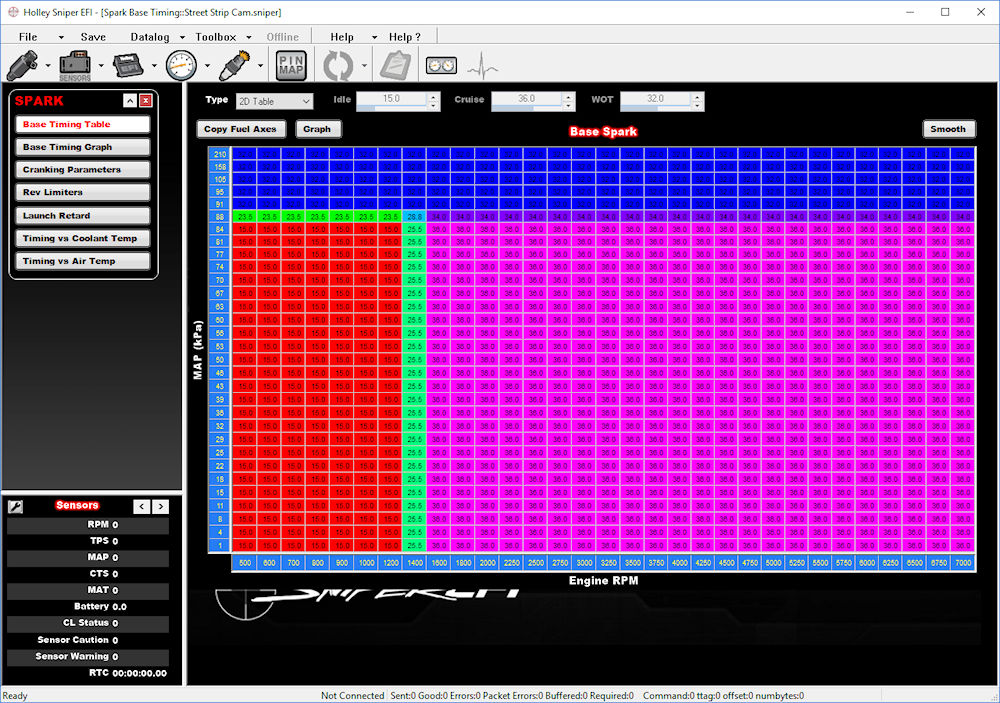
This is the base timing table for the Sniper EFI system that I have. Theoretically, you can put those values to whatever you want whenever you want. Straight line, curve, flat, bumpy and random, etc.
FTE Stories
Ford Trucks for Ford Truck Enthusiasts

Top 6 Best Deals Available on New Fords & Lincolns Right Now
Brett Foote
This Hennessey Takes the Expedition Tremor's Off-Roading Capability to the Next Level
Verdad Gallardo
Top 10 Fords at 2026 Carlisle Ford Nationals
Joe Kucinski
3 Best / 3 Worst Parts of Modern Ford Ownership
Brett Foote
10 Amazing Upgrades That Solve Common Ford Truck Owner Headaches
Pouria Savadkouei
Every 2026 Ford Engine Explained
Brett Foote
10 Ugly Ford Trucks That We Still Kinda Love
Joe Kucinski
10 Things Every Truck Owner NEEDS (2026 Edition)
Michael S. Palmer
Rezvani's Latest Post-Apocalyptic Monster Is a Ford F-150 Raptor Underneath
Verdad Gallardo
Thread Starter
|
Cargo Master
Joined: Jan 2019
Posts: 3,369
Likes: 16
From: Caraway, AR
In addition to the above explanation there is also the effect that volumetric efficiency has on the amount of spark advance needed. If you have an engine that is running WOT at a volumetric efficiency of, say 70% - about what a 300 does at WOT on the high rpm end - then the cylinder will not fill with as much charge, effectively creating a "part throttle" condition even though the throttle plates are open completely. Thus some of the above explanation of part throttle operating conditions would apply to an engine at WOT but with reduced vol.eff. Cylinder filling also is dependent on cam timing. Hence a long duration cam may "bleed off" compression if it is operating below its intended RPM range, also affecting volumetric efficiency.
The charge will burn faster if it is compressed more. So an engine with 12:1 compression ratio will need less spark advance than an engine with 8:1 compression ratio.
No discussion would be complete without considering the fuel being used. Different fuels have different burn rates. But just as important is the octane rating of the fuel and at what point will the fuel start to detonate, requiring that spark advance be dialed back from the optimum minimum-spark-for-best-torque curve.
Then there's the effect of weather, specifically barometric pressure and moisture content and oxygen content. Operating at high altitudes vs at sea level also should be considered, one big advantage EFI has over carbs.
The charge will burn faster if it is compressed more. So an engine with 12:1 compression ratio will need less spark advance than an engine with 8:1 compression ratio.
No discussion would be complete without considering the fuel being used. Different fuels have different burn rates. But just as important is the octane rating of the fuel and at what point will the fuel start to detonate, requiring that spark advance be dialed back from the optimum minimum-spark-for-best-torque curve.
Then there's the effect of weather, specifically barometric pressure and moisture content and oxygen content. Operating at high altitudes vs at sea level also should be considered, one big advantage EFI has over carbs.
AB thanks for listing your curve. Will see if I can graph it to use as a visual to go with a few questions I have on "curves."
Fleet Mechanic
Joined: Nov 2002
Posts: 1,643
Likes: 69
Let's say you've arrived at the perfect timing curve / table (using knock free fuel like we do in Ford Dyno). You take it out and drive it and the engine detonates like crazy. You can do one of two things: Increase the octane of the fuel you are using - OR - retard the timing from optimum. Oh, I suppose you could introduce water/meth injection too but I digress.
Some of our MBT timing curves on engines with fast burn chambers actually had portions of the WOT MBT curve that had a negative slope. Hard to do with springs and weights.
Some of our MBT timing curves on engines with fast burn chambers actually had portions of the WOT MBT curve that had a negative slope. Hard to do with springs and weights.
Thread Starter
|
Cargo Master
Joined: Jan 2019
Posts: 3,369
Likes: 16
From: Caraway, AR
Let's say you've arrived at the perfect timing curve / table (using knock free fuel like we do in Ford Dyno). You take it out and drive it and the engine detonates like crazy. You can do one of two things: Increase the octane of the fuel you are using - OR - retard the timing from optimum. Oh, I suppose you could introduce water/meth injection too but I digress.
It for sure sounds like the higher the octane and the leaner the mix the more advanced the timing needs to be. How would running lean with a higher octane and advanced timing affect fuel economy?
Another one of those crazy thoughts. What would happen if the weights opened in the opposite direction? Would that slow things down some?
Post Fiend
Joined: Apr 2002
Posts: 19,311
Likes: 97
From: Waterloo, Iowa
I've wondered, since the extra vacuum advance is used to light off the very lean part throttle cruise fuel mixtures, will it start pinging if I were to jet back up? See where I'm goin' with that? Rich fuel mixtures burn faster, right?
It seems to me under those specific conditions, introducing a richer cruise AFR could act this way. Lean fuel mixtures under power, under acceleration are no bueno, but part throttle cruising is a different deal altogether. There was no practical way (before computers) to get enough ignition advance loafing along on the highway with springs and weights alone.
It seems to me under those specific conditions, introducing a richer cruise AFR could act this way. Lean fuel mixtures under power, under acceleration are no bueno, but part throttle cruising is a different deal altogether. There was no practical way (before computers) to get enough ignition advance loafing along on the highway with springs and weights alone.

Posting Guru
Joined: Mar 2006
Posts: 1,182
Likes: 1
i don't think i'd mess with redesigning how the advance mechanisms work.
Durasparks are a *bear* to recurve. that little horseshoe spring clip is a nightmare. and then once you get in there, you've only got 2 choices for the mechanical advance limit.
I don't like the GM-style HEI distributors, but they're a lot easier to adjust if you really want to play with the timing. ie - they don't require full disassembly.
(I would have said "get a MSD", but I don't think they make one for the 300.)
I run a custom-curved Duraspark on my Galaxie. If it ever needs replacing, i'll go back with a MSD.
Durasparks are a *bear* to recurve. that little horseshoe spring clip is a nightmare. and then once you get in there, you've only got 2 choices for the mechanical advance limit.
I don't like the GM-style HEI distributors, but they're a lot easier to adjust if you really want to play with the timing. ie - they don't require full disassembly.
(I would have said "get a MSD", but I don't think they make one for the 300.)
I run a custom-curved Duraspark on my Galaxie. If it ever needs replacing, i'll go back with a MSD.
Thread Starter
|
Cargo Master
Joined: Jan 2019
Posts: 3,369
Likes: 16
From: Caraway, AR
Could you go into a little more detail about them being so difficult to recurve? Disassembly went pretty easy. I can see needing to keep a pile of breaker plates on hand to get different ranges to fool around with, and even that was limited. But you can always modify them, weld, grind, or rubber stop.
You don't think it would be fun to rebuild the mechanism? lol, get a better curve that way.
You don't think it would be fun to rebuild the mechanism? lol, get a better curve that way.