


Timing Curve

Thread Starter
|
Cargo Master


Joined: Jan 2019
Posts: 3,369
Likes: 16
From: Caraway, AR


Thread Starter
|
Cargo Master
Joined: Jan 2019
Posts: 3,369
Likes: 16
From: Caraway, AR
lol I haven't, mine's rattling around loose in a box somewhere out in the shop. I'd probably use a pick though. Haven't looked at it in a couple of weeks. Need to get it put back together. My breaker plate is set for 18 and 13, Which sounds perfect actually. Will see if I can't push it some and get it on the 18 one of these days. Lot of assembly though before I'm ready to recurve. In the mean time I've been drooling over some sun machines on ebay.

Posting Guru
Joined: Mar 2006
Posts: 1,182
Likes: 1
and this is where it gets fun.
if you were to get it up to the 18L slot, that's 36 degrees of timing.
that's about all these old motors can handle...which means you'd have to run near-0 degrees of base timing.
and that would make it super-doggy coming up from low rpm.
i'm hoping Frenchtown Flyer is still reading this thread...if so, maybe he knows what scenario the 18L slot could be used for?
if you were to get it up to the 18L slot, that's 36 degrees of timing.
that's about all these old motors can handle...which means you'd have to run near-0 degrees of base timing.
and that would make it super-doggy coming up from low rpm.
i'm hoping Frenchtown Flyer is still reading this thread...if so, maybe he knows what scenario the 18L slot could be used for?
Thread Starter
|
Cargo Master
Joined: Jan 2019
Posts: 3,369
Likes: 16
From: Caraway, AR
and this is where it gets fun.
if you were to get it up to the 18L slot, that's 36 degrees of timing.
that's about all these old motors can handle...which means you'd have to run near-0 degrees of base timing.
and that would make it super-doggy coming up from low rpm.
i'm hoping Frenchtown Flyer is still reading this thread...if so, maybe he knows what scenario the 18L slot could be used for?
if you were to get it up to the 18L slot, that's 36 degrees of timing.
that's about all these old motors can handle...which means you'd have to run near-0 degrees of base timing.
and that would make it super-doggy coming up from low rpm.
i'm hoping Frenchtown Flyer is still reading this thread...if so, maybe he knows what scenario the 18L slot could be used for?
Fleet Mechanic
Joined: Nov 2002
Posts: 1,643
Likes: 69
I am. And I don't have a clue. Maybe it would be useful for an application that uses a slower burning fuel - like alcohol or (gasp) nitromethane. But I have to agree that 18 degrees of centrifugal alone seems like too much mechanical advance to have at any RPM. That does not leave much room to add vacuum advance at part throttle for good fuel economy. And perish the thought of using that curve with a fast-burn EFI head. Detonation City
Thread Starter
|
Cargo Master
Joined: Jan 2019
Posts: 3,369
Likes: 16
From: Caraway, AR
I am. And I don't have a clue. Maybe it would be useful for an application that uses a slower burning fuel - like alcohol or (gasp) nitromethane. But I have to agree that 18 degrees of centrifugal alone seems like too much mechanical advance to have at any RPM. That does not leave much room to add vacuum advance at part throttle for good fuel economy. And perish the thought of using that curve with a fast-burn EFI head. Detonation City
Really I'd just like to see how much advance I can pull in, maybe play around with AFR and different fuels. I bet if I had a box of assorted springs I could play with that thing for weeks. I promise to stop once I break something(I can't fix or replace) or she starts singin' a tune o' 32mpg... You no, nothing crazy.
Thread Starter
|
Cargo Master
Joined: Jan 2019
Posts: 3,369
Likes: 16
From: Caraway, AR
I always remember the good stuff after I hit reply. I dunno if it's a banned topic or what, but I never hear any talk of propane.
FTE Stories
Ford Trucks for Ford Truck Enthusiasts

Top 6 Best Deals Available on New Fords & Lincolns Right Now
Brett Foote
This Hennessey Takes the Expedition Tremor's Off-Roading Capability to the Next Level
Verdad Gallardo
Top 10 Fords at 2026 Carlisle Ford Nationals
Joe Kucinski
3 Best / 3 Worst Parts of Modern Ford Ownership
Brett Foote
10 Amazing Upgrades That Solve Common Ford Truck Owner Headaches
Pouria Savadkouei
Every 2026 Ford Engine Explained
Brett Foote
10 Ugly Ford Trucks That We Still Kinda Love
Joe Kucinski
10 Things Every Truck Owner NEEDS (2026 Edition)
Michael S. Palmer
Rezvani's Latest Post-Apocalyptic Monster Is a Ford F-150 Raptor Underneath
Verdad Gallardo
Moderator


Joined: Dec 2007
Posts: 7,987
Likes: 104
From: Boise, Idaho

The curiosity I've always had with mechanical advance is, why does it stop increasing?
The idea behind mechanical advance, as far as I know, is that the timing needs to spark the air/fuel mixture sooner and sooner due to the speed of the piston. The higher the RPM, the faster the piston is moving and the faster it's compressing the fuel.
So, why would you spark a piston travelling at 6000 RPMs at the same degrees of advance as a piston travelling at 3000 RPMs?
The idea behind mechanical advance, as far as I know, is that the timing needs to spark the air/fuel mixture sooner and sooner due to the speed of the piston. The higher the RPM, the faster the piston is moving and the faster it's compressing the fuel.
So, why would you spark a piston travelling at 6000 RPMs at the same degrees of advance as a piston travelling at 3000 RPMs?
Thread Starter
|
Cargo Master
Joined: Jan 2019
Posts: 3,369
Likes: 16
From: Caraway, AR
AB I haven't researched it but I have thought about it some. I figure it's a mechanical limitation, like floating valves, sprigs are unable to keep up.
Does anyone know, or can we calculate combustion? Say pick whatever fuel is most readily available, low octane, with or without etheanol, whatever gets decided on. And use stock compression for whichever model is most requested. And calculate combustion time. I figure if we know that, how long the spark takes, we can apply that to rpm to get degrees of advance. And maybe we can get some time correspondence per degree of advance?
I may not have that right, but I think you guys can pick out what I was thinking and correct me. I have a feeling if we look at it that closely what we will see is insignificant as far as need for and ability to implement more advance.
But I'd love to be wrong. I mean what if we could reasonably apply 90-120* of advance before the laws of physics break down.
Does anyone know, or can we calculate combustion? Say pick whatever fuel is most readily available, low octane, with or without etheanol, whatever gets decided on. And use stock compression for whichever model is most requested. And calculate combustion time. I figure if we know that, how long the spark takes, we can apply that to rpm to get degrees of advance. And maybe we can get some time correspondence per degree of advance?
I may not have that right, but I think you guys can pick out what I was thinking and correct me. I have a feeling if we look at it that closely what we will see is insignificant as far as need for and ability to implement more advance.
But I'd love to be wrong. I mean what if we could reasonably apply 90-120* of advance before the laws of physics break down.
Moderator
Joined: Dec 2007
Posts: 7,987
Likes: 104
From: Boise, Idaho
I thought it could be something to do with the mechanical nature of the distributor as well, but this theory also still stands for computer controlled timing.
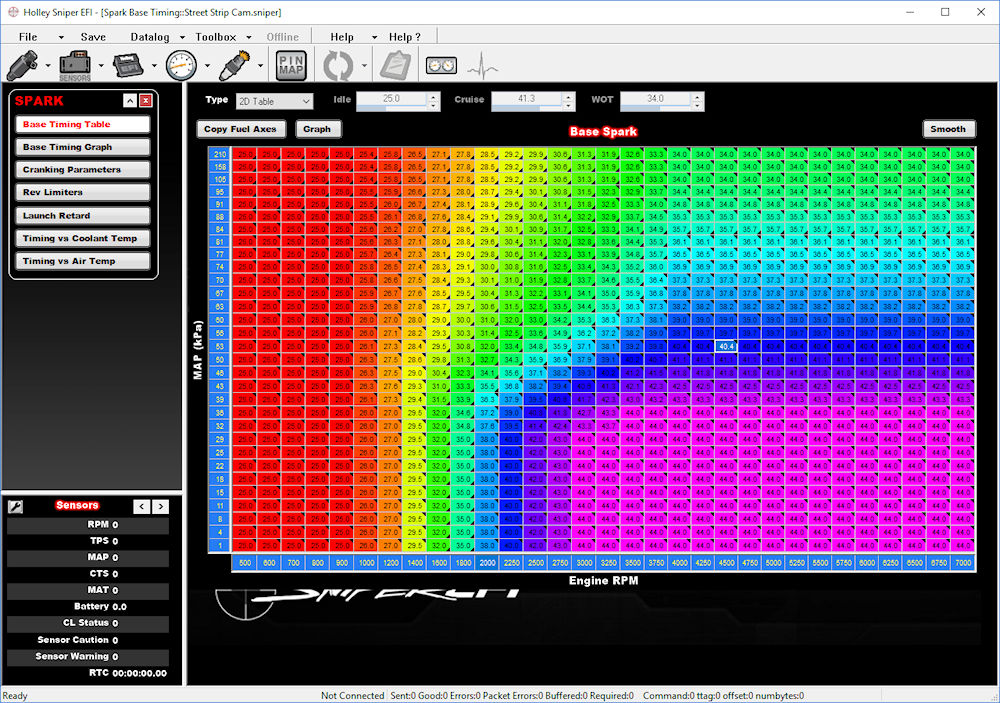
I recently converted my timing system to be controlled by my Holley Sniper, so now I can input everything into a table, and the computer sets the timing.
I could see there being some sort of a limit with a spinning distributor since, if you advance too far back, the points on the stator might be pointing at the previous cylinder. But, it seems that that limit applies to pretty much any discussion about mechanical advance timing. I don't see anything about "if you have a distributorless ignition, the sky's the limit". They all seem to have the same limitations.
This is a timing curve for the Sniper, and even still, you can see that at 4000 RPMs it locks it out at 34° and holds (and then increases up to 44° for "vacuum")
I recently converted my timing system to be controlled by my Holley Sniper, so now I can input everything into a table, and the computer sets the timing.
I could see there being some sort of a limit with a spinning distributor since, if you advance too far back, the points on the stator might be pointing at the previous cylinder. But, it seems that that limit applies to pretty much any discussion about mechanical advance timing. I don't see anything about "if you have a distributorless ignition, the sky's the limit". They all seem to have the same limitations.
This is a timing curve for the Sniper, and even still, you can see that at 4000 RPMs it locks it out at 34° and holds (and then increases up to 44° for "vacuum")
Posting Guru
Joined: Mar 2006
Posts: 1,182
Likes: 1
AB, that's an interesting question. I would have said "mechanical limits of what can be done with springs and weights", but...computer-controlled ignition curves are pretty much the same, I think.
i'm looking at spark tables for the 4.6 mod motor, and even with computer control, it levels out after ~4000 rpm.
Kramer- more advance doesn't really mean more power, or mileage. fastest burn = most power. the fast-burn EFI heads that FF mentioned above requires significantly less timing, to do the same job.
if you were to tinker with the fuel, to slow the combustion to the point that you could utilize 90* of timing...you'd only be robbing Peter to pay Paul.
i'm looking at spark tables for the 4.6 mod motor, and even with computer control, it levels out after ~4000 rpm.
Kramer- more advance doesn't really mean more power, or mileage. fastest burn = most power. the fast-burn EFI heads that FF mentioned above requires significantly less timing, to do the same job.
if you were to tinker with the fuel, to slow the combustion to the point that you could utilize 90* of timing...you'd only be robbing Peter to pay Paul.
Thread Starter
|
Cargo Master
Joined: Jan 2019
Posts: 3,369
Likes: 16
From: Caraway, AR
I figure it's all centered around spark right, that's a constant. I figure you can't time it and more than that. No clue how much time that event takes. What I'm wondering is at what rpm the engine has to spin to where the time from tdc exhaust to tdc compression is equal to spark timing. That would be 180* out right? Now what point would you have to worry about dieseling? Are other factors at play? Compression, afr, and is it thermal efficiency?
What's nagging at me right now though is, what if you sped up the spark?
What's nagging at me right now though is, what if you sped up the spark?
Posting Guru
Joined: Mar 2006
Posts: 1,182
Likes: 1
no, spark is not a constant. Variables: amount of spark energy, width of spark plug gap, multi-spark ignition systems, optimal fuel mixture for fastest burn of the charge...all sorts of stuff to think about there.
Yes, compression and AFR are in play as well.
some people will say "all that is required is enough energy to jump the gap", but that leaves all sorts of things out, which can rob you of power.
you need the hottest ignition system that you can run, with the widest plug gap, and get your mixture right, in order to increase the speed of the flame front.
faster burn = more power
Yes, compression and AFR are in play as well.
some people will say "all that is required is enough energy to jump the gap", but that leaves all sorts of things out, which can rob you of power.
you need the hottest ignition system that you can run, with the widest plug gap, and get your mixture right, in order to increase the speed of the flame front.
faster burn = more power