


Whats the practical difference

Thread Starter
|
Posting Guru
Joined: Nov 2010
Posts: 1,430
Likes: 6
From: Alabama
Whats the practical difference
between pulling in tow haul and using engine braking (EB)? And should I use just one singularly or both simultaneously?
If I'm in my truck its pulling - and I always activate tow haul; but the other day I was in some short/ 8% climbs (then downhill of the same stuff) very twisty roads - so I activated EB. From my perspective they performed about the same in controlling my descents. I can say that (while using EB) I've never before heard so many RPMs from my truck as I was going downhill.
For those interested it was somewhere between Buford, Ga and Murphy, NC - a 100 mile stretch? (maybe halfway).
If I'm in my truck its pulling - and I always activate tow haul; but the other day I was in some short/ 8% climbs (then downhill of the same stuff) very twisty roads - so I activated EB. From my perspective they performed about the same in controlling my descents. I can say that (while using EB) I've never before heard so many RPMs from my truck as I was going downhill.
For those interested it was somewhere between Buford, Ga and Murphy, NC - a 100 mile stretch? (maybe halfway).

Tuned
Joined: Jul 2003
Posts: 274
Likes: 20
I think that the optimal situation is to use both. With only tow/haul the transmission will downshift to try and hold speed on descents, but without the engine brake turned on you don't get any of the exhaust braking added in. With both turned on (I run my engine brake on the automatic setting) you've enabled the exhaust brake and it works in conjunction with the tow/haul mode on descents.
Thread Starter
|
Posting Guru
Joined: Nov 2010
Posts: 1,430
Likes: 6
From: Alabama
I suppose to y'all who live in this type of geography think nothing of what I traveled over, but I can typically cross a thousand southern miles with only a few hundred feet of elevation change - all with gentle turns.
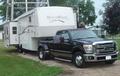
On this particular road I was looking out the left side window to see the road ahead, dragging 42 feet of fifth wheel behind me; its axles were well into the wrong lane on some of these turns. On top of that there were a bunch of bikers hot-rodding this stretch.
On this particular road I was looking out the left side window to see the road ahead, dragging 42 feet of fifth wheel behind me; its axles were well into the wrong lane on some of these turns. On top of that there were a bunch of bikers hot-rodding this stretch.
Tuned
Joined: Jul 2003
Posts: 274
Likes: 20
I suppose to y'all that live in this type of geography think nothing of what I traveled over, but I can typically cross a thousand southern miles with only a few hundred feet of elevation change - all with gentle turns.
On this particular road I was looking out the left side window to see the road ahead, dragging 42 feet of fifth wheel behind me; its axles were well into the wrong lane on some of these turns. On top of that there were a bunch of bikers hot-rodding this stretch.
On this particular road I was looking out the left side window to see the road ahead, dragging 42 feet of fifth wheel behind me; its axles were well into the wrong lane on some of these turns. On top of that there were a bunch of bikers hot-rodding this stretch.
Thread Starter
|
Posting Guru
Joined: Nov 2010
Posts: 1,430
Likes: 6
From: Alabama
If it weren't for the occasional stop sign at the bottom of a hill (often followed by another 100 foot climb) I don't think I'd ever use tow haul - but I've seen enough of this situation that I now routinely do; and it does well, shifting (with an engine RPM response) in reaction.
I've never pulled anything like this road before; white knuckles as I made those turns - hoping to not meet oncoming traffic. The reckless bikers were on their own.
I've never pulled anything like this road before; white knuckles as I made those turns - hoping to not meet oncoming traffic. The reckless bikers were on their own.
Thread Starter
|
Posting Guru
Joined: Nov 2010
Posts: 1,430
Likes: 6
From: Alabama
Getting back to my question ...
I understand that tow haul asks the tranny to downshift - and this causes the engine RPMs go higher.
But if using EB - does the engine actually perform the braking (which from what I remember is NOT exhaust braking) and allow the tranny to remain in a higher gear?
And if all that is true, what does the engine actually do to slow things down?
One final thought, please keep your answers simple - for this simple mind (currently sipping Watermelon Vodka).
I understand that tow haul asks the tranny to downshift - and this causes the engine RPMs go higher.
But if using EB - does the engine actually perform the braking (which from what I remember is NOT exhaust braking) and allow the tranny to remain in a higher gear?
And if all that is true, what does the engine actually do to slow things down?
One final thought, please keep your answers simple - for this simple mind (currently sipping Watermelon Vodka).
Moderator


Joined: May 2004
Posts: 6,530
Likes: 929
From: Home Base Nebraska

Trending Topics
Thread Starter
|
Posting Guru
Joined: Nov 2010
Posts: 1,430
Likes: 6
From: Alabama
"When I'm pulling in those situations I use the manual mode not TH."
Oh yes, yet another viable option (damn those crafty Ford engineers) - one which I've also never tried.
Am I wrong to think of that as a manually operated tow haul function?
Oh yes, yet another viable option (damn those crafty Ford engineers) - one which I've also never tried.
Am I wrong to think of that as a manually operated tow haul function?
FTE Stories
Ford Trucks for Ford Truck Enthusiasts

Top 6 Best Deals Available on New Fords & Lincolns Right Now
Brett Foote
This Hennessey Takes the Expedition Tremor's Off-Roading Capability to the Next Level
Verdad Gallardo
Top 10 Fords at 2026 Carlisle Ford Nationals
Joe Kucinski
3 Best / 3 Worst Parts of Modern Ford Ownership
Brett Foote
10 Amazing Upgrades That Solve Common Ford Truck Owner Headaches
Pouria Savadkouei
Every 2026 Ford Engine Explained
Brett Foote
10 Ugly Ford Trucks That We Still Kinda Love
Joe Kucinski
10 Things Every Truck Owner NEEDS (2026 Edition)
Michael S. Palmer
Rezvani's Latest Post-Apocalyptic Monster Is a Ford F-150 Raptor Underneath
Verdad Gallardo
Hotshot


Joined: Oct 2006
Posts: 10,188
Likes: 8,071
From: Texas
between pulling in tow haul and using engine braking (EB)? And should I use just one singularly or both simultaneously?
If I'm in my truck its pulling - and I always activate tow haul; but the other day I was in some short/ 8% climbs (then downhill of the same stuff) very twisty roads - so I activated EB. From my perspective they performed about the same in controlling my descents. I can say that (while using EB) I've never before heard so many RPMs from my truck as I was going downhill.
For those interested it was somewhere between Buford, Ga and Murphy, NC - a 100 mile stretch? (maybe halfway).
If I'm in my truck its pulling - and I always activate tow haul; but the other day I was in some short/ 8% climbs (then downhill of the same stuff) very twisty roads - so I activated EB. From my perspective they performed about the same in controlling my descents. I can say that (while using EB) I've never before heard so many RPMs from my truck as I was going downhill.
For those interested it was somewhere between Buford, Ga and Murphy, NC - a 100 mile stretch? (maybe halfway).
Thread Starter
|
Posting Guru
Joined: Nov 2010
Posts: 1,430
Likes: 6
From: Alabama

Due to the twisty road conditions (and other users) my eyes were riveted to the road ahead of me; I have no idea of what gear I was in nor the RPMs. Even my copilot let loose a few exclamations. The only relaxed one was located in the rear seat.



Super Moderator

Joined: Aug 2008
Posts: 37,384
Likes: 1,868
From: Frederick, MD
I would use them both. The Idea is to not have to use your brakes to control the decent.
As Denny said, I that situation I would have most likely placed the truck in manual mode as I crested the hill and then maintained that gear for the decent.
As Denny said, I that situation I would have most likely placed the truck in manual mode as I crested the hill and then maintained that gear for the decent.
Tuned
Joined: Jul 2003
Posts: 274
Likes: 20
Getting back to my question ...
I understand that tow haul asks the tranny to downshift - and this causes the engine RPMs go higher.
But if using EB - does the engine actually perform the braking (which from what I remember is NOT exhaust braking) and allow the tranny to remain in a higher gear?
And if all that is true, what does the engine actually do to slow things down?
One final thought, please keep your answers simple - for this simple mind (currently sipping Watermelon Vodka).
I understand that tow haul asks the tranny to downshift - and this causes the engine RPMs go higher.
But if using EB - does the engine actually perform the braking (which from what I remember is NOT exhaust braking) and allow the tranny to remain in a higher gear?
And if all that is true, what does the engine actually do to slow things down?
One final thought, please keep your answers simple - for this simple mind (currently sipping Watermelon Vodka).

Logistics Pro
Joined: Mar 2005
Posts: 3,552
Likes: 2,511
From: West Michigan
Tow/Haul doesn't just use transmission to slow you down, it also changes the shift points and Torque Converter behavior (locks up quicker). I think NOT using T/H when towing heavy will cause premature transmission wear and possibly additional heat build-up. Just be careful using T/H if the roads are a bit slippery. You could lose traction when it downshifts. I use both T/H and EB when towing my 5th wheel, 100% of the time. As for manual gear selection, I dont mess with that much, the transmission does a pretty good job deciding what gear it wants to be in.
Tuned
Joined: Jul 2003
Posts: 274
Likes: 20
[QUOTE=djousma;18848226]Tow/Haul doesn't just use transmission to slow you down, it also changes the shift points and Torque Converter behavior (locks up quicker). /QUOTE]
I think that changing shift points and locking up the converter still qualifies as using the transmission to slow you down. My point is that the EB makes the engine a much more effective brake as well, working in conjunction with the tow/haul mode and the transmission.
I think that changing shift points and locking up the converter still qualifies as using the transmission to slow you down. My point is that the EB makes the engine a much more effective brake as well, working in conjunction with the tow/haul mode and the transmission.